“To Father Javier Giraldo, a defender of human rights, indigenous peoples and nature, an example of tireless struggle in the quest for Truth, Remembrance and Justice, walking alongside the most vulnerable communities, who has left his mark on the history of Colombia, the defence of human rights, the building of peace, and PBI – we wish him a speedy recovery with all our affection.”
Infobae further explains: “Jesuit priest Javier Giraldo remains under medical observation after suffering a fall at his home on the night of Monday, August 17. The severity of the blow led to his emergency transfer to the San Ignacio Hospital in Bogotá, where medical teams are closely monitoring his evolution, according to information known by El Tiempo.”
That article adds: “Since 1997, the priest has accompanied the Peace Community of San José de Apartadó in Urabá. Its work has focused on recording and denouncing the crimes suffered by its members, including the 2005 massacre, in which leader Luis Eduardo Guerra and members of his family were killed. PBI Colombia has highlighted Father Giraldo’s perseverance in denouncing these events and his contribution to the international visibility of the situation.”
Minuto 60 adds: “In 1988 he also participated in the creation of the Inter-Congregational Commission for Justice and Peace, later known as the Inter-Church Commission for Justice and Peace. From that space, she accompanied communities that were victims of the conflict and participated in processes of documentation and denunciation of events related to violence.”
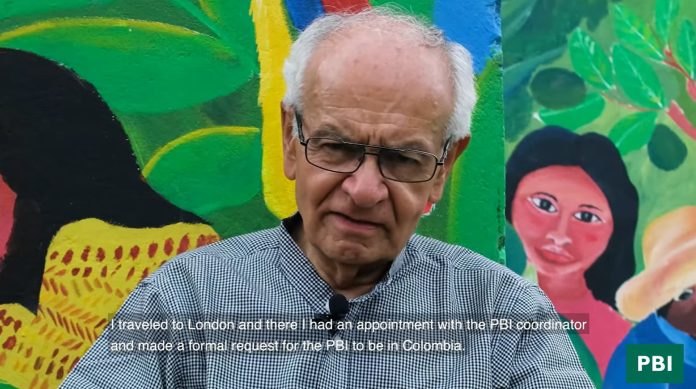
After receiving requests from civil society organizations, in particular Father Javier Giraldo of the organization Justicia y Paz, and following an exploratory mission in 1993, PBI opened a project with offices initially in Bogota and Barrancabermeja.
Father Giraldo talks about that invitation in this video.
From PBI-Canada, we wish a speedy recovery and good health to Father Javier Giraldo with appreciation for all of his good works.
Photo: RCMP C-IRG raid on Wet’suwet’en territory, January 2019. Photo by Michael Toledano.
The long-awaited report on the systemic investigation of the Royal Canadian Mounted Police (RCMP) Community-Industry Response Group (C-IRG) is expected to be released before October 15, 2026.
A spokesperson for the Civilian Review and Complaints Commission (CRCC) has previously told PBI-Canada: “The Interim Chairperson [Brent Cotter] is expected to make a decision on the report and provide it to the Minister of Public Safety and the RCMP Commissioner.”
Cotter was appointed on April 15, 2026, for a six-month term that would end by October 15, 2026, less than eight weeks from now.
Peace Brigades International-Canada has been following the CRCC systemic investigation of the C-IRG, now renamed the Critical Response Unit-British Columbia/ CRU-BC, since it was launched on March 9, 2023.
The CRCC systemic investigation promised a detailed examination of RCMP procedures, a review to see C-IRG guidelines are consistent the Canadian Charter of Rights and Freedoms, if C-IRG operations are carried out in accordance with legal standards, and, where appropriate, if C-IRG actions are consistent with the United Nations Declaration on the Rights of Indigenous Peoples.
The systemic investigation was to specifically examine C-IRG operations in three sites, including its actions on Wet’suwet’en territory in response to Indigenous land defenders resisting the construction of the Coastal GasLink pipeline.
The report outlining the investigative findings by the CRCC was completed by March 18, 2026, just over five months ago, but could not be released due to the vacancy in the position of CRCC chairperson.
It remains to be seen if the report will have any impact on C-IRG/CRU-BC operations in the coming months. Land defenders are expected to peacefully resist the construction of the proposed Prince Rupert Gas Transmission (PRGT) pipeline on Gitanyow and Gitxsan territories in northern British Columbia.
On August 12, 2026, CBC News reported: “A positive final investment decision would see construction start on the facility and pipeline in early 2027.”
Photo: Francisco Cerezo Contreras (Comite Cerezo), Brent Patterson (PBI-Canada), Manuel Jabonero Prieto (PBI-Mexico).
The Cerezo Committee is commemorating its 25th anniversary.
Their Facebook page notes: “We are an independent organization that defends and promotes human rights in Mexico since August 13, 2001.”
Their website adds: “We are a solidarity collective of volunteer work, dedicated to the defense of the Human Rights of victims of repression for political reasons in Mexico.”
The Comité Cerezo was founded after the arrest of three Cerezo brothers, Alejandro, Héctor and Antonio. They were sent to a maximum-security federal prison, suffering physical and psychological torture. Francisco, family members and allies formed the Comité Cerezo to fight for their liberation.
Five years ago, on their 20th anniversary, the Cerezo Committee noted: “On 14 February 2002, Peace Brigades International (PBI) informed the comrades of the Committee for the release of brothers Cerezo Contreras and Pablo Alvarado Flores that they would accompany them in their activities to secure the freedom of their families.”
Alejandro Cerezo was released from prison on February 28, 2005, while his brothers Héctor and Antonio Cerezo were released on February 16, 2009.
In this 25th anniversary video posted four days ago, you can see clips of PBI-Mexico accompanying the release of the two brothers.
PBI-Canada coordinator Brent Patterson had the pleasure of meeting Francisco Cerezo Contreras alongside Manuel Jabonero Prieto from PBI-Mexico on February 26, 2026, in Mexico City. After that meeting, Francisco posted on social media: “We were visited by Brent Patterson from Peace Brigades International-Canada; we had a very enjoyable chat about the human rights situation in Mexico and about our organization, its origins and where we stand today. The event was hosted by Peace Brigades International – Mexico Project. Thank you both for everything.”
A warm greeting from Canada to the Cerezo Committee.
You can find out more about the work of the Cerezo Committee from their website and on Facebook and X.
On August 16, the Peace Brigades International-Guatemala Project posted on social media:
“Next week, the family of #LuzLeticia is expecting the closing arguments to begin in the #CasoLuzLeticiaYOtros [Luz Leticia and others] case.
We’d like to share Luz Leticia’s story and her family’s struggle to demand truth and justice for her #EnforcedDisappearance in 1982.
#PBIaccompanies”
Who was Luz Leticia?
Verdad Justicia has posted: “Luz Leticia was born on November 22, 1957, the same day she was detained-disappeared, when she was 25 years old. Her family remembers her as a woman, she was a very intelligent, affectionate woman, such a beautiful smile and a hard worker.”
Mirtala has shared in an interview with El Salto that Luz Leticia was a member of Nuestro Movimiento (Our Movement). She explains: “The organization originated as a militant guerrilla group whose goal was to defend the people against poverty, abuses of power, and the actions of the security forces.”
The state agent accused in her disappearance
On the accused Juan Francisco Cifuentes Cano, Prensa Libre also reports: “Cifuentes Cano was the director of a police division and worked closely with the Army in counterinsurgency operations during the de facto government of the dictator Efraín Ríos Montt (1982-1983), as explained by the Prosecutor’s Office before the Fifth Criminal Court of First Instance. The ex-commander is accused of the forced disappearance of the university students Luz Hernández and Ana López, who 40 years later have still not been located.”
Judge expected to issue sentence soon
On August 13, Prensa Comunitaria reported: “The oral and public trial for the disappearance of university student Luz Leticia Hernández Agustín, 44 years ago, which is taking place in the Eighth Criminal Court against Juan Francisco Cifuentes Cano, reaches its final phase. On Tuesday, August 18, the last witness will be heard by videoconference, then the legal representation of Luz Leticia’s family, the prosecution and the defense of the accused will issue their conclusions before the judges issue a sentence.”
PBI accompaniment
This week, PBI-Guatemala posted ten slides – that can be read here – including this one that says:
“The Luz Leticia case has finally reached the courts thanks to the tremendous efforts of her family: ‘Our sister’s despair cut deep into our family, and in order to heal we need to recover Luz Leticia’s remains and ensure that her killers are brought to justice once and for all.’
PBI continues to support Valentina, Marta and Mirtala, Luz Leticia’s mother and sisters.”
Luz’s sister in Canada
PBI-Guatemala had also previously accompanied another sister during the 1980s before she had to go into exile in Canada.
Mirtala further explains to El Salto: “In 1987, my sister was a political exile in Canada, and my mother went to be with her. My sister took a job with the Canadian government, and with her salary, they decided to launch this legal battle. They hired legal counsel from the human rights law firm led by Edgar Pérez Archila, one of the attorneys handling several cases related to the genocide in Guatemala.”
Two years ago, Publico reported: “In addition to resolving their sister’s case, the family is fighting to create a museum that tells the story of repression in Guatemala. [Mirtala says] ‘We want the museum to be built in a military base in the capital, but the right wing is intransigent with this.’”
The Peace Brigades International-Guatemala Project is seeking new field volunteers.
The link for all of the application information can be found here.
That webpage notes: “Deadline for receipt of applications and references: 1 September 2026. Training and selection week in Navarra / Spain: 24 to 30 January 2027.”
“‘We’re ready to pack our bags. We’re not here because we want to be. As soon as we’re told that the trial is over and that our comrades are being returned to us, we’ll leave,’ says Miriam Miranda of #OFRANEH [the Black Fraternal Organization of Honduras].
The #Garifuna community is demanding that the case for ‘usurpation’ in a territory recognized as part of the IACHR [the Inter-American Court of Human Rights] ruling be dismissed, and they point out that the recent transfer of the court file from San Pedro Sula to Tela ‘does not mean the case is closed’.
PBI continues to support the camp, where there are reports of the presence of national police, military police and armoured vehicles.”
This evening, HCH Televisión Digital posted on social media: “Garifuna leader Miriam Miranda denounced that members of the National Police notified the members of the ‘Viva Berta’ camp, set up near the Supreme Court of Justice, that they must vacate the premises. Miranda questioned what she considers a contradiction between the discourse on human rights and the actions against the protesters. ‘There they go saying outside the country that they respect human rights, and they send the Police against us,’ she stated.”
“One week into the protest outside the Supreme Court of Justice, OFRANEH is calling on civil society organizations to join the peaceful protest and support its demand: that the criminal case against the five people arrested during the eviction in Tela on charges of being ‘squatters’ be dropped.
‘We Garifuna do not invade; we are reclaiming our lands (…) we demand that they stop persecuting us, stop criminalizing us, and stop calling us criminals,’ says human rights defender Miriam Miranda from the camp, where PBI continues to provide support.”
Prensa Comunitaria has also explained: “On July 6, without an eviction order, the police violently dispossessed the community of San Juan, Tela. Five defenders of their ancestral territory were arrested while Judge Norma Fuentes declared her incompetence and transferred the case to the Court with National Jurisdiction in Organized Crime. In other words, land defenders were labeled as criminals, drug traffickers and members of a criminal structure after defending what belongs to them by history and by right.”
Criterio.hn adds: “At the center of the conflict is the failure to comply with four judgments of the Inter-American Court, which held the State of Honduras responsible for failing to guarantee the protection of the Garifuna ancestral territory in the communities of Punta Piedra in Iriona, Colón; Triunfo de la Cruz and San Juan in Tela, Atlántida; and Cayos Cochinos, jurisdiction of the municipality of Roatán, Bay Islands. It is precisely in San Juan, Tela, Atlántida, – still pending the process of territorial sanitation ordered by the Inter-American Court of Human Rights – where the first eviction of a property was carried out on Monday, July 6, under the controversial Law for the Strengthening and Protection of the Agroindustrial Sector, Energy Projects, Tourism, Livestock, Small Agricultural Producers, approved by the National Congress presided over by the nationalist Tomás Zambrano.”
Video still: After the bombing of a farmhouse in Ecuador in March 2026, Hegseth tweeted: “We are bombing Narco Terrorists on land as well. Thank you to our partners in Ecuador. Much more to come from [U.S. Southern Command].”
What do the human rights defenders who are accompanied by Peace Brigades International think about possible US military operations in Colombia, Honduras and Guatemala? What are the implications for their safety, for their protection needs? How do the accompaniment and advocacy activities of the international community respond to the likelihood of increasing militarization in the hemisphere?
These are questions PBI-Canada is looking into.
The Associated Press reports: “U.S. President Donald Trump’s defence secretary, Pete Hegseth, announced last week during a visit to Panama [from August 11 to 13, 2026] that Colombia, Guatemala and Honduras had agreed to allow the U.S. to carry out joint military operations against criminal groups on their soil, following Ecuador, which launched similar missions with the U.S. in March.”
That article notes: “Guatemala, however, has denied reaching such an agreement. …Its progressive government has worked closely with Washington on security despite political differences. But President Bernardo Arévalo has denied agreeing to joint anti-drug operations, saying they would be illegal without congressional approval.”
Notably, Arévalo term in office will be coming to close with the general election in Guatemala now scheduled for June 27, 2027.
The report further highlights: “Since Trump returned to office in January 2025, Washington has pursued its most interventionist approach to the region in decades.”
The International Business Times also reports: “US maritime strikes in Latin America have already killed more than 200 alleged drug traffickers since January 2025, and the Pentagon now plans to extend the lethal campaign from the high seas onto land, Defence Secretary Pete Hegseth has confirmed. The shift, which would see joint US-backed assaults inside Colombia, Honduras and Guatemala, marks a significant escalation in President Donald Trump’s regional security strategy.”
United Nations experts have stated: “The use of lethal force in international waters without proper legal basis violates the international law of the sea and amounts to extrajudicial executions.”
The IBT article adds: “Ecuador has become the proving ground for the land-based approach, despite voters rejecting foreign military bases in a November 2025 referendum. …One such operation in March, initially described as targeting a drug laboratory, instead destroyed a cattle farm, according to a New York Times investigation, raising doubts about the intelligence underpinning the campaign.”
Deutsche Welle has previously reported that Peace Brigades International, Front Line Defenders, the World Organization Against Torture (OMCT), Civicus, 11.11.11, and other international human rights organizations participated in an observation mission in Ecuador that took place from March 2-5, 2026.
DW highlighted this excerpt of the statement from the observation mission: “The implementation of a security-type policy and the normalization of states of emergency and surveillance, as well as militarization, under the argument of facing a serious structural security crisis, is part of the deeply worrying panorama that we observe.”
A pledge to accompany
Peace Brigades International and the other groups in the observation mission pledged to “continue to accompany, monitor and raise awareness internationally about the situation of human rights and the rights of nature in Ecuador.”
This summer, The Maple reported that Canadian Defence Minister David McGuinty told reporters at the Farnborough Airshow in the United Kingdom that there’s ‘really little daylight’ between Canada and the United States on military and intelligence affairs.” This raises concerns about the potential role Canada could play in Latin America as US policy there intensifies.
PBI-Canada continues to follow this from the perspective of the safety and protection needs of human rights organizations, defenders and communities situated in the countries in Latin America where Peace Brigades International has a physical accompaniment presence (Colombia, Honduras, Guatemala, Mexico).
PBI-Mexico: “We call on the relevant authorities to respond to the requests made by various human rights organisations in light of the threats being received by the community and the family, and regarding the disappearance of José Luis Silva Andrade.”
“We call on the relevant authorities to respond to the requests made by various human rights organisations in light of the threats being received by the community and the family, and regarding the disappearance of José Silva Andrade.
On 15 July 2026, José Luis Silva, brother of human rights defender Rolando Silva Andrade, left his home to investigate the sound of chainsaws in his community’s woodland; this was the last time he was seen by his family.”
On July 30, Espacio OSC, which is accompanied by PBI-Mexico, posted on their website: “The environmental defender of the community of Agua Fría in the area of Los Azufres, in Michoacán, has been missing since July 15, after being held against his will by an armed group. The population and Silva Andrade family continue to receive threats; the reason: the dispossession of the territory of the community of Agua Fría for the exploitation of the pine and oyamel forest.”
Revista ESPEJO has also reported: “This August 15 marks a month without knowing the whereabouts of José Luis. Relatives and the community of Agua Fría, together with activists and organizations such as Services and Advice for Peace (Serapaz), Amnesty International Mexico, Peace Brigades International in Mexico and Front Line Defenders demand and demand the location and appearance alive of the guardian of the forest.”
That article adds: “The organizations Services and Advice for Peace A.C. and Front Line Defenders demand that the FGR initiate an immediate, exhaustive and impartial investigation into the disappearance of human rights defender José Luis Silva Andrade and present the progress of the process and the lines of investigation, in order to guarantee his protection and his return to the community.”
And it further notes: “Regarding the Protection Mechanism for Human Rights Defenders and Journalists, they demand that it immediately prioritize, evaluate and incorporate the defenders of the Agua Fría community and immediately safeguard their life, physical integrity and safety.”
Photo: “March for Anas Al-Sharif and all martyred journalists”, August 15, 2026, Ottawa.
The Palestinian Youth Movement-Ottawa has posted on social media: “This past Monday [August 10] marked one year since israel’s deliberate attack on a journalists’ tent at Al-Shifa Hospital in Gaza. [Palestinian journalist and videographer] Anas Al Sharif was martyred alongside his colleagues Mohammed Qreiqeh, Ibrahim Zaher, Mohammed Noufal, Momen Aliwa, and Mohammed al-Khalidi.”
On July 24, 2025, just two weeks before he was killed, the Committee to Protect Journalists (CPJ) stated it was “gravely worried about the safety of Al Jazeera Arabic’s Gaza correspondent Anas al-Sharif, who is being targeted by an Israeli military smear campaign, which he believes is a precursor to his assassination.”
An Israeli drone bombed the Al Jazeera tent
Eyewitness and journalist Wadeaa Abu Al-Saud told CPJ: “At 11:22 p.m. on Sunday [August 10, 2025], an Israeli drone bombed the Al Jazeera tent inside the Al-Shifa medical complex in western Gaza with a single missile. I was about 40 meters away from them, and shrapnel even reached me.”
And PBS News Hour’s Foreign Affairs and Defense Correspondent Nick Schifrin has reported: “A missile fired by an Israeli drone killed [Al-Sharif] and four other journalists last night in the tent where they were living outside Shifa Hospital. Journalist Mohammed Qeita was 20 feet away and was injured in his lower back.”
Elbit and IAI drones
The Israeli television station i24NEWS has reported: “There are at least three types of drones that Israel uses in attack missions, according to Haaretz. Of them, two – Hermes 450 and Hermes 900 – are manufactured by Elbit Systems defense firm. The third, the Eitan, is manufactured by the Israel Aerospace Industries [IAI], and can fly up to 4,660 miles while relaying precise information. It was used during Operation Protective Edge in Gaza as it can provide reconnaissance to ground forces as well as attack targets, The Post reported.”
Elbit and IAI should be banned from CANSEC
This past May, the International Centre of Justice for Palestinians (ICJP) Canada, in collaboration with Just Peace Advocates, requested that the Canada Border Services Agency deny entry to representatives of Israeli arms manufacturers Elbit Systems and Israel Aerospace Industries seeking to attend CANSEC 2026 in Ottawa.”
Their submission called on Canadian authorities “to exercise their powers under the IRPA [the Immigration and Refugee Protection Act] and the Crimes Against Humanity and War Crimes Act to prevent Canada from providing entry to individuals who represent corporations reasonably suspected of enabling the Israeli military during its serious violations of international humanitarian law.”
Their website notes: “On Thursday August 13th communities from coast-to-coast mobilized at the facilities of Canadian companies that are supplying Elbit Systems— the engine of Israel’s genocide in Palestine. Together, we’re putting these companies on notice and sending them a clear message: drop your ties with Elbit Systems.”
Actions took place across the country, including in London, Kitchener, Midland, Cayuga, Toronto, Peterborough, Belleville and Ottawa.
Midland Today has reported on “a 12-hour demonstration that stretched through the night” outside Raytheon ELCAN in Midland, and the Peterborough Examiner reported: “A group of protesters calling for the Canadian government to end ties with Elbit Systems gathered outside Peterborough City Hall Thursday morning as part of a national day of action organized by the group Arms Embargo Now.”
In their social media promotion for the Arms Embargo Now “phone zap” campaign on August 13, Outaouais For Palestine highlighted on social media: “Billet Precision Ltd – A components manufacturer located exclusively in Ottawa that has been identified shipping goods to an Elbit Israeli facility in Rehovot.”
This continuing campaign was noted at the march in Ottawa this past weekend.
Journalists increasingly targeted by drones
The Committee to Protect Journalists further notes: “Drone use against journalists and media workers has been escalating, with two deaths recorded in 2023, 21 in 2024, and at least 39 in 2025. In total, 62 journalists and media workers have been killed by drones in the last three years. Israel was responsible for nearly 75% of the journalists and media workers killed by drones from 2023 to 2025.”
The CPJ documents that the Israeli military killed 70 journalists in 2025 and that 28 of those attacks were by drones.
We continue to follow this.
Video still: The “Team” video by Nemahsis is dedicated to the “memory of journalists Saleh Aljafarawi, Anas Al-Sharif and the martyrs of Gaz@.”
“No more excuses or breaches of the law: we demand the reinstatement of Esteban Antonlino Diaz”
“The Association for Democracy and Human Rights (ASOPODEHU) and Young Promoters and Defenders of Human Rights (JOPRODEH), in light of the ongoing systemic human rights violations suffered by the president of SITRAINFOP, Esteban Antonlino Diaz, wish to bring the following to the attention of the national and international community:
1.Since February 2025, during the government of Xiomara Castro, the National Institute for Vocational Training Workers’ Union (SITRAINFOP) and its main leaders, including its president Esteban Antonlino Diaz, have been subjected to a series of arbitrary and illegal actions by the INFOP authorities, headed at that time by its director Carlos Suazo.”
“Compliance with the labour authority’s provisions is not optional: it is a state obligation. Labour justice cannot be put on hold any longer, and revictimisation must stop. Esteban Antonlino Diaz must be reinstated immediately and allowed to take up his post as president of SITRAINFOP, as decided by the General Assembly of workers affiliated to this trade union.
Freedom of association is non-negotiable.”
In this video interview with Meza, SPDH reports: “ASOPODEHU informs that the Labor Secretariat ordered the reinstatement of Mr. Antolino Díaz, president of SITRAINFOP [Union of Workers of the National Institute of Professional Training], however the director of INFOP [National Institute for Vocational Training] denies it.”
We continue to follow this.
Peace Brigades International has accompanied Meza since May 2014.