


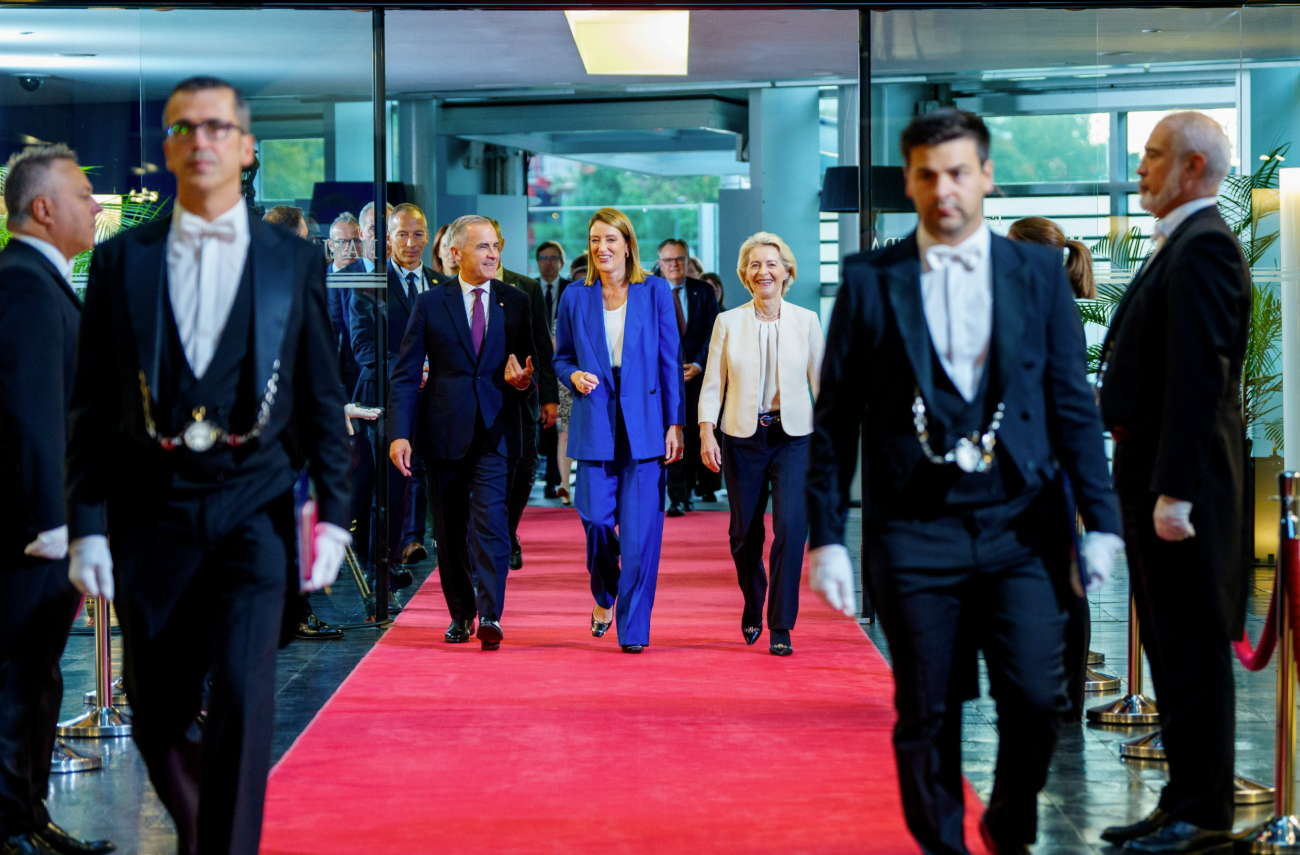
Photo: Canadian Prime Minister Carney, President of the European Parliament Roberta Metsola, and President of the European Commission Ursula von der Leyen in Strasbourg, France, September 17, 2026.
The European Union and Canada will hold a summit in Montreal, Quebec this coming Thursday October 29 and Friday October 30.
The Financial Post reports: “The two sides will commit to building ‘a deeper, more integrated and strategically aligned relationship,’ according to a draft communique to be agreed at the gathering… ‘The full scope of this associate membership will be defined by the 2027 Canada-EU Summit’, the text states.”
This summit comes weeks after European Commission President Ursula von der Leyen proposed inviting Canada to become an associate member of the European Union, and Prime Minister Carney’s address to the European Parliament.
In her State of the Union address in September, von der Leyen stated: “We will create a tech alliance. We will integrate defense industrial bases. We will make the Arctic a flagship joint project. We will work on energy, critical minerals and batteries. On AI, quantum, cyber and economic security.”
Euronews reports: “At a summit in Montreal next week, the two sides will begin putting substance behind the idea, seeking closer cooperation on trade, defence, technology and energy without Canada formally joining the bloc. …The summit in Montreal on 29-30 October is the first real chance to define the partnership in more detail.”
LNG exports to Europe
The Euronews article adds: “On energy, the conclusions open the door to ‘the development of liquefied natural gas exchanges’, notably through a joint long-term feasibility study on LNG exports to Europe.”
It is possible that the thinking is that these LNG exports to Europe could be sourced from the Prince Rupert Gas Transmission (PRGT) pipeline that crosses Gitanyow and Gitxsan territory in northern British Columbia.
Critical minerals
Euronews also notes: “Critical raw materials, one of Canada’s key assets for the EU, are also on the table. The two sides have agreed that the European Investment Bank will play a role in critical mineral projects, from extraction and processing to manufacturing and recycling.”
The Ring of Fire mining agenda, a 5,000 square kilometre area that spans Indigenous territories in northern Ontario, could be part of this Canada-EU agenda. Earlier this week, the Canadian Press reported: “The federal government will put down $1 billion to help build a controversial road to the Ring of Fire region in northern Ontario, Prime Minister Mark Carney said Wednesday [October 21].”
Attawapiskat land defenders Jeronimo Kataquapit (founder of the grassroots youth advocacy group Here We Stand) and Ramon Kataquapit (founder of the Indigenous youth organization Okiniwak) are among those opposing the Ring of Fire.
Foreign aid
In the lead-up to the upcoming Canada-EU summit in Montreal, Canada also attended the EU development ministers in Dublin on October 8-9.
The Canadian Press reports: “Canada’s deepening ties with Europe could help fill some of the massive gaps left behind as the United States pulls back from foreign aid and embraces a ‘transactional’ approach, says [Randeep Sarai] the secretary of state for international development.”
That article adds: “He said this effort includes recent talks with the European Union on leveraging private dollars and philanthropy for aid, while maintaining some government funding for the world’s most vulnerable.”
Canada now spends about 1.6 per cent of its budget on foreign aid. In the November 2025 federal budget, the Carney government cut $2.7 billion from Canada’s foreign aid budget over the next four years. Budget 2026 will be tabled on November 5, 2026, less than a week after the Canada-EU summit.
PBI-Canada following the talks
With the International Office of Peace Brigades International situated in Brussels, and with PBI-Germany and PBI-Spanish State two of the largest PBI entities, PBI-Canada is paying close attention to the Canada-EU relationship and any opportunities to help strengthen the protection of PBI accompanied human rights defenders.
PBI sends volunteers, brigadistas, to physically accompanied at-risk organizations, defenders and communities in Colombia, Guatemala, Honduras and Mexico. In 2025, 231 defenders were killed in those four countries.
Further reading
–PBI-Canada seeks to strengthen the accompaniment of human rights defenders with the European Parliament office in Ottawa (PBI-Canada, September 15, 2026)
–Canadian prime minister highlights critical minerals, LNG exports, solidarity and international law in speech to European Parliament (PBI-Canada, September 17, 2026).

