


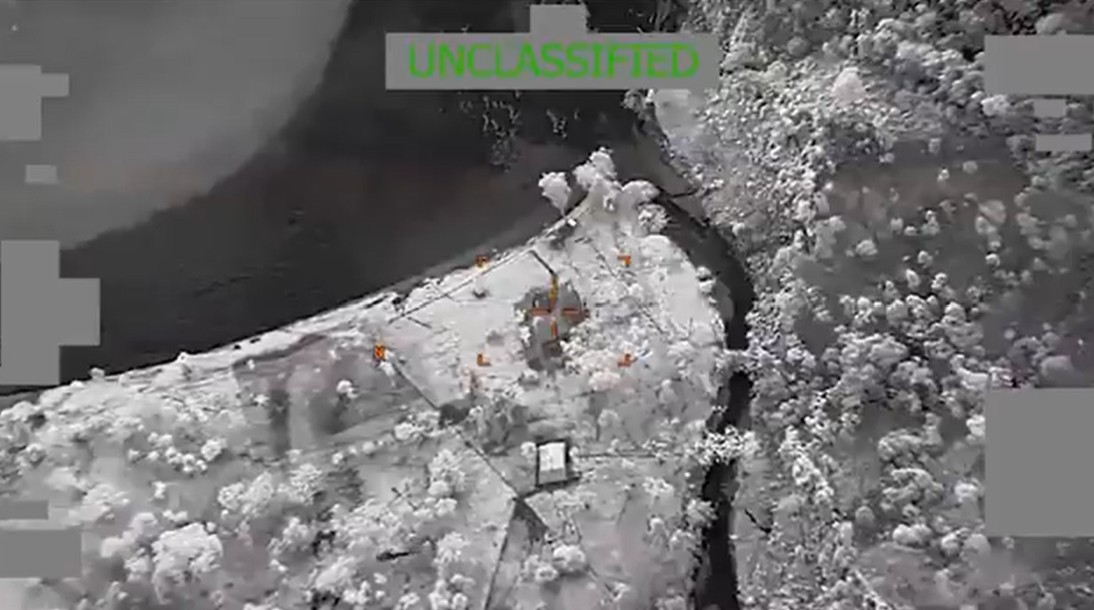
Video still: After the bombing of a farmhouse in Ecuador in March 2026, Hegseth tweeted: “We are bombing Narco Terrorists on land as well. Thank you to our partners in Ecuador. Much more to come from [U.S. Southern Command].”
What do the human rights defenders who are accompanied by Peace Brigades International think about possible US military operations in Colombia, Honduras and Guatemala? What are the implications for their safety, for their protection needs? How do the accompaniment and advocacy activities of the international community respond to the likelihood of increasing militarization in the hemisphere?
These are questions PBI-Canada is looking into.
The Associated Press reports: “U.S. President Donald Trump’s defence secretary, Pete Hegseth, announced last week during a visit to Panama [from August 11 to 13, 2026] that Colombia, Guatemala and Honduras had agreed to allow the U.S. to carry out joint military operations against criminal groups on their soil, following Ecuador, which launched similar missions with the U.S. in March.”
That article notes: “Guatemala, however, has denied reaching such an agreement. …Its progressive government has worked closely with Washington on security despite political differences. But President Bernardo Arévalo has denied agreeing to joint anti-drug operations, saying they would be illegal without congressional approval.”
Notably, Arévalo term in office will be coming to close with the general election in Guatemala now scheduled for June 27, 2027.
The report further highlights: “Since Trump returned to office in January 2025, Washington has pursued its most interventionist approach to the region in decades.”
The International Business Times also reports: “US maritime strikes in Latin America have already killed more than 200 alleged drug traffickers since January 2025, and the Pentagon now plans to extend the lethal campaign from the high seas onto land, Defence Secretary Pete Hegseth has confirmed. The shift, which would see joint US-backed assaults inside Colombia, Honduras and Guatemala, marks a significant escalation in President Donald Trump’s regional security strategy.”
United Nations experts have stated: “The use of lethal force in international waters without proper legal basis violates the international law of the sea and amounts to extrajudicial executions.”
The IBT article adds: “Ecuador has become the proving ground for the land-based approach, despite voters rejecting foreign military bases in a November 2025 referendum. …One such operation in March, initially described as targeting a drug laboratory, instead destroyed a cattle farm, according to a New York Times investigation, raising doubts about the intelligence underpinning the campaign.”
Video footage from the United States Southern Command retweeted by U.S. Secretary of War Pete Hegseth suggests that the Ecuadorian armed forces used an Airbus H225M helicopter purchased directly from the manufacturer in 2023 in the bombing of a farmhouse in the village of San Martin in northern Ecuador on March 6, 2026, that is now the subject of an Alliance for Human Rights complaint as “an attack on a civilian population” filed with the United Nations and Ecuadorean officials.
Deutsche Welle has previously reported that Peace Brigades International, Front Line Defenders, the World Organization Against Torture (OMCT), Civicus, 11.11.11, and other international human rights organizations participated in an observation mission in Ecuador that took place from March 2-5, 2026.
DW highlighted this excerpt of the statement from the observation mission: “The implementation of a security-type policy and the normalization of states of emergency and surveillance, as well as militarization, under the argument of facing a serious structural security crisis, is part of the deeply worrying panorama that we observe.”
A pledge to accompany
Peace Brigades International and the other groups in the observation mission pledged to “continue to accompany, monitor and raise awareness internationally about the situation of human rights and the rights of nature in Ecuador.”
This summer, The Maple reported that Canadian Defence Minister David McGuinty told reporters at the Farnborough Airshow in the United Kingdom that there’s ‘really little daylight’ between Canada and the United States on military and intelligence affairs.” This raises concerns about the potential role Canada could play in Latin America as US policy there intensifies.
PBI-Canada continues to follow this from the perspective of the safety and protection needs of human rights organizations, defenders and communities situated in the countries in Latin America where Peace Brigades International has a physical accompaniment presence (Colombia, Honduras, Guatemala, Mexico).
Additional reading
The implications of Latin America as “the far right’s front yard” for human rights defenders, the trade union movement (PBI-Canada, August 13, 2026)
PBI-Colombia accompanied organizations reject US military aggression against Venezuela (PBI-Canada, January 6, 2026)
Canadian tech helped U.S. strike alleged Venezuelan drug boats: report (CBC News, October 6, 2025).

