


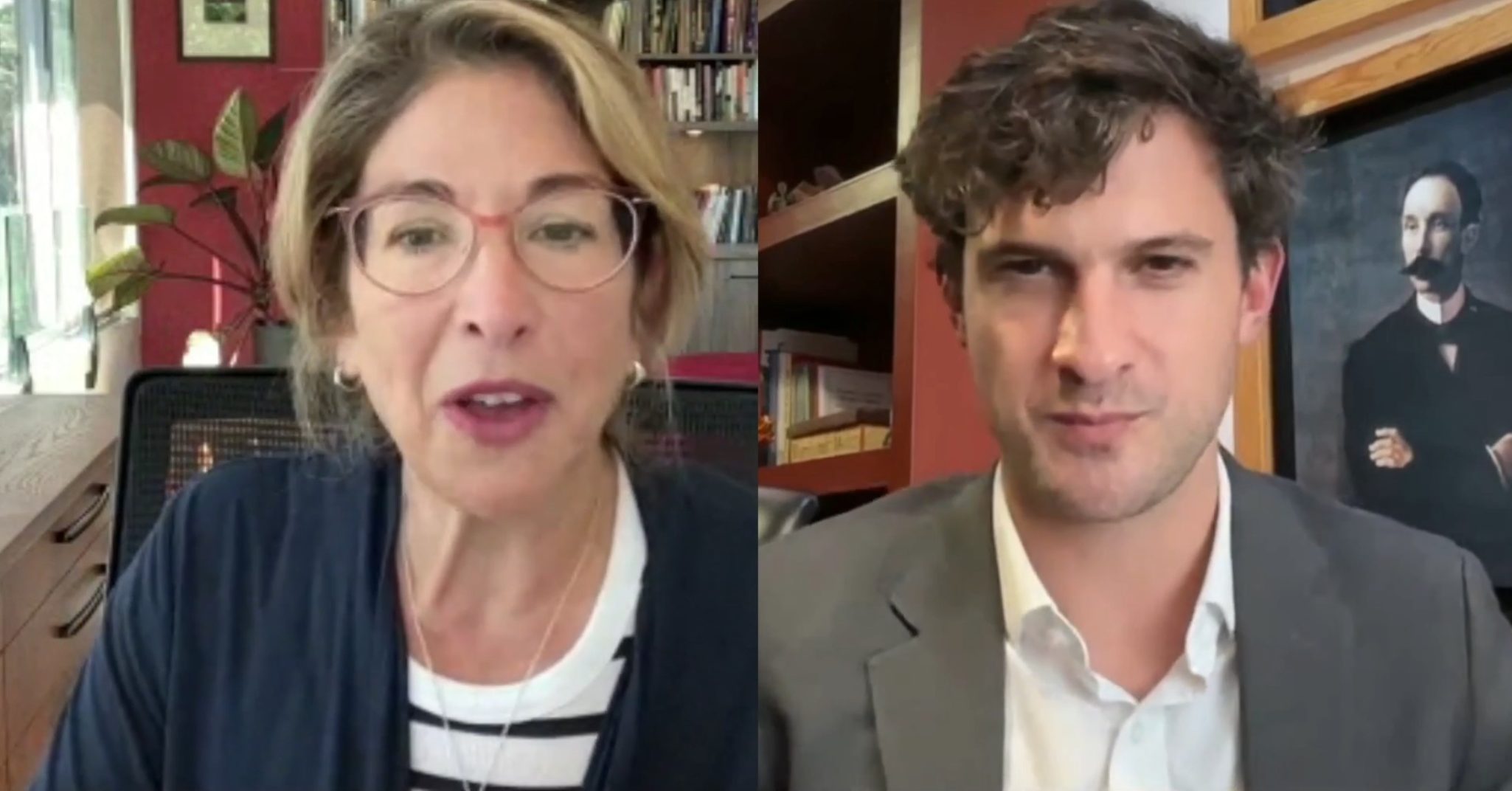
Video still: Klein and Adler discuss the situation across Latin America.
Canadian author-activist Naomi Klein has posted on social media: “Latin America isn’t the US’s ‘backyard’ anymore. It’s turned into the far right’s frontyard … a testing ground for fascist experiments that’s now spreading across the hemisphere.”
This assertion is explored in Klein’s conversation with David Adler here and in an article by Adler and Verónica Gago titled “The Goal is a Fascist Continent” posted by Klein on her Substack page here.
What are the implications for the trade union movement in Latin America?
Historically, union activists have faced high levels of violence in Latin America. According to the Colombian Trade Union Confederation, 1,500 union members were killed between 1986 and 1994.
Now, on June 24, 2026, Infobae reported: “The Central Union of Workers (CUT) has shown its total rejection of the next government of the far-right Abelardo de la Espriella, winner of the presidential elections in Colombia by a narrow margin, considering that it will be ‘fascist’ and ‘neoliberal’ and will be ‘moved by hatred and persecution of the adversary’.” The CUT union further expressed concern about “stigmatization” against trade unionism under de la Espriella.
Last month, Percy Oyola, the president of the General Confederation of Labor (UTRADEC-CGT), stated that the CGT is in “a state of alert in the face of the tax reform of the incoming Minister of Finance, Miguel Gómez”, is concerned by the possible dismissal of 700,000 public servants and the privatization of more than 100 state entities, and says “We do not tolerate any more union persecution!”.
With US electoral interference leading to controversial presidential elections by de la Espriella in Colombia (who was sworn into office on August 7, 2026) and by Nasry Asfura in Honduras (sworn in on January 27, 2026) and the potential for interference in the presidential election in Brazil (on October 24, 2026, in which US President Donald Trump is backing far-right candidate Flavio Bolsonaro), in the presidential election in Guatemala (June 2027) and the elections in Mexico (on June 6, 2027), there is reason to be concerned by what is already being seen in Argentina and El Salvador.
Javier Milei assumed the presidency of Argentina in December 2023. In February 2026, The Guardian reported: “Argentina’s senate is poised to approve a sweeping overhaul of labour laws aimed at weakening trade unions and lowering labour costs for businesses.” That article highlights the “overhaul” includes cuts to severance pay and extending the maximum working day from eight to 12 hours.
Nayib Bukele has been the president of El Salvador since June 2019. In December 2024, the International Labour Network for Solidarity and Struggles stated: “Between 2019 and 2024, over 50 unions were dissolved, dismantled, or weakened as a result of government policies prioritizing budget cuts and regressive fiscal adjustments in collaboration with the International Monetary Fund (IMF).”
Similar attacks against the union movement have also been seen under the right-wing governments of Daniel Noboa in Ecuador (since November 2023), José Antonio Kast in Chile (since December 2025), and potentially under Keiko Fujimori in Peru (who was sworn into office on July 28, 2026).
Given the role played by labour union activists in upholding the human rights of workers, the history of killings and repressions of union members in Latin America, the escalated risks now being faced by workers in Latin America, PBI-Canada continues to follow this situation with respect to their safety and security.
Additional reading: Accounts of Guatemalan teachers’ union seized, after announcement of demonstration (Infobae, August 12, 2026); Honduras: In a context of great challenges, SITRAINA socializes its work plans (Línea Sindical, August 7, 2026); Protests call for demands for informal trade and labor rights in Mexico City (La Prensa, August 11, 2026); Milei met in Colombia with Abelardo de la Espriella before his presidential inauguration (Telefe Noticias, August 7, 2026).

