Home Blog Page 70

The rush to deploy “frontline personnel” to the border to avoid Trump’s tariffs overlooks human rights concerns about militarization

RCMP photo: Black Hawk helicopters will be deployed to the New Brunswick-US border on Wednesday February 5.

The National Post reports: “Canada has agreed to deploy its $1.3-billion border enhancement plan along with thousands of frontline personnel to strengthen security on the U.S. boundary in exchange for the White House pausing 25-per-cent tariffs for at least 30 days.”

On February 3, Prime Minister Justin Trudeau said: “I just had a good call with President Trump. Canada is implementing our $1.3 billion border plan — reinforcing the border with new choppers, technology and personnel, enhanced coordination with our American partners, and increased resources to stop the flow of fentanyl. Nearly 10,000 frontline personnel are and will be working on protecting the border.”

The Canadian Press adds: “[Public Safety Minister David] McGuinty said the 10,000 frontline staff Canada is talking about could encompass a broad range of officials, including border officers on the front lines and intelligence officers behind the scenes. ‘So what we’ve managed to do here is take a look at how many people are working, and it’s 10,000. And we’ve got hundreds of new officers,’ McGuinty said. ‘We’ll look to see where it makes most sense to deploy the assets we’ve got, the people, or if we need to we will bump it up.’ The Canada Border Services Agency has 8,500 front-line staff already.”

The border plan also includes “a Canada-U.S. Joint Strike Force to combat organized crime, fentanyl and money laundering.”

Black Hawk helicopters

On January 22, the Royal Canadian Mounted Police (RCMP) began patrolling the Manitoba-Minnesota-North Dakota border with Black Hawk helicopters. On January 28, patrols began on the Alberta-Montana border. Those were extended to the Quebec-Maine-New Hampshire-New York-Vermont border on January 30. They are scheduled to begin on the New Brunswick-Maine border on February 5.

Photo: Heavily armed RCMP officers onboard a Black Hawk helicopter near the Alberta-Montana border, January 29, 2025.

Photo: “Asylum-seekers wait in line to cross into Canada from the U.S. border on Roxham Road in Champlain, New York, on Feb. 25, 2023. Photo by Christinne Muschi /Reuters.”

Poilievre calls for Canadian Armed Forces on the border

The Canadian Press is also reporting: “Conservative Leader Pierre Poilievre is calling on Ottawa to send Canadian Armed Forces troops and helicopters to the U.S. border ‘to spot and intercept risks.’ …Installing border surveillance towers and truck-mounted drone systems to spot incursions and track deportees to ensure they are leaving is also part of Poilievre’s recommendations.”

Photo: A Canadian Armed Forces Boeing CH-47 Chinook helicopter.

2,000 more Border agents

The CBC further notes: “The Opposition leader also said a Conservative government would hire 2,000 more Canada Border Services Agency (CBSA) agents and extend the powers of the agency along the entire border. As it stands, the CBSA is in charge of official ports of entry and the RCMP patrols in between.”

The CBSA as a branch of the Armed Forces

The CBC also reports: “Saskatchewan Premier Scott Moe [has also now] suggested Ottawa look into making the CBSA a branch of the Canadian Armed Forces. The premier said it would make it easier to deploy military troops along the border.”

That article adds: “Moe also suggested the Canadian Armed Forces absorbing the CBSA would help Canada get closer to meeting NATO’s military investment benchmark of two per cent of gross domestic product.”

Border militarization

The California-based National Network for Immigrant and Refugee Rights (NNIRR) has cautioned: “The outcome of border militarization has not been to deter migration, but instead to create more vulnerability. …Border militarization includes not just increased tactics, technology, and strategy, but also rhetoric and ideology.”

The San Diego-based Southern Border Communities Coalition adds: “Turning the region we call home into a war zone doesn’t make us safer. In fact, it leads to more violence, corruption and even death. We can’t afford to continue with harmful enforcement-only policies that militarize our communities.”

Doctors without Borders also says: “Militarization of borders and mass expulsions increase dangers for asylum seekers and migrants.”

And Maria Coronado with the American Civil Liberties Union (ACLU), has commented: “A militarized approach to the border not only harms undocumented people, but it also harms entire communities. Border Patrol agents racially profile and harass people of color across the region. They drive recklessly through our communities and fatally wound our neighbors in vehicle pursuits. [The U.S. Customs and Border Protection] CBP’s use of intrusive surveillance technologies erode border residents’ privacy rights and force them to live under the constant gaze of the federal government.”

Border militarization vs climate mitigation

In October 2021, the Transnational Institute reported Canada spent an average of $1.9 billion a year (over the years 2013-18) on the militarization of its borders while only contributing $149 million a year over the same period on climate financing to mitigate the impacts of climate change that drive forced migration.

The report concludes: “The world’s wealthiest countries have chosen how they approach global climate action – by militarising their borders.”

We continue to follow this.

Additional reading: RCMP Black Hawk helicopters now patrol Quebec-United States border target “individuals who illegally enter Canada” (January 31, 2025), PBI-Canada to follow the human rights implications of RCMP Black Hawk helicopters deployed at US-Canada border (January 30, 2025) and RCMP to deploy Sikorsky-Lockheed Martin Black Hawk helicopters on border as early as January 17 (January 16, 2025).

“The dignity of people is beyond any border” 

Video: Saltillo Migrant Shelter director Alberto Xicotencátl Carrasco denouncing federal police attempting an immigration check at the Shelter, July 24, 2019.

PBI-Kenya meets with Women Human Rights Defenders, supports their work against the colonial legacy of violence

PBI-Kenya has posted:

Recently, Women Human Rights Defenders (WHRDs) Toolkit Organizers (TOs) Cohort 1 held their first Monthly Movement Meeting of the year at Kwacha Africa in Malindi (Shela Ward). They checked in on each other, mapped out a year-long plan with concrete actions and roles, and wrapped up the day by reflecting on their vision for 2024.

PBI Kenya also visited WHRDs in their respective organizations to strengthen relationships, monitor progress, and gain a deeper understanding of their work. These visits help build trust, provide insights for better collaboration, show solidarity, and ensure accountability.

Colonial context and current issues

The Portuguese presence in Kenya began in 1498. The city of Mombasa was under Portuguese rule from 1593-1698 and then again from 1728-1729. Kenya was then a protectorate of the German Empire from 1885-1890, and then a British colony from 1888-1962. Kenya formally became independent on December 12, 1963.

Photo: A painting of anti-colonial revolutionary and Pan-Africanist leader Thomas Sankara at the Mathare Social Justice Centre in Nairobi.

Photo: PBI-Kenya outside a police station after the arrest of defenders at a Saba Saba march. Saba Saba (seven-seven) refers to an historic protest on July 7, 1990, when Kenyans took to the streets to demand free elections after 26 years of single-party rule.

Issues of concern

Among the issues that defenders contend with in Kenya are violence against women, enforced disappearances, police brutality, the police repression of the protests against the IMF/WB-backed Finance Bill, and police violence against the resistance to the construction of Kenya’s first nuclear power plant in the coastal town of Kilifi.

WHRD Editar Ochieng has commented: “Violence against women is very common in Kibera [an informal settlement in Nairobi] and many people have normalized it. So many women experience violence and they do not talk about it because they think it is normal, especially women experiencing violence in their relationships.”

Photo: Editar Ochieng.

The Johannesburg-based Centre for the Study of Violence and Reconciliation says: “[Sexual and gender-based violence] has deep roots, as African women and girls have been dehumanized as possessions since the colonial era, which has rendered them especially vulnerable in conflict. The norms and prejudices that are the legacies of historical violence against women and girls needs to be confronted.”

Photo: PBI-Kenya supports the creation of community murals in the urban settlements of Nairobi that speak against gender-based violence.

PBI-Kenya has commented: “Enforced disappearances in Kenya can be traced back to the colonial era. Subsequent Kenyan governments have relied on enforced disappearances to oppress the political opposition, instill fear and control the population.” In November 2024, the Kenya National Commission on Human Rights recorded 74 enforced disappearances between June and November 2024.

Video still: Mathare Social Justice Centre co-founder Wanjira Wanjiru: “I’m protesting because you’re killing us! You police! You’re killing us in our communities! People power! When we lose our fear, they lose their power! No more killings!”

PBI-Kenya also works with Perpetua Kariuki of the Kayole Community Justice Centre. She says: “Everyone in the informal settlement knows a person who is a victim of police brutality in some way. We just want to live in dignity.”

Photo: Perpetua Kariuki with Bernard Gachie from PBI-Kenya.

The non-governmental Kenya Human Rights Commission (KHRC) has commented: “Kenya’s police force has historically been an instrument of political control, a consequence that dates back to the colonial period. Before independence, the colonial police were used to suppress dissent and enforce the interests of British Empire. Unfortunately, this oppressive structure continued after independence.”

PBI-Kenya has also noted: “Before, during & after widespread protests triggered by the Finance Bill 2024, many individuals, including activists, human rights defenders & lawyers were disappeared.”

Kenya joined the International Monetary Fund (IMF) on February 3, 1964, just months after independence.

The IMF and World Bank have imposed structural adjustment programs on Kenya. The protests in Kenya in June 2024 related to a $12 billion World Bank loan and a $4.4 billion IMF loan. Al Jazeera notes: “For years, multilateral lenders, especially the IMF, have had bad reputations in African countries for providing loans to desperate countries based on stringent conditions that critics said have always disproportionately affected the poor.”

In July 2024, PBI-Kenya was in Kilifi County in solidarity with the residents of Uyombo village who were brutalized by the National Police Service-Kenya while fighting against the proposed building of a nuclear power plant in their village. Construction on the power station is expected to start in 2027 with it due to be operational in 2034. Construction will cost about 500bn Kenyan shillings (CAD $5.6 billion).

Photo: PBI-Kenya accompanies land and environmental defenders from Kilifi County at a march against the nuclear plant.

For more on PBI-Kenya’s support of grassroots efforts to end gender-based violence, advocacy against extrajudicial killings by police, its work within an alliance of national and grassroots organizations to reform the police, its efforts within a group of organizations whose mission it is to end enforced disappearances and extrajudicial killings by the police, and its support for the community social justice centres in the urban settlements of Nairobi including in Kayole, Kibera, Ruaraka, Kiambiu and Mathare, you can go to their website here.

Photo: PBI-Kenya visits the Mombasa Social Justice Centre.

PBI-Colombia accompanied CREDHOS founding member David Rabelo Crespo acquitted after 15 years

Video still: “The last six months in jail I was blind, but thanks to PBI’s monitoring I could see my freedom after so many years.”

PBI-Colombia has reposted:

“In a historic ruling, the Review Section of the @JEP_Colombia [Special Jurisdiction for Peace] acquitted in the first instance the Human Rights Defender David Rabelo Crespo, who had been unjustly convicted of the murder of engineer David Núñez Cala, a crime for which some paramilitaries acknowledged their responsibility.

Find out more information on our website.”

PBI-Colombia has previously explained: “David Ravelo Crespo is an economist, human rights defender and founding member of the [PBI-Colombia accompanied] Regional Corporation for the Defence of Human Rights (CREDHOS) in the oil port of Barrancabermeja.”

They add: “He was arrested and jailed in September 2010 for a crime that he, according to his defence lawyers and the international organisations which monitor his case, never committed.”

PBI-Colombia has also highlighted: “After exhausting all the legal possibilities in Colombia, in 2015 David’s lawyer, Reinaldo Villalba, decided to take the case to the Inter-American Commission on Human Rights. One year later, he presented the case before the Special Peace Jurisdiction (Justicia Especial para la Paz – JEP), where it is being studied by the Review Section of the Peace Tribunal. Ravelo [was released on parole in 2017] while awaiting the definitive decision of the Tribunal.”

Photo: “Despite the irregularities in the judicial process against David Ravelo, the conviction against him remained in place.” Photo: Bianca Bauer

Now, El Espectador reports: “ After 16 years of enduring a process in which he always pleaded not guilty, the Peace Tribunal acquitted the human rights leader, David Rabelo. The JEP clarified that it was an unfair process that was based on lies. Behind them were paramilitaries, such as alias El Panadero, and, apparently, the former commander of the AUC, Rodrigo Pérez Alzate, alias Julián Bolívar.”

The PBI-Colombia accompanied José Alvear Restrepo Lawyers’ Collective (CAJAR) says: “The JEP considered the grounds for transitional review of the case, demanded since 2018 by the José Alvear Restrepo Lawyers’ Collective (Cajar), to be well-founded. The innocence of the human rights defender was definitively proven, so he ordered his release.”

Further reading: Human rights defender served 7 years for homicide he did not commit: JEP (La Patria) and JEP acquits David Rabelo Crespo after review of his conviction (Enlace Television).

Photo by PBI-Colombia, December 2016.

Implications of pause and possible closure of USAID on HRDs in Mexico, Guatemala, Honduras and Colombia

Photo: Elon Musk and Donald Trump, November 2024.

The Associated Press reports: “The U.S. Agency for International Development (USAID) is facing its greatest threat since its inception over 60 years ago, as President Donald Trump and his billionaire adviser Elon Musk spent the weekend impugning the agency that has contributed to Washington being the most critical source of foreign assistance around the world.”

Musk says: “You’ve got to basically get rid of the whole thing. It’s beyond repair.” He has also commented: “With regards to the USAID stuff, I went over it with (the president) in detail and he agreed that we should shut it down.”

The USAID building was closed to Agency personnel on Monday February 3 and 600 staffers were locked out of computer systems overnight.

The AP article adds: “In fiscal year 2023, the most recent data available, $68 billion US had been obligated in U.S. foreign aid to programs ranging from disaster relief to health and pro-democracy initiatives in 204 countries and regions. USAID was responsible for about 62 per cent of the total, with the State Department next at 28 per cent.”

That article also notes: “The Trump administration and Secretary of State Marco Rubio have imposed an unprecedented freeze on foreign assistance. Rubio has said there is a 90-day review period analyzing programs and that those offering “life-saving” assistance including medicine, medical services, food and shelter would be exempted from the aid freeze, though what qualifies is not immediately clear.”

WOLA analysis

The Washington Office on Latin America (WOLA) has commented: “The unprecedented pause and potential elimination of many U.S. foreign assistance programs, announced in President Trump’s executive order ‘Reevaluating and Realigning United States Foreign Aid’, has caused shock waves worldwide.”

Implications for the countries where PBI is present include:

Mexico

“USAID has provided important support for Mexican institutions’ efforts to address the country’s devastating disappearance crisis, as well as assistance that aims to improve human rights, protect journalists and human rights defenders, and support economic development and state-level justice institutions.”

Guatemala

“In Guatemala, the most impacted project will be Justice and Transparency, which aims to ‘reduce criminal impunity and more effectively investigate, prosecute, and adjudicate crimes that drive illegal migration’. Given the country’s lack of judicial independence and criminalization of dissident voices, freezing this program could prevent elected President Bernardo Arévalo and civil society organizations from denouncing irregularities in the troubled judiciary and restoring the rule of law.”

Honduras

“In Honduras, measures to improve government’s transparency, accountability, and citizen-responsiveness will be affected during the crucial runup to the November 2025 general elections.”

Colombia

“USAID’s cooperation supports the country’s efforts to consolidate peace in conflict areas. It focuses explicitly on vulnerable populations disproportionately affected by violence, especially Afro-descendant, Indigenous, and rural communities. USAID efforts are crucial to advancing citizen security and reconciliation in one of the most violent and conflictive countries in the region. In one of the most biodiverse and mineral-rich countries in the world, USAID has sought to preserve Colombia’s natural resources.”

USAID and military assistance

WOLA also highlights: “We have opposed certain forms of U.S. assistance, particularly military assistance through the Departments of Defense and State, which backed military dictatorships; supported security-force units that engage in abuse, corruption, or support of paramilitaries and death squads; or distorted civil-military relations by, for instance, helping armed forces to take on what should be internal civilian roles. We have advocated for conditions on U.S. assistance to ensure that U.S. tax dollars do not go to security forces that violate human rights with impunity.”

It adds: “Much U.S. military and police aid, including training programs and counter-drug eradication and interdiction funded through the State Department’s International Narcotics and Law Enforcement Affairs (INL) Bureau, is now on hold.”

Notably, WOLA says: “The INL mission in Bogotá has reportedly been forced already to lay off 250 contractors. The freeze has also grounded dozens of Colombia’s U.S.-provided Black Hawk helicopters for at least three months, for lack of maintenance and contractor crews. The Black Hawks were the largest single item in the much-touted ‘Plan Colombia’ aid packages of the early 2000s.”

“Informal imperialism”

Others have more sharply criticized USAID.

Carlos Cruz Mosquera, a PhD candidate and teaching associate at Queen Mary University of London, has commented: “Alongside overt forms of domination — military interventions, territorial acquisition, direct political interference — Western powers have long developed parallel forms of intervention and control, sometimes called informal imperialism. …Though firmly aligned with violent, militaristic forms of intervention, European Union aid, USAID, and other such developmental agencies have worked in the region with relatively little scrutiny or opposition. This is largely due to the widespread assumption that their projects are inherently benevolent and a force for good.”

We continue to follow this.

Artificial intelligence poses new threats to human rights defenders, UN Human Rights Council to receive thematic report in June 2025

Photo: PBI-Mexico concerned Cerezo Committee on list the Ministry of National Defence targeted with Pegasus spyware (October 4, 2022).

There is no single, simple definition of artificial intelligence, but crucial elements of it include sorting through massive amounts of data, finding patterns, creating hyper-realistic video or audio recordings that can make it appear as if someone is saying or doing something they never did, and more.

Surveillance

In May 2022, the European Parliament’s Subcommittee on Human Rights (DROI) called for hearings on the use of artificial intelligence. They noted: “The increasing use of artificial intelligence (AI) generates new challenges for human rights, with expressed concern about the unprecedented level of surveillance across the globe by state and private actors, which is incompatible with human rights. Human rights defenders and dissenters face particular risks that they will be targeted…”

Karine Gentelet, a professor at the Université du Québec en Outaouais, and Sarit K. Mizrahi, a Ph.D. in Law Candidate at the University of Ottawa, have also warned: “AI systems created to monitor illegal activities have been used to track and target human rights defenders.”

Pegasus spyware

The reference by Gentelet and Mizrahi to human rights defenders links to a Forbidden Stories consortium article about Pegasus spyware developed by an Israeli company called the NSO Group.

It is believed that 85 human rights activists and 189 journalists are among the 50,000 phone numbers targeted by clients of the NSO Group since 2016.

The PBI-Mexico accompanied Espacio OSC has stated: “We stand in solidarity with the victims [of Pegasus espionage] and their families, among whom is the member of the Management Team of Consorcio Oaxaca, Yesica Sánchez Maya, as well as the Director of the Tlachinollan Human Rights Centre, Abel Barrera and the lawyer Vidulfo Rosales, who are also part of the Espacio OSC, as well as the other defenders and journalists subject to attempts at espionage.”

It is also believed that the Cerezo Committee and journalist Cecilio Pineda Birto (who was murdered in 2017) were targeted by Pegasus spyware.

Keyboard surveillance, digital union busting

A.J. Schumann and Omar Ocampo at the Washington, DC-based Institute for Policy Studies have commented: “When people speak of AI today, what they’re most often referring to are machines capable of making predictions through the identification of patterns in large datasets. … Military AI technology is being sold to corporations to subvert and disrupt unionization efforts before they gain momentum. Artificial intelligence is effectively used for digital union busting, identifying and firing labor organizers through keyboard tracking, Zoom call spying, and alert systems tracking when a large number of employees hold internal meetings.”

Digital surveillance technologies

Luke Stark, an Assistant Professor at Western University in London, Ontario, also cautions: “If you’re tracking things like public transit use via digital smart cards, geolocation data via cell phones, all these different kinds of digital traces, a state that is willing and able to put all that data together is going to be able to really, really crack down on dissent extraordinarily effectively.”

The fabrication of false information to discredit defenders

In October 2024, Mongabay reported: “[UN Special Rapporteur Michel Forst] says that there is a growing pattern of attacks against environmental and territorial defenders, ‘using increasingly sophisticated technological means that we were not used to in the past.’ Forst also told Mongabay Latam that not only is justice turning to artificial intelligence, but criminals are using it to fabricate videos, audios and other false information to discredit environmental defenders. ‘It’s an issue that we still don’t know how to deal with effectively.’”

Mining of raw materials required for AI

Heather Ashby, an independent researcher and consultant, also notes: “The physical infrastructure and components behind AI—data centers, advanced chips, and servers—directly impact countries throughout the world. Many of the raw materials required for AI infrastructure, including cobalt, copper, and lithium, are sourced from areas in the Global South, including countries facing ongoing conflicts or near lands where Indigenous communities are located, adversely impacting the environment for those communities. The extraction of these resources without regard for local communities contributes to fueling violence, human rights abuses, and environmental degradation.”

Report to be presented at Human Rights Council in June 2025

The UN Working Group on Business and Human Rights has also noted: “Pursuant to Human Rights Council resolution 53/3, the United Nations Working Group on the issue of human rights and transnational corporations and other business enterprises (the Working Group) will present a thematic report to the 59th session of the UN Human Rights Council in June 2025. The theme of the report will be ‘The Use of Artificial Intelligence and the UNGPs [UN Guiding Principles].’”

The Working Group adds: “The report seeks to clarify the respective duty and responsibility of States and businesses outside the technology sector, understood here as businesses which do not develop AI, to protect and respect human rights, as well as the roles of other relevant stakeholders, including civil society, human rights defenders, academia, and trade unions, in the context of the evolving landscape of AI procurement and deployment.”

We continue to follow this.

Tweets by PBI-Mexico.

From #PBIMéxico we express our concern about the use of #Pegasus in Mexico.

We call on the State to comply with the demands for transparency, exhaustive investigation and guarantees of non-repetition formulated by the @EspacioOsc

The @espacioOSC points out that in #México 🇲🇽 , the acts of espionage revealed by #PegasusProject:

“These were not isolated incidents and were part of a government policy that was characterized by attacks and acts of harassment against human rights defenders and journalists.”


What impact could Trump’s tariff war have on Canadian military exports, the F-35 fighter jet purchase, critical minerals and human rights?

Video still of Prime Minister Justin Trudeau’s media conference, February 1, 2025.

Yesterday, Saturday February 1, CBC reported: “[US president Donald] Trump launched a trade war against Canada … by imposing a 25 per cent tariff on virtually all goods from this country — an unprecedented strike against a long-standing ally that has the potential to throw the economy into a tailspin.”

That article adds: “Prime Minister Justin Trudeau announced late Saturday the federal government will hit back… To start, Canada will slap 25 per cent tariffs on $30 billion worth of American goods coming into Canada as of [February 4]. The tariffs will then be applied to another $125 billion worth of American imports in three weeks’ time.”

The export of Canadian military goods

It is not clear if the Trump tariffs will be applied to the more than $1 billion of Canadian-produced military “goods” exported to the US every year.

One week ago, the Canadian Association of Defence and Security Industries (CADSI) commented: “CADSI is aware that any U.S. tariffs applied to Canadian #defenceexports would have a significant negative impact on our members, and on the highly integrated Canada-U.S. defence industrial base.”

To avert this “negative impact”, CADSI asked its member groups: “Can you provide examples of Canadian-made defence goods that are mission-critical to the U.S. and would be impacted by the anticipated tariffs?”

One example could be Ottawa-based Gastops. The Breach has reported: “Gastops is the only company in the world that produces engine sensors that go into U.S.-made F-35 combat jets—including the ones dropping 2,000 pound bombs in Gaza.”

Restrictions on the export of critical minerals?

The CBC article yesterday also noted: “Trudeau said there is more non-tariff trade action coming to try to force Trump’s hand and get him to call off the hostilities. Those actions are still to be decided but could include measures like restrictions on the export of critical minerals and energy products to the U.S. and a move to block American companies from bidding on government contracts, he said.”

In May 2024, Washington, DC-based CBC correspondent Alexander Panetta reported: “The U.S. military has, for the first time in generations, spent public money on minerals projects inside Canada: nearly $15 million US to mine and process copper, gold, graphite and cobalt in Quebec and the Northwest Territories. It might not be the last: Officials expect additional cross-border announcements under the more than half-billion-dollar U.S. program. These minerals are vital ingredients in an endless array of civilian and military products — including medicine, batteries, electronics, engines, cars, planes, drones and munitions.”

For example, by one estimate, every F-35 fighter jet has about 920 pounds of rare earth elements (a subset of crucial minerals) built into its engines and electronics

That CBC article further highlighted: “The cash comes with no strings attached — for now [but] in a national-security crisis, the U.S. military could demand these supplies — say in the event of a severe trade war, or worse, a shooting war in the Asia-Pacific.”

Could trade war impact the purchase of F-35 fighter jets?

Yesterday, Global News reporter Paul Johnson asked British Columbia NDP premier David Eby: “We are about to buy a bunch of surveillance planes from Boeing [16 P-8A Poseidon aircraft for $10 billion], replace our fighter jets in a multi-billion dollar deal from Lockheed Martin [$19 billion on 88 F-35s that will be assembled in Fort Worth, Texas], might it not be time for Canada to start considering the timing and the terms of major investments in the American economy like that at this point?”

Eby responded: “The prime minister will speak for the national approach… For major defence expenditures, which I know is a priority for the Americans, for the president, he wants to see Canada putting additional money into defence, well, we are all happy to do that work together, but these tariffs will force Canada into procuring from other countries.”

Video still: BC premier Eby responds to question on “defence” procurement.

The Trudeau government decided to purchase the Lockheed Martin F-35 fighter jet in January 2023. The other main contender in the competition had been Saab. This Swedish aerospace firm had pledged to build the Gripen E fighter jet in Canada.

The first four of the 88 F-35s being purchased are expected to arrive in 2026. It’s not clear the payment schedule for Canada, but in the past Canada has made payments in April for its participation in the F-35 program.

Implications for human rights

In March 2024, Kelsey Gallagher of the Canadian peace research institute Project Ploughshares “conservatively” estimated that: “The total annual value of Canadian military exports to the United States exceeds one billion dollars. However, the Government of Canada does not regulate the majority of Canada’s military transfers to the United States; the total is, therefore, not officially reported or known.”

The Defence Production Sharing Agreement (DPSA) means that Canada does not report on most transfers to the US, nor does it require specific permits for them.

This lack of transparency is troubling given William D. Hartung, a Senior Research Fellow at the Washington, DC-based Quincy Institute for Responsible Statecraft, has argued that US arms sales have played a role in the “enabling of human rights abuses”.

In October 2022, Hartung wrote: “The United States routinely sells to undemocratic regimes, many of which commit major human rights abuses. As of 2021, the most recent year for which full statistics are available, the U.S. has provided weapons and training to 31 nations that Freedom House has defined as ‘not free’. …As [Yale Law School professor] Asli Bali noted in a Quincy Institute issue brief, ‘What is needed is not selective human rights conditionality but an end to arms sales to abusive regimes.’”

David Swanson, the Virginia-based executive director of World Beyond War, has also highlighted that since World War II the United States has overthrown at least 36 governments, interfered in at least 86 foreign elections, attempted to assassinate over 50 foreign leaders, and dropped bombs on people in over 30 countries.

We continue to follow this situation.

The CADSI-organized CANSEC arms show in Ottawa this coming May 28-29, 2025 could be a significant moment where these issues further come to the fore.

Twitter photo of US Ambassador David L. Cohen (right) at CANSEC 2023.

PBI-Honduras accompanied COPINH, ARCAH, CNTC and Arcoiris sign statement declaring emergency in the Aguan Valley

Organizations accompanied by Peace Brigades International-Honduras – including the Council of Popular and Indigenous Organizations of Honduras (COPINH), the Honduran Alternative for Community and Environmental Vindication (ARCAH), the National Union of Rural Workers (CNTC) and the LGTBI rights group Arcoiris – along with affiliated organizations including the Municipal Committee in Defence of Common and Public Goods of Tocoa, the Agrarian Platform, the San Alonso Rodriguez Foundation and C-Libre – have signed a statement declaring an emergency in the Aguan Valley.”

That statement on the situation in the Aguan Valley (Bajo Aguan) is signed by “social, popular, feminist, human rights, Indigenous, Garifuna, artistic, sexual dissidence, Afro-indigenous, student, social, popular, feminist movements”.

COPINH has tweeted:

National Declaration of Emergency in Bajo Aguán.

COPINH joins together with various social organizations in Honduras to warn about the serious situation in the cooperatives of Camarones, El Tranvío and El Chile, where armed groups are attacking, displacing and killing peasants (campesinos y campesinas).

Despite denunciations by organizations such as COPA and Plataforma Agraria, the government continues to fail to intervene effectively. The violence is escalating and the deadly risk is imminent.

Read the full statement and join the urgent call to protect their lives.

EFE reports: “Social, peasant and human rights organizations in Honduras declared an ‘emergency’ on Saturday [February 1] in the Caribbean department of Colon, mainly in what is known as the Aguan Valley, due to the ‘mortal risk’ faced by organized peasants.”

That article continues: “These peasants from the Camarones, Chile and Tranvío cooperatives are victims of ‘armed attacks by hitman groups, supported by guards under the responsibility of the Dinant Corporation (one of the largest producers of African palm in Honduras), who are displacing and murdering’ peasants to ‘evict them from the land for which they have organized’, the organizations said in a statement.”

That article adds: “They regretted that ‘the calls for help and solidarity’ from the organized peasants ‘have not touched’ the government presided over by Xiomara Castro, whom they accuse of being ‘now an accomplice’ of what is happening in Colón, one of the most violent regions of the country due to land problems and drug trafficking that have operated for many years.”

The Dinant Corporation

As noted above, the statement highlights the Dinant corporation.

Dialogue Earth has explained: “The Honduran government started promoting oil palm cultivation during the 1960s [but] it was really in the late 1990s that production skyrocketed [and by July 2023, when the article was published] the country has roughly 200,000 hectares of oil palm yielding close to 600,000 metric tonnes of oil a year.”

That article adds: “Of the total national production, 61% comes from just three companies – Corporación Dinant, Grupo Jaremar and Aceydesa – and their plantations are located where the highest levels of violence have been recorded.”

The Guardian further notes: “In Honduras, [palm oil exports are] mostly going to the Netherlands, the US, Italy and Switzerland.”

Two peasants killed

Another article by EFE also notes: “The Office of the UN High Commissioner for Human Rights in Honduras (OHCHR) on Saturday condemned the murder of José Luis Hernández and Suyapa Guillén, members of the Gregorio Chávez peasant cooperative, in an attack that occurred this Friday in the department of Colon, in the country’s Caribbean.”

Image from COPINH tweet.

We continue to follow this situation.

Further reading: Photo-journal of PBI-Canada visit with PBI-Honduras accompanied organizations, defenders and communities (November 1, 2024).

PBI-UK notes win by farmers against LSE listed mining company in Mexico, the environmental defenders killed after denouncing abuses

Image from PBI-UK report: The Case For Change: Why human rights defenders need a UK law on mandatory due diligence.

PBI-UK has posted on X/Twitter: “WIN! Court confirms UK-registered company owes farmers in El Bajío over £5 million for gold illegally extracted from community land. Environmental defenders were murdered after denouncing land & environmental abuses.”

The Pie de Página article by independent journalist Alejandro Ruiz shared by PBI-UK reports: “The Unitary Agrarian Tribunal Number 28 accredited that the company Fresnillo PLC, owned by the Baillères family, owes the ejidatarios of the ejido El Bajío, in Sonora, the sum of 13,258,667,000 pesos. The amount corresponds to the illegal extraction of gold that the mining company carried out on ejido lands from 2005 to 2013…”

That article further notes: “The information could lead to sanctions for the company, which is listed on the London Stock Exchange in the United Kingdom, where the board informs its shareholders that the mine is still active and that ‘there is no legal conflict’, so they could be expelled from that space.”

The Mexican Network of People Affected by Mining (REMA) also highlights the Pie de Página article and the significance of this ruling in this tweet.

Fresnillo in PBI-UK report

PBI-UK highlighted the Fresnillo case in their investigative report: The Case For Change: Why human rights defenders need a UK law on mandatory due diligence (November 2024).

That report highlighted (on pages 21 to 23):

Minera Penmont operated the Soledad-Dipolos open-pit gold mine located in the territory of the El Bajío Ejido in Mexico, between 2010 and 2013. When mining exploration began on communal lands, local communities began to defend their rights. Agrarian Courts have ruled that Penmont were operating on the land illegally without the community’s permission, ordering Penmont to leave the land and compensate the residents. However, land and environmental defenders calling for accountability have faced a series of reprisals including arbitrary detention, criminalisation, and killings. Minera Penmont is a subsidiary of Fresnillo PLC, a UK-incorporated company listed on the London Stock Exchange.

Attacks against land defenders opposed to the mine

Their report further notes:

Leaders of the peaceful community resistance faced arbitrary arrest in April 2016 when police officers – allegedly escorted by private security guards of Minera Penmont – arrived at the Ejido and arrested land rights defender Bartolo Pacheco and four other members of the Ejido.

Attacks against community representatives continued to escalate and, in February 2018, land rights defender Raúl Ibarra de la Paz was murdered, and his wife Noemí López Gutierrez forcibly disappeared. Journalists who went to the El Bajío Ejido to cover the story reported being threatened by security staff allegedly linked to Minera Penmont.

In May 2021, José de Jesús Robledo Cruz, human rights defender and former Ejido President, was found murdered in the middle of the desert together with his wife, María de Jesús Gómez Vega.José de Jesús had actively opposed the activities of Minera Penmont in the region. Alongside their bodies, a list with the names of 13 other anti-mining Ejido members was found. When invited by the Business and Human Rights Resource Centre to respond to the killing of José de Jesús and his wife, Minera Penmont categorically rejected that it is linked in any way with the crimes.

PBI has provided security and advocacy support to members of the Ejido due to the ongoing threats they face.

How a UK Business, Human Rights and Environment Act would have applied

PBI-UK concludes:

Ultimately, a Business, Human Rights and Environment Act would likely have provided a robust framework to prevent serious human rights violations and environmental harm by compelling early and appropriate action, ensuring meaningful consultation, and offering avenues for redress. This is all that the land and environmental defenders from the El Bajio Ejido ever wanted. It is what some of them paid the ultimate price for demanding.

We continue to follow this and support calls in Canada for a “Mandatory Human Rights and Environmental Due Diligence” law (proposed by the Canadian Network on Corporate Accountability, of which we are members) as well as for a legally-Binding Treaty on transnational corporations and human rights that the Canadian government continues to oppose at United Nations talks in Geneva.

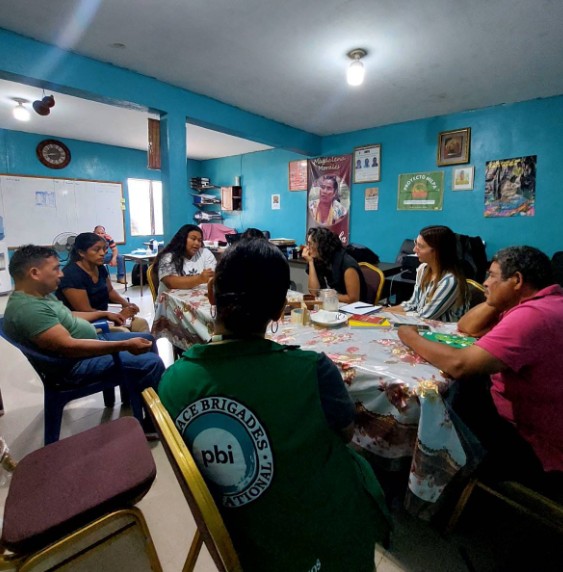
PBI-Germany together with PBI-Honduras meets with defenders from ARCAH and COFADEH

PBI-Honduras has posted:

“Together with ARCAH and Peace Brigades International Deutschland, we accompany the German Embassy in Honduras during a visit to Rio Grande or Choluteca in Aldea Loarque, Tegucigalpa. ARCAH defenders shared about the importance of creating legislation on atmospheric pollution in Honduras and denounced the river pollution allegedly caused by the poultry company El Cortijo. From PBI, we remind you that 11 members of ARCAH have precautionary measures from Inter-American Commission on Human Rights and that it is important to ensure their protection.”

The Honduran Alternative for Community and Environmental Vindication (Alternativa de Reivindicación Comunitaria y Ambientalista de Honduras, ARCAH) is a space for community articulation and an anti-capitalist, anti-racist, anti-patriarchal, anti-colonialist and anti-classist social movement that seeks to defend territories and common goods from any project that threatens the peace and cosmovision of communities.

PBI-Honduras then posted:

“Together with the Committee of Relatives of the Detained and Disappeared in Honduras (COFADEH) we met with defender Berta Oliva de Nativi and PBI-Germany to talk about the importance of not forgetting what happened in Honduras in the 1980s under the Doctrine of National Security. During the visit, we shared that the proposal for Victims Act has not yet been approved by Congress, while the State of Honduras has, among other things, the obligation to incorporate the subject into the educational curriculum, as stipulated by the Inter-American Court of Human Rights in the sentence Deras Garcia and others vs. Honduras.”

The Committee of Relatives of the Disappeared in Honduras (Comité de Familiares de Detenidos Desaparecidos en Honduras, COFADEH) is a human rights NGO in Honduras founded in 1982 by twelve families of disappeared Hondurans, including Bertha Oliva de Nativí, whose husband Professor Tomás Nativí was disappeared in 1981.

For more about PBI-Deutschland, see their website, as well as on social media at X/Twitter, Instagram, Bluesky and Facebook.

RCMP Black Hawk helicopters now patrol Quebec-United States border target “individuals who illegally enter Canada”

Photo: RCMP officers approach Black Hawk helicopter.

On January 30, the Montreal Gazette reported: “Facing the threat of U.S. trade tariffs, the RCMP has deployed a new Black Hawk helicopter to bolster patrols along the Quebec-U.S. border, a move the RCMP says signals to Washington that Canada is serious about tackling illegal migration and drug smuggling.”

The province of Quebec borders four US states: Maine, New Hampshire, New York, and Vermont.

The Gazette article adds: “The RCMP has acquired two Black Hawk border patrol helicopters, with the other being used in the Prairies. The helicopters are being rented for $5.3 million from Ontario company Helicopter Transport Services from Jan. 17 until the end of March.”

On January 22, the RCMP began patrolling the Manitoba-US border with Black Hawk helicopters. On January 28, patrols with Black Hawk helicopters began on the Alberta-US border.

An RCMP media release on the Alberta patrols says the helicopters will “search for, and target, all illegal activity along the border region; this includes searching for individuals who illegally enter Canada between official ports of entries and for the human smugglers who facilitate their travel. It will also be used to detect and stop illegal smuggling and trafficking of contraband such as illicit drugs into, and out of, Canada.”

Global News further reports: “Since Trump’s election victory, Ottawa has pledged $1.3 billion to increase border security, including 60 new drones in the air along the border and more surveillance towers.”

And Northeast Now adds: “The Black Hawks [that can carry up to twelve officers] are being used to patrol, detect, and respond to both north and southbound threats. Six of the helicopters in the fleet have cameras capable of thermal imaging, and one is capable of hoisting operations.”

The Toronto-based Migrant Rights Network has commented: “Seven years ago, when Trump was first elected, Prime Minister Trudeau declared that ‘refugees are welcome’. Now, as Trump returns to power, the Canadian government has allocated $1.3 billion to increase border policing and create a ‘border strike force’.”

Decades of exclusion

In April 2021, just after Trump’s first term as president ended, Vancouver-based migrant rights activist Harsha Walia commented: “There’s been a lot of emphasis on the ways in which Donald Trump was enacting very exclusionary immigration policies. But border securitization and border controls have been bipartisan practices in the United States. We saw the first policies of militarization at the border with Mexico under Bill Clinton in the late 90s.”

At that same time, Erika Guevara-Rosas, the Americas director at Amnesty International, also said that Biden was “repeating the mistakes of past administrations by securing agreements with Mexico, Guatemala, and Honduras to further militarize their borders in a bid to stop people who are fleeing from state repression, violent crime, food insecurity, and the devastating effects of the climate crisis.”

In December 2018, Pedro Rios, the director of the American Friends Service Committee US-Mexico Border Program, noted: “Over the past four decades, policies under every presidential administration – regardless of political party – have systematically militarized southern border communities, criminalizing millions of immigrants and creating repressive conditions from California to Texas.”

Border observatory

We are following the human rights implications of Canada’s border policies and are seeking to amplify the voices of migrant rights defenders.

Further reading: PBI-Canada to follow the human rights implications of RCMP Black Hawk helicopters deployed at US-Canada border (PBI-Canada, January 30, 2025).

PBI-Mexico: “The dignity of people is beyond any border”