
PBI-Kenya has posted:
“Recently, Women Human Rights Defenders (WHRDs) Toolkit Organizers (TOs) Cohort 1 held their first Monthly Movement Meeting of the year at Kwacha Africa in Malindi (Shela Ward). They checked in on each other, mapped out a year-long plan with concrete actions and roles, and wrapped up the day by reflecting on their vision for 2024.
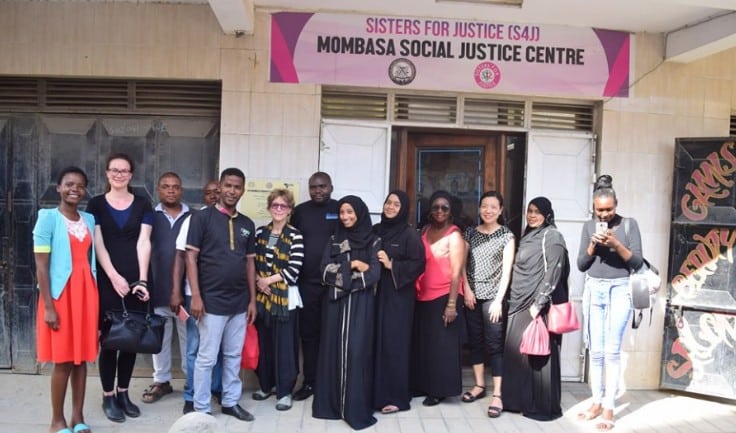
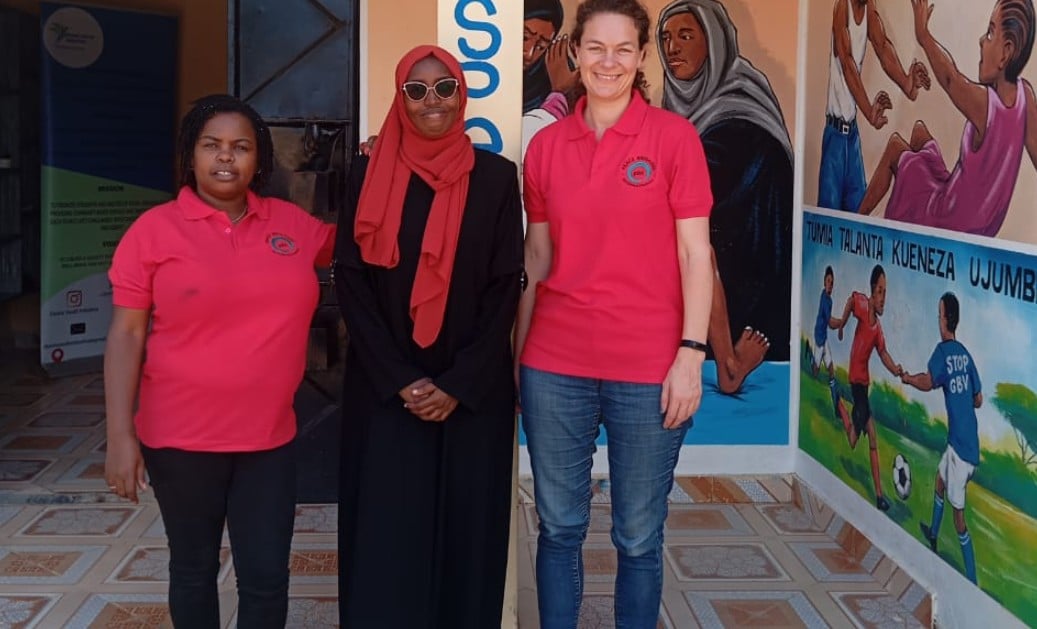
PBI Kenya also visited WHRDs in their respective organizations to strengthen relationships, monitor progress, and gain a deeper understanding of their work. These visits help build trust, provide insights for better collaboration, show solidarity, and ensure accountability.”
Colonial context and current issues
The Portuguese presence in Kenya began in 1498. The city of Mombasa was under Portuguese rule from 1593-1698 and then again from 1728-1729. Kenya was then a protectorate of the German Empire from 1885-1890, and then a British colony from 1888-1962. Kenya formally became independent on December 12, 1963.
Photo: A painting of anti-colonial revolutionary and Pan-Africanist leader Thomas Sankara at the Mathare Social Justice Centre in Nairobi.

Photo: PBI-Kenya outside a police station after the arrest of defenders at a Saba Saba march. Saba Saba (seven-seven) refers to an historic protest on July 7, 1990, when Kenyans took to the streets to demand free elections after 26 years of single-party rule.

Issues of concern
Among the issues that defenders contend with in Kenya are violence against women, enforced disappearances, police brutality, the police repression of the protests against the IMF/WB-backed Finance Bill, and police violence against the resistance to the construction of Kenya’s first nuclear power plant in the coastal town of Kilifi.
WHRD Editar Ochieng has commented: “Violence against women is very common in Kibera [an informal settlement in Nairobi] and many people have normalized it. So many women experience violence and they do not talk about it because they think it is normal, especially women experiencing violence in their relationships.”
Photo: Editar Ochieng.

The Johannesburg-based Centre for the Study of Violence and Reconciliation says: “[Sexual and gender-based violence] has deep roots, as African women and girls have been dehumanized as possessions since the colonial era, which has rendered them especially vulnerable in conflict. The norms and prejudices that are the legacies of historical violence against women and girls needs to be confronted.”
Photo: PBI-Kenya supports the creation of community murals in the urban settlements of Nairobi that speak against gender-based violence.

PBI-Kenya has commented: “Enforced disappearances in Kenya can be traced back to the colonial era. Subsequent Kenyan governments have relied on enforced disappearances to oppress the political opposition, instill fear and control the population.” In November 2024, the Kenya National Commission on Human Rights recorded 74 enforced disappearances between June and November 2024.
Video still: Mathare Social Justice Centre co-founder Wanjira Wanjiru: “I’m protesting because you’re killing us! You police! You’re killing us in our communities! People power! When we lose our fear, they lose their power! No more killings!”

PBI-Kenya also works with Perpetua Kariuki of the Kayole Community Justice Centre. She says: “Everyone in the informal settlement knows a person who is a victim of police brutality in some way. We just want to live in dignity.”
Photo: Perpetua Kariuki with Bernard Gachie from PBI-Kenya.

The non-governmental Kenya Human Rights Commission (KHRC) has commented: “Kenya’s police force has historically been an instrument of political control, a consequence that dates back to the colonial period. Before independence, the colonial police were used to suppress dissent and enforce the interests of British Empire. Unfortunately, this oppressive structure continued after independence.”
PBI-Kenya has also noted: “Before, during & after widespread protests triggered by the Finance Bill 2024, many individuals, including activists, human rights defenders & lawyers were disappeared.”
Kenya joined the International Monetary Fund (IMF) on February 3, 1964, just months after independence.
The IMF and World Bank have imposed structural adjustment programs on Kenya. The protests in Kenya in June 2024 related to a $12 billion World Bank loan and a $4.4 billion IMF loan. Al Jazeera notes: “For years, multilateral lenders, especially the IMF, have had bad reputations in African countries for providing loans to desperate countries based on stringent conditions that critics said have always disproportionately affected the poor.”
In July 2024, PBI-Kenya was in Kilifi County in solidarity with the residents of Uyombo village who were brutalized by the National Police Service-Kenya while fighting against the proposed building of a nuclear power plant in their village. Construction on the power station is expected to start in 2027 with it due to be operational in 2034. Construction will cost about 500bn Kenyan shillings (CAD $5.6 billion).
Photo: PBI-Kenya accompanies land and environmental defenders from Kilifi County at a march against the nuclear plant.

For more on PBI-Kenya’s support of grassroots efforts to end gender-based violence, advocacy against extrajudicial killings by police, its work within an alliance of national and grassroots organizations to reform the police, its efforts within a group of organizations whose mission it is to end enforced disappearances and extrajudicial killings by the police, and its support for the community social justice centres in the urban settlements of Nairobi including in Kayole, Kibera, Ruaraka, Kiambiu and Mathare, you can go to their website here.


Photo: PBI-Kenya visits the Mombasa Social Justice Centre.