

1- What do PBI field project teams do?
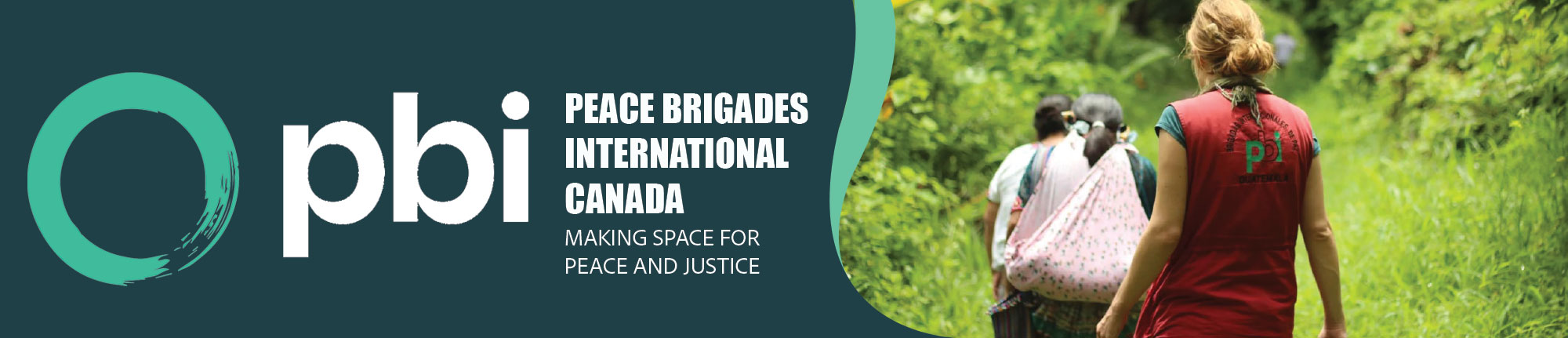
PBI teams try to support the peaceful resolution of conflicts through an international, non-violent and non-partisan presence.
Specifically, PBI teams:
– offer support and accompaniment as a protection mechanism for human rights defenders who are under threat and at risk of violence;
– develop a solid analysis of the political situation;
– inform the outside world about the situation observed on the ground through a non-partisan analysis;
– hold regular meetings with local and national civil and military authorities, as well as with embassies, to raise awareness of their concerns about the abuse of human rights that affect the accompanied organizations.
2- Is PBI a development organization?
No. PBI sends requests for development projects to other organizations established for this purpose.
3- What does the non-partisan principle of PBI mean?
We believe it is inappropriate for PBI, being a foreign entity, to have any influence on the decisions of the organizations it accompanies.
The non-partisan position also gives us access to a broader spectrum of political support, which reinforces our ability to protect and promote nonviolence in conflict resolution.
In practical terms, it means that PBI does not:
– provide financing to any of the organizations it accompanies;
– accept payment for their services;
– participate directly in the rallies and protests we observe or accompany.
4- What does PBI look for in a volunteer?
The following list of skills, experience and abilities is an example of the criteria used to assess the aspiring volunteers. Some requirements are essential and others desirable:
– a clear understanding and commitment to nonviolence;
– fluency in Spanish is necessary to work in Mexico, Guatemala, Honduras and Colombia;
– discretion and diplomacy;
– a minimum age of 25 years is recommended;
– ability to work effectively while under pressure;
– knowledge and understanding of the history, politics and culture of the country of work;
– ability to work with people from different cultures, demonstrated through previous intercultural experiences;
– ability to change tactics, work methodology and opinion;
– familiarity with consensual decision making and ability to work in a team in a cooperative and flexible way;
– previous experience working with an NGO in the fields of peace, human rights or social justice;
– knowledge of computer equipment, accounting, writing, library science, group relations, rural communities, photography, cooking, music and many more can be useful.
5- What is the process to become a volunteer?
After completing the application and having given your references to the project office, there is then a qualifying interview (usually by telephone).
The next stage of the process consists of attending a training course that lasts between seven and ten days. These courses take place several times a year in Europe, North America and in the Asia-Pacific area.
Training for projects in Colombia, Guatemala and Mexico is in Spanish, and for projects in Indonesia, Kenya and Nepal it is in English.
Each volunteer undertakes a rigorous training process, in order to be fully prepared to take on the challenge of working on a PBI project.
The courses cover the following topics: The principles of PBI, its mandate, structure and decision-making processes, non-violence and non-partisanship, political analysis, cultural sensitivity, group processes and how to act in emergency situations, fear and stress.
The training will help you decide if you really want to volunteer in a PBI team and will help you and your project members decide if you have adequate preparation for the experience.
Each applicant will have an interview with members of the training team, in which they can present the questions or concerns that arise. Some projects give their recommendation on the last day of the training period, others do so later.
6- What are the living conditions like?
PBI volunteers share a house that is used as accommodation and office.
Generally, it is a house with a very international character, where all people have the commitment to live for 12 to 18 months.
7- What measures does PBI take to minimize the risks that volunteers face?
Given the nature of PBI’s work, there are certain personal risks that are well defined.
Team members frequently accompany people who are under threat of suffering all kinds of physical damage. Before applying, each volunteer applicant should consider whether they are prepared to take these risks.
The safety of our volunteers is essential to maximize the protection we offer to the organizations and communities we accompany.
When accompanying missions are undertaken, particularly those that are potentially risky, the PBI teams conduct a thorough analysis of the political situation and inform the police and local authorities that PBI volunteers will be in the area.
These high levels of visibility indicate to the authorities that they will be held responsible if anything happens to the volunteers or those they accompany.
As a preventive measure, the embassies of the countries of the volunteers are also informed.
In addition, as an additional measure, they always carry mobile phones (or satellite phones if they travel to remote areas) so they can immediately communicate with the support teams and offices.
Field teams are backed by an international support network, which protects not only the organizations we accompany but also our volunteers.
For more than 25 years of accompaniment there have been two cases of serious incidents, both of which happened 18 years ago. In August 1989, a hand grenade was thrown at the PBI home in Guatemala (no one was injured), and three months later three volunteers were stabbed. However, such incidents are rare.
8- Can I volunteer with a PBI team in my own country?
No. For reasons of non-partisanship and security, volunteers cannot join a PBI project in their own country. But volunteers from Latin America can work with a field project in another Latin American country.
The first reason for having this “own country rule” is that PBI teams must keep their distance with the organizations they accompany, so that local pressures do not influence their work.
The second reason is for security. In order to provide effective support to organizations, we must ensure the maximum safety of our own volunteers.
9- What about financial support?
In all projects, all of the following costs are covered by PBI: round trip to the country of work, living expenses, lodging, food, internal travel, medical insurance and an amount of money to support the repatriation of the person to your country of origin at the end of volunteering
Volunteers are also offered compensation that covers additional costs. The monthly stipend would be in the range of $335.
In addition, support is provided for internal trips, for mental health, and an economic contribution to support (not always completely cover) a vacation flight to the place of origin.
10- What does PBI offer?
The great experience of working with an international organization for peace and human rights, committed to the transformation of ideals into practical actions.
Specialized training based on more than 25 years of field work experience.
The experience of living and working in a closely united team of volunteers from very different countries and cultures.
The unique opportunity to observe first-hand the intense pressures faced by human rights defenders and their capacity for resistance and courage.
11- What about emotional support?
PBI has a commitment to support its volunteers before, during, and after its work with the organization in the field.
We have developed minimum standards to provide emotional support to our teams during their stay with PBI during preparation, field work and reintegration.
Our partnership with the European Gestalt Therapy Association (EAGT) allows PBI volunteers to receive professional support if they need it. They can also receive individual support from EAGT mental health professionals during and after volunteering with PBI.
12- Do I join a team immediately after the training?
Field projects are responsible for organizing the integration of volunteers into teams. While the needs of the volunteer are kept in mind, the needs of each team include maintaining a balance regarding nationality, sex, age and knowledge. For this reason, it could take between a month and a year from the end of the training until the moment of joining a team.
13- Can I volunteer with a PBI country group?
Yes, there is a country group in Canada in and 12 other countries around the world.
The work of country groups is fundamental to the protective accompaniment of human rights defenders and increases our global impact.
Country groups work to raise the visibility of at-risk human rights defenders and to create support networks. Thanks to their links with government officials, parliamentarians, legal bodies and other groups, they are able to amplify the voices of human rights defenders around the world and ensure that the international community responds adequately to their needs.
Country groups are also responsible for recruiting field volunteers, raising awareness of attacks against human rights defenders and securing funding for our field work.
Many country groups organize training courses that offer a general introduction on the principles on which the work of PBI is based, and on its implementation in the field work.
In addition, country groups support volunteers during the preparation period before joining a team and during the readjustment period at the end of field work.
14- How do I learn more about the overall work of PBI?
You can contact us directly, read our 2018 annual review, and/or check out any of the field project and country groups websites, Facebook, Twitter and Instagram pages for information about our latest activities.
This FAQ is based on the PBI-Colombia Project’s Preguntas Frecuentes web-page.


