Home Blog Page 218

PBI-Honduras observes ‘Fraud on the Gualcarque’ trial in Tegucigalpa

On August 3, PBI-Honduras tweeted:

“These days we are observing the oral and public trial ‘Fraud on the Gualcarque’ against six people accused of managing the resources of the Gualcarque River. We remember the important work of @COPINHHONDURAS [Civic Council of Popular and Indigenous Organizations of Honduras] in the defense of the Lenca indigenous territory and the river.”

The International Federation for Human Rights (FIDH) has explained:

“The oral hearings [began on July 25] in the corruption trial in the concession of the Gualcarque River, in Honduras. FIDH and other organisations that make up the Qualified Observation Mission in the Berta Cáceres case in Honduras will follow the oral hearings.

This trial seeks accountability for those involved in the network of corruption that allowed for fraudulent concessions of the Gaulcarque River. These concessions are still in force in the territories of the Lenca community, violating their rights to land and water. The complaint is linked to the 2016 murder of renowned environmental and human rights defender Berta Cáceres.

This trial is also emblematic because it is the first time in the country that Indigenous communities — direct victims of these criminal acts — have become parties to a corruption case for violation of their human rights.

The Observation Mission hopes and calls for a transparent and public process in the trial of the ‘Fraud in the Gualcarque’ case.

The Observation Mission also calls on the national and international community, in particular the diplomatic missions in Tegucigalpa, to closely observe and follow this trial given its importance for human rights jurisprudence, the rights of Indigenous peoples, and the fight against corruption.”

The FIDH media release can be read in full at Honduras: International mission will observe “Fraude sobre el Gualcarque” case.

For more on this, please see the Proceso Digital article Por constancia médica de un defensor, juicio por “Fraude sobe el Gualcarque” seguirá el lunes.

PBI-Honduras has accompanied COPINH since May 2016.

PBI-Honduras accompanies LGBTI+ Pride mobilization in San Pedro Sula

On August 2, PBI-Honduras tweeted:

“PBI accompanies @arcoirisghn [the LGTB Rainbow Association of Honduras] at the LGBTI+ Pride mobilization in San Pedro Sula. We highlight the work of those who make up the organization, which for the last 19 years has been dedicated to the defense of the human rights of the LGTBI+ community in #Honduras.”

La Tribuna further reports:

“With the cry “presence and struggle, they will not silence us”, the LGTBIQ + community celebrated with a parade the month of gay pride this weekend in San Pedro Sula.

The official commemoration is in June, but the leaders usually celebrate it in July since the coup d’état of 2009, explained Deputy Victor Grajeda, one of the organizers of the parade.

During the tour, the community recalled the murder of 450 members in the last ten years and whose crimes, for the most part, remain in impunity.

The parade was accompanied by floats and choreographic groups along the third avenue of the industrial city, with the governor of Cortés, Alexa Solórzano, as marshal.

Grajeda stressed the need to advance in respect for sexual diversity and eradicate once and for all all types of discrimination in the country.”

The full article is at “No nos callarán”: comunidad LGTBIQ+.

PBI-Honduras has accompanied Arcoiris since July 2015.

PBI-Mexico accompanies march against enforced disappearance and femicide in Chihuahua

On August 1, PBI-Mexico tweeted:

“On July 29, PBI accompanied relatives of victims of #disappearance and #femicide in #Chihuahua. In their intervention, family members asked, Where is the #Justice? and they assured that ‘for them and them, we render memory and make a complaint’.”

On Facebook they added:

“During the event, people marched around the square in front of the government palace ‘against the hands of the clock and in silence’ as a symbol of disappearances and #impunity.”

In April of this year, The Guardian reported: “Last year Mexico recorded 1,015 cases of femicide – when a woman is murdered specifically because of her gender – compared with 977 in 2020. Overall, about 3,500 women were killed.”

And in May, the number of people disappeared in Mexico surpassed 100,000.

At that time, Dawn Marie Paley wrote: “Most of the disappearances have taken place in the context of the War on Drugs, which was launched by former President Felipe Calderón in December of 2006. On average, 25 people are disappeared every day in Mexico. Since Andrés Manuel López Obrador took office on December 1, 2018, that number has topped 30,000 in total.”

Paley has also noted: “Families in Chihuahua state have found remains that correspond to over a dozen bodies in an abandoned mine, and are pushing authorities to grant them access to three more, including one previously owned by a Vancouver company called Kimber Resources Inc. The state of Chihuahua is a major producer of gold, silver, lead, zinc and copper. Over one tenth of the state’s territory is concessioned to mining companies.”

She highlights that Canada has remained silent on this issue.

Paley then writes: “Instead, the emphasis of the Trudeau government in Mexico has been on ensuring the rights of energy companies and monitoring the state of the automotive industry under the new Canada-United States-Mexico Agreement. …It [also] reflects Canada’s own failure to respond to disappearance domestically, which disproportionately impacts Indigenous peoples.”

PBI-Colombia amplifies statement denouncing attack against Barrancabermeja wetland protector Luidmila Gutiérrez

Photo: Last week’s visit to the pollution points in the San Silvestre wetland.

On July 29, PBI-Colombia tweeted:

“At risk environmentalists #MagdalenaMedio Repeated attacks against leaders/those of #Fedepesán are of concern, such as an attack against Yuli Velásquez and persecution and threats against Luidmila Gutiérrez, who protect water and territory, accompanied by @Credhos_Paz #Urgent Guarantees.”

Infobae reports:

“On the night of Monday, July 25, at the home of Luidmila Gutiérrez, three armed men forcibly entered the place, intimidated her and forced her to stay still, while her son watched the scene with fear.

Yuli Velásquez, who has been the victim of three attempts on her life for the defense of the environment in Barrancabermeja [says]: “They took a motorcycle, cell phones. They told the son of comrade Oswaldo, a 7-year-old boy, that if he did not do what they asked for, they would crush the mother’s hands. I told the security forces this, but nobody does anything, or says anything.”

According to the account of Juan Camilo Delgado, environmental engineer of the Regional Corporation for the Defense of Human Rights (Credhos) … after entering the house, the men “proceeded to requisition the house, demanded cash of her. She says they lasted about an hour in the house, she is sure of two subjects who entered, but presumes that there was someone else outside. They stole money, a cell phone and Luidmila’s motorcycle.”

Luidmila Gutiérrez is part of Asopesadiba [the Association of Fishermen, Farmers and Producers of the Water Bodies of the District of Barrancabermeja] and is the wife of Oswaldo Beltrán, belonging to Fedepesan [the Federation of Artisanal Fishermen, Environmentalists and Tourists from the Department of Santander] who led last Friday’s visit to the pollution points in the San Silvestre swamp.

The San Silvestre swamp in the city of Barrancabermeja is one of the main bodies of water in the region, because in addition to its ecological function as a natural habitat for a large number of biological species, it is the source of water collection for purification and supply of the urban area and part of the rural area of the city.

The contamination of the San Silvestre swamp, which has been caused, in large part, by the [Ecopetrol] refinery and the company Aguas de Barrancabermeja, violent attacks against this population have continued to occur.”

This joint statement from CREDHOS, the Territorial Development Observatory Corporation and FEDEPESAN denounces the attack against Luidmila Gutierrez on July 25.

It also notes: “[On] previous days –June 30 and July 1, 2022– FEDEPESAN had conducted an inspection visit that was attended by CREDHOS, PBI-Canada, and a team of international journalists who interviewed YULY VELASQUEZ and LUIDMILA GUTIERREZ, each at her residence, in order to make visible the work of artisanal fisherwomen in the region.”

Photo: Visit to the San Silvestre wetland, June 30.

Their joint statement further highlights: “We consider that this last fact against LUIDMILA, added to other victimizing acts against members of FEDEPESAN, are retaliations for the work in defense of the complexes swampy areas and their tributaries, the protection of artisanal fishing and the complaints made by the artisanal fishermen, through different means of communication and regional, national and international organizations that defend human rights and the territory.”

It also calls on the international community to help request “the Colombian State guarantees for the protection of life, physical and psychological integrity, security and Permanence in the territory of the artisanal fishermen of the District of Barrancabermeja and the Magdalena Medio region, in addition to monitoring the situation of social leaders in the region” and calls for “a verification mission to identify and analyze the risks and violations of the Human Rights of members of FEDEPESAN.”

We continue to follow this situation.

PBI-Canada attends advocacy planning meeting in Brussels with PBI projects and country groups

Ottawa-based Peace Brigades International-Canada coordinator Brent Patterson attended a PBI advocacy working group face-to-face meeting in Brussels, Belgium this past Monday July 18 to Friday July 22.

As our friends at PBI-UK tweeted:

The PBI projects present at this meeting were Colombia, Honduras, Guatemala, Mexico, Indonesia and Kenya. The country groups were from the United Kingdom, Norway, Germany, Switzerland, Spain and Canada. There were also representatives from the PBI international office which is based in Brussels.

Among the key outcomes from this planning meeting, you will see this coming year:

1- more webinars featuring PBI accompanied front line defenders (including PBI entities collaborating on a webinar on the UN COP27 climate summit in November)

2- new ways for you to support these defenders using online advocacy tools (including urgent actions and petitions)

3- more research on the connections between Canadian companies, pension funds and other forms of financing and the human rights struggles that PBI accompanies (in order to better leverage changing the situations in which rights are violated)

4- support for PBI accompanied defenders to participate in mobilizations at annual shareholder meetings (hopefully including meetings in Toronto and Calgary)

5- increased use of social media as an advocacy tool to support the defenders that PBI accompanies.

We look forward to carrying out this work plan over the coming months.

Stay tuned!

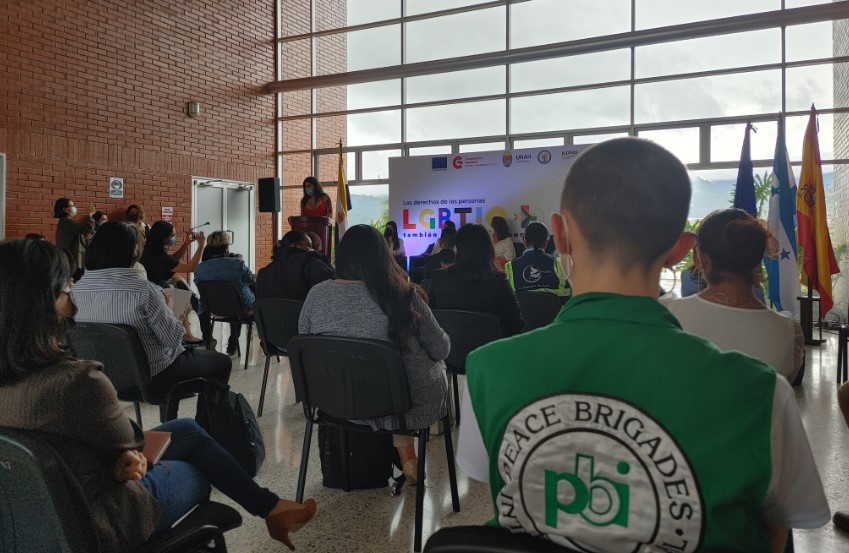
PBI-Honduras observes symposium on “Sexual diversity: challenges and progress towards equality”

On July 22, PBI-Honduras tweeted:

“A few days ago, we observed the Symposium ‘Sexual Diversity: challenges and advances towards equality’. We applaud the participation of different LGBTI+ organizations and members and celebrate the participation of other venues such as embassies and national and international organizations.”

On Facebook, PBI-Honduras adds:

“Carla Antonelli first trans deputy in Spain, representatives of the EU [European Union], OACNUDH [Office in Honduras of the United Nations High Commissioner for Human Rights], the University Institute IUDPAS [University Institute in Democracy, Peace and Security] and some government institutions, among others [were also present at the meeting].

Some of the topics discussed in the space were, the historic debt in human rights to the LGBTI+ community in Honduras, the cases of violence against the collective so far in 2022, the judgment of the CIDH [Inter-American Court of Human Rights] on the case Vicky Hernandez, and the process of changing name to National Register of Persons.

From PBI we celebrate that there are spaces to reflect on the complex situation of human rights facing the LGBTI + collective, we remember that it is urgent to address the situation and ensure respect for human rights of the common kindness.

We applaud the participation of various organizations and members of the collective at a national and international level and celebrate the participation of other stays such as embassies and national and international agencies.”

Then on July 28, PBI-Honduras further tweeted:

“Recently, we accompanied @somoscdc_hn at the Confines Festival in Gracias. We emphasize that it was the first time that sexual diversity was discussed at a cultural event in Gracias.”

PBI-Honduras has accompanied the Centre for LGTBI Development and Cooperation (Somos-CDC) since January 2022.

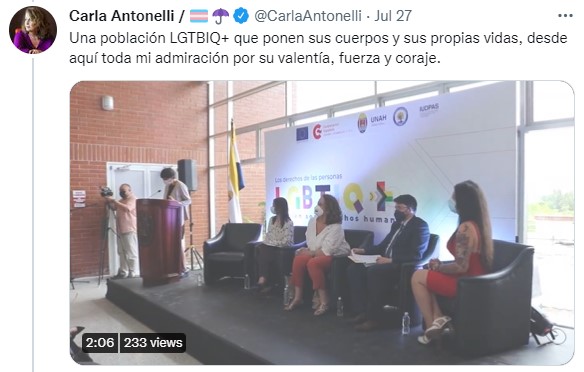
Carla Antonelli tweet: “An LGTBIQ+ population who put their bodies and their own lives, from here all my admiration for their bravery, strength and courage.”

PBI-Mexico accompanies the ongoing struggle for the human right to water

On April 23, the Peace Brigades International-Mexico Project tweeted: “PBI accompanies the end of the Caravan for Water and Life in the Nahuatl community of Cuentepec in the state of Morelos. It is the outcome of a month of articulation of struggles in defense of land, territory and the environment in 9 states of the country.”

Now, Lillian Perlmutter further reports in The Guardian on the water crisis in Monterrey, Nuevo León and across Mexico.

She notes: “More than half of Mexico is suffering from drought, and the national water authority, Conagua, declared a state of emergency in four northern states [Sonora, Baja California, Coahuila and Chihuahua].”

“Nowhere is the crisis felt more acutely than in Monterrey’s poorest areas. Several brewers and soft drinks companies have factories in the city, and these use about 60 times the amount consumed by the city’s population, nearly 90bn litres a year in total, and over half of that – nearly 50bn litres a year (or 50m cubic metres) – is water from public reservoirs.”

“The drought has not halted their water use; companies including Coca-Cola and Heineken use private wells to continue extracting groundwater for their production lines.”

Her article also highlights: “In recent weeks, activists have popularised the phrase: “No es sequía, es saqueo” (“It’s not drought, it’s plunder”).”

The full article can be read at ‘It’s plunder’: Mexico desperate for water while drinks companies use billions of litres.

Caravan for Water and Life

On January 15 and 16 of this year, PBI-Mexico accompanied the National Meeting of Struggles Against Gas Pipelines and Death Projects in the municipality of Juan C. Bonilla in the state of Puebla in south-eastern Mexico.

The meeting took place at the Bonafont bottled water plant that had been reclaimed by Indigenous and local communities in August 2021. La Jornada has reported that Bonafont has taken more than 1,400,000 litres of water a day over the past 25 years.

The National Meeting expressed opposition to the Canadian company TC Energy’s Tuxpan-Tula gas pipeline, the Morelos gas pipeline (part of the Morelos Integral Project/PIM). Latino Rebels has reported: “To cool the turbines at the [thermoelectric] plant, the adjoining aqueduct must draw 50 million liters of water daily from the Cuautla River.”

Pie de Pagina noted: “The final result of the Meeting was the announcement of the Caravan for Life that will depart on March 22.”

Tamara Pearson reported in Truthout: “For the launch, the caravan held a press conference and marched outside Bonafont, a water bottling plant that is owned by Danone. Local Nahua peoples had taken over the plant last year, but were evicted by the military in February. The bottling plant is now guarded by security forces in full battle gear, with a wall of 20-liter water bottles and two steel fences to prevent Indigenous locals from returning.”

Pearson also wrote: “It’s not a drought, it’s looting” has been one of the main chants of the month-long caravan.”

The full article by Tamara Pearson in Truthout can be read at “It’s Not a Drought, It’s Looting”: Water Rights Activists Organize in Mexico.

On July 28, 2010, through Resolution 64/292, the United Nations General Assembly explicitly recognized the human right to water and sanitation and acknowledged that clean drinking water and sanitation are essential to the realization of all human rights.

We celebrate this recognition and continue to follow the ongoing struggle for the implementation of this human right.

On December 15, 2021, PBI-Mexico participated in the International Observation Mission on Human Rights at the occupied Bonafont plant that had been renamed La Casa de los Pueblos, Altepelmacalli.

PBI-Guatemala accompanies criminalized Poqomchi environmental defender Justino Xollim Tilom at court hearing

On July 26, PBI-Guatemala posted:

“PBI accompanies Justino Xollim Tilom member of the UVOC [Verapaz Union of Campesino Organizations] in a debate audience. he is accused of illegal logging, a crime he reported against other people.”

On February 17, 2019, Prensa Comunitaria reported that Xollim, a representative of Poqomchi communities in his territory, has worked for a decade to have the government grant them general title to their lands. While Xollim was going to the Public Ministry on February 15 to denounce the felling of trees by a wood company on this territory, he was arrested by members of the Tourism Security Division.

PBI-Guatemala has also noted: “His community is part of the UVOC which has endured several processes against it because of its demand for access to land.”

UVOC is an indigenous and peasant organization dedicated to the defence and promotion of access to land in the context of historical dispossession and ongoing inequality in Guatemala. UVOC represents Q’eqchi’, Poqomchi, Achi and Mestizas peoples.

About 40 per cent of the population of Guatemala is indigenous.

Indigenous and peasant farmers were dispossessed of their land in the 18th century through Spanish colonization which drove them to the less fertile highlands.

Land distribution in Guatemala continues to be deeply unequal with the largest 2.5 per cent of farms currently occupying more than 65 per cent of the land while 90 per cent of the farms are on only one-sixth of the agricultural land in the country.

There are now at least 1,000 land conflicts happening in Guatemala, many of which are related to concessions given to foreign companies for mining, sugar cane and palm oil farms, and hydroelectric dams, all of which deepen dispossession, exclusion and poverty among the indigenous peoples of Guatemala.

PBI-Guatemala has accompanied UVOC since 2005.

PBI-Mexico accompanies meeting of Rarámuri communities as they present a development plan for the Sierra Tarahumara

On July 26, PBI-Mexico tweeted:

“On July 12 and 13, 11 communities from the municipalities of Bocoyna and Urique in the Sierra Tarahumara in #Chihuahua presented the ‘Nátiga Busuré Development Plan’ with the accompaniment of @CONTECAC. PBI accompanied the meetings.”

Raichali further reports:

“Eleven Rarámuri communities of the Sierra Tarahumara, presented on Tuesday [July 12] the Nátiga Busuré Regional Development Plan, a project created through dialogue between them, which analyzes and proposes solutions to the different problems that are lived in their territory, and with the intention of responding to the ruling of the Supreme Court of Justice of the Nation (SCJN) that ordered the government since 2012 to take into account the affected communities for the tourist project in Barrancas del Cobre.

The ruling of the SCJN was given by the breach of the obligations contracted by the federal and state governments on December 10, 1996, related to the creation of the Advisory Council of the Barrancas del Cobre Trust, which was not formed until 2016.

The information gathered from the inhabitants of these villages, through workshops and assemblies that began in June 2021, exposes how after 26 years the two types of government [state and federal] have not fully complied with the agreed commitments of development and social investment for indigenous peoples.

For the Rarámuri, development means having a quiet, balanced and autonomous life. That is, there must be a respect and harmony with nature, where they can inhabit and plant their own food, recover and live their traditions, while creating stable jobs hand in hand with tourism, while exercising their autonomy as a people, free of violence.

In this context, Nátiga Busuré, which means “waking up dreaming” or “waking up thinking”, is raised from 6 fundamental axes, which were explained by the inhabitants of the communities: education, health, environment, security, tourism, and economy (agriculture and housing).

During the presentation of the plan, the representatives of the Rarámuri communities made it clear that each of the axes on which it was built are equally important, since none has been properly attended since 1996.

In terms of security, the regional development plan seeks to guarantee the safety of families in the mountains and their access to justice. Activities such as the defense of its forests against illegal logging, sustained and increased during the pandemic, has aggravated the situation of disappeared and forced displacement.”

The full article can be read in Spanish at Comunidades rarámuri presentan plan de desarrollo regional “Nátiga Busuré”, denuncian olvido histórico del gobierno.

PBI-Colombia accompanies visit by German parliamentarian Kathrin Henneberger to the Amazonian Pearl Peasant Reserve Zone

On July 25, PBI-Colombia tweeted:

“Important visit and support from parliamentarian @KathrinAnna to #ZRCPA [the Perla Amazónica Peasant Reserve Zone] in #Putumayo where Jani Silva, leader of #Adispa [the Association for the Integral Sustainable Development of the Perla Amazónica], women #MEMPA [the Central Women’s Committee known as My Name is Amazon Pearl Woman/MEMPA] and environmental promoters face serious risks for defending life, biodiversity and territory, accompanied by @Justiciaypazcol [the Inter-Church Commission for Justice and Peace].”

PBI-Colombia also tweeted:

“The women defenders of the environment #Mempa ‘My name is Amazon Pearl Woman’, the leader Jani Silva of #Adispa and @Justiciaypazcol have spent years protecting the territory from the serious environmental impacts caused by oil companies, in the midst of the armed conflict.”

Background

The ZRCPA is located near Puerto Asis in the department of Putumayo, which is situated in south-west Colombia near the border with Ecuador.

PBI-Colombia accompanies the Justice and Peace Commission that in turn accompanies Jani Silva, the president of ADISPA.

Amnesty International has highlighted: “Jani Silva has dedicated her life to protecting the Amazon and the life that exists in it from efforts by armed groups and multinational companies to take control of her territory.”

The Guardian has also reported: “Silva says she has seen firsthand the effects of big business in Putumayo, where, she believes, oil companies ‘exploit irresponsibly’ and contaminate the environment.”

And PBI-Colombia has noted: “Over the years, one of the great challenges they have faced has been the arrival and expansion of oil companies.”

“According to Jani, these projects came about in the early 2000s when the people leading the ZRCPA were less active due of the threats they were receiving.”

That timing coincides, as Canadian Dimension has reported, with Canada’s Petrobank investing $50 million in its Putumayo oil operations.

Petrobank was a Calgary-based company whose Putumayo operations were taken over by Calgary-based Petrominerales Ltd. in December 2010. Calgary-based Pacific Rubiales (now Frontera Energy Ltd.) bought Petrominerales in September 2013.

Amnesty International has noted: “[Jani Silva] has also denounced the socio-environmental effects of oil operations, including those of Amerisur [now owned by GeoPark].”

It adds: “Amerisur is a hydrocarbon exploitation company operating mainly in Putumayo basins [whose partners have included] Canacol Energy Ltd. (Canada) [and] Pacific Exploration & Production (Frontera Energy, Canada).”

We continue to follow this situation.