Home Blog Page 217

PBI-Guatemala accompanies the Peaceful Resistance of Cahabón as struggle against OXEC dams built without consent continues

On August 7, PBI-Guatemala posted:

“PBI accompanies and meets with members of the Peaceful Resistance of Cahabón who defends their territory against the OXEC hydroelectric power that entered their lands without prior consultation, free and informed.”

The Peaceful Resistance of Cahabón, a collective of 38 Maya Q’eqchi communities, began as a collective process around 2015 to oppose the construction of the Oxec and Renace dams on the Cahabón River and its tributaries.

On August 27, 2017, PBI provided security support to a community organized consultation in which 26,537 people in 195 communities of the Cahabón River participated. 26,526 rejected the presence of the hydroelectric dam company.

The Guatemalan Human Rights Commission (GHRC) highlights: “A few months later [in December 2017], Bernardo Caal Xol [of the Peaceful Resistance] was arrested [in] a clear act of retribution for the defense of his community’s water rights.”

In November 2018, Bernardo was sentenced to seven years and four months in jail. On March 24, 2022, Bernardo was finally released from jail.

The two most recently completed dams on Cahabón River are Oxec II which began operation in September 2018 and Renace IV which became operational in January 2019. These dams were built without free, prior and informed consent.

In December 2021, Digis Mak reported: “[The] Oxec private hydroelectric project has two dams and one more in the construction stage.”

PBI-Guatemala has accompanied the Peaceful Resistance since July 2017.

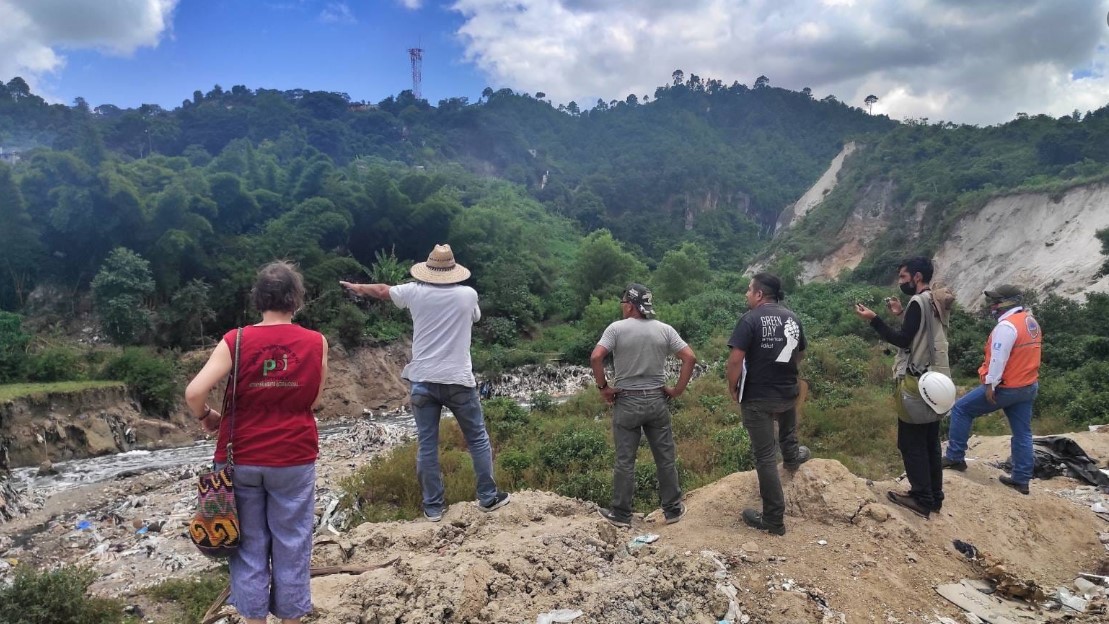
PBI-Guatemala accompanies Multisectoral Chinautla at meeting in follow-up to CONRED valuation of damage

On August 8, PBI-Guatemala posted:

“PBI accompanies the Multisectoral Chinautla in its visit to the City to continue the follow-up Table with the Ministry of Energy and Mines, Ministry of Environment and Natural Resources, the National Coordinator for Disaster Reduction (CONRED), the deputy Aldo Davila and ancestral authorities of the Poqoman people, in representation of Chinautla Multisectoral. In this meeting, the technical results obtained in the day of structural valuation of the houses surrounding the sand dunes, held last Friday (August 5) by CONRED are shared.”

On August 5, PBI-Guatemala had also posted:

“PBI accompanies the multisectoral Chinautla, in the inspection by CONRED to verify damage to house structures caused by sand extraction in the region.”

CONRED (The National Coordination for Disaster Reduction/ Coordinadora Nacional para la Reducción de Desastres) is a Guatemalan government organization created to prevent disasters or reduce their impact on society, and coordinate disaster relief efforts.

On July 19, Con Criterio reported:

“The struggle of the Poqomam people of Santa Cruz, Chinautla, has been going on for decades. They have never received a response to their demands: to stop the extraction of sand that, according to them, destroys homes, hills and causes the migration of families to other municipalities to escape environmental degradation.

Chinautla is a municipality in Guatemala, located seven kilometers from the capital, it is estimated that 114,752 people live there. There, according to the records of the Ministry of Energy and Mines (MEN), six mining companies operate with authorization to extract sand and other materials. The neighbors, however, assure that there are more companies that extract behind their backs or with the consent of the municipal authorities.

The mining companies in Chinautla and registered with the MEN are these 6: La Presa, Arenera del Pino, San Fernando, El Manguito, La Primavera and San Luis, which have operated in that locality since 1996 and 2005. All have licenses for the manufacture stone, select, mud extraction, white sand and river.

Peace Brigades International (PBI), an entity that accompanies the civilian population for the resolution of conflicts, revealed through this report on its electronic portal that the sand extraction projects in that municipality have caused alterations in the course of the rivers and riverbanks, as well as respiratory diseases. The community most affected by extractive activities, according to the brigades, is Santa Cruz, Chinautla, because of 150 families that lived 500 meters from the sand pits, only 20 remain, the rest migrated to other places.

According to PBI, during the administration of former mayor Arnoldo Medrano between (between 1988 and 2015) the industrial extraction process was authorized with machinery and trucks from the capital, without consulting the affected communities.”

The full article can be read in Spanish at “La arenera se llevó todo, ya no podemos vivir en Chinautla”.

In May 2018, the Guatemalan newspaper Prensa Libre also reported that the extraction of sand from the channel of the Chinautla River and the confluence of the Tzaljá and Las Vacas tributaries, in an area where there are already geological faults, accelerates the cracking of walls and the sinking of some homes in the community.

Residents of Santa Cruz Chinautla have also denounced the degradation of the Chinautla River basin as eco-ethnocide against the Poqomam peoples.

The PBI-Guatemala Project has accompanied the Chinautla Multisector Urban Platform since December 2018.

Parliamentary Secretary Maninder Sidhu in Colombia for the inauguration of Gustavo Petro and Francia Márquez

Photo: Parliamentary Secretary Maninder Sidhu in Bogota.

Maninder Sidhu, the Parliamentary Secretary to the Minister of Foreign Affairs, is in Bogota, Colombia for the inauguration on Sunday August 7 of Gustavo Petro as President and Francia Márquez as Vice-President.

On August 6, PS Sidhu posted this video and tweeted:

“Proud to represent Canada at the inauguration of President @petrogustavo here in Colombia. Canada and Colombia have a very strong relationship and I am looking forward to continuing to build upon our nearly 70 years of diplomatic relations.”

Earlier in the day, Foreign Policy Canada also tweeted:

“PS Sidhu is in #Colombia to meet key government, civil society, Indigenous, and business leaders & to attend the inauguration of President-elect @petrogustavo and Vice-president elect @FranciaMarquezM.”

The U.S. delegation

The U.S. delegation attending the inauguration will be led by Samantha Power, Administrator of the United States Agency for International Development (USAID), who will be joined by Gregory Meeks, Chairman of the House Foreign Affairs Committee; Francisco Palmeri, Ambassador in charge of the United States in Colombia; Desiree Cormier, United States Department of State Representative for Racial Equality and Justice, and Juan Gonzalez, Western Hemisphere Director of President Joe Biden’s National Security Council.

Video: Samantha Power arrives in Bogota.

Key cabinet appointments

Among the cabinet appointments Petro has made:

– Francia Márquez (Equality)

– Álvaro Leyva Duráb (Foreign Affairs)

– José Antonio Ocampo (Finance)

– Susana Muhamad (Environment)

– Ivan Velasquez (Defence)

– Alfonso Prada (Interior)

– Cecilia López Montaño (Agriculture)

– Alejandro Gaviria (Education)

– Carolina Corcho (Health)

– Patricia Ariza (Culture)

– Gloria Inés Ramírez (Labour)

– María Isabel Urrutia (Sport)

– Irene Vélez (Mines and Energy).

Reuters has reported: “Petro, who opposes fracking and new oil contracts in favor of moving toward renewable energy, said Velez has extensive experience in the environmental sector and will take on the “difficult task” of leading the transition towards an economy not based on extraction.”

Ministers Velez (Mines and Energy), Muhamad (Environment).

Promises

NPR has also noted: “The incoming president has said Colombia will stop granting new licenses for oil exploration and will ban fracking projects… He [also] plans to finance social spending with a $10 billion a year tax reform that would boost taxes on the rich and do away with corporate tax breaks.”

Canada in Colombia

With $8 billion invested, Colombia is the second largest location for Canadian Energy Assets Abroad (CEAA). Twenty-eight Canadian mining companies also hold assets totalling $1.406 billion in Colombia.

Notably, Toronto-based Scotiabank has provided more than $3 billion in financing to the state-owned oil company Ecopetrol, the company that would operate the planned Platero and Kale fracking pilot projects in Puerto Wilches.

Reuters has previously reported: “Some in the industry believe Petro will not be able to slow their operations anytime soon, since the government of current President Ivan Duque has signed 69 exploration and production contracts during bidding rounds.”

Significantly, of those 69 oil and gas exploration contracts that were awarded between 2019 and 2021 by the Duque government, 39 went to Canadian companies (and 26 of those 39 blocks went to Calgary-based Parex Resources Inc.).

NPR has also reported: “[Petro] wants to make changes to Colombia’s relations with the United States by seeking a renegotiation of a free trade agreement.” It is possible that a renegotiation of the Canada-Colombia FTA could be on Petro’s agenda.

Calls to protect human rights defenders

On August 4, Mary Lawlor (the UN Special Rapporteur on the situation of human rights defenders), Francisco Cali Tzay (the UN Special Rapporteur on the rights of indigenous peoples) and members of the Working Group on Business and Human Rights called on the Petro government to step up protection for activists who challenge big business in Colombia.

And on August 5, El Pais reported: “Several human rights organizations presented President-elect Gustavo Petro with an emergency plan to protect the lives of social leaders and peace signatories.” The plan has 29 concrete actions to be implemented within the first 100 days of government.

PBI-Colombia accompanied human rights defender Franklin Castañeda sat next to Petro at the presentation of this emergency plan.

We will be watching over the coming 100 days and beyond how Petro’s campaign promises and the responses from Canada, transnational corporations and other interests materially affect the security situation for environmental defenders in Colombia.


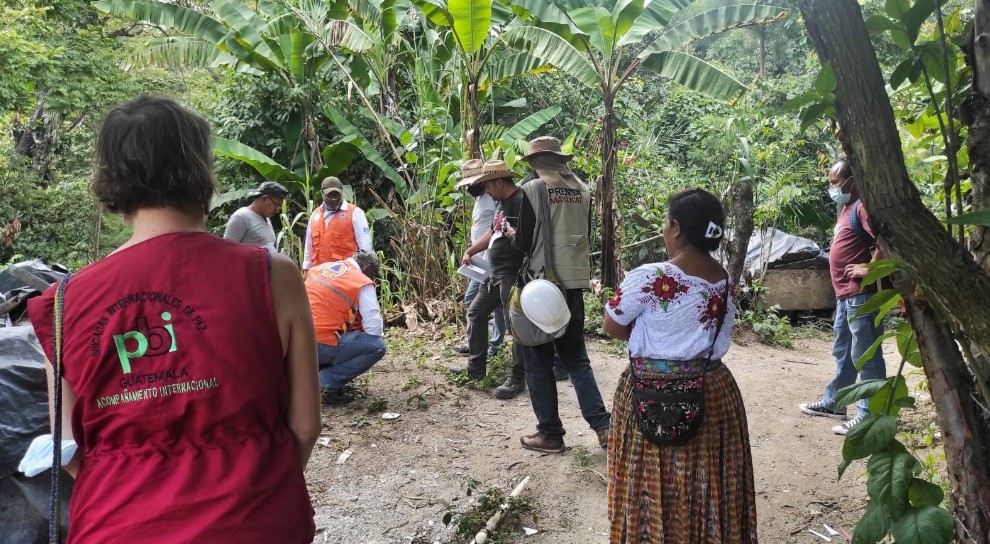
PBI-Guatemala accompanies Chinautla Multisector Urban Platform as CONRED verifies damage to homes from sand extraction

On August 5, PBI-Guatemala posted:

“PBI accompanies the multisectoral Chinautla, in the inspection by CONRED to verify damage to house structures caused by sand extraction in the region.”

CONRED (The National Coordination for Disaster Reduction/ Coordinadora Nacional para la Reducción de Desastres) is a Guatemalan government organization created to prevent disasters or reduce their impact on society, and coordinate disaster relief efforts.

On July 19, Con Criterio reported:

“The struggle of the Poqomam people of Santa Cruz, Chinautla, has been going on for decades. They have never received a response to their demands: to stop the extraction of sand that, according to them, destroys homes, hills and causes the migration of families to other municipalities to escape environmental degradation.

Chinautla is a municipality in Guatemala, located seven kilometers from the capital, it is estimated that 114,752 people live there. There, according to the records of the Ministry of Energy and Mines (MEN), six mining companies operate with authorization to extract sand and other materials. The neighbors, however, assure that there are more companies that extract behind their backs or with the consent of the municipal authorities.

The mining companies in Chinautla and registered with the MEN are these 6: La Presa, Arenera del Pino, San Fernando, El Manguito, La Primavera and San Luis, which have operated in that locality since 1996 and 2005. All have licenses for the manufacture stone, select, mud extraction, white sand and river.

Peace Brigades International (PBI), an entity that accompanies the civilian population for the resolution of conflicts, revealed through this report on its electronic portal that the sand extraction projects in that municipality have caused alterations in the course of the rivers and riverbanks, as well as respiratory diseases. The community most affected by extractive activities, according to the brigades, is Santa Cruz, Chinautla, because of 150 families that lived 500 meters from the sand pits, only 20 remain, the rest migrated to other places.

According to PBI, during the administration of former mayor Arnoldo Medrano between (between 1988 and 2015) the industrial extraction process was authorized with machinery and trucks from the capital, without consulting the affected communities.”

The full article can be read in Spanish at “La arenera se llevó todo, ya no podemos vivir en Chinautla”.

In May 2018, the Guatemalan newspaper Prensa Libre also reported that the extraction of sand from the channel of the Chinautla River and the confluence of the Tzaljá and Las Vacas tributaries, in an area where there are already geological faults, accelerates the cracking of walls and the sinking of some homes in the community.

Residents of Santa Cruz Chinautla have also denounced the degradation of the Chinautla River basin as eco-ethnocide against the Poqomam peoples.

The PBI-Guatemala Project has accompanied the Chinautla Multisector Urban Platform since December 2018.

Human rights organizations present President-elect Gustavo Petro with 29-point emergency plan to protect social leaders

Photo: PBI-Colombia accompanied CSPP president Franklin Castañeda on panel with President-elect Gustavo Petro, August 5, 2022.

On August 5, El Pais reported:

“On Friday afternoon, several human rights organizations presented President-elect Gustavo Petro with an emergency plan to protect the lives of social leaders and peace signatories.

During an event, representatives of the Agrarian Summit, the Colombian Human Rights Platform and the Somos Defensores Program presented to the president the central ideas of a strategy that is designed to be executed in the first 100 days of government, with 29 concrete actions for seven subregions and in 65 municipalities of the country.

The plan is supported by five senators and a representative to the Chamber of the Historical Pact, the coalition for which Petro was elected: Iván Cepeda Castro, Jahel Quiroga Carrillo, Gloria Flórez, Isabel Zuleta, Aida Avella, Pablo Catatumbo and Alirio Uribe.

During the presentation of the document, Franklin Castañeda, spokesman for the human rights platforms, thanked the new president for receiving his proposals. “We are very happy to have you this afternoon, Mr. President Petro, because to meet with Iván Duque we had to do many paperwork and bureaucratic procedures and he never listened to us,” he said.

For its operation, human rights defenders explain, the Government must form the National Commission for Security Guarantees, which should be created according to the Agreement with the FARC, but which has not yet been installed.

The strategy was built with technical assistance from the Office in Colombia of the United Nations High Commissioner for Human Rights, and in consultation with the UN Verification Mission.”

Red Mas adds:

“Where do those 65 municipalities come from? Well, in the last four years those 65 municipalities located in certain specific regions have presented the highest rates of homicides, forced disappearances and threats against the beneficiary population of this plan,” explains Franklin Castañeda, defender and president of the Committee of Solidarity with Political Prisoners.”

Video: Juliette De Rivero, the representative of the UN High Commissioner for Human Rights in Colombia, speaks at the media conference.

Furthermore, on Thursday (August 4), Mary Lawlor (the UN Special Rapporteur on the situation of human rights defenders), Francisco Cali Tzay (the UN Special Rapporteur on the rights of indigenous peoples) and members of the Working Group on Business and Human Rights also called on the incoming Petro government to step up protection for activists who challenge big business in Colombia.

Their media release draws attention to threatened Indigenous Misak land defender Pedro Jose Velasco Tumiña in relation to the Irish company Smurfit-Kappa that controls over 67,000 hectares in Colombia, mainly comprised of pine and eucalyptus plantations, for their paper packaging business.

The UN experts said:

“In order to ensure businesses respect human rights, the incoming Government should encourage companies to engage constructively with human rights defenders. Companies, for their part, should publicly state their willingness to do so, even if the defenders’ advocacy concerns the company’s own operations.”

While the UN experts highlight an Irish company, their recommendation could also apply to Canadian companies operating in Colombia.

Castañeda and the Committee of Solidarity with Political Prisoners (CSPP) accompany community leaders in San Luis de Palenque, Casanare who have been criminalized by the Toronto-based company Frontera Energy for raising concerns about the social and environmental impacts of their Cubiro Block oil operations.

PBI-Canada met with Castañeda on June 27 in Bogota and then travelled on July 1 to meet with the community along with PBI-Colombia, the CSPP and the Social Corporation for Community Advice and Training (COSPACC).

Photo: CSPP lawyer Reymundo Vásquez at community meeting in San Luis de Palenque, July 1, 2022.

Further reading: Photo-journal of 10-day PBI-Canada visit to frontline communities in Colombia.

PBI-Mexico at protest against Grupo México Buenavista del Cobre mine toxic spill into Bacanuchi and Sonora rivers

On August 5, PBI-Mexico tweeted:

“At PBI Mexico we express our concern about the possible impacts on the #environment within the framework of #megaprojects and we recall that [the United Nations] declared that access to a clean and healthy environment is a universal #human right.”

They further noted on Facebook:

“PBI Mexico was present at the peaceful protest of Cuenca Rio Sonora [Sonora River Basin], accompanied by PODER [the Project on Organizing, Development, Education, and Research] in their fight for respect for a healthy environment.”

On August 4, Des Informemonos reported:

“The company Grupo México remains unpunished eight years after the spill of 40 million liters of toxics from its Buenavista del Cobre mine in the Bacanuchi and Sonora rivers, denounced the Sonora River Basin Committees (CCRS).

Among the demands made by the communities to the authorities is a comprehensive and effective plan for justice and reparation, with an ecotoxicological, long-term perspective in terms of health, socio-environmental, and other rights affected by Grupo México, which considers the definitive installation of a specialty clinic and the installation of water treatment plants with the capacity to separate heavy metals in the communities that require it.

The defenders of the CCRS, together with the organization Project on Organization, Development, Education and Research (PODER), also called on the authorities to impose themselves and punish those responsible for the disaster, since “the debt to justice and for accountability to those responsible continues to increase.””

El Pais has also reported:

“Despite the environmental disaster, the federal government has allowed Grupo México to expand its mining operation with the construction of a new dam for its toxic waste, 23 kilometers from Bacanuchi, one of the towns most affected by pollution.

Throughout these years the inhabitants of the Sonora River have been winning battles.

“They took away our right to water and life, but we have learned to fight, to document ourselves and to follow,” says Elda León, from the [affected]  town of Banámichi.”

The articles can be read at Grupo México, impune a ocho años del derrame en río Sonora and Plomo en la sangre y pérdidas millonarias, la tragedia del río Sonora sigue sin resolverse.

PBI-Mexico also highlights the article: La Asamblea General de la ONU declara el acceso a un medio ambiente limpio y saludable, un derecho humano universal.

PBI-Kenya provides safety and security workshops in the lead up to the August 9 presidential election

An election will take place in Kenya this coming Tuesday August 9.

It is expected that 22.1 million registered Kenyans will go to the polls to elect the country’s fifth president and successor to the incumbent Uhuru Kenyatta.

The Peace Brigades International-Kenya Project has been providing workshops on safety and security in the lead-up to the vote.

On July 26, PBI-Kenya tweeted:

“Last week, we supported human rights defenders from Nairobi, Kisumu, Mombasa and Kakamega Social Justice Centre in assessing their safety and security situation, particularly during this election period. This activity enabled the HRDS [human rights defenders] to identify the risks. Based on these risks, they could identify security and safety needs/gaps, develop mitigation measures, and develop a security plan.”

On July 11, PBI-Kenya also tweeted:

“Last week, we supported the human rights defenders from Mombasa and Kilifi County Social Justice Centers in developing safety measures for their centers. This training aimed at enabling participants to assess their current safety as Kenya prepares for its general elections, establish safety and protection polices and protocols to be adapted in the running of centres during and after elections.”

Now, on August 5, the International Federation for Human Rights (FIDH) has posted:

“Despite the early warnings on the potential for an electoral crisis, and continued pledges by the government to address election-related sexual and gender-based violence (SGBV), the run-up to the 9 August election has been marred by violence targeting women. Several rapes have been recorded during the campaign period, including four cases following the failed Jacaranda campaign rally on 19 June 2022.”

FIDH adds:

“Women in politics have also faced aggressive sexist language, gender-based violence, gender stereotyping, online gendered abuse and sexual harassment — including sexual overtures as they were seeking party certificates to vie for leadership positions. These tactics deliberately prevent women politicians or candidates from participating in politics.”

On August 3, CIVICUS posted:

“According to the new research brief [by CIVICUS and the Kenya Human Rights Commission], Kenyan authorities have used excessive force to clamp down on protests and suppress dissent in the run-up to the election. Recent demonstrations to protest the rising cost of food under the hashtag #Njaa-Revolution (‘Hunger Revolution’) have been met with unlawful arrests, detention and brutal force; in April, human rights defender Julius Kamau was violently assaulted outside the National Treasury after protesting rising food prices.  Lethal and crowd control weapons such as live ammunition, teargas and rubber bullets are commonly used by police to disperse gatherings.”

They add:

“Attacks on freedom of speech extend to journalists. Incidents and violations against the press are on the rise ahead of elections, including the assault of two journalists covering an event at Raila Odinga’s party headquarters in March 2022. …The apparent political capture of the country’s media regulatory body has also contributed to a decline in press freedom.”

And on August 1, Human Rights Watch warned:

“The failure of Kenyan authorities to address accountability for past abuses by police heightens the risk of police abuse around the August 9, 2022, general elections, Human Rights Watch said today. Kenya has a history of election-related violence including excessive, unlawful use of force by police, with few, if any, police officers held to account.”

HRW adds:

“Victims’ families, activists, government officials, and police officers, have expressed concerns about possible violence if the August 9 presidential election results are disputed. In the aftermath of the 2017 elections, Human Rights Watch and other Kenyan and international human rights organizations documented killings by police and armed gangs, of 104 people, most of the victims being supporters of the then main opposition party, the National Super Alliance (NASA). With just seven days to another general election, Kenyan authorities have yet to take steps to ensure justice for police abuses that characterized the 2017 general elections, or to credibly investigate allegations that police are involved in recent extrajudicial killings.”

PBI established a project in Kenya in December 2012, to provide support and protection to human rights defenders during a period of expected heightened risk during the March 2013 presidential elections.

We continue to follow this situation.

PBI-Colombia facilitates protection workshop with the Colombia-Europe-United States Coordination network

On August 4, PBI-Colombia tweeted:

“PBI facilitated a #integral protection workshop with the @coeuropa [the Coordination Colombia-Europe-United States] in which human rights defenders from Tolima, Huila, Meta and Casanare participated. We appreciate the space for collective construction and shared learning.”

The Colombia-Europe-United States Coordination is a network of 285 social and human rights organizations.

As further noted on their website:

“The Coordination Colombia Europe United States CCEEU is a platform of human and social rights organizations, whose mandate is recognized as a collective actor of international and national advocacy, which through a political agenda of work seeks to contribute to the promotion, dissemination and defense of human rights with emphasis on civil and political rights, the fight against impunity, the observance of the social rule of law, the construction of peace and the search for a negotiated political solution to the armed conflict.”

PBI-Honduras facilitates workshop on security for human rights defenders at ‘Rights for All’ conference

On August 4, PBI-Honduras tweeted:

“We recently held a workshop with several Honduran human rights organizations. We thank CEM-H [Centre for Women’s Studies] for the invitation and the more than 20 organizations that participated.”

Among the organizations tagged in their tweet are the Progressive Care Center for Disability (CAPRODI), Alternative of Community and Environmentalist Reclamation of Honduras (ARCAH), Caritas (a Catholic development, aid and social services organization) and the National Human Rights Commissioner (CONADEH).

On July 27, CEM-H also posted:

“First day of the workshop Integral Security for Human Rights Defenders; participating more than 20 organizations defending common goods, Network OSC, members of the Local Boards of the MP -CONAPREV and CONADEH, facilitated by PBI; in the framework of the project “Inclusion, Governance and Restoration of Rights for All” and All of them.”

PBI-Colombia accompanies Nydia Erika Bautista Foundation and searchers and relatives of the disappeared in Meta

On August 3, PBI-Colombia tweeted:

“At the end of June, several women searchers and relatives of the disappeared, accompanied by @nydia_erika and PBI, visited the places where their loved ones were last seen and submitted reports.”

Along with that tweet, PBI-Colombia adds this article by team member Margherita Forni.

Forni writes:

“The river water crosses Sibao stream—located in the municipality of Granada in Meta—gently flowing as a father, accompanied by members of the Nydia Erika Bautista Foundation (FNEB), shows us where his son’s motorcycle was found. He was disappeared in 2017.

Under the strong afternoon sun, we visit the places where C was last seen and his father tells us about a call he received in 2019 when unidentified men told him that his son had been murdered and buried near the river.

Members of the Foundation meticulously mapped the streets and corners while we went to the river’s edge where C’s body could be found. His father told us that the vegetation had grown a lot in recent years, changing the landscape and making the search for his son more difficult.

The next day, on our way to Puerto Rico, we stopped to pick up Ms. P. She led us down a rural path, stopping in front of a rice field.

Her husband was disappeared about twenty years ago, accused of being a FARC-EP guerrilla. She scanned the rice field along the horizon as she also has an idea where her loved one’s body could be.

Members of the Foundation follow Ms. P’s indications, as she shook her head, lamenting not having taken photographs in the past. The rice field had not been there before and now orientation is more difficult.

These are just a couple of the stories from the families of victims of enforced disappearance, who participated in a workshop organized by the Nydia Erika Bautista Foundation, on 22 June in Villavicencio, the capital of Meta. Meta is one of the departments most affected by the crime of enforced disappearance.

PBI accompanied the event that was mainly focused on the right to truth, justice, and guarantees of non-repetition for relatives concerning their loved one’s enforced disappearance.

[Then] from June 23 to 25, several women “searchers” and other family members of disappeared people, accompanied by the FNEB team and PBI, visited the places where their loved ones were seen for the last time and where their bodies could be.

As these women told us, the difficulties they face in the search process go beyond the emotional emptiness left by enforced disappearance. There are practical challenges too. In fact, even if they can locate exactly where the body is and, even though there is a law that prioritizes exhumations, the remains often rest in locations where buildings have been constructed. The construction of homes or hospitals, or places and landscapes that change over the years, complicate and extend the exhumation process.”

The full article can be read at: “BRING THEM BACK ALIVE, BECAUSE THEY WERE TAKEN ALIVE”