Photo: The Canada-European Union Summit in Montreal, October 2026.
In his remarks at the conclusion of the two-day Canada-European Union summit in Montreal, Quebec this past October 29-30, Canadian Prime Minister Mark Carney stated that efforts and processes are already underway for Canada to become the first “associate member” of the European Union.
Carney highlighted near the top of his concluding comments: “This is about democracy” and “supporting human rights”.
The prime minister also stated: “Canada is already establishing itself as an energy supplier of choice for Europe. Thanks to new supply arrangements between Ksi Lisims [a proposed liquefied natural gas terminal to be fed by the Prince Rupert Gas Transmission pipeline], SEFE [a state-owned international energy company based in Berlin], and Uniper [a multinational energy company based in Düsseldorf], British Columbia’s low-carbon LNG will power homes and industries in Germany.”
LNG to Germany
In May 2026, the Canadian minister of energy stated: “Through this agreement [to secure liquefied natural gas offtake from Ksi Lisims LNG], SEFE will purchase 1 million tonnes per annum of LNG for up to 20 years, beginning in the early 2030s.”
In June 2026, Uniper also explained: “Ksi Lisims LNG and its feed pipeline PRGT have received key environmental approvals and have been identified as Projects of National Interest by the Government of Canada. Pending a Final Investment Decision by the project co-developers, construction could begin by early 2027. Uniper could start receiving first volumes of LNG as early as 2032.”
Final investment decisions
In late-October 2026, it was reported that Texas-based Western LNG, Rockies LNG and the Nisga’a Nation intend to make a final investment decision (FID) on the Ksi Lisims project “by the end of 2026”. And Hydrocarbon Processing reported in August 2026: “Pending a Final Investment Decision by the project co-developers, construction [on the PRGT pipeline] could begin by early 2027.”
Notably, Dogwood has highlighted that Blackstone Inc., a trillion-dollar Wall Street firm run by CEO Steve Schwarzman who has been an advisor to US President Donald Trump since 2016, is the biggest investor behind Western LNG.
Canada-EU meetings in 2027
While in Montreal, Prime Minister Carney also noted two Canada-European Union meetings in March and June 2027: “In March, we will convene the EU’s College of Commissioners and our federal Cabinet in Canada, to advance this work. And, in June, I have accepted President Costa’s invitation to attend the European Council meetings, where we intend to conclude these negotiations.”
The College of Commissioners is the executive branch of the EU. It consists of 27 members, one commissioner from each EU country, and is headed by the President of the European Commission, Ursula von der Leyen.
Indigenous resistance to PRGT
The proposed PRGT pipeline, up to 780 kilometres of it land-based and up to 120 kilometres underwater, could carry up to 3.6 billion cubic feet of fracked gas per day. It is expected that the pipeline would cross approximately 50 kilometres of Gitanyow territory and 120 kilometres of Gitxsan territory in northern British Columbia. Indigenous land defenders on these territories, along with Wet’suwet’en land defenders, have expressed their opposition to this pipeline.
In June 2025, PBI-Canada and PBI-Colombia visited Gitanyow territory and learned about the opposition to PRGT.
In October 2025, we met with Gitanyow Hereditary Chief Watahayetsxw (Deborah Good) in Smithers, British Columbia.
In November 2025, Hereditary Chief Watahayetsxw vowed to establish a blockade on her territory in northern British Columbia after Prime Minister Carney announced his support for the Ksi Lisims LNG export terminal.
At that time, Watahayetsxw stated: “I’ll keep fighting, I’m not going to stop because to me it’s clean air and the health of my great-grandchildren. …I’m going back on the ground. Whether I’m in two feet of snow, ten feet of snow, it doesn’t matter. I’m going back on the ground. …I’m blockading because there is not one level of government whether it be British Columbia or Canada that has come to talk to me. I did not give permission, I did not give consent for them to be here.”
International mechanisms
The Secretariat of the Convention on Biological Diversity, the main administrative body of the United Nations Convention on Biological Diversity, is based in Montreal (413 Saint-Jacques Street, Suite 800).
Target 22 of the Kunming-Montreal Global Biodiversity Framework (part of the UN Convention on Biological Diversity) pledges to “ensure the full protection of environmental human rights defenders”.
The European Union Delegation to Canada (run by the European Commission) has had an office in Ottawa since 1976. In September 2026, the European Parliament announced it “will open an antenna office in Ottawa to further strengthen parliamentary relations between the European Union and Canada”. The same month, the Euro-Latin American Parliamentary Assembly (EuroLat) and 39 organizations, including Peace Brigades International, signed an open letter calling for greater safeguards in EU-backed investments to prevent human rights violations.
Safety and security of Indigenous land defenders
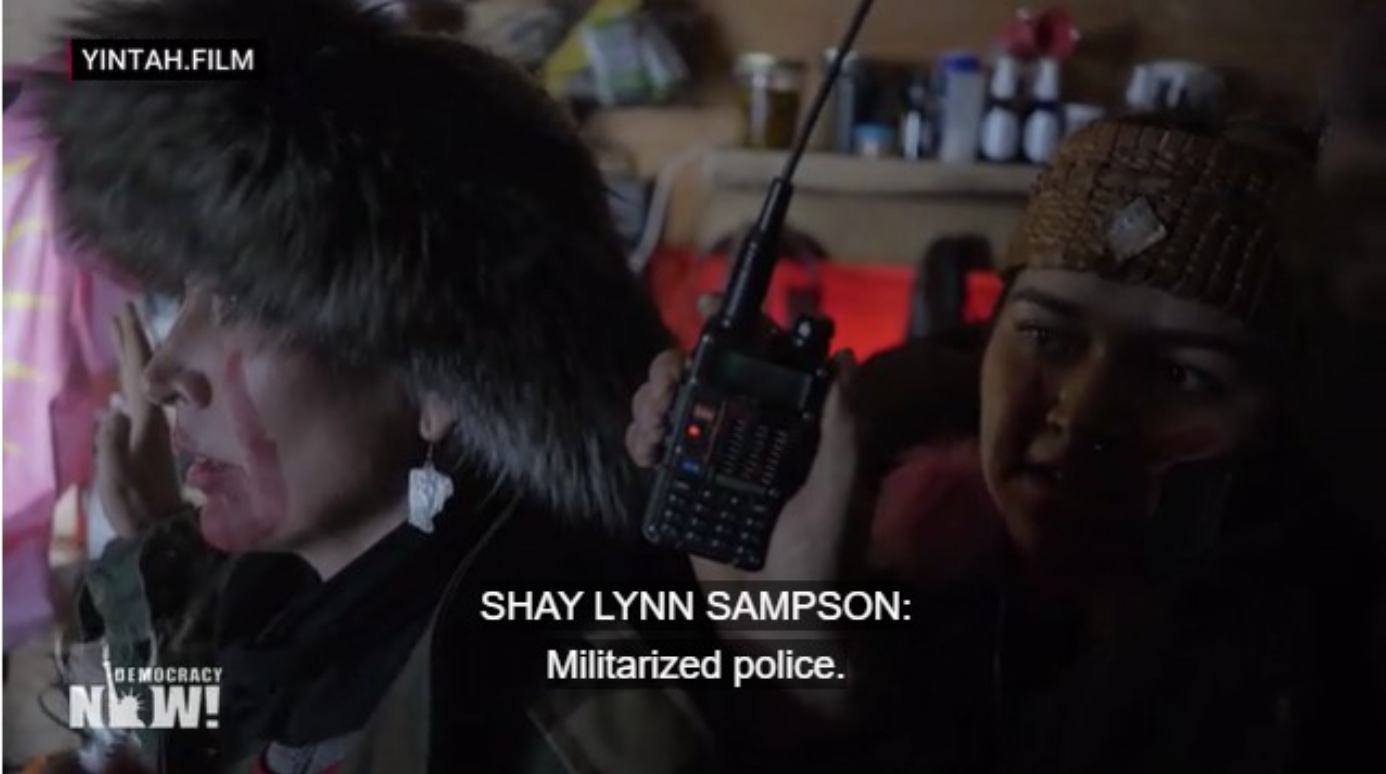
At PBI-Canada we are concerned about the use of court injunctions against the Constitutional rights of the Gitanyow, as well as the potential for militarized raids by the Royal Canadian Mounted Police (RCMP) Critical Response Unit-British Columbia (CRU-BC) as seen on Wet’suwet’en territory in 2019, 2020 and 2021.
Those raids have been the subject of a systemic investigation by the Ottawa-based Civilian Review and Complaints Commission (CRCC). They also drew the attention of the Geneva, Switzerland-based United Nations Committee on the Elimination of Racial Discrimination (CERD) that issued three letters of concern to the Canadian government.
We are also concerned with the implications of “critical minerals, defence production, energy supply” noted in the Canadian government’s “national security” plan announced in late-October 2026.
The Government of Canada lists the Ksi Lisims LNG terminal and associated PRGT pipeline as a “major project”.
The “National Security for Canadians” plan pledges to “Strengthen Canada’s resilience with a comprehensive, all-threats approach to securing critical infrastructure, including government-supported major projects”.
We continue to follow this.
Additional reading: PBI-Canada seeks to strengthen the accompaniment of human rights defenders with the European Parliament office in Ottawa (September 15, 2026).
Video: “Dramatic Video Shows Militarized Canadian Police Raid Wet’suwet’en Land Defenders & Journalists” on November 19, 2021 (Democracy Now!).