Home Blog Page 219

PBI-Colombia accompanies CREDHOS at meeting with the National Union of Agricultural Industry Workers

On July 25, CREDHOS tweeted:

“Today a meeting was held between #CREDHOS and members of @SINTRAINAGRO [National Union of Agricultural Industry Workers] to analyze the human rights situation in the Puente Sogamoso District of the Municipality of Puerto Wilches, #35 years of defending life.”

The Peace Brigades International-Colombia Project has accompanied the Regional Corporation for the Defence of Human Rights (CREDHOS) since 1994.

PBI-Colombia accompanies FEDEPESAN, CREDHOS and CAHUCOPANA at meeting in Barrancabermeja with Canadian Embassy

On July 25, PBI-Colombia tweeted:

“Visit from @rolar116 [Canadian foreign service officer Robin Larocque Roy], @CanadayColombia [the Embassy of Canada in Colombia] with @CAHUCOPANA [the Humanitarian Action Corporation for Coexistence and Peace in Northeast Antioquia], @Credhos_Paz [the Regional Corporation for the Defence of Human Rights], and FEDEPESAN [the Federation of Santander Fishers for Tourism and Environment] in #Barrancabermeja in which they exposed the serious security situation #NordesteAntioqueño #MagdalenaMedio and the responsibility of companies in increasing the risks of defenders #human rights and environmentalists.”

Following that meeting, the Canadian Embassy tweeted:

“In #Barrancabermeja , we met with @PBIColombia, @CAHUCOPANA, @Credhos_Paz and Fedepesan to talk about the difficult security situation in #MagdalenaMedio. We must protect the leaders and guarantee free and safe movement in the territories.”

In the photo above, Canadian Embassy official Robin Larocque Roy is standing beside Yuli Velasquez, president of FEDEPESAN.

In this Urgent Action, Amnesty International is calling for strengthened protection for Yuli Velásquez and other defenders of FEDEPESAN.

They highlight: “On July 5, two unknown persons approached Yuli on a motorcycle and opened fire. Yuli managed to take cover but the bodyguard granted to her by the National Protection Unit, following previous threats to her life, was shot.”

On June 30, just days before that attack, Yuli guided CREDHOS, PBI-Colombia and PBI-Canada on a tour of the environmental impacts on the San Silvestre wetland.

When Yuli participated in a PBI-Canada webinar on April 29, 2021, she said: “We are working hard to stop fracking. Pollution will impact future generations. As fisherpeople we are impacted by water pollution. We can’t allow corporations and contractors to come in and affect the well-being of our communities.”

She added: “We have faced various threats and assassination attempts, but we will continue working and contributing to the protection of the environment.”

We continue to follow this with great concern.

PBI-Mexico observes Regional Forum on General Law of Prevention and Protection for human rights defenders and journalists

On July 19, PBI-Mexico tweeted:

“Today in #Chihuahua begins the ninth dialogue for the discussion on the General Law of Prevention and Protection against Offenses to Defenders of #human rights and #journalists. PBI is present with other civil society representatives who demand better #protection.”

Then on July 20, PBI-Mexico tweeted:

“PBI observes the second day of the Regional Forum #Chihuahua on the General Law of Prevention and Protection against offenses against human rights defenders of #human rights and #journalists. It continues to follow up on the requests and reflections of the organizations it accompanies in the state.”

PBI-Mexico has previously explained that a Protection Mechanism was created for journalists in Autumn 2010.

Later, the Law for the Protection of Human Rights Defenders and Journalists was signed into law in June 2012. That law obliges both federal and state authorities to protect the rights of journalists and human rights defenders.

In March 2020, PBI-Mexico commented “the Mechanism continues to demonstrate notable deficiencies and concerning failures.”

The year before that, PBI also highlighted: “The Mechanism can’t possibly address its shortcomings with its current budget and staffing levels. Providing additional funding would be the first step the Mexican government can take to ensure the Mechanism has the resources necessary to manage its rapidly growing caseload.”

On June 29, Al Jazeera reported that Antonio de la Cruz had been killed and that he was “the 12th Mexican journalist murdered this year amid rising violence against members of the press.”

That article adds: “More than 150 journalists have been killed since 2000.”

In February, Front Line Defenders documented that 42 human rights defenders had been killed in 2021 in Mexico.

For more, please see the report Turning the Tide on Impunity: Protection and Access to Justice for Journalists and Human Rights Defenders in Mexico.


PBI-Guatemala accompanies Poqomam resistance to sand extraction that impacts the environment and community

On July 18, PBI-Guatemala posted:

“PBI accompanies the Multisectoral Chinautla to the Dialogue Table between people belonging to the community, transporters of the La Primavera sand and the San Luis quarry and the PDH [Human Rights Ombudsman]. The St. Louis operation license expired on June 25 of this year, which is why the community is demanding a cessation of its activities in accordance with the law.”

Just a few days earlier, on July 15, PBI-Guatemala had also posted:

“Yesterday, PBI accompanied the multisectoral Chinautla in its resistance against the sand companies operating in the region and have left damage to the environment and the population.”

And on July 19, Con Criterio reported:

“The struggle of the Poqomam people of Santa Cruz, Chinautla, has been going on for decades. They have never received a response to their demands: to stop the extraction of sand that, according to them, destroys homes, hills and causes the migration of families to other municipalities to escape environmental degradation.

Chinautla is a municipality in Guatemala, located seven kilometers from the capital, it is estimated that 114,752 people live there. There, according to the records of the Ministry of Energy and Mines (MEN), six mining companies operate with authorization to extract sand and other materials. The neighbors, however, assure that there are more companies that extract behind their backs or with the consent of the municipal authorities.

Over the weekend, the problem intensified when the drivers of the trucks that extract sand from the La Primavera and San Luis projects clashed with indigenous leaders and neighbors who were blocking the road. The PNC [National Civil Police] mediated between both groups.

Photo: The resistance of the Poqomam Mayan people of Chinautla, was installed on June 27 two days after the extraction license of Piedrinera San Luis had expired. Photo by Simón Antonio.

The mining companies in Chinautla and registered with the MEN are these 6: La Presa, Arenera del Pino, San Fernando, El Manguito, La Primavera and San Luis, which have operated in that locality since 1996 and 2005. All have licenses for the manufacture stone, select, mud extraction, white sand and river.

Peace Brigades International (PBI), an entity that accompanies the civilian population for the resolution of conflicts, revealed through this report on its electronic portal that the sand extraction projects in that municipality have caused alterations in the course of the rivers and riverbanks, as well as respiratory diseases. The community most affected by extractive activities, according to the brigades, is Santa Cruz, Chinautla, because of 150 families that lived 500 meters from the sand pits, only 20 remain, the rest migrated to other places.

According to PBI, during the administration of former mayor Arnoldo Medrano between (between 1988 and 2015) the industrial extraction process was authorized with machinery and trucks from the capital, without consulting the affected communities.”

The full article can be read in Spanish at “La arenera se llevó todo, ya no podemos vivir en Chinautla”.

The PBI-Guatemala Project has accompanied the Chinautla Multisector Urban Platform since December 2018.

Recent news articles on this situation include:

Serious damage portrays the illegal operation of mining companies in Chinautla (July 27)

Communities in Chinautla continue to resist sandpits (July 25)

Community members receive death threats from mining entrepreneur in Chinautla (July 22)

Chinautla communities suspend resistance, but do not stop the defense of the territory (July 20)

Two sand companies with expired licenses continue to operate in Chinautla (July 18)

In Chinautla sand companies do not have a license extension (July 11)

In Chinautla sand companies do not have a license extension (July 8)

PBI-Guatemala accompanies David Maxena, Poqomchi’ defender of land and territory, at court hearing

On July 18, PBI-Guatemala posted:

“PBI accompanies UVOC in the hearing of the opening debate in the case of David Maxena, defender of land and territory.”

UVOC has previously posted: “Months in prison without committing any crime. Since February 14 of this year, the Mayan Poqomchi’ community leader David Alejandro Maxena Caal, defender of human rights and mother land, was detained.”

UVOC adds: “The Santa Teresa Hydroelectric and the Shintun Agriculture S.A. municipality of San Miguel Tucuru, are the main plaintiffs against the communities that were stripped of their land that was an ancestral belonging to them.”

In January 2017, Avispa Midia explained: “In the case of the Santa Teresa hydroelectric plant, it belongs to the company Agro Comercializadora del Polochic, SA (AGROPOLOCHIC), a member of the CM [Corporacion Multi Inversiones] consortium.”

That article adds: “EGI Guatemala was involved in the construction of the Santa Teresa hydroelectric plant, located in the Polochic region, in the municipality of Tucurú, which is owned by the Agropolochic company, a member of the CM group.”

It further notes that EGI Guatemala is the main subsidiary of ENEL in Guatemala, which owns the El Canada hydroelectric dam. That dam has been described as a “controversial carbon finance project”.

The Santa Teresa dam is situated on the Polochic River, which discharges 70 per cent of the total freshwater input to Lake Izabal.

The Peace Brigades International-Guatemala Project has accompanied the Union of Verapaz Campesino Organizations (UVOC) since 2005.

PBI-Guatemala accompanies Chinautla Multisectoral resistance to sand companies damaging the environment and community

On July 15, PBI-Guatemala posted: “Yesterday, PBI accompanied the multisectoral Chinautla in its resistance against the sand companies operating in the region and have left damage to the environment and the population.”

The Chinautla Multisector Urban Platform advocates for the human right to water to be respected and raises concerns about the nearby resource (sand) extraction that endangers homes and a massive garbage dump that pollutes water.

PBI-Guatemala has previously explained, “Since 1989, the Chinautla Multisector Urban Platform has defended its right to be consulted on the projects of several sand companies operating in its territory.”

It adds, “The region has been a sand area for decades, but it was in 1995 when large-scale sand extraction began with heavy machinery” with major consequences.

In May 2018, the Guatemalan newspaper Prensa Libre reported that the extraction of sand from the channel of the Chinautla River and the confluence of the Tzaljá and Las Vacas tributaries, in an area where there are already geological faults, accelerates the cracking of walls and the sinking of some homes in the community.

Chinautla Multisector Urban Platform member Martín Catalán has stated that the group had called for the extraction of the sand to be moderated to stop the erosion of the soil, but that their proposals were not taken into account by local authorities.

Prensa Libre has also noted that the residents of Santa Cruz Chinautla are additionally impacted because during rainy season the floods from three rivers drag trash from (the dump in zone 3 in) Guatemala City into their community.

The Urban Platform proposal is to “Create a water law and government and municipal agreements that guarantee community and indigenous peoples’ participation to guarantee equal rights to water” within a two-year period.

The PBI-Guatemala Project has accompanied the Chinautla Multisector Urban Platform since December 2018.

PBI-Honduras observes meeting on violence against LGBTI+ community, women, Afro-descendants and other vulnerable groups

On July 13, PBI-Honduras tweeted: “[PBI] recently observed a meeting of the Municipal Political Technical Committee against Discrimination. At PBI we celebrate the realization of spaces focused on eradicating violence and discrimination in Honduras.”

On Facebook they further noted: “At the meeting worked on a proposal that will seek to eliminate violence and discrimination against vulnerable groups such as, for example, the LGBTI+ community, people of Afro-descendants, women, migrants, people with disabilities city, among others.”

This recent PBI-Honduras report on human rights in Honduras highlights:

– “Since the coup d’état, discrimination and unequal treatment towards the LGBTI+ community in Honduras have increased. These patterns are reflected in legislative rollbacks to the rights of the LGBTI+ community and in acts of violence. From 2009 to March 2022, at least 409 members of the LGBTI+ community were killed in Honduras. According to Sin Violencia LGTBI, a network of Latin American LGBTI+ organisations, during this time Honduras became one of the most dangerous countries in the world in which to be LGBTI+, alongside Mexico and Colombia”

– “According to data from the Women’s Rights Centre (Centro de Derechos de la Mujer – CDM), at least 342 women were killed in Honduras in 2021. This amounts to one femicide every 28 hours, and an increase of 23% over the 278 femicides recorded in 2020.53 With a femicide rate of 6.2 killings per 100,000 women, Honduras is the most dangerous country in Latin America for women. Over 95% of these cases remain in impunity.”

– “Due to the location of their ancestral lands, the Garífuna, an afro-indigenous people, have been severely impacted by extractivism through the installation of tourism projects and the numerous ensuing socio-environmental conflicts.”

The report calls on the international community to: “Support the approval of the Equality and Equity Law, a draft law designed in conjunction with several organisations representing marginalised sectors of the population, such as the LGBTI+ community, indigenous and afro-descendant peoples, and people living with disabilities.”

We continue to follow this situation.

Toronto-based Brookfield owns Colombia’s fourth-largest dam that impacts artisanal fishers and the San Silvestre wetland

Photo: CREDHOS president Ivan Madero along with Andrea Nocove and Julia Figueroa from CCALCP outside the Brookfield office in Toronto, Canada during a Peace Brigades International-organized advocacy tour in November 2019.

Mongabay reports: “In La Playa, a fishing village of around 500 people in Santander, Colombia, well-kept houses and vibrant murals live in the shadow of el monstruo — the locals’ nickname for the Hidrosogamoso Dam, a mega project that has challenged local livelihoods and triggered a wave of activism.”

The article explains: “Operating since 2014 on the Sogamoso River, Hidrosogamoso is Colombia’s fourth-largest hydroelectric dam. But ISAGEN, the company that built the dam more than a decade ago, now owned by multinational Brookfield Asset Management, failed to consult the community and address concerns about the project’s social and environmental costs, according to local sources.”

“Hidrosogamoso’s reservoir, Topocoro, replaced about 7,000 hectares (17,300 acres) of forest and cropland, causing deforestation and loss of habitat and aquatic species diversity. More than 1,000 people had to relocate, while the livelihoods of those relying on the river for fishing, small-scale mining, and subsistence agriculture suffered, according to Colombia’s Ombudsman’s Office and local NGOs.”

“Over a recent video call, four women from the Ríos Vivos movement told Mongabay that the local community continues to feel the long-term impacts of the dam, while also being threatened by pilot fracking projects in the area.”

The full article by Jane K. Feeney can be read at Displaced by a dam, women defenders fight for their land rights in Colombia.

Brookfield Asset Management

In January 2016, Toronto-based Brookfield bought a majority share (57.6 per cent) in the Colombian power generation and distribution company Isagen.

One of the dams Brookfield bought through its majority share in Isagen is the Sogamoso Hydroelectric Dam which is located 30 kilometres west of Bucaramanga.

Between 2009 and 2014, six activists were killed and many more were disappeared in relation to their opposition to the Sogamoso dam.

In March 2020, El Espectador published this article titled Community denounces fish and bird deaths in Barrancabermeja.

That article notes: “The fishermen of the San Silvestre spout, in Santander, denounce that since the middle of February there is a fish mortality in the place. According to them, this emergency is due to the fact that Isagen, a company in charge of the Sogamoso dam, opened the floodgates to feed the river that bears the same name.”

PBI-Canada visits the San Silvestre wetland

On the morning of Thursday June 30, PBI-Canada visited the San Silvestre wetland ecosystem in Barrancabermeja with Federation of Santander Fishers for Tourism and Environment (FEDEPESAN) president Yuli Velasquez, CREDHOS and PBI-Colombia and witnessed the impacts of Ecopetrol and large-scale agribusiness (buffalos and palm) on the water, wildlife and livelihoods of artisanal fishers.

On the afternoon of Tuesday July 5, we learned that Yuli had experienced an armed attack and that her guard had been shot.

On July 13, PBI-Colombia accompanied a mobilization by FEDEPESAN and CREDHOS in defence of life, water and the environment.

The CREDHOS-FEDEPESAN joint statement released that day highlights: “We recognize that the protection and conservation of our bodies of water is not only guarantee for the welfare of the artisanal fishermen, but also for the good living of entire communities that take advantage of its ecosystem services.”

They also highlighted: “The frequent presence of crude oil in Caño Rosario, a tributary of the San Silvestre swamp, product of the industrial activities of ECOPETROL. Similar situation occurs in the Guadualito swamp and in other areas of the swampy complex.”

Canadian financing impacts San Silvestre

The Banking on Climate Chaos website reveals Scotiabank’s investments in Ecopetrol. Scotiabank provided USD $665 million to Ecopetrol in 2018, another $666.67 million in 2020, and $1.7 billion in 2021 for a total of $3.0 billion in financing.

Bronwen Tucker of Oil Change International also shared on a recent PBI-Canada organized webinar this slide of the top recipients of Export Development Canada financing in Colombia between 2012 and 2020.

In May of this year, Al Jazeera reported: “Local environmental defenders and a representative of the JEP [Special Jurisdiction for Peace] told Al Jazeera that they suspected a connection between the paramilitary groups intimidating them and the state-owned Ecopetrol, which is behind the fracking project. …The company has been accused of having ties with the Gulf Clan [AGC] specifically.”

Infobae also recently reported: “In the testimony, [Dairo Antonio Úsuga David, alias Otoniel] spoke of an alleged link of the armed group [the Gulf Clan/AGC] with a director of the Regional Autonomous Corporation of Orinoquía, as well as contributions they received from the company Ecopetrol. According to the cited media [El Espectador], the oil company gave the group monthly contributions of 75 million pesos in exchange for providing security in two wells in the same department. He also revealed that he had allegedly traveled with them and that he could even use those aircraft to move members of the gang.”

We continue to follow this situation.

PBI-Mexico co-organizes regional meeting with human rights defenders and journalists in Monterrey, Nuevo Leon

On July 11, Casa del Migrante Saltillo tweeted: “This weekend, human rights defenders and journalists from northern Mexico are reflecting on what should be included in a comprehensive public policy for our protection. It was a pleasure meeting you again.”

Espacio OSC also tweeted: “Days past we held a meeting with human rights defenders and journalists from the north of the country to strengthen alliances and exchange protection strategies for the right to defend and freedom of expression.”

Now, Debate further reports: “A clear trend of stigmatization and smear campaigns stand out as patterns of violence against human rights defenders and journalists in the northern states of Mexico.”

“[A regional meeting], that took place in Monterrey, Nuevo Leon, with two participants from Sinaloa, was held within the framework of a generation of a public policy of comprehensive protection for human rights defenders and journalists.”

The article further notes: “The organizers were Casa del Migrante Saltillo, Cimac, Article 19 and Peace Brigades International, who promoted in this project a discussion and reflection on the challenges faced by journalists and human rights defenders, and the demand that must be made to the state so that, beyond the mechanism, safe environments are guaranteed to be able to carry out our work.”

The full article can be read at Articulan agenda en favor de periodistas y defensores derechos humanos.

Researching the sale of Canadian military goods to the Colombian military in relation to human rights violations

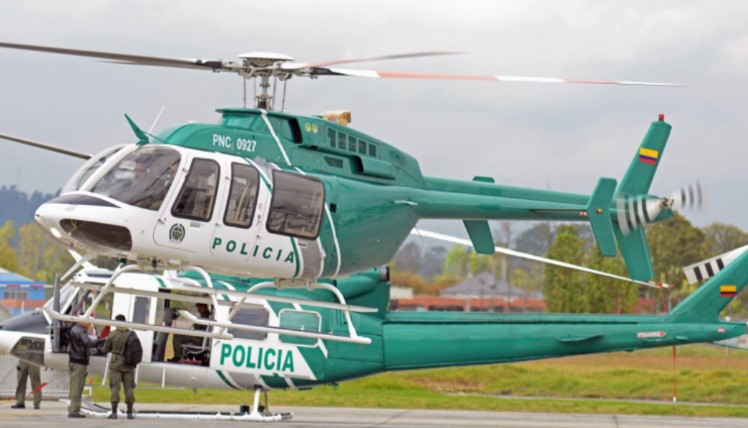
Photo: On November 20, 2019, Semana reported that the Bell 407 Halcón (Falcon) helicopter would be used by the National Police to monitor National Strike protests in Bogotá with high resolution cameras with facial recognition technology.

Peace Brigades International-Canada is working with Research for the Front Lines to better understand the approval process, sale and use of Canadian-manufactured armoured vehicles and other “military goods” to the Colombian military.

We are specifically looking into the possible use of Canadian-manufactured military goods – including INKAS and GDLS armoured vehicles and Bell 407 surveillance helicopters – against the social protests/national strike that took place in Colombia from 2019 to 2021.

This includes the issue of “substantial risk”. As Global News has reported: “According to Canadian law, Ottawa is required to deny export permits ‘if there is a substantial risk that the export would result in a serious violation of human rights.’”

To begin this process, we have looked at the example of the sale of Canadian-manufactured Light Armoured Vehicles (LAVs) to Saudi Arabia.

Following the murder of journalist Jamal Khashoggi on October 2, 2018, at the Saudi consulate in Istanbul, Canada’s Minister of Foreign Affairs announced in November 2018 that Global Affairs Canada would conduct a review of arms exports to Saudi Arabia.

Notably, the review looked at whether the armoured vehicles had been used to suppress an uprising and in human rights abuses.

As the CBC reported: “A review that examined whether the Saudis had violated the terms of the 2014 contract by using the armoured vehicles to suppress an uprising in the eastern part of the country, and in combat in Yemen, was carried out for over a year by the Liberal government. It found no evidence that Canadian-made equipment was used in alleged human rights abuses.”

By April 2020, the Government of Canada published its Final Report: Review of export permits to Saudi Arabia.

It found that the export of armoured vehicles to Saudi Arabia posed “no substantial risk” of facilitating any of the “negative consequences” referred to in subsection 7.3(1) of the Export and Import Permits Act (EIPA).

That subsection refers to whether the exported military goods “could be used to commit or facilitate … a serious violation of international human rights law” among other considerations such as “serious acts of gender-based violence or serious acts of violence against women and children.”

Following that report, the suspension on new export permits to Saudi Arabia was lifted and the Canadian government announced that permits would be reviewed on a case-by-case basis.

The National Post has also reported: “Canadian weapons manufacturers need government-issued export permits to sell “controlled goods” — which can include anything from sniper rifles to military-grade body armour — outside the country. When a manufacturer reaches a deal to sell such goods, Global Affairs Canada sometimes conducts a “consultation,” or review, that is supposed to be completed within 40 days.”

While a review is reportedly conducted “sometimes” prior to a sale of military goods, follow-up after the sale appears sparse.

The Ottawa Citizen has reported: “The Ottawa-based CCC [Canadian Commercial Corporation], which helps Canadian exporters get contracts with foreign governments acknowledges  it conducts no follow-up to ensure exported Canadian-built equipment isn’t being used to abuse human rights.”

When asked specifically about Colombia by Radio Canada International, Global Affairs Canada spokesperson Jason Jung commented: “Canada is monitoring developments in Colombia and will take appropriate action if credible evidence of the inappropriate use of any controlled Canadian product or technology is identified, including to perpetrate or facilitate serious violations of international human rights law.”

What does that monitoring include?

In an email obtained by Peace Brigades International-Canada through an Access to Information request, Global Affairs Canada states: “Officials from BGOTA [the Embassy of Canada in Colombia] asked the Colombian National Police (CNP) whether these armoured vehicles were being used in response to the social protests that began in late April. CNP officials responded that no Canadian armoured vehicle was being used for such a purpose.”

As such, Canada appears to have been to ask the police – implicated in human rights violations against the social protests – if they had used Canadian-made vehicles in that repression and then accepted their response without additional scrutiny.

The questions that emerge from this brief review include:

1- Did the terms of the contracts with Colombia note a prohibition on internal repression as the contract with Saudi Arabia may have included?

2- What was the review process for these sales?

3- Did the sales of military goods to Colombia include a “consultation” or review within a 40-day period? If so, were any concerns flagged?

4- Was the Colombian military’s role in the falso positivo killings of 6,402 civilians between 2002 and 2008 noted in any reviews that may have been conducted? (Maclean’s magazine reported on this as early as August 2010, prior to the sale the armoured vehicles and helicopters.)

5- Are there any requirements on the part of the Canadian Commercial Corporation or Global Affairs Canada for independent verification if there are concerns that Canadian-manufactured military goods have been involved in human rights violations?

6- Following the concerns expressed about arms sales to Colombia by numerous entities including the NDP, has Canada taken any additional steps in reviewing its sales to Colombia (including the reported sale of 50 more GDLS LAVs to Colombia)?

With Research for the Front Lines, we continue to seek the information to help answer to these questions.

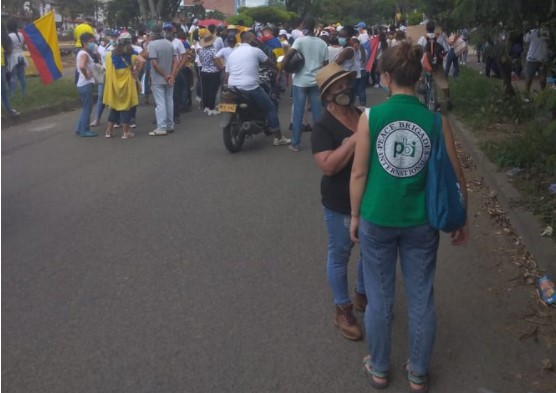
Photo: On May 8, 2021, PBI-Colombia accompanied Berenice Celeita of the Association for Social Research and Action (NOMADESC) at a mobilization of mothers and women in the city of Cali in opposition to the murders of young people by the police and other armed actors during the national strike social protests.