Home Blog Page 91

PBI-Guatemala accompanies the CCR as it meets with ASOGRIPEZDICH fishers to defend together the right to water

PBI-Guatemala has posted: “Yesterday [June 30], #PBIaccompanies the Board of Directors of the Council of Communities of Retalhuleu (CCR) to the meeting with the Association of Farmers and Fishermen Integral of Champerico (Asogripezdich), a new association that since a few months ago joined the Council to defend together the right to water.”

The right to water in Guatemala has been impacted by multiple threats, including shrimp farming and sugar plantations.

Shrimp farming

Back in March 2021, we noted that six fishers had been criminalized since 2015 by the shrimp company, Pesca Nova S.A.

The Bufete para Pueblos Indígenas explained: “This is due to their exercise in defence of a healthy environment and for having denounced the contamination that this shrimp company was doing in the estuaries from which the families were supplied.”

UDEFEGUA further explains: “[The fishers] demanded intervention from MAGA [the Ministry of Agriculture, Livestock and Food] and MARN [Ministry of Environment and Natural Resources] due to contamination and ecocide in the Champerico estuary by the [Pesca Nova S.A.] company.”

The World Rainforest Movement has also noted: “Fisherfolk have seen their traditional fishing grounds threatened by the intrusive moves of the company which has also polluted the estuaries, logged mangroves to build industrial shrimp ponds, provoked the death of hundreds of fish, and repressed and intimidated fisherfolk.”

Historically, the Food and Agriculture Organization of the United Nations has noted: “According to their value, the Guatemalan shrimp exports in 2003 were distributed as follows: United States, 54 percent; Europe (Spain and France), 44 percent; other, 2 percent.”

Additional research is required to know the current markets for Guatemalan shrimp exports.

Sugar plantations

Simon Granovsky-Larsen, an Assistant Professor of Politics and International Studies at the University of Regina has written about resistance to sugarcane plantations in Renewable energy and the fight over Guatemalan rivers (Down To Earth, September 2018).

Granovsky-Larsen notes: “Due to a shortage of water, plantations have begun ‘stealing’ water, in the words of people from surrounding communities: diverting river routes, mechanically extracting river water and drilling deep wells.”

PBI-Guatemala has noted: “The CCR began to organize in 2015 as a result of adverse effects caused by the expansion of the monoculture of sugar and the use of large-scale agrochemicals and pesticides used by the mills in the region.” Four members of the CCR have been criminalized since November 2019 due to their advocacy. It was not until May 30, 2023, that they were fully acquitted.

Canada

Between 2015 and 2022, Canada imported 1.46 million metric tons of sugar from Guatemala. The sugarcane crop system in Guatemala requires about 100 cubic meters of water per ton. That would suggest that the sugar exported to Canada since 2015 has required 146 million cubic meters of water.

In 2023, Canada continued to be one of the largest importers of unrefined sugar from Guatemala. That sugar is transported to the Lantic/Rogers refinery in Vancouver and the Redpath refinery in Toronto.

Source: United States Department of Agriculture, April 1, 2024.

If Canada imports shrimp from Guatemala, the amounts may be small.

Fisheries and Oceans Canada has noted: “Top suppliers of fish and seafood to Canada [in 2021] were the United States ($1.67B), China ($520M) and Vietnam ($314M), accounting for 54 percent of Canada’s total fish and seafood import value.” More specifically, Agribank has explained: “India, Vietnam, Thailand, China and Ecuador are respectively the largest shrimp suppliers to Canada.”

And while it does not appear that Canadian companies are involved in shrimp farming in Guatemala, The Chronicle Herald reported in 2019: “[Saint John-based] Cooke Inc. says it has acquired Seajoy Seafood Corp., which farms shrimp in Honduras and Nicaragua.”

We continue to follow this.

Further reading: Pacific Coast Communities Confront Shrimp Farm Threat (NACLA, September 25, 2007) and Guatemala’s sugar cartel (El Faro, April 2017).

PBI-Kenya meets with survivors of National Police Service violence at protest against proposed nuclear power plant in Uyombo

The Peace Brigades International-Kenya Project has posted: “We met survivors of police brutality from the anti-nuclear plant protest in Uyombo. They shared heartbreaking stories of how @NPSOfficial_KE [National Police Service-Kenya] metre’s violence against them as they sought to be heard. We urge the govt to heed their calls and @IPOA_KE [Independent Policing Oversight Authority] to investigate the incident.”

That same day, PBI-Kenya also posted: “We held a meeting with @CJGEA_Kenya [Center for Justice Governance and Environmental Action-Kenya] discussing the risks of a proposed nuclear power plant in Uyombo, Kilifi County. We covered environmental threats, public health concerns, lack of remediation policies, and potential security issues. Community input and safety must come first.”

The Guardian has reported: “The proposals [for nuclear power plants in Kenya] have sparked fierce opposition in Kilifi. In a building by Mida Creek, a swampy bayou known for its birdlife and mangrove forests, more than a dozen conservation and rights groups meet regularly to discuss the proposed plant.”

The Guardian also notes: “Tensions between anti-nuclear activists and the government are growing. The UN special rapporteur on human rights defenders, Mary Lawlor, expressed concern [in this tweet] over police violence against people in Uyombo, a potential plant site, during a protest [on May 21]. Activists said their peaceful protest was met with excessive violence, beatings, arrests and intimidation.”

Right Livelihood further explains: “Police in Uyombo, Kenya, fired 137 live rounds and 70 tear gas canisters near a group of peaceful protestors and arrested two environmental defenders on Tuesday, May 21… Omido, who is at the forefront of efforts to stop the dangerous project and is currently abroad, fears arrest upon her return to Kenya.”

Their article adds: “Protests broke out on Tuesday after work began on the construction of the nuclear reactor. The day before, NuPEA officials installed a seismic station at a secondary school in the village without informing the community. When a woman questioned officials over the move, she was brutalised by police.”

To listen to Alan Kasujja interview environmental activist Phyllis Omido, who is leading the campaign against the project, click on the BBC Africa Daily podcast.

Omido highlights that Kenya will need to import uranium for nuclear power plants. 

The Guardian has also noted: “The use of nuclear power would make Kenya dependent on imported uranium, used to generate nuclear fuel.”

The World Nuclear Association also says: “In 2022 Kazakhstan produced the largest share of uranium from mines (43% of world supply), followed by Canada (15%) and Namibia (11%).” Most of Canada’s reserves are located in the Athabasca Basin of northern Saskatchewan. Russia produces about 5-8% of the world’s supply. It’s not clear from published sources where Kenya’s nuclear power plants would receive uranium.

Construction on the power station is expected to start in 2027 with it due to be operational in 2034.

We continue to follow this situation.

Wet’suwet’en hereditary chief Dtsa’hyl sentenced to 60-days of house arrest for defending territory from megaproject

Video: Chief Dtsa’hyl comments after his sentencing.

The CBC reports: “A Wet’suwet’en hereditary chief will serve a 60-day jail sentence under house arrest for disrupting pipeline construction through Wet’suwet’en traditional territory in northern British Columbia in October 2021.”

The article continues:

During the sentencing hearing [in Smithers, British Columbia] this week, defence lawyer Rebecca McConchie said the chief’s actions needed to be understood in the context of ‘the oppression of Wet’suwet’en people in colonial history and the ongoing issues with unceded land.’ The defence said the criminal contempt case punished the chief ‘for upholding Indigenous law because doing so breached a colonial court order.’

Crown [prosecution] lawyers had called for a jail sentence of 60 to 90 days to be served in a custodial facility. They argued that the accused’s actions were premeditated, that he used his authority as a hereditary chief to counsel others to defy the court and that he showed no remorse. The Crown referred to case law in previous criminal contempt prosecutions of striking nurses, anti-abortion activists, Trans Mountain Pipeline opponents and protesters at Fairy Creek. Quoting those judgments, it said ‘anarchical holidays’ can’t be permitted, ‘no matter the righteousness of a cause.’

‘A jail sentence is required in this case,’ said Justice Michael Tammen as he passed sentence Wednesday afternoon in the B.C. Supreme Court in Smithers. ‘He caused a significant degree of disruption for the workers and the pipeline construction.’

Chief Dtsa’hyl will serve house arrest at his home in Witset, a Wet’suwet’en community of about 600 people. He will be allowed to leave home to go swimming, which eases his cancer symptoms [the 68-year-old has recently been diagnosed with Stage 4 lymphoma cancer].

The full article can be read at B.C. hereditary chief gets house arrest for pipeline blockade (CBC News, July 3, 2024).

Context

The Tyee has previously reported: “Chief Dsta’hyl, a wing chief of the Likhts’amisyu Clan was arrested Oct. 27, 2021, following an interaction with Coastal GasLink security on his clan’s traditional territory. Although he was originally taken into custody for mischief and theft over $5,000, Dsta’hyl now faces a charge of criminal contempt.”

Grist has also previously explained: “As a supporting chief from the Likhts’amisyu clan, Dsta’hyl had been tasked with enforcing Wet’suwet’en law in the area. Construction crews preparing to build a pipeline through Wet’suwet’en territory, without their consent — represented a blatant violation of those laws.”

A news release in 2022 from the Likhts’amisyu, one of five clans within the Wet’suwet’en nation, stated: “On October 27, Likhts’amisyu Hereditary Chief Dsta’hyl was arrested and forcibly removed from unceded Likhts’amisyu territory, along with Kolin Sutherland-Wilson of the Gitxsan Git’luuhl’um’hetxwit wilp. In observance of Wet’suwet’en trespass laws, Dini ze’ Dsta’hyl decommissioned 10 pieces of heavy construction equipment.”

Photo: Chief Dsta’hyl disables a Coastal Gaslink bulldozer. Photo by Michael Toledano.

Video: Chief Dsta’hyl and Sutherland-Wilson detained by the RCMP.

Further reading: Crown seeks 60-90 day jail sentence for Likhts’amisyu Clan Wing Chief Dsta’hyl for defending Wet’suwet’en territory (PBI-Canada, March 7, 2024).

Abolish C-IRG post on Instagram.

TC Energy may have launched “geo-fenced” ad campaign to counter visit of Wet’suwet’en and Otomi land defenders to Toronto and Ottawa

Image from The Narwhal of British Columbia attorney general Niki Sharma, former TC Energy director Liam Iliffe, and premier David Eby.

At an internal company presentation on February 22, 2024, TC Energy’s B.C. director of operations Liam Iliffe appeared to discuss “case studies” of the tactics the company uses to influence public opinion.

That meeting, according to the National Post, included representatives from TC Energy’s Canada, U.S. and Mexican offices. The company’s head of geopolitical intelligence and research, Michael Evanoff, was also there.

The newspaper reports that Iliffe discussed “protests against the company’s pipeline projects in Toronto and Ottawa in the fall of 2023.”

This could refer to the Otomi and Wet’suwet’en land defenders who marched in Toronto against TC Energy pipelines on their territories (October 14), met with Export Development Canada (EDC) and the Canadian Ombudsperson for Responsible Enterprise (CORE) and spoke at a public forum in Ottawa (October 16), and met with Global Affairs Canada and Member of Parliament Mike Morrice (October 17).

More on this visit at Wet’suwet’en and Otomi land defenders unite against the TC Energy Coastal GasLink and Tuxpan-Tula pipelines (PBI-Canada, October 18, 2023).

Photo: Public forum at the University of Ottawa, October 16, 2023.

The National Post article then notes: “’The reason that (protesters) chose that area is because that’s where our financiers are,’ [Iliffe] said. He said the company launched a ‘geo-fenced’ ad campaign around the protest areas in Toronto and Ottawa to ensure it got its message out to both its financiers and media covering the events. ‘Remarkably effective,’ Iliffe said. ‘It really actually did drive some more positive news stories, or at least added balance and in a lot of times, balance is a win.’”

The Narwhal explains: “Geofencing is a marketing tactic that consists of targeting ads on devices located within specific geographic boundaries.”

Iliffe, who journalist Amanda Follett Hosgood has highlighted “was chief of staff for BC premier John Horgan as TC Energy was building Coastal GasLink pipeline through Wet’suwet’en territory”, resigned from TC Energy on June 17 after video of his comments was obtained by a reporter.

The Guardian also reports: “Iliffe has said he left his government position in May 2022. TC Energy filings with the provincial registrar of lobbying, viewed by the Narwhal, show Iliffe listed as a lobbyist as early as April 2023. The filings did not identify Iliffe as a former public office holder [as required].”

An investigation has now been reportedly launched by British Columbia’s attorney general to determine if Iliffe improperly used his political connections.

You can read more in The Narwhal at Leaked TC Energy recording prompts B.C. to probe claims of outsized lobbying influence on government (June 26), Inside a former TC Energy exec’s claim he got pro-pipeline messaging ‘stuck on government letterhead’ (June 27) and Behind The Narwhal’s reporting on a leaked TC Energy recording (June 27).

Photo: March in Toronto, October 14, 2023.

PBI-Colombia accompanies CREDHOS in Guayabo as AGROPEGU and JAPROLASAN recognized in Case 08

Photo by CREDHOS.

PBI-Colombia has posted:

“We accompanied @credhos_paz [the Regional Corporation for the Defence of Human Rights] in the Community of Guayabo, Puerto Wilches, Santander, in workshops with victims on Restorative Justice in the framework of the JEP [Special Jurisdiction for Peace]. The JEP accredits the associations AGROPEGU [Agricultural and Fisheries Association – Guayabo and Bella Unión Community] and the Community Action Board JAPROLASAN of Guayabo as collective victim in case 08.”

CREDHOS has also tweeted:

“We are excited to announce that the Special Jurisdiction for Peace, accredits the Guayabo Community; represented by the peasant associations AGROPEGU and the JAPROLASAN Community Action Board…

…who are located in the northern part of Puerto Wilches, in the department of Santander. This action vindicates the legacy of struggle and resistance of the Peasant and Fishing community, who have faced different damages and impacts within the framework of the conflict.”

What is macro-case 08?

The Special Jurisdiction for Peace (JEP) is a tribunal that is responsible for administrating justice for crimes committed before December 1, 2016, in the context of the internal armed conflict that began in May 1964.

The José Alvear Restrepo Lawyers’ Collective (CAJAR) has noted: “In this macro-case, crimes committed by members of the security forces and other agents of the State, in collusion with paramilitary groups or civilian third parties in the context of the conflict, are being investigated.”

MSN also explains: “It addresses the alliances between members of the security forces and paramilitary groups to commit crimes against humanity and war crimes against the civilian population. Homicides, massacres, forced displacement, forced disappearance, torture, threats, sexual and gender-based violence, murders, massacres and land dispossession.”

And Caracol highlights: “Alliances between members of the security forces and paramilitary groups to commit crimes against humanity and war crimes against the civilian population will be addressed.”

How many people impacted by Case 08?

Semana has previously reported: “In this case alone, more than 70,000 victimizing events are concentrated, of which more than 15,000 are attributed to the Public Force, then another figure to State agents. The total number of alleged perpetrators who will be investigated, according to the president of the JEP, Eduardo Cifuentes, is more than 2800 people.”

CAJAR further specifies: “Figures from the JEP indicate that in this macro-case there were 15,710 victims of crimes attributed to members of the security forces, 56,502 to paramilitaries and 280 to other agents of the State. The crimes being investigated in this case are: massacres, homicides, sexual violence, illegal detentions, torture, forced disappearances, dispossession and forced displacement.”

The JEP webpage on “Caso 08” can be read here.

We continue to follow this.

PBI-Colombia has accompanied CREDHOS since 1994.

PBI-Kenya amplifies concerns about a proposed nuclear power plant in the coastal village of Uyombo, Kilifi

Photo: Muslims for Human Rights (MUHURI).

PBI-Kenya has posted:

“The proposed nuclear power plant in Uyombo, Kilifi County has sparked significant concerns from many including @CJGEA [Center for Justice Governance and Environmental Action-Kenya] & @RepInitiative [Right Energy Partnership with Indigenous Peoples]. Uyombo, a small village, is seen as an ideal site due to its proximity to water and low population. But do the benefits outweigh the risks?”

Video (Aljazeera, June 9, 2024).

The tweets from PBI-Kenya continue:

Environmental activist and 2023 Right Livelihoods Award winner Phyllis Omido spoke to Al Jazeera. She brings up important points to consider  in the video above, some listed below;

The proposed plant threatens the biodiversity of Uyombo, bordering the Arabuko-Sokoke Forest and home to coral reefs, mangroves, and endangered species. The thermal pollution from the plant could severely disrupt these sensitive ecosystems.

NuPEA  [the Nuclear Power and Energy Agency] has not conducted adequate risk and health impact assessments for the proposed site. Without these assessments, the safety and well-being of the Uyombo community are at serious risk.

Without a radioactive waste management policy, Kenya is unprepared to handle the long-term environmental and health risks posed by nuclear waste. This endangers not just Uyombo but the entire country.

Past failures, like the Owino-Uhuru lead contamination [by a lead-acid batteries recycling smelter in Owino Uhuru slum in the coastal city Mombasa, that killed workers, poisoned residents, and polluted the community], highlight the risks of proceeding without a clear framework to manage potential nuclear disasters.

“Kana nuclear!”

On June 17, The Guardian reported:

The proposals have sparked fierce opposition in Kilifi. In a building by Mida Creek, a swampy bayou known for its birdlife and mangrove forests, more than a dozen conservation and rights groups meet regularly to discuss the proposed plant.

“Kana nuclear!” Phyllis Omido, an award-winning environmentalist who is leading the protests, tells one such meeting. The Swahili slogan means “reject nuclear”, and encompasses the acronym for the Kenya Anti-Nuclear Alliance who say the plant will deepen Kenya’s debt and are calling for broader public awareness of the cost. Construction on the power station is expected to start in 2027, with it due to be operational in 2034.

Government officials believe nuclear could be the “gamechanger” and argue that it has become “indispensable” to tackling carbon emissions in the face of the climate crisis, pointing to pledges by nearly two dozen countries, including Britain and the US, to triple their own nuclear power.

Police violence against environmental defenders

The Guardian also notes: “Tensions between anti-nuclear activists and the government are growing. The UN special rapporteur on human rights defenders, Mary Lawlor, expressed concern [in this tweet] over police violence against people in Uyombo, a potential plant site, during a protest [on May 21]. Activists said their peaceful protest was met with excessive violence, beatings, arrests and intimidation.”

Photo: Center for Justice GEA.

Right Livelihood further explains: “Police in Uyombo, Kenya, fired 137 live rounds and 70 tear gas canisters near a group of peaceful protestors and arrested two environmental defenders on Tuesday, May 21… Omido, who is at the forefront of efforts to stop the dangerous project and is currently abroad, fears arrest upon her return to Kenya.”

Their article adds: “Protests broke out on Tuesday after work began on the construction of the nuclear reactor. The day before, NuPEA officials installed a seismic station at a secondary school in the village without informing the community. When a woman questioned officials over the move, she was brutalised by police.”

Foreign involvement

Power Engineering International notes: “The government plans to follow in South Korea’s footsteps by targeting 95% of its construction vendors from foreign sources.”

The World Nuclear Association has also explained: “Emerging countries generally do not have the expertise for [licensing reactor designs], and must initially rely on design licensing by countries such as the UK, USA, France, Russia and China while they focus on building competence to license the actual operation of plants.”

That article suggests the involvement at various points in time China General Nuclear Power (CGN), the Russian State Atomic Energy Corporation (Rosatom), France, and the Korea Electric Power Corporation (KEPCO).

Sources of uranium

The Guardian has noted: “The use of nuclear power would make Kenya dependent on imported uranium, used to generate nuclear fuel.”

The World Nuclear Association also says: “In 2022 Kazakhstan produced the largest share of uranium from mines (43% of world supply), followed by Canada (15%) and Namibia (11%).” Most of Canada’s reserves are located in the Athabasca Basin of northern Saskatchewan. Russia produces about 5-8% of the world’s supply. It’s not clear from published sources where Kenya’s nuclear power plants would receive uranium.

We continue to follow this situation.

UN Special Rapporteur says Canada fails to protect human rights defenders who raise concerns about Canadian companies

The Globe and Mail reports: “The federal government’s failure to protect human-rights advocates who raise concerns over the activity of Canadian corporations abroad is tarnishing the country’s global reputation, a United Nations official said in an interview.”

“Mary Lawlor, the UN special rapporteur on human-rights defenders, said Canada should strengthen legislation and bolster oversight of extractive firms operating abroad, some of which she says are causing harms to the environment and human rights advocates.”

The article continues: “Her office has registered 15 cases, between June, 2019, and March, 2022, of retaliation against human-rights advocates that she alleges can be linked to the activities of Canadian mining abroad.”

Lawlor says: “[Canada] is one of the worst offenders, in terms of cases and companies. …[Canada] parades itself on the world stage as being the good guys … But when it comes to the conduct of companies in the context of business and human rights, the UN guiding principles and the obligations of Canadian embassies themselves abroad, they’re really found wanting. And it’s a big issue.”

The Globe and Mail report adds: “[Lawlor] also singled out Canadian embassies, saying many have failed to respond adequately to those who raise serious concerns about the impacts of mining and oil activities abroad. Canada introduced ‘Voices at Risk’ guidelines in 2019, aimed at supporting human-rights defenders and giving advice to Canadian diplomats working overseas, but she says it hasn’t been properly implemented.”

The full article can be read at Canada failing to protect human rights activists from mining companies operating overseas: UN watchdog (The Globe and Mail, July 2, 2024).

PBI-Canada met with Lawlor on June 26 in Ottawa. Photo (left to right): Mora Johnson, Ketty Nivyabandi, Brent Patterson, Catherine Coumans, France-Isabelle Langlois, Mary Lawlor, Penelope Simons, Charlotte Connolly, Michael Phoenix, Shane Moffatt.

Dutch court to rule on indirect export of F-35 parts to Israel via the United States, July 12

Video still: How Canada helps build Israel’s fighter jets (The Breach, April 11, 2024)

The Associated Press reports: “Human rights groups returned to a Dutch court Friday [June 29] seeking stricter enforcement of a court order to halt Dutch exports to Israel of parts for F-35 fighter jets used in the Gaza war, saying that the parts likely still wind up in Israel via the United States.”

The article continues:

An appeals court ordered the Dutch government in February to halt the export of F-35 fighter jet parts to Israel, citing a clear risk of violations of international law if they are used in strikes on Gaza. The government has appealed that ruling, but says it is abiding by the order pending the outcome by halting direct exports to Israel.

However, lawyer Liesbeth Zegveld told a judge at a summary hearing at The Hague District Court that Dutch F-35 parts are still being delivered to other countries, notably staunch Israeli ally the United States and urged the judge to ensure those deliveries also do not wind up in Israel.

Rolien Sasse, of the Dutch rights group PAX, told the court it should order the Netherlands to take proactive measures to prevent parts made in the Netherlands being installed in Israeli fighter jets. PAX launched the summary proceedings along with Oxfam Novib and The Rights Forum.

The Dutch court set July 12 as the tentative date to deliver its decision.

Canadian-made components in Israeli F-35s

This past January, Kelsey Gallagher of Project Ploughshares wrote in Fanning the Flames: “Some Canadian-made components transferred to the United States, including components integrated in the F-35 aircraft, are eventually supplied to the IDF.”

Gallagher adds: “The aircraft is assembled with components from manufacturers in more than a dozen countries, including Canada. …Canadian suppliers have manufactured segments of the F-35’s airframe and a host of internal components, including engine monitoring sensors, printed circuit boards, segments of the landing gear, inserts of the weapons bay door, and the horizontal tail of the aircraft. …Canadian components produced for the F-35 program are manufactured in Canada and exported to Fort Worth, Texas, to be integrated into the aircraft on the final assembly line, ‘Plant 4’, a government-owned production facility that is operated by Lockheed Martin.”

He further notes: “An April 2018 study commissioned by Lockheed Martin outlining the economic impact of F-35 production on the Canadian economy stated that ‘there is $2.3 million USD [approximately C$3.1-million] worth of Canadian components on every F-35 jet manufactured.’”

Canadian parts

Gallagher highlights: “Canadian suppliers have manufactured segments of the F-35’s airframe and a host of internal components, including engine monitoring sensors, printed circuit boards, segments of the landing gear, inserts of the weapons bay door, and the horizontal tail of the aircraft.”

The supply chain for the F-35 includes Stelia North America in Lunenburg, NS. CBC has reported: “The company builds many different parts for the aircraft, ranging from panels used as part of the fuselage, to shims used to help open and close the weapons bay doors on the underside of the jet.”

The Breach also produced this video listing about 12 of the estimated 110 companies in Canada that produce parts for the F-35.

Gallagher also writes: “According to publicly available U.S. Department of Defense federal procurement records, a number of active F-35 production contracts include subawards to Canadian aerospace manufacturers or Canadian-based subsidiaries, including Apex Industries [Moncton, NB], Asco Aerospace Canada [Delta, BC], Avcorp Industries [Delta, BC], Centra Industries [Cambridge, ON], Héroux-Devtek [Kitchener, ON], Honeywell ASCa [Mississauga, ON], and Magellan Aerospace [Haley Station, ON].”

Peace Brigades International

In October 2023, Peace Brigades International called for an immediate ceasefire, respect for international humanitarian law, an end to collective punishment and a process of negotiations leading to a just and lasting peace.

In February 2024, PBI further called for on the international community to suspend the supply of arms to Israel and the armed groups involved in the conflict.

Then in May 2024, PBI-Canada signed this statement calling for an arms embargo that specifies: “Canadian companies export weapons, components, and military technology to Israel, including via the United States. These military exports, whether directly or by way of intermediaries, put Canada at risk of complicity in Israel’s grave human rights violations in Gaza and the West Bank.”

We continue to follow this.

Further reading: More than 800 human rights defenders killed in Palestine over the past six months (April 26, 2024)

Also: The companies arming Israel and their financiers published on June 20, 2024, by 19 civil society organizations and trade unions including PAX, the largest peace organization in the Netherlands.

PBI-Geneva notes violence related to business investments, calls for a Binding Treaty at UN Human Rights Council

During the Interactive Dialogue on Transnational Corporations at the United Nations Human Rights Council session on June 6 in Geneva, Switzerland, Peace Brigades International expressed “its concerns about violence in business investment contexts in Honduras, Guatemala and Colombia.”

The full statement is as follows:

In Colombia, we continue to observe serious human rights violations, such as forced disappearances, killings and other violence in the context of corporate investments. This is occurring alarmingly in Putumayo, Magdalena Medio, Urabá and Buenaventura. There is an urgent need for a robust legal framework on business and human rights that prioritizes the protection of rights and their defenders.

In Guatemala, in the context of national and international business investments, PBI observes multiple violations, such as the lack of consultation with indigenous communities, insufficient environmental impact studies, extractive work with expired licenses, defamation and attacks on defenders, and the absence of reparation measures.

In Honduras, progress is urgently needed in the justice process for communities affected by extractive projects. COPINH highlights the importance of the Supreme Court confirming the sentences of the perpetrators of the murder of defender Berta Cáceres and the individual sentences in the “Fraud on the Gualcarque” case. In the Guapinol case, it is essential to comply with Decree 18-2024 and respect the communities’ right to consultation.

The Guiding Principles, being voluntary, do not impose obligations on companies or investors. The working group, in its report, highlights the need for a legislative framework to regulate investors. PBI, as part of the Global Campaign, emphasizes the need for a binding international instrument according to resolution 26/9, which establishes effective mechanisms of legal accountability for transnationals and access to justice for affected communities.

The video of this intervention can be seen here.

PBI-Mexico concerned by 226 attacks against community defenders opposed to Interoceanic Corridor megaproject

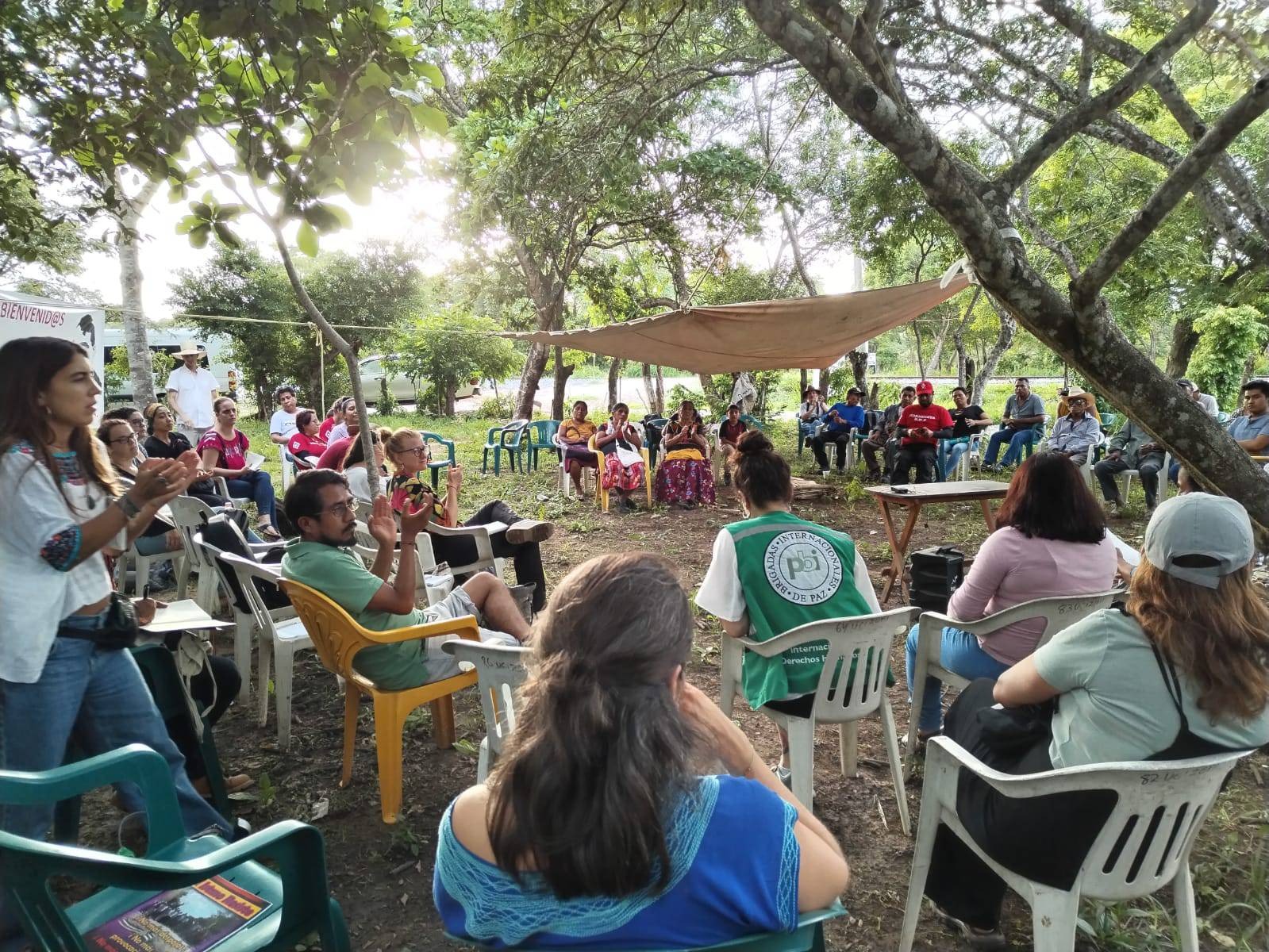
Photo: PBI-Mexico was part of the Civilian Observation Mission (MCO) in July 2023 documenting concerns about this megaproject.

El Universal Oaxaca reports: “The Interoceanic Corridor of the Isthmus of Tehuantepec (CIIT) project has been developed in Oaxaca through authoritarian methods that include cases of disappearance and forced displacement of indigenous communities, as well as a total of 226 attacks on community defenders including women and children, reveals the report of the Civilian International Observation Mission.”

The Peace Brigades International-Mexico Project is one of the 23 organizations in the Observation Mission, along with Union of Indigenous Communities of the Northern Isthmus (UCIZONI), the Business and Human Rights Resource Centre (BHHRC), Services for an Alternative Education A.C. (EDUCA) and Espacio OSC.

Photo: Carlos Beas of UCIZONI at media conference, June 27.

The El Universal article further notes: “During the presentation of this report in the city of Oaxaca, the parties concluded that between May 2021 and May 2024 the Mexican State used authoritarian methods to impose the project, which is not only about a highway or a corridor, but that ‘there is a background that includes the militarization of the indigenous territories of the Oaxacan Isthmus where local and state political actors linked to organized crime have been involved in the development of the Indigenous Territory. dedicated to looking after the interests of transnational corporations.’”

Educa Oaxaca, that has been part of the Observation Mission, specifies: “From May 1, 2021, to May 1, 2024, a total of 72 attacks were recorded, in which at least 226 various attacks were perpetrated against defenders, the most recurrent being: intimidation (30%), harassment (28%), threats (10%) and physical aggression (7%). In addition, 3 homicides against Zapotec defenders were documented: Jesús Manuel Martínez (2022), Félix Vicente Cruz (2023) and Noel López Gallegos (2023).”

With respect to the perpetrators of these attacks, the Mexican State is linked to “94 occasions out of the 72 documented attacks, with a permanent and leading presence of the Army, Navy and National Guard in the indigenous territories of the Isthmus.”

Pagina 3 adds: “At a press conference, members of the Observation Mission said that 92% of the victims of human rights belong to an indigenous people. In this context, the Mixe (Ayuujk) and Zapotec (Binnizá) peoples faced a greater number of aggressions against them.”

The megaproject

The Interoceanic Corridor is a megaproject that has been described by a proponent as including “two deep sea ports, railroads, highways, three airports (Minatitlán, Ixtepec and Huatulco), a gas pipeline and a fiber optic network.”

That pipeline appears to be the Jaltipan-Salina Cruz Gas Pipeline Expansion (Interoceanic Corridor Gas Pipeline). It also appears that the gas pipeline would feed a proposed LNG export terminal in Santa Cruz.

TC Energy

The Calgary-based company TC Energy appears to play the pivotal role of building a controversial offshore pipeline that would connect to the pipeline that would cross the interoceanic corridor.

Informe Isto has noted: “In July 2022, Canadian firm TC Energy announced a partnership with CFE (Federal Electricity Commission) to build a 420 km extension to TC Energy’s existing South Texas-Tuxpan Gas Pipeline. The new pipeline [the Puerta del Sureste/ Southeast Gateway pipeline] would carry natural gas from the southern end of the existing pipeline in Tuxpan to the port of Coatzacoalcos in Veracruz state, where it could feed the Jáltipan-Salina Cruz Gas Pipeline to ship natural gas across the Isthmus of Tehuantepec to the proposed Salina Cruz LNG export terminal.”

Calgary-based TC Energy confirms: “[The Southeast Gateway] marine pipeline will transport natural gas, connecting the supply from Tuxpan, Veracruz, to delivery points in Coatzacoalcos, Veracruz, and in Paraíso, Tabasco.”

Royal Bank of Canada

The Toronto-headquartered Royal Bank of Canada and other Canadian banks also appear to be key funders of the US company that is to build an LNG export terminal in Santa Cruz that is part of the interoceanic megaproject.

Avispa Midia further notes: “Since 2021, the CFE has announced among its agreements that the U.S. company Sempra Energy, through its Mexican subsidiary Sempra Infraestructura -a partner of TC Energy-, is included in the ‘development of a liquefied natural gas terminal in the port of Salina Cruz, Oaxaca’, the same terminal from which gas will be exported to the European and Asian continents.”

As documented in the Banking on Climate Chaos website (a project of Oil Change International and other groups), the Royal Bank of Canada (RBC) is the second larger financier of Sempra Energy, providing $3.23 billion to the company between 2016 to 2023, including $551.9 million in 2023. Other Canadian banks involved in Sempra are Toronto-Dominion Bank ($323 million), Scotiabank ($122 million), and CIBC ($109 million) since 2016.

CPKC

And it appears that the Calgary-based railway company CPKC (formerly the Canadian Pacific Railway) has been approached by the Mexican government to participate in the interoceanic megaproject.

The Atlas Report also reported earlier this year that: “On December 22, 2023, Mexico inaugurated a new railway line that connects the two largest oceans in the world: the Pacific and the Atlantic, connecting the Port of Salina Cruz, in Oaxaca, to that of Coatzacoalcos, in the city of Veracruz.”

That article adds: “The new Z Line of the Isthmus of Tehuantepec Interoceanic Train, which will be managed by the Secretariat of Mexican Navy, promises to be a strong alternative to the Panama Canal in transporting cargo and passengers between the two oceans.”

Mexico Business News reports the CIIT (Corredor Interoceánico del Istmo de Tehuantepec) includes three lines: “Line Z (Coatzacoalcos-Salina Cruz), Line FA (Coatzacoalcos-Palenque), and Line K (Ciudad Ixtepec-Ciudad Hidalgo). … The Mexican Navy (SEMAR) will assume custodial responsibilities for the project, ensuring its security.”

On December 22, 2023, Reuters reported: “[Mexican President] Lopez Obrador has also said he wants to get major rail operator CPKC, which operates a network through Canada and the U.S. and ends in Veracruz, on board with his rail projects to connect their lines to the government’s projects in the south.”

Prior to the Reuters article, Trains reported in May 2023 that: “CPKC tweeted that it shared with López Obrador ‘exciting plans about how CPKC will grow commerce and prosperity in Mexico, the United States & Canada.’”

Providing more context, BNAmericas also reported on May 5, 2023, that Lopez Obrador met with CPKC executives in Mexico City seeking to incorporate the company in three projects, the Tehuantepec isthmus rail corridor between Oaxaca and Veracruz states, the Maya Train, and the Mexico City-Querétaro high-speed train.

Mapping

Further research is needed to document and map the role Canadian companies and investment capital may be playing in this megaproject.

From there, an articulation of their responsibilities is needed in relation to the United Nations Guiding Principles on Business and Human Rights. The observation mission’s continued reporting on intimidation, harassment, threats, physical aggression and killings also brings to mind the role the Embassy of Canada in Mexico could play in relation to the Voices at Risk guidelines on supporting human rights defenders.

And given Mexican security forces are implicated as the leading perpetrators in the violence and displacement of Indigenous peoples, it is also important to look at the export of Canadian-made “military goods” to Mexico ($602,154.43 in 2023, $625,160.28 in 2022, $1,084,963.51 in 2021) as well as the largely undocumented transfer of these goods via the United States. 

We continue to follow the findings of the Observation Mission, the concerns about attacks against community defenders, and the role of Canada in this.