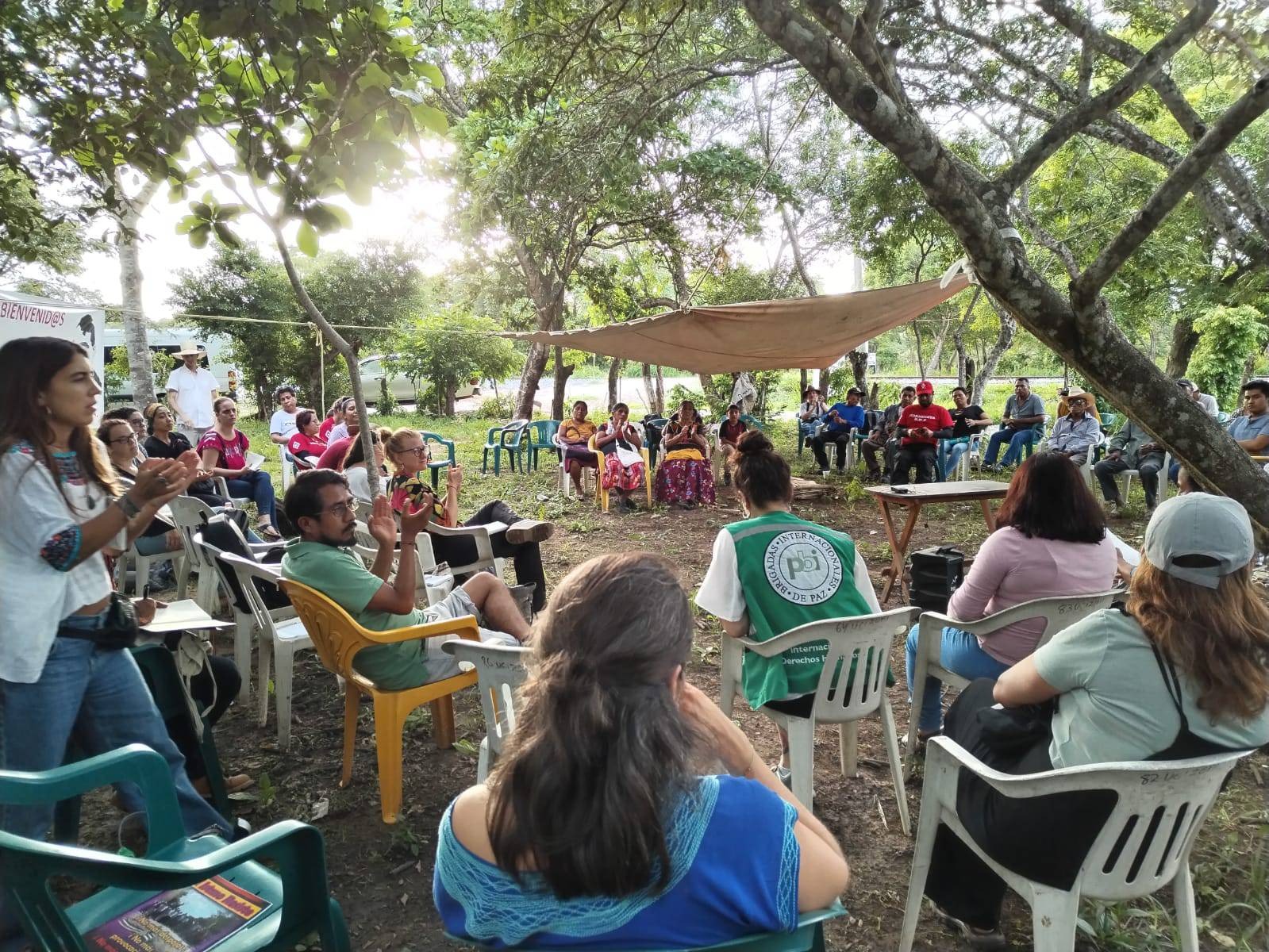


Photo: PBI-Mexico was part of the Civilian Observation Mission (MCO) in July 2023 documenting concerns about this megaproject.
El Universal Oaxaca reports: “The Interoceanic Corridor of the Isthmus of Tehuantepec (CIIT) project has been developed in Oaxaca through authoritarian methods that include cases of disappearance and forced displacement of indigenous communities, as well as a total of 226 attacks on community defenders including women and children, reveals the report of the Civilian International Observation Mission.”
The Peace Brigades International-Mexico Project is one of the 23 organizations in the Observation Mission, along with Union of Indigenous Communities of the Northern Isthmus (UCIZONI), the Business and Human Rights Resource Centre (BHHRC), Services for an Alternative Education A.C. (EDUCA) and Espacio OSC.
Photo: Carlos Beas of UCIZONI at media conference, June 27.

The El Universal article further notes: “During the presentation of this report in the city of Oaxaca, the parties concluded that between May 2021 and May 2024 the Mexican State used authoritarian methods to impose the project, which is not only about a highway or a corridor, but that ‘there is a background that includes the militarization of the indigenous territories of the Oaxacan Isthmus where local and state political actors linked to organized crime have been involved in the development of the Indigenous Territory. dedicated to looking after the interests of transnational corporations.’”
Educa Oaxaca, that has been part of the Observation Mission, specifies: “From May 1, 2021, to May 1, 2024, a total of 72 attacks were recorded, in which at least 226 various attacks were perpetrated against defenders, the most recurrent being: intimidation (30%), harassment (28%), threats (10%) and physical aggression (7%). In addition, 3 homicides against Zapotec defenders were documented: Jesús Manuel Martínez (2022), Félix Vicente Cruz (2023) and Noel López Gallegos (2023).”
With respect to the perpetrators of these attacks, the Mexican State is linked to “94 occasions out of the 72 documented attacks, with a permanent and leading presence of the Army, Navy and National Guard in the indigenous territories of the Isthmus.”
Pagina 3 adds: “At a press conference, members of the Observation Mission said that 92% of the victims of human rights belong to an indigenous people. In this context, the Mixe (Ayuujk) and Zapotec (Binnizá) peoples faced a greater number of aggressions against them.”
The megaproject
The Interoceanic Corridor is a megaproject that has been described by a proponent as including “two deep sea ports, railroads, highways, three airports (Minatitlán, Ixtepec and Huatulco), a gas pipeline and a fiber optic network.”
That pipeline appears to be the Jaltipan-Salina Cruz Gas Pipeline Expansion (Interoceanic Corridor Gas Pipeline). It also appears that the gas pipeline would feed a proposed LNG export terminal in Santa Cruz.
TC Energy
The Calgary-based company TC Energy appears to play the pivotal role of building a controversial offshore pipeline that would connect to the pipeline that would cross the interoceanic corridor.
Informe Isto has noted: “In July 2022, Canadian firm TC Energy announced a partnership with CFE (Federal Electricity Commission) to build a 420 km extension to TC Energy’s existing South Texas-Tuxpan Gas Pipeline. The new pipeline [the Puerta del Sureste/ Southeast Gateway pipeline] would carry natural gas from the southern end of the existing pipeline in Tuxpan to the port of Coatzacoalcos in Veracruz state, where it could feed the Jáltipan-Salina Cruz Gas Pipeline to ship natural gas across the Isthmus of Tehuantepec to the proposed Salina Cruz LNG export terminal.”
Calgary-based TC Energy confirms: “[The Southeast Gateway] marine pipeline will transport natural gas, connecting the supply from Tuxpan, Veracruz, to delivery points in Coatzacoalcos, Veracruz, and in Paraíso, Tabasco.”
Royal Bank of Canada
The Toronto-headquartered Royal Bank of Canada and other Canadian banks also appear to be key funders of the US company that is to build an LNG export terminal in Santa Cruz that is part of the interoceanic megaproject.
Avispa Midia further notes: “Since 2021, the CFE has announced among its agreements that the U.S. company Sempra Energy, through its Mexican subsidiary Sempra Infraestructura -a partner of TC Energy-, is included in the ‘development of a liquefied natural gas terminal in the port of Salina Cruz, Oaxaca’, the same terminal from which gas will be exported to the European and Asian continents.”
As documented in the Banking on Climate Chaos website (a project of Oil Change International and other groups), the Royal Bank of Canada (RBC) is the second larger financier of Sempra Energy, providing $3.23 billion to the company between 2016 to 2023, including $551.9 million in 2023. Other Canadian banks involved in Sempra are Toronto-Dominion Bank ($323 million), Scotiabank ($122 million), and CIBC ($109 million) since 2016.
CPKC
And it appears that the Calgary-based railway company CPKC (formerly the Canadian Pacific Railway) has been approached by the Mexican government to participate in the interoceanic megaproject.
The Atlas Report also reported earlier this year that: “On December 22, 2023, Mexico inaugurated a new railway line that connects the two largest oceans in the world: the Pacific and the Atlantic, connecting the Port of Salina Cruz, in Oaxaca, to that of Coatzacoalcos, in the city of Veracruz.”
That article adds: “The new Z Line of the Isthmus of Tehuantepec Interoceanic Train, which will be managed by the Secretariat of Mexican Navy, promises to be a strong alternative to the Panama Canal in transporting cargo and passengers between the two oceans.”
Mexico Business News reports the CIIT (Corredor Interoceánico del Istmo de Tehuantepec) includes three lines: “Line Z (Coatzacoalcos-Salina Cruz), Line FA (Coatzacoalcos-Palenque), and Line K (Ciudad Ixtepec-Ciudad Hidalgo). … The Mexican Navy (SEMAR) will assume custodial responsibilities for the project, ensuring its security.”
On December 22, 2023, Reuters reported: “[Mexican President] Lopez Obrador has also said he wants to get major rail operator CPKC, which operates a network through Canada and the U.S. and ends in Veracruz, on board with his rail projects to connect their lines to the government’s projects in the south.”
Prior to the Reuters article, Trains reported in May 2023 that: “CPKC tweeted that it shared with López Obrador ‘exciting plans about how CPKC will grow commerce and prosperity in Mexico, the United States & Canada.’”

Providing more context, BNAmericas also reported on May 5, 2023, that Lopez Obrador met with CPKC executives in Mexico City seeking to incorporate the company in three projects, the Tehuantepec isthmus rail corridor between Oaxaca and Veracruz states, the Maya Train, and the Mexico City-Querétaro high-speed train.
Mapping
Further research is needed to document and map the role Canadian companies and investment capital may be playing in this megaproject.
From there, an articulation of their responsibilities is needed in relation to the United Nations Guiding Principles on Business and Human Rights. The observation mission’s continued reporting on intimidation, harassment, threats, physical aggression and killings also brings to mind the role the Embassy of Canada in Mexico could play in relation to the Voices at Risk guidelines on supporting human rights defenders.
And given Mexican security forces are implicated as the leading perpetrators in the violence and displacement of Indigenous peoples, it is also important to look at the export of Canadian-made “military goods” to Mexico ($602,154.43 in 2023, $625,160.28 in 2022, $1,084,963.51 in 2021) as well as the largely undocumented transfer of these goods via the United States.
We continue to follow the findings of the Observation Mission, the concerns about attacks against community defenders, and the role of Canada in this.