Home Blog Page 92

PBI-Honduras attends National Union of Rural Workers (CNTC) assembly amid threats against the organization

PBI-Honduras has posted:

Yesterday [June 24], we attended the Assembly of the @CNTC  [National Union of Rural Workers] El Progreso. The organization has been defending the rights of the peasantry for more than 30 years, claiming their access to land and supporting the development of agricultural production and small livestock projects.

Farm workers are essential to ensure national food, care for the land and resilience in the face of climate change.

From PBI, we are concerned about the situation of threats, surveillance, attacks and criminalization against the people of the organization and its bases.

Just a few days earlier, PBI-Honduras also posted:

Yesterday [June 17], we visited the 17 June peasant base of the CNTC El Progreso, on its second anniversary.

We at PBI are concerned about the criminalization of the peasant population, whose work is fundamental to guarantee food security.

We also applaud the work of the CNTC El Progreso and its defense of peasant rights.

Accompaniment

The CNTC, created in 1985, is a small-scale farming and trade union organization that fights for the distribution of land.

In Honduras fewer than 5% of landowners control 60% of the fertile terrain.

The CNTC is affiliated with the Unified Confederation of Honduran Workers (CUTH) which in turn is affiliated with the International Trade Union Confederation (ITUC), along with 150+ labour organizations including the Canadian Labour Congress.

PBI-Honduras has been accompanying the CNTC since May 2018.

PBI-Canada meets with UN Special Rapporteur on human rights defenders Mary Lawlor during her visit to Ottawa

On June 26, PBI-Canada coordinator Brent Patterson took part in a civil society meeting with Mary Lawlor, the United Nations Special Rapporteur on the situation of human rights defenders, and Michael Phoenix, Head of Research and Campaigns.

We raised our concerns related to Frontera Energy, TC Energy and Enbridge and the criminalization of frontline environmental defenders; noted the recent court ruling on the transnational corporation Chiquita Brands and paramilitary violence in Colombia; highlighted our position on mandatory due diligence legislation and the Binding Treaty; and raised the ongoing concern about RCMP C-IRG violence against those resisting extractive megaprojects on Indigenous territories in Canada.

We follow Lawlor’s posts on social media with interest, including these:

We have also often posted on our website about Lawlor’s interventions, including these articles:

UN special experts call for an arms embargo, continue to press for a ceasefire in Gaza to avoid a genocide in the making (November 20, 2023)

Giniw Collective meets with UN Special Rapporteur Lawlor, discuss Canadian company funding police in Minnesota (August 17, 2021)

New report by UN Special Rapporteur Mary Lawlor: Final warning: death threats and killings of human rights defenders (January 29, 2021)

“Governments are not doing enough to protect human rights defenders”: Mary Lawlor, UN Special Rapporteur (October 22, 2020)

We look forward to continued follow-up with the UN Special Rapporteur’s office.

PBI-Mexico accompanied Espacio OSC denounces Civil Force violence and water takings by Carroll Farms pig farms

Photo: The Civil Force in Veracruz.

The Associated Press has reported: “Two people were killed Thursday [June 20] when locals protesting alleged water contamination by a pork processing plant clashed with police in the Mexican gulf coast state of Veracruz.”

“Residents of the community of San Antonio Limon had been blocking a road demanding government action against the operation, which they said was responsible for polluting the aquifer and using too much water.”

That article further notes: “State security forces arrived Thursday in the community, also known as Totalco, and protesters said police began beating them and opened fire. Brothers Alberto and Jorge Cortina Vázquez, aged 22 and 27 respectively, were killed, according to the Veracruz state prosecutor’s office, which opened an investigation.”

El Pais adds: “On June 20, the Movement in Defense of Water of the Libres Oriental Basin began as a new protest on the federal highway that connects Veracruz and Puebla. Farmers had a clear message: that Carroll farms should stop hoarding water.”

“[Carroll Farms] has 18 farms between [the states of] Veracruz and Puebla. The peasants claim that the concessions of the National Water Commission benefit the company, while they do not have liquid to irrigate their fields. In addition to the overexploitation of the wells, the residents denounce the disposal of sewage contaminated with biological and chemical waste by the company.”

That article adds: “The government of Cuitláhuac García announced on Monday [June 24] that it is going to extinguish [disband/dissolve] the Civil Force, a special directorate of the police, after the brutal repression of a demonstration by farmers in Totalco, Veracruz, which ended with the death of two peasants.”

Civil society statement

The Civil Society Organization (CSO) Space for the Protection of Human Rights Defenders and Journalists (Espacio OSC) has signed this statement that says:

The undersigned organizations express our rejection and reiterate our concern over the acts of violation of the right to protest and the attacks against defenders during an operation by the Civil Force of the state of Veracruz, which occurred on June 20 in the community of Totalco, municipality of Perote, Veracruz, Mexico.

The events occurred during the protest by several communities in the Free-Eastern Basin against the activities of the pig industry, of Caroll Farms, a subsidiary of Smithfield, part of the WH Group.

Civil society organizations in a statement reported that during the protest and the peaceful camp in defense of water and against the pig industry, elements of the Civil Force beat the demonstrators, who were defending their right to water and a healthy environment.

In the same way, they reported, in addition to physical violence, the use of firearms by elements of this institution, causing the death of the peasants Jorge and Alberto Cortina Vázquez.

In light of the announcement by the government of Veracruz on June 23 about the dissolution of the Civil Force, we demand that the measures go further and guarantee truth, justice, reparation and non-repetition of the facts, as well as the punishment of those responsible.

The full statement can be read at Condenamos las violaciones al derecho a la protesta y los ataques contra las personas defensoras de derechos humanos y el agua de la Cuenca de Libres-Oriental (June 25, 2024).

The company

As noted on their website: “Granjas Carroll de México (GCM) is a Mexican company established in 1993 with the objective of raising, marketing and processing live pigs. It is made up of two private groups that manage international operations: the first, Mexican, Agroindustrias Unidas de México (AMSA), with activities in the agri-food industry; the second, Smithfield, is American, the main pork producer and processor in the world.”

Smithfield Foods, Inc., is a pork producer and food-processing company based in Smithfield, Virginia. It operates as a wholly-owned subsidiary of the Chinese-owned conglomerate WH Group.

WH Group, formerly known as Shuanghui Group, is a publicly traded Chinese multinational meat and food processing company headquartered in Hong Kong.

El Sol de Mexico has reported: “On March 1, 2023, an administrative resolution was issued by the Environmental Prosecutor’s Office against Granjas Carroll, in the Perote Valley, for various breaches in environmental matters. It was even sanctioned and measures were dictated to prevent contamination of the soil, air and water.”

Canada and Mexico

In June 2021, Porcicultura.com reported: “According to the Agricultural Markets Consulting Group (GCMA), in the first four months of the year, 1,265 tons of pork were positioned in Canadian territory, which represented an increase of 253.7% over the same period in 2020, representing 1.3% of Mexican shipments.”

In 2023, Canada exported  $602,154.43 in “military goods” to Mexico. In 2022, the amount was $625,160.28. The year before it was $1,084,963.51. The lack of transparency prevents us from knowing if any of this equipment might have supplied the Civil Force in Veracruz that killed the campesinos.

That said, the Newmarket, Ontario-based Terradyne Armored Vehicles posted a tweet that suggests its vehicles have been used by the Civil Force.

Terradyne has also exhibited its armoured vehicles at CANSEC, an annual weapons show in Ottawa organized by the Canadian Association of Defence and Security Industries (CADSI) that receives funding from Global Affairs Canada.

We continue to follow this.

PBI-Colombia accompanies the Peace Community touring villages of Mulatos, Resbalosa and Calzón Rojo

PBI-Colombia has posted:

“We accompanied the Peace Community @sanjoapartado, touring the villages of Mulatos, Resbalosa and Calzón Rojo in #Urabá.

Their community work strengthens the defense of the territory from food sovereignty. We recognize this political project, which persists in search of peace and respect for life. #WeArePBI”

Moira Birss, formerly of PBI-Colombia, has recently written this feature article about the Peace Community of San José de Apartadó for the NACLA Report. Key excerpts from her article include:

The day before the murders [of community members Nalleli Sepúlveda, 30, and Edinson David, 14, on March 19], President Gustavo Petro and members of his cabinet made a stopover in Apartadó…

In a large public meeting, the president honored the Peace Community’s years of nonviolent resistance and asked the regional military commander to apologize for the army’s past collaboration in paramilitary attacks against the community.

He also issued an ultimatum to the Gulf Clan, successor to the country’s most notorious paramilitaries: either abandon drug trafficking and accept his invitation to negotiate, or the government will ‘wage war’ to ‘destroy’ the group.

Petro’s attention was not enough to stop the murders of Nalleli and Edinson. Amid slow progress toward the current president’s promise of ‘total peace,’ the killings shed light on the key ways in which Colombia’s first leftist government has changed [from previous governments that insinuated community members were guerillas] and has also been unable to change both the tone and practice of safeguarding land rights defenders and the territories they themselves seek to protect.

Colombian history shows that one of the main causes of political violence in recent decades is the struggle for control of territory and the resources it contains.

Part of what makes Apartadó and the Urabá region so attractive to armed groups (and the economic interests that often drive them) is the area’s strategic location near the Gulf of Urabá. The gulf flows into the Caribbean Sea, connecting to the Panama Canal and all its commodity export opportunities. On the other side of the gulf is the Darien Gap, which in recent years has become an important migratory route and where transit is controlled by the Gulf Clan. The Peace Community believes that the transit of goods and people through this area is central to the motivation behind the murders of Nalleli and Edinson.

Land grabbing for activities such as large-scale cattle ranching cleared around 1,600 hectares in Apartadó between 2019 and 2023.

Coal deposits

The area is also reported to contain significant coal deposits, for which the state issued an exploratory license more than 15 years ago. The Peace Community has sought to protect its collective agricultural lands from unwanted development projects and rapid deforestation, declaring water reserves and forests and practicing sustainable small-scale agriculture, but its efforts have faced major obstacles.

In the months and weeks leading up to the killings, tensions had been building in La Esperanza over widening a pedestrian and horse path to become a car-sized road that would go deep into the hills, presumably to facilitate commodity exports.

The route runs through the Las Delicias estate [where Nalleli and Edinson were killed]. As it is not authorized by the regional authorities, the construction of the road is illegal. The Peace Community has opposed the project and has denounced the involvement of the Gulf Clan and the support of the Army in the process.

Community opposition was met with a series of escalating attacks on Las Delicias [including fences being cut down and a gate chainsawed]. In response to these attacks, Nalleli, Edinson and other members of the Peace Community rebuilt, over and over again, the fences and gates and promised to protect the territory.

Photo: Nalleli Sepúlveda paints a wooden gate that the Peace Community rebuilt after it was destroyed. It reads: “Mining kills the land. We have the right to protect nature.” Photo by the Peace Community.

In the following days, the government sent a delegation of high-level officials led by the director of human rights of the Ministry of the Interior, Franklin Castañeda, to visit Las Delicias. During the delegation, Castañeda and other officials made a number of commitments related to the revision of the coal mining license and road construction approvals (or lack thereof), as well as streamlining land restitution procedures and protecting existing titles. They also proposed a comprehensive review of the Armed Forces’ compliance (or lack of compliance) with the judgments in favor of the community by the Inter-American Court of Human Rights and the Constitutional Court of Colombia.

The violence and inequalities derived from the territorial power of armed groups such as the Clan del Golfo and the economic interests that try to snatch land from peasants and Black and Indigenous communities are not problems that can be solved in a single year or from offices in Bogotá. Real change will require years of work on the ground, as well as accountability from the other actors — from the U.S. government to the coal companies to the Colombian Department of Justice — who participate in and perpetuate a system that supports this kind of political violence.

The full article by Moira Birss can be read at “No nos callaremos ante nuestros verdugos” (NACLA, June 25, 2024).

The Peace Brigades International-Colombia Project has accompanied the Peace Community of San José de Apartadó since 1999.

PBI-Kenya calls for the release of activists arbitrarily detained before protest against vote on finance bill

PBI-Kenya has posted:

‘We express our grave concern about the reports of disappearances of Oguda, Osama, Drey, TemperCR7, Harriet, Shad, Franje, Worldsmith and Hilla254. Before this, Billy, Dr Omondi and Leslie Muturi had also been disappeared and later returned. Billy and Dr Omondi were found at Nairobi police stations. There are indications of a pattern of enforced disappearances. The rights of these men and women taken by police against their will are being violated every minute they are held. We urge for the immediate release of all individuals who have been arbitrarily detained.”

Now, The Star reports:

Several social media users and content creators are missing after they were abducted in overnight operations in the country hours to anti-Finance Bill demonstrations.

Officials said this was among strategies being used to defuse the planned protests against the proposed taxes.

Among those taken were vocal social media and political activist Gabriel Oguda.

He was among at least ten people who were rounded up on Tuesday, June 25, officials said.

Osama Otero who has been holding popular X Spaces opposing the Finance Bill 2024, was also reportedly abducted by unknown people.

Other X users who are suspected to have been abducted include Drey Mwangi, TemperCR7, Harriet, Shad, Franje, Worldsmith and Hilla254.

Many others are missing after being abducted by state agents amid uproar from families and friends.

Photo: Protest against the Finance Bill, June 25. Photo by Boniface Okendo, Standard.

Tweet of CNN interview with Auma Obama, Kenyan-British community activist, sociologist, journalist, author, and half-sister of Barack Obama.

Shots fired on peaceful protests

This hour, Aljazeera reports: “People have been shot with live fire in Nairobi, but the exact number of casualties remains unconfirmed. A Reuters journalist counted the bodies of at least five protesters outside parliament. A paramedic, Vivian Achista, told Reuters at least 10 had been shot dead. Another paramedic, Richard Ngumo, said more than 50 people had been wounded by gunfire.”

IMF loan

Reuters has explained: “In the 2024/25 bill, the Kenyan government aims to raise $2.7 billion in additional taxes to reduce the budget deficit and state borrowing. Kenya’s public debt stands at 68 per cent of GDP, higher than the 55 per cent of GDP recommended by the World and the International Monetary Fund. Grappling with acute liquidity challenges amid uncertainty over its ability to access capital from financial markets, Kenya has turned to the IMF – which has urged the government to meet revenue targets to access more funding.”

The BBC has also noted: “Amendments to the bill look set to be approved but some of the controversial provisions initially put forward included a plan to introduce a 16% sales tax on bread and 25% duty on cooking oil. The government said it was dropping these measures amid a public outcry.”

That report adds: “The finance bill introduces a 16% tax on goods and services for the direct and exclusive use in the construction and equipping of specialised hospitals with a minimum bed capacity of 50. Many Kenyans have been apprehensive that this could mean higher costs to access critical health services for cancer, diabetes, kidney dialysis or other chronic illnesses.”

#FreeOguda #FreeOsama #RejectFinanceBill2024 #OccupyParliament

PBI-Guatemala accompanies National Day Against Enforced Disappearances at media conference and former military base

Photo: PBI-Guatemala at the commemoration ceremony at the Memorial of the Victims of Enforced Disappearance, Landscapes of Memory that is located at the former San Juan Comalapa military base.

On June 22, PBI-Guatemala posted:

On the National Day Against #Forced Disappearance, #PBI accompanies Famdegua Guatemala [the Association of Relatives of the Detained-Disappeared of Guatemala] in the press conference, an event in which they are dignifying the memory of the 27 union leaders of the National Workers’ Central [CNT] disappeared in 1980.

The Working Group against Enforced Disappearance in Guatemala, in which FAMDEGUA, GAM [Mutual Support Group] and the Center for International Human Rights Research (CIIDH) participate, continues to demand the enactment of Law 3590 to consolidate a search mechanism for missing persons, the opening of military archives and files, and the fulfillment of agreements for reparations and redress for victims.

Later that same day, PBI-Guatemala also posted: “Today, #PBI accompanies the commemoration of the National Day Against #Enforced Disappearance in the Landscape of Memory by the Guatemalan Forensic Anthropology Foundation – FAFG and Conavigua [the National Coordination of Widows of Guatemala].”

The FAFG and Conavigua were commemorating the 6th anniversary of the return of 172 skeletons recovered in the former military detachment of San Juan Comalapa, now transformed into Memorial of the Victims of Enforced Disappearance, Landscapes of Memory.

200,000 killed, 45,000 forcibly disappeared

NACLA has explained: “Between 1962 and 1996, 200,000 Guatemalans were killed and 45,000 were forcibly disappeared. For the majority of families, the whereabouts of those lost loved ones are still unknown, even decades after security forces abducted them. Most of the victims [83%] of the conflict were Indigenous. Most of the perpetrators [93%] were members of government forces.”

Law 3590

In September 2023, Ruda reported: “The Mutual Support Group (GAM) presented initiative 3590 that provides for the approval of the Law of the Commission for the Search of Persons, Victims of Forced Disappearance and other forms of Disappearance, an initiative shelved without progress in the Congress of the Republic.”

On June 12, 2024, the International Centre for Human Rights Research (CiiDH) posted this update:

The proposed Law 3590 is a humanitarian initiative that seeks to respond to the thousands of families who are still waiting to find their missing loved ones who disappeared during the Internal Armed Conflict (CAI).

After many years that the Working Group Against Enforced Disappearances in Guatemala proposed before the Congress of the Republic the initiative of Law 3590, its final approval is still pending.

Its approval is of National Urgency because it creates the ‘Commission for the Search of Victims of Forced Disappearance and other Forms of Disappearance’.

This will help the state to add its responsibility in the search for more than 45,000 victims of forced disappearance during the [internal armed conflict] and thus give an answer to thousands of families who live in agony for not knowing the whereabouts of their loved ones.

Trade unionists killed

Prensa Comunitaria reports: “Every June 21, since 1990, the National Day against Enforced Disappearance has been commemorated in Guatemala, in memory of 27 trade unionists and students who were gathered at the headquarters of the National Workers’ Central (CNT) in the historic center of Guatemala City, and were kidnapped by agents of the Guatemalan State security.”

Mapeo de la Memoria adds: “The National Workers’ Central [CNT] brought together union leaders from different companies such as Coca Cola, the Kerns food factory, Prensa Libre, among others. The employment situation of all workers was generally not favourable, so demonstrations or occupations of company plants to demand better wages and better working conditions were common.”

That article further notes: “It was in the last raid [on June 21, 1980] that the government of then-President General Romeo Lucas García took drastic measures, taking away all the people who were gathered there on that occasion. Among the victims were a pregnant woman and several young people between 19 and 29 years old.”

Ceremony at former military base

In another article, Prensa Comunitaria also reports:

On the National Day of Forced Disappearance, members of the National Coordinator of Widows of Guatemala (Conavigua), commemorated the memory of 172 victims, who were exhumed between 2003 and 2005, in the former Military Detachment of Chimaltenango, today converted into a memory center called Landscape of Memory.

During the activity, representatives of the Forensic Anthropology Foundation of Guatemala (FAFG), shared about the identification processes of the victims, since of the 172, they have managed to identify 86, through DNA samples and scientific investigations.

Relatives of the victims also participated and told stories of how their brothers, parents, and children were taken and disappeared by the Guatemalan Army. Some of the families have been searching for their families for more than 36 years in the hope of finding them.

Photo by PBI-Guatemala.

Currently, several families continue with the search processes for their relatives who disappeared during the 80s, in the hope of finding them and giving them a dignified burial. Some families have managed to identify their relatives and decide that their remains remain in the Landscape of Memory. Because it was in that place where they were found and it is part of their history that they continue in this memorial that seeks to dignify the disappeared.

Between 2003 and 2005, the National Coordinator of Widows of Guatemala [Conavigua], together with the Forensic Anthropology Foundation of Guatemala [FAFG], promoted the exhumation of 220 bones of victims in the former military detachment of Comalapa, Chimaltenango, which was under the direction of General Víctor Augusto Vásquez Echeverría, accused of the disappearance of more than 180 people opposed to the military regime of Óscar Humberto Mejía Víctores in the case of the Military Diary.

It was in 2018, in that old military detachment, that the women of Conavigua built the Passage of Memory, to remember their disappeared relatives. The memorial that seeks to make new generations know about these atrocities committed by the Guatemalan Army in the 80s.

The full article can be read at Familias de Comalapa conmemoran el Día Nacional contra la Desaparición Forzada (Prensa Comunitaria, June 23, 2024).


Indigenous Yaqui community resist RBC-financed Guyamas-El Oro gas pipeline in Sonora, Mexico

Video still: “The conflict continues: Yaqui members started to dismantle the pipeline”

Meganoticias reports: “After 8 years of struggle to prevent the passage of the gas pipeline through Loma de Bácum [in the state of Sonora], the resistance by the traditional guard continues…”

“The Guyamas-El Oro gas pipeline would pass through Yaqui territory and would have a length of 330 km, of which 18 would cross Loma de Bácum. The construction of the pipeline has begun despite not having the permission of the Yaqui tribe in this town, which has been in conflict [against the pipeline] for almost a decade.”

“The government of Loma de Bácum estimates that the passage of the pipeline through this place puts the lives of close to 20,000 people at risk.”

The article adds: “Members of the Yaqui tribe for years began to dismantle the pipeline… The Yaqui tribe has been characterized by its ancestral and tireless struggles; proof of this is these 8 years in which they have not yielded despite the company’s promises to pay millions of pesos to allow them to pass.”

In August 2020, Natural Gas Intelligence carried an opinion piece that noted: “President López Obrador [has] promised the Yaquis of Sonora the option to change the route of the stalled 510 MMcf/d Guaymas-El Oro gas pipeline owned by IEnova, the Mexican subsidiary of California’s Sempra Energy. It will be costly, but it will be more expensive not to complete the pipeline.”

It does not appear that re-routing happened.

And as documented in the Banking on Climate Chaos website, the Royal Bank of Canada (RBC) is the second larger financier of Sempra Energy, providing $3.23 billion to the company between 2016 to 2023, including $551.9 million in 2023.

Other Canadian banks involved in Sempra are Toronto-Dominion Bank ($323 million), Scotiabank ($122 million), and CIBC ($109 million) since 2016.

We continue to follow this.

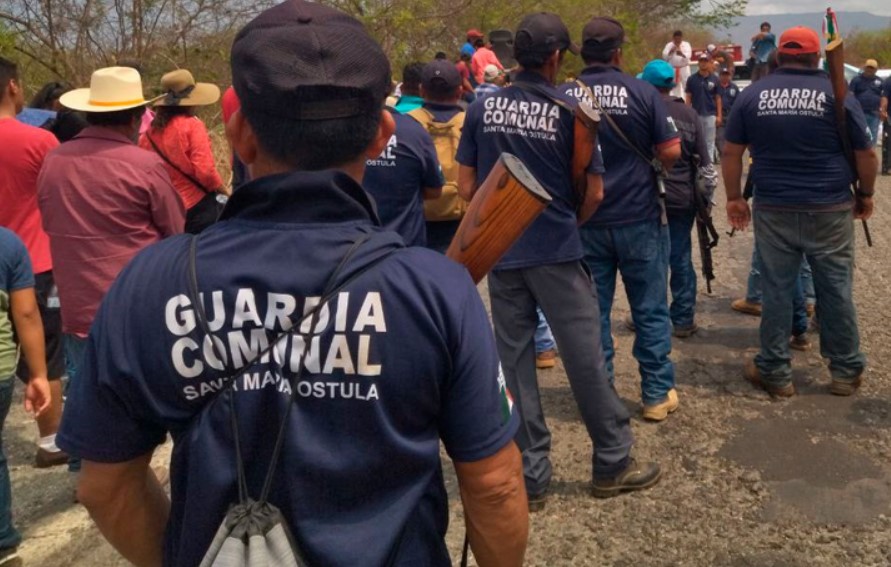
PBI-Mexico calls for respect for the Communal Guard of the Indigenous Nahua community of Santa María Ostula following CJNG attack

Photo by Comunicación Ostula.

PBI-Mexico has posted:

“These latest aggressions on Thursday, June 13 in the Michoacán community of Santa María Ostula add to a context of high levels of insecurity caused by organized crime, in which the community member Antonio Regis Nicolás was murdered on Friday, May 17. In the context of our accompaniment of the Human Rights Solidarity Network [Red Solidaria DH], PBI expresses its concern and solidarity with the community and calls on the corresponding authorities, given this increase in violence and direct aggressions against the indigenous community, to ensure security conditions and to respect the jurisdiction of the communal government and the Communal Guard of Santa Maria Ostula.”

This statement from the Indigenous Nahua Community of Santa Maria Ostula further explains that a community member was attacked when he was herding his cattle on June 13 by approximately thirty armed men. The person was able to shelter in a checkpoint that had been installed by the Communal Guard earlier this year following another attack by the Jalisco Cartel – New Generation (CJNG). The Communal Guard repelled the attack and saved the life of the community member.

The statement adds “the highest levels of the federal and state governments have full knowledge of the situation of violence that prevails throughout the region and the aggressions that our community has constantly suffered; however, they have refused to take effective measures to provide protection to the people of the region and particularly to the families of our community in the face of the increasing and more violent presence of the CJNG in the area.”

The demands of the community include the dismantling of the CJNG cartel, guarantees for the functioning of the Communal Guard, and self-determination and autonomy for the Indigenous community of Santa Maria Ostula.

Antonio Regis Nicolás Espacio OSC explains: “On May 17, 2024, Antonio Regis Nicolás, a community member of Santa María Ostula, in the municipality of Aquila, Michoacán, was murdered and intercepted by a heavily armed commando of organized crime, dressed in military uniforms. The place where the community member was murdered has been repeatedly pointed out to the Federal and State governments as an area controlled by criminal groups, so far all levels of government have ignored the request of the Ostula authorities to strengthen surveillance in these areas.”

Jalisco New Generation Cartel In a recent article, CBC reports: “The Jalisco New Generation Cartel (known by its Spanish initials CJNG) has existed for only 15 years, yet ranks one of Mexico’s largest and most powerful criminal organizations. It operates in at least 27 of the country’s 32 states, with affiliates across the globe. Its home base is Puerto Vallarta. Over its ultra-violent history, the group has expanded its activities from drug production and trafficking, to kidnapping and extortion, to less predictable turf like the avocado trade and, more recently, time-share scams.”

Communal Guard Avispa Midia notes: “The Nahua community of Santa María Ostula … has exercised self-government and maintained the operation of their Communal Guard since 2009. …Through an act of their community assembly, they reiterated their rejection of whatever external governmental forces from entering their territories beneath the pretext of providing security. … ‘Our Communal Guard is recognized by a community assembly which governs our laws and customs,’ explain members of the Community Council of Ostula. They emphasize that participation in the security system is an obligation of community members when they reach the appropriate age to provide free service in benefit of the population.”

The community statement also mentions the names of nine people along with Antonio Regis Nicolas:

Lorenzo Froylan de la Cruz Ríos: Red TDT explains this member of the Communal Guard was murdered on August 10, 2023.

Isaul Nemecio Zambrano, Miguel Estrada Reyes and Rolando Mauno Zambrano: Serapaz notes these were members of the Communal Guard who were murdered by the CJNG on January 12, 2023, while carrying out surveillance tasks.

Eustaquio Alcala Diaz: Centro PRODH and Red Solidaria say that Eustaquio was an environmental defender fighting against a mining concession granted on their territory who was disappeared on April 1, 2023 and later found murdered.

Juan Medina: El Sol de Morelia reports he was a “communal councillor, in charge of order, community guard and member of the Communication Commission in Ostula” murdered on April 14, 2023.

The Guardian has reported: “Ricardo Arturo Lagunes Gasca, a renowned human rights lawyer, and Antonio Díaz Valencia, leader of the Aquila Indigenous community in the state of Michoacán, were last seen on Sunday [January 15, 2023] evening after attending an anti-mining community meeting.”

Animal Politico has reported: “Environmental activist José Gabriel Pelayo Zalgado allegedly received threats from the Jalisco New Generation Cartel (CJNG) prior to his disappearance on March 19 [2024] in Coalcomán, Michoacán, for his defense of forests and natural resources, according to federal security sources and residents of the area.”

We continue to follow this situation.

Photo of Comunal Guard from Red TDT.


Peace Brigades International supports Declaration +25 with new provisions to protect human rights defenders

Peace Brigades International (PBI) supports Declaration +25, “a landmark document systematising relevant developments in regional and international human rights law and standards of the last 25 years.”

Declaration +25 addresses key issues that were not fully addressed by the Declaration on human rights defenders that was adopted by consensus by the United Nations General Assembly in 1998.

Excerpts from Declaration +25 include:

PREAMBLE

DISTURBED by the trend of security forces engaging in assaults against human rights defenders and the role of judicial bodies in judicial harassment and criminalization,

DEEPLY CONCERNED by the persistence of significant challenges and threats to human rights defenders and the persistent instances of killing, physical violence, stigmatization, criminalization, and other online and offline attacks that compromise their ability to carry out their work or activities, as well as their legitimacy, safety and freedom;

EMPHASIZING the vital importance of investigating all threats and attacks against human rights defenders, and ensuring accountability and addressing impunity, whether perpetrated by State or non-State actors (including business enterprises);

STRESSING the responsibility of non-State actors (including business enterprises) to respect and support human rights defenders and, DEEPLY CONCERNED by their increasing role in attacks against, and undermining or obstructing the vital work or activities of, human rights defenders;

ARTICLE 4

States shall ensure a safe and enabling environment for human rights defenders.

ARTICLE 7

(c) Take effective measures to address the structural conditions that create or accentuate the risks faced by human rights defenders, including impunity and lack of accountability, political instability such as militarization, states of emergency and extremism, any form of systemic discrimination, and transnational repression.

ARTICLE 11

In particular, in conflict, post-conflict, and crisis-affected settings, States should:

(h) Ensure that security forces deployed to police assemblies have received human rights training, especially in assembly facilitation and de-escalation techniques, and that they are placed under civilian command and oversight, have clearly defined responsibilities and rules of engagement, and are accountable.

ARTICLE 12

States shall adopt such legislative, administrative and other steps as may be necessary to implement the Declaration and the Declaration +25 within their jurisdiction and in territories under their control, in particular to ensure that the rights and protections accorded to human rights defenders under the Declaration and the Declaration +25 are given effect in domestic legislation, as well as by local governments and judicial bodies.

ARTICLE 17

States shall adopt and enforce laws and policies, and take all necessary measures to ensure that non-State actors (including business enterprises) respect human rights defenders and do not, directly or indirectly, violate or restrict their rights or activities.

ARTICLE 18

In particular, in safe and meaningful consultation with human rights defenders, business enterprises should:

(c) Ensure that due diligence processes respect the right to free, prior, and informed consent (FPIC), including the right of Indigenous Peoples to define the process by which FPIC is achieved and to withhold consent, regardless of any opposing claim by the government.

READ MORE

The 8-page Declaration (1998) can be read here and here. You can download the 36-page Declaration on Human Rights Defenders +25 here.

#Declaration25 #Right2DefendRights

TC Energy shareholders vote against Wet’suwet’en and Otomi request for independent assessment of its projects

Photo: On October 14, 2023, Wet’suwet’en and Otomi land defenders marched together in Toronto in opposition to the construction of TC Energy pipelines on their territories.

On June 10, Forbes Mexico reported: “Indigenous communities in Mexico and Canada demanded that the Canadian firm TC Energy carry out an external assessment of the impacts caused by the imposition of the Tuxpan-Tula and Puerta al Sureste gas pipelines in ancestral territories of Veracruz.”

This request was for “an independent assessment of the financial, time, reputational and goodwill damages that the company has suffered for not obtaining the prior, free and informed consent of the communities affected by its projects.”

Members of the Otomi, Nahua, Totonac, Nuntajɨɨyi’ and Tepehua peoples together with the Wet’suwet’en submitted this request to the TC Energy general meeting of shareholders that was held virtually on June 4.

The TC Energy Report of Voting Results notes: “By resolution passed via ballot, the shareholder proposal submitted by the Salal Foundation requesting TC Energy commission an independent assessment on its practices relating to obtaining Free, Prior and Informed Consent on its projects, as set forth in Schedule M of the Circular, was not approved. The results of the ballot were as follows:

The Victoria, BC-based Salal Foundation seeks “to nurture transparency, citizen engagement, democracy, and communities living within natural limits.”

Tuxpan-Tula

TC Energy is building the Tuxpan-Tula pipeline resisted that is being resisted by Otomi, Nahua and Tepehua communities grouped together as the Regional Council of Indigenous Peoples in Defense of the Territory of Puebla and Hidalgo.

In April 2023, the Federal Electricity Commission (CFE) confirmed the intention to complete the pipeline. As of June 2023, efforts to complete the construction of the pipeline appeared to be moving ahead despite continued opposition.

Puerta al Sureste

The Southeast Gateway (aka Puerta al Sureste) pipeline would begin on land in Tuxpan and continue across the ocean and flow to Coatzacoalcos, Veracruz and the refinery in Dos Bocas, Paraiso, Tabasco. This pipeline is opposed by the Union of Indigenous Communities from the North of the Isthmus (UCIZONI).

When TC Energy began the construction of this pipeline in May 2023, Carlos Beas Torres of UCIZONI commented: “We are witnessing this Canadian company threaten the Laguna del Ostion estuary, in the south of the state of Veracruz.”

Otomi and Wet’suwet’en

Last year, Otomi and Wet’suwet’en land defenders marched in Toronto against TC Energy pipelines on their territories (October 14), met with Export Development Canada (EDC) and the Canadian Ombudsperson for Responsible Enterprise (CORE) and spoke at a public forum in Ottawa (October 16), and met with Global Affairs Canada and Member of Parliament Mike Morrice (October 17).

We continue to follow this.

Further reading: Wet’suwet’en and Otomi land defenders unite against the TC Energy Coastal GasLink and Tuxpan-Tula pipelines (October 18, 2023) and What we know about TC Energy pipelines in Mexico (December 12, 2023).