Home Blog Page 7

PBI-Canada notes CESPAD report that cites use of military equipment in eviction of CNTC union members in Honduras

Noticias 24/7 reports: “The Center for the Study of Democracy (CESPAD) published an analysis of the first 100 days of President Nasry Asfura’s government, in which it warns of the persistence of structural problems in environmental, agrarian and territorial matters, in addition to warning about the progress of strategic projects without clear mechanisms for community consultation.”

That article adds: “The report, entitled ‘Critical Points and Challenges of Current Environmental and Territorial Management’ and prepared by Lucía Vijíl and Kevin Isidro, argues that Honduras maintains a development model based on extractive activities, land concentration and socio-environmental conflicts that have not been resolved by the different changes of government.”

Among the issues CESPAD raises in their report is the situation for the National Union of Rural Workers (CNTC):

Evictions of peasant communities linked to the CNTC: On April 9, 2026, police and military forces carried out the eviction of 39 peasant families in the community of San Nicolás, Comayagua. Peasant organizations denounced the disproportionate deployment of security forces, including military equipment, as well as the burning of crops and the arrest of 17 people. In response, on April 16, 2026, the National Union of Rural Workers (CNTC) filed an appeal for amparo requesting the suspension of the eviction, the release of the detainees, and the restitution of the right to land, denouncing the illegality of the operation. At the time of this analysis, the State has not issued a public response or established reparation measures for the affected families.”

Law on strengthening the agro-industrial sector: On February 10, 2026, a draft law aimed at granting preferential legal and administrative protection to the agro-industrial sector was presented in the National Congress. The proposal stands out for measures such as the streamlining of licenses, the declaration of non-affectability of lands and the immediate intervention of security forces in conflict scenarios.”

The report also includes recommendations such as:

Protection of defenders. Implement urgent mechanisms for prevention, protection, and investigation in the face of threats, attacks, and murders of people who defend land, territory, and common goods. Eradicating impunity in these emblematic cases weakens the rule of law and erodes trust in institutions.”

The use of military equipment against CNTC community

On March 3, 2026, PBI-Honduras, PBI-Canada coordinator Brent Patterson met with Franklin Almendares, General Secretary, and Rosa Santamaría, member of the National Board of Directors, of the CNTC at their office in Tegucigalpa.

We told the CNTC at that time, PBI-Canada continues to highlight the role that military equipment and technology has in the repression of human rights defenders and communities.

A month after our visit, on April 9, 2026, the CNTC condemned the eviction of the ‘7 de Febrero’ farming community. The CNTC statement noted: “We condemn the excessive military and police deployment, including the use of ‘Black Mamba’ armoured combat vehicles, which were used against humble families, treating them as if they were ‘terrorists’ or highly dangerous criminals.”

The U.S. International Trade Commission notes: “Major exporters of security equipment to Honduras are Israel, Colombia, Mexico, Brazil, and the United States.” In 2019, Israel was the largest supplier of arms to Honduras.

With respect to the Black Mamba armoured vehicles, Proceso Digital has reported: “The Honduran government bought 10 Black Mamba, six of which arrived in the country, the payments were made against delivery to an Israeli company that assembled them in Mexico.” The Rio Times adds: “The Black Mambas are a joint effort by Mexican companies TPS Armoring and Epel Tácticos. They are based on the Israeli Sandcat and come in three versions for different needs.”

It’s not clear the “Israeli company” in Mexico, but the Israeli Sandcat is manufactured by the Israeli armoured vehicle company Plasan. That company will be exhibiting at the CANSEC “defence, security and emerging technology event” in Ottawa, Canada this coming May 27-28, 2026.

Updates on the community mobilization against CANSEC can be found here.

The CNTC is affiliated with the Unified Confederation of Honduran Workers (CUTH) which in turn is affiliated with the International Trade Union Confederation (ITUC), along with 150+ labour organizations including the Canadian Labour Congress.

Peace Brigades International has accompanied the CNTC since May 2018.

Photo: Black Mamba Sandcat, March 2024.

PBI-Guatemala accompanies family of disappeared Luz Leticia to court hearing of accused police officer

The Peace Brigades International-Guatemala Project has posted on social media:

“Last week and this week #PBI accompanied Mirtala and Marta Hernandez Agustín to hearings of the discussion of the case of the enforced disappearance of their sister #LuzLeticia after 44 years of her disappearance. The accused is Juan Francisco Cifuentes Cano, former chief of the Fifth National Police Corps.

During the first hearings, the sisters of Luz Leticia, Marta and Mirtala, gave their statements. During the month of May, the oral and public debate will follow.”

Video still from Telediario news report.

Luz Leticia Hernández Agustín studied at the Belen Institute, School of Commerce and Faculty of Economics of the University of San Carlos.

Verdad Justicia has posted: “Luz Leticia was born on November 22, 1957, the same day she was detained-disappeared, when she was 25 years old. Her family remembers her as a woman, she was a very intelligent, affectionate woman, such a beautiful smile and a hard worker.”

The Inter-American Commission on Human Rights (IACHR) has noted Luz Leticia and Ana Maria López Rodríguez were “captured on November 21, 1982, by security forces made up of elements of the special operations reaction battalion (BROE) and the intelligence service. (SIM) while they were at the address located in block 4, block “E”, lot 13 of the Monte Real II neighborhood, zone 4 of Mixco.”

On the accused, Prensa Libre also reports: “Cifuentes Cano was the director of a police division and worked closely with the Army in counterinsurgency operations during the de facto government of the dictator Efraín Ríos Montt (1982-1983), as explained by the Prosecutor’s Office before the Fifth Criminal Court of First Instance. The ex-commander is accused of the forced disappearance of the university students Luz Hernández and Ana López, who 40 years later have still not been located.”

Additional reading: PBI-Guatemala accompanies family of Luz Leticia Hernández Agustín at remembrance ceremony (April 20, 2022).

Video.

PBI-Mexico accompanies search groups at Mother’s Day marches in Cuernavaca and Mexico City

The Peace Brigades International-Mexico Project has posted on social media:

“PBI accompanies search groups in Mexico City and Cuernavaca during the marches and other activities on May 10. We recognize the strength of the searching mothers and all the women who defend truth and justice in Mexico.

We continue to stand in solidarity with them and raise awareness of their struggle for human rights.”

We have previously posted about PBI-Mexico at the march in Mexico City at: PBI-Mexico accompanies the XIV March of National Dignity for the disappeared on Mother’s Day in Mexico City (May 11, 2026).

Proceso also reports: “On May 10, mothers of missing persons marched through the main streets of Cuernavaca and set up a memorial for the victims in a hallway of the Government Palace – a space they renamed ‘The Hallway of Truth’ – where they placed photographs, candles, flowers, and messages demanding justice, truth, and the safe return of their loved ones.”

That article adds: “For years, May 10 has ceased to be a date of celebration for thousands of mothers in Mexico. In Morelos, the day has been consolidated as a day of protest in which mothers, daughters, sisters, wives and granddaughters take to the streets to demand the return alive of their missing loved ones.”

And El Universal reports: “On the esplanade of the Plaza de Armas in Cuernavaca, they denounced that the enthusiasm for events such as the World Cup contrasts with the reality of those who live in a permanent absence. In Morelos, they pointed out, there are more than two thousand missing people and at the national level the figure exceeds 133 thousand. ‘Hopefully just as millions of people will gather to shout a goal, there will also be space to shout for those who are missing,’ said a mother during the statement.”

From Canada we follow this including in the context of the “Mexico-Canada Dialogue on Human Rights and Multilateral Issues” taking place in Ottawa on May 20, 2026, and as noted by El Universal the FIFA World Cup that runs from June 11, 2026 to July 19, 2026, with games to be played in Toronto and Vancouver.

BHRC documents 790 attacks against HRDs in 2025, including defenders raising concerns about arms fairs and weapons companies

Photo: Human rights defenders block the headquarters of Leonardo s.p.a. in Brescia, Italy. Photo by Extinction Rebellion Italia.

The London, United Kingdom-based Business and Human Rights Centre (BHRC) has released a new report titled Navigating a global crossroads: Human rights defenders and business in 2025.

The BHRC report documents that in 2025 there were 790 attacks against human rights defenders raising concerns about business in 80 countries.

The report specifies that 53 defenders speaking out about business-related harms were killed in 2025.

The countries where the BHRC recorded the highest number of attacks against people speaking out about business-related risks and harms in 2025 were Brazil (68), the Philippines (53), Honduras (45), Mexico (41), Uganda (40), Indonesia (38), Argentina (34), India (32), Ecuador (31) and Panama (27).

The report also notes that defenders who experienced attacks in 2025 raised concerns about human rights risks or harms related to 160 companies headquartered in 37 countries. It further notes that 30 attacks were connected to companies headquartered in Canada in 2025.

The BHRC also found that three quarters of the attacks (75%) were against climate, land and/or environmental defenders.

Defenders raising concerns about weapons companies

The report highlights: “Forty-six attacks were against defenders raising concerns about arms and weapons companies and their complicity in conflict and genocide – a significant increase from only two attacks recorded per year in 2023 and in 2024.”

Their report further notes: “Protesters at arms fairs targeting companies selling weapons to Israel were detained in the United StatesTurkeySwitzerland and France, whilst activists in New Zealand faced violence for protesting the militarisation of aerospace technology and its uses against civilian populations.”

CANSEC in Ottawa

The BHRC adds: “A journalist in Canada was forcefully restrained and arrested by police for covering protests against the CANSEC arms show, targeting companies linked to weapons sales to Israel and the war in Gaza.”

Photo: Handcuffed journalist Ramona Murphy being put into Ottawa Police Service van outside the CANSEC arms show in Ottawa, May 2025. Photo by Koozma J. Tarasoff.

Leonardo implicated in the highest number of attacks

The BHRC also lists the five projects and companies associated with the highest number of attacks in 2025 namely the East African Crude Oil Pipeline (linked to the French transnational TotalEnergies); the Grasberg Mine in Indonesia (linked to the US-based company Freeport-McMoRan); the Tegucigalpa-based agribusiness company Dinant in Honduras; the Cobre Panamá mine (linked to Vancouver-based First Quantum Minerals) and the aerospace, defence and security company Leonardo in Italy.

With respect to Leonardo, the BHRC explains: “On 13 January 2025, 22 activists from Extinction Rebellion Italy, Last Generation, and Palestina Libera staged a peaceful protest outside Leonardo S.p.A. in Brescia, Italy. The demonstration targeted the company’s role as a major European defence contractor and its reported involvement in supplying military equipment used in the genocide in Gaza. Police detained all participants for approximately seven hours, after which they were released but charged with ‘seditious assembly’ and related offenses.”

The communication from the United Nations Special Rapporteur on the situation of human rights defenders and other special rapporteurs can be read here.

Leonardo is both a sponsor and an exhibitor at the upcoming CANSEC “defence, security and emerging technology event” in Ottawa on May 27-28, 2026.

For updates from the Shut Down CANSEC campaign, click here.

To read the full BHRC report, click here.

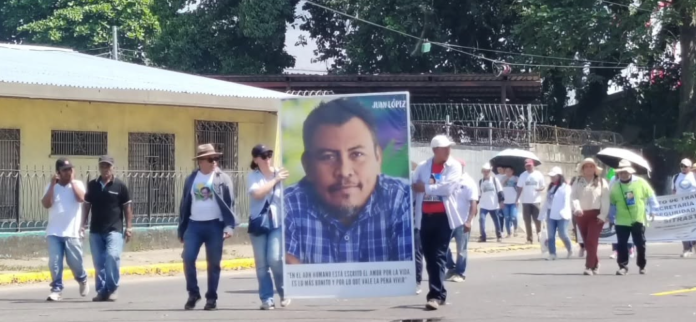
Three alleged perpetrators arrested in the murder of human rights defender Juan López in Honduras

Photo: Juan López.

This hour we are following a media conference being held by the Tocoa Municipal Committee for the Defence of Common and Public Goods (Comité Municipal en Defensa de los Bienes Comunes y Públicos).

That media conference can be seen here.

The Public Ministry of Honduras has posted: “The Public Prosecutor’s Office, through the Special Prosecutor’s Office for Crimes Against Life (FEDCV) in coordination with members of the Police Directorate of Investigations (DPI), executed the arrest of three alleged perpetrators of the murder of human rights and environmental defender, Juan Antonio López.”

Their statement adds: “They are the former mayor of Tocoa, Adán Fúnez Martínez, Juan Ángel Ramos Gallegos and Héctor Eduardo Méndez; whom the Public Prosecutor’s Office also accuses of the crime of association to commit a crime to the detriment of other fundamental rights.”

Infobae also reports: “The Public Prosecutor’s Office confirmed that Adán Fúnez is being investigated as the alleged mastermind of the murder of environmentalist Juan López, within a line of investigation that is still open and has already included the arrest of other alleged suspects.”

That article adds: “The spokesman for the Public Prosecutor’s Office, Yuri Mora … said that investigations cover not only the material authors of the crime, but also possible masterminds, with the aim of fully clarifying the structure behind the murder.”

Juan López was the coordinator of the Tocoa Municipal Committee for the Defence of Common and Public Goods. He was killed on September 14, 2024, inside his vehicle after leaving a church in the city of Tocoa.

With PBI-Honduras, PBI-Canada coordinator Brent Patterson visited Tocoa and Guapinol on October 29-30, 2024.

Peace Brigades International has accompanied Municipal Committee for the Defence of Common and Public Goods of Tocoa (CMDBCPT) processes and the defenders of the Guapinol River since January 2019.

This is a developing story that we are following.

CANSEC to include three countries considered “not free”, with documented violations against human rights defenders

Photo: CADSI image promoting the CANSEC event in Ottawa showing the flags of Saudi Arabia (third row, sixth over), Türkiye (fourth row, fourth over) and the United Arab Emirates (fourth row, sixth over).

The Ottawa-based Canadian Association of Defence and Security Industries (CADSI) has published a partial list of the 60+ international delegations that will be attending the CANSEC “defence, security and emerging technology event” at the EY Centre in Ottawa this coming May 27-28, 2026.

In that list published by CADSI, three countries are listed by the Washington, DC-based Freedom House as “not free”.

Those countries are Saudi Arabia (with a score of 9/100), Türkiye (32/100), and the United Arab Emirates (18/100).

The Dublin-Brussels-Mexico City-based human rights organization Front Line Defenders notes:

Saudia Arabia: “Human rights defenders, activists and individuals who criticise government policies or express dissent or diverging opinion to those of the authorities are subjected to harassment, surveillance, arbitrary detention, smear campaigns, prolonged and unfair trials. Family members of HRDs are also targeted and subjected to intimidation and harassment at the hands of the authorities.”

Türkiye: “Human rights defenders (HRDs) in Türkiye have been subjected to judicial harassment, including criminal prosecution, violent attacks, threats, surveillance, prolonged arbitrary detention, and ill-treatment. In the aftermath of an attempted coup in July 2016, the environment for the work of HRDs deteriorated even further. Through the wide-ranging use of State of Emergency laws, the Turkish government has significantly infringed on the rights to freedom of expression, media, assembly, and association, and has particularly restricted the liberty of those engaged in human rights work.”

United Arab Emirates: “The persecution of human rights defenders (HRDs) in the UAE is systematic. Since 2011, the state has intensified its crackdown on freedom of association, assembly and freedom of expression. HRDs and members of their families are subjected to forced disappearance, prolonged arbitrary detention, torture, judicial harassment and unfair trials, travel ban, physical and digital surveillance and arbitrary dismissal from work.”

“Partly free” countries

Freedom House also ranks seven additional countries that will be at CANSEC as “partly free”. Those countries are Hungary, Mexico, Pakistan, Peru, the Philippines, Singapore, and Ukraine (with an average freedom score of 54/100).

Israel and international human rights law

And while Freedom House gives Israel a score of 73/100 for freedom, we do note that there are concerns about its presence at CANSEC this year given the International Court of Justice ruling (that the claim of Israel committing genocide against the Palestinian people is “plausible”), the International Criminal Court ruling (that has issued arrest warrants for Israeli Prime Minister Benjamin Netanyahu and former defence minister Yoav Gallant citing allegations of war crimes and crimes against humanity), and the UN Independent International Commission of Inquiry on the Occupied Palestinian Territory finding (that concluded that Israeli authorities and Israeli security forces committed four of the five genocidal acts defined by the 1948 Convention on the Prevention and Punishment of the Crime of Genocide).

We further note the expert commentary that these findings trigger State obligations within the Genocide Convention and the Arms Trade Treaty.

We also recall that the Committee to Protect Journalists (CPJ) has documented: “The Israel Defense Forces (IDF) has committed more targeted killings of journalists than any other government’s military since CPJ began documentation in 1992.”

Canada’s position

With respect to arms exports to Saudi Arabia, Canada has previously taken the “no substantial risk” position that while Saudi Arabia’s overall human rights record remains problematic, “officials found no credible evidence linking Canadian exports of military equipment or other controlled items to any human rights or humanitarian law violations committed by the Saudi government.”

But as Amnesty International and Project Ploughshares conclude in their report, No Credible Evidence: Canada’s Flawed Analysis of Arms Exports to Saudi Arabia, the federal government’s assessment is “fundamentally flawed” as it misinterprets, or ignores, key pillars of the Arms Trade Treaty.

With respect to Israel, on August 2, 2025, Anita Anand, Canada’s Minister of Foreign Affairs, stated: “Canada has drawn, and will continue to draw, a hard line: since January 2024, we have refused any new permits for controlled goods that could be used in Gaza. Not one has been approved. We went further by freezing all existing permits in 2024 that could have allowed military components to be used in Gaza, and those permits remain suspended today.”

While investigative reporting by The Maple questions this, the Government of Canada has yet to comment on why Israel (along with Israeli weapons companies Elbit Systems and Plasan) will be at CANSEC this year.

Accompaniment

As part of our commitment to promoting education and awareness and the accompaniment of human rights defenders whose lives are at risk, PBI-Canada continues to monitor the implications of the CANSEC arms show in the context of the safety and security of human rights defenders and journalists.

PBI-Canada congratulates Fedepesan and Credhos on landmark court ruling in fight to protect the San Silvestre wetlands

Photo: Fedepesan president Yuli Velásquez commenting on, as Credhos notes, this achievement for the historic struggle of artisanal fishing communities.

This past Saturday May 9, Los Informantes reported: “Yuli Velásquez’s fight against pollution in the San Silvestre Marsh in Barrancabermeja culminated in a landmark ruling in favor of the fishermen and endangered species that inhabit these waters. Tune in this Sunday to #LosInformantes to meet a leader who faced threats for defending the water that sustains hundreds of families.”

A portion of that Los Informantes video report can be seen here. The full video cannot be seen in Canada, but for others here is the link.

The Regional Corporation for the Defence of Human Rights (Credhos) has also highlighted on social media: “This [court ruling] undoubtedly represents an achievement for the historic struggle of artisanal fishing communities, who defend the water, their enterprise, their habitat for subsistence and permanence on the territory.”

Credhos also notes: “Since the year 2022 CREDHOS together with Fedepesan have begun research work, compiling the evidence that Fedepesan has been collecting since its inception on environmental impacts through the Environmental and Community Monitoring in Caño Rosario and Caño San Silvestre.”

The court ruling

On May 6, 2026, Enlace Television reported: “The Administrative Court of Santander issued a ruling that warns of a serious threat to collective environmental rights due to the contamination of Caño Rosario, a key tributary that directly impacts the San Silvestre swamp, a strategic ecosystem in the Barrancabermeja region. According to the ruling, the environmental problem has been intensified by multiple factors, including wastewater discharges, the presence of hydrocarbons and other chemical contaminants that have significantly deteriorated the quality of the water.”

The article continues: “The court ruling mandates the implementation of an environmental monitoring process that includes physicochemical testing of the water, sludge analysis, and detailed studies of ecosystem conditions. These tests must be carried out in certified laboratories to guarantee reliable results. In addition, a period of six months was established from the notification of the sentence to initiate the necessary actions in the Caño Rosario and the San Silvestre swamp, in order to evaluate and mitigate the environmental damage.”

The article also highlights: “The communities see this decision as an important step towards the environmental recovery of Caño Rosario, with the expectation of achieving the cleaning of the tributary and the protection of the natural resources that sustain their economy and way of life.”

Vanguardia further reports: “The Administrative Court of Santander confirmed in second instance the ruling of the popular action filed by the Federation of Artisanal Fishermen, Environmentalists and Tourists (Fedepesan) for the alleged contamination of the El Rosario channel in Barrancabermeja.”

That article notes that the Regional Corporation for the Defense of Human Rights (Credhos) accompanied the popular action.

The Vanguardia article also quotes Yuli Andrea Velasquez, the president of Fedepesan, who says following this court ruling: “As fishing communities we have always been concerned about the state of the water of the El Rosario channel, about all the species that have died day by day in large quantities. Our concern was always that water and sludge tests could be carried out to find out what the fishing communities and the community in general of Barrancabermeja were consuming.”

PBI-Canada visits the Rosario channel

On the morning of Thursday June 30, 2022, PBI-Canada joined with PBI-Colombia as they accompanied Fedepesan and Credhos on a visit by boat on the San Silvestre wetland ecosystem in Barrancabermeja and were shown the impacts on water, wildlife and livelihoods of artisanal fishers.

We also recall that just a few days later, on July 5, 2022, there was an armed attack against Velásquez by two unknown assailants who shot at her, harming her bodyguard. who had been with us that day on the water.

On December 7, 2022, we hosted this webinar with Credhos and Fedepesan to further amplify their concerns about the San Silvestre wetlands.

Accompaniment

The Regional Corporation for the Defence of Human Rights (Credhos) accompanies the Federation of Artisanal Fishermen, Environmentalists and Tourists (Fedepesan). Peace Brigades International has accompanied Credhos since 1994.

From Canada we continue to follow the work of Fedepesan and Credhos with great interest and congratulate them on this landmark court ruling.

PBI-Mexico accompanies the XIV March of National Dignity for the disappeared on Mother’s Day in Mexico City

Photo: PBI-Mexico accompanies the Cerezo Committee as members hold banners with the images of Gabriel Alberto Cruz Sánchez and Edmundo Reyes Amaya. Photo by Comité de Familiares de Detenidos Desaparecidos “Hasta Encontrarlos”.

El Economista reports: “Collectives of searching mothers and relatives of disappeared persons marched on May 10 in Mexico City during the XIV March of National Dignity ‘Mothers Searching for their Sons, Daughters, Truth and Justice’, to demand from the Mexican State results in the searches, justice and attention to the crisis of disappearances in the country. In this context of the mobilization, the Office in Mexico of the United Nations High Commissioner for Human Rights recognized the work of the searching mothers and pointed out that disappearances continue to be one of the main challenges in terms of human rights in Mexico.”

The Guardian now reports: “State actors are involved in disappearances in Mexico at an ‘alarming’ rate, according to a report from the Inter-American Commission on Human Rights (IACHR). The sweeping investigation, to which the Guardian was given exclusive access, presents a dire picture of the crisis of disappearances in Mexico, where more than 130,000 people have gone missing, mostly in the last 20 years since the government declared its war on drug cartels.”

The article adds: “Forced disappearance – where a person is detained, extrajudicially killed by the state and their body then destroyed or hidden – has a long history in Mexico, going back to the country’s so-called dirty war of the 1960s and 70s where dissidents were even thrown out of planes and into the Pacific Ocean.”

The Cerezo Committee has previously explained: “On May 25, 2007, in the city of Oaxaca, Edmundo Reyes Amaya and Gabriel Alberto Cruz Sánchez, members of the Popular Democratic Revolutionary Party-Popular Revolutionary Army (PDR) were arrested and disappeared by various police and military groups.”

Twelve years after their disappearance, Proceso reported: “On May 6, 2019, the Fourth District Court of Amparo in Criminal Matters in Mexico City issued a sentence that recognized ‘the serious violation of human rights’ against Popular Revolutionary Army members ‘by agents of the Mexican State’.”

That decision was appealed by the Attorney General’s Office (FGR) and the Secretariat of National Defence (Sedena), but the First Chamber of the Supreme Court of Justice of the Nation upheld the decision on August 10, 2022.

Photo: PBI-Mexico at the August 10, 2022, ruling.

A Special Search Commission was established on November 3, 2022.

On April 21, 2026, Nadin Reyes Maldonado, daughter of Edmundo Reyes Amaya, met with the United Nations High Commissioner for Human Rights, Volker Türk in Mexico City.

Proceso reports: “Reyes said that the ominous delays in investigations of cases of the so-called ‘dirty war’ were discussed… The defender added that the objective of the collectives was for the High Commissioner ‘to understand the dimension of the problem of forced disappearances in the country and the lack of political will that the Mexican State as a whole has to, first, recognize the problem.’”

Accompaniment

Peace Brigades International began to accompany the Cerezo Committee in 2002.

PBI-Mexico advocacy coordinator Manuel Jabonero and PBI-Canada coordinator Brent Patterson met with Francisco Cerezo Contreras of the Cerezo Committee in Mexico City in February 2026.

PBI-Honduras meets with Arcoíris, expresses concern over delay in Honduras implementing LGBTI+ rights

The Peace Brigades International-Honduras Project has posted on social media:

“This week, we met with Arcoíris to get an update on the security situation facing the LGBTI+ community in Honduras and to assess the status of compliance with the reparations measures ordered in landmark rulings such as the Leonela Zelaya case.

The Inter-American Court of Human Rights’ ruling established the implementation of a procedure for the recognition of gender identity, which would allow transgender people to update their information on identity documents.

At PBI, we express concern over the delay in implementing these reparations measures and emphasize that the right to life, dignity, security, and access to justice are fundamental human rights.”

Leonela Zelaya detained, assaulted by the police

Outright International has explained: “Leonela Zelaya was a trans woman living in Tegucigalpa, Honduras. She was 34, a sex worker, and lived with HIV—conditions that, in 2004, placed her in the direct line of routine policing and abuse. The record reflects that she was detained repeatedly that year, and the Court accepted that she was assaulted by police officers in the context of those detentions. On the night of September 6, 2004, she went out to work; in the early hours of 7 September, a street vendor found her body in Comayagüela, just outside Tegucigalpa—bearing indications of a violent death.”

Vicky Hernández killed by security forces

Outright International has also noted: “Vicky Hernández was a trans woman, a sex worker, and an activist with the Colectivo Unidad Color Rosa, a group working on the human rights of trans people and on HIV prevention. In the early hours after the June 2009 coup d’état in Honduras, as a nationwide curfew took effect and military and police forces flooded the streets, Hernández went to a friend’s house; the next morning, she was found dead. From the outset, the authorities’ handling of the case reflected the prejudice the Court would later identify: in official records she was initially registered as an ‘unknown’ male, despite information that should have allowed her to be identified.”

In June 2021, The Guardian reported: “In a landmark ruling for transgender rights, the Honduras government has been found responsible for the 2009 murder of the trans woman and activist Vicky Hernández.”

“The Costa Rican-based Inter-American court of human rights … has ordered Honduras, which has the world’s highest rate of murders of trans people, to pay reparations to Hernández’s family and implement a sweeping range of measures designed to protect trans people, including anti-discrimination training for security forces and state collection of data on violence against LGBTQ+ people. It also ruled that the state must allow people to alter their gender identity on identification documents and public records. This could set an important precedent for Central America, where most countries do not allow people to legally change their gender.”

Security forces a major threat

On November 1, 2024, PBI-Canada coordinator Brent Patterson met with Jennifer Cordoba, the director of the Muñecas (Dolls) Collective, and Donny Reyes, the director of Asociación Arcoiris, at the Arcoiris office in Tegucigalpa.

Reyes has stated: “The biggest problem that we face is the violence of the state security forces towards the LGBT+ community: the armed forces, the police, the criminal investigation police, military police, municipal police.”

As noted above, Hernández was murdered on June 28, 2009, the first night of the coup. On July 30, 2009, about a month after the coup, The Globe and Mail reported: “Canada is still providing training to members of the Honduran army.”

By February 17, 2015, Sandra Cuffe reported in Ricochet: “Militarization, impunity, and human rights abuses have dominated Honduras since the coup. …Since 2011, Canada has provided the Northern Triangle (Honduras, Guatemala and El Salvador) with $5 million in surveillance and criminal investigation equipment and training to investigate homicides and violent crimes, wrote Department of Foreign Affairs, Trade and Development spokesperson John Babcock in an email to Ricochet.”

That article adds: “Given the alarming frequency of threats and attacks against human rights activists, farmworker movement participants, Indigenous leaders, journalists and others in Honduras, training in surveillance raises concerns. Bertha Oliva, coordinator of the Committee of Relatives of the Detained-Disappeared [COFADEH] in Honduras takes it for granted that human rights activists and social movement organizations are under heavy surveillance.”

PBI-Honduras COPINH coordinator Bertha Zúñiga Cáceres has commented: “We have an army in a country where there’s no armed conflict with any other country. The only conflict in Honduras is a conflict of interests of the richest people with the most historically impoverished people.”

She has backed the proposed US legislation titled The Berta Cáceres Act, named in honour of her mother who was assassinated in March 2016, that states: “The Honduran police are widely established to be deeply corrupt and to commit human rights abuses, including torture, rape, illegal detention, and murder, with impunity.”

It calls on the United States to suspend all “security assistance to Honduran military and police until such time as human rights violations by Honduran state security forces cease and their perpetrators are brought to justice.”

PBI-Canada has highlighted that with Canada exporting $1 billion of “military goods” to the United States every year for the production of weapons there that The Berta Cáceres Act should also apply to Canada.

Accompaniment

The Peace Brigades International-Honduras Project has accompanied Arcoíris, the LGTB Association of Honduras, since July 2015.

Nomadesc amplifies Global Sumud Flotilla call to release human rights defenders Thiago Ávila and Saif Abukeshek

Photo and video: Nomadesc president Berenice Celeita (center) with Global Sumud Flotilla members Ledys Sanjuán and Saif Abukeshek in Cali, Colombia, December 2025.

The Association for Social Research and Action (Nomadesc) has posted on social media:

“While the Palestinian people continue to face bombings, forced displacement, hunger, and a devastating humanitarian crisis in Gaza, thousands of people around the world continue to raise their voices to denounce the genocide and demand an end to the violence against Palestine.

On April 30, Thiago Ávila and Saif Abukeshek were arrested during international solidarity actions and human rights advocacy. The Global Sumud Flotilla demands their immediate release and guarantees for those who stand in solidarity with and denounce the situation facing the Palestinian people.

Today, it is urgent to add more voices, break the silence, and continue denouncing the ongoing genocide. Solidarity with Palestine cannot be criminalized.”

Thiago Ávila and Saif Abukeshek

Just prior to the departure of the Flotilla from Spain on April 12, Amnesty International stated: “Israeli authorities must ensure safe passage for these unarmed activists and human rights defenders.”

Greenpeace International also explained: “Hundreds of medics, teachers, and eco-builders, with expertise in healthcare, education, and sustainable rebuilding, are sailing to support the people of Gaza.”

On the night of April 29-30, Israel intercepted 22 boats from the Flotilla in the international waters of the Mediterranean Sea and detained nearly 180 people from multiple countries, including two Canadians.

The Hellenic League for Human Rights (HLHR), the International Federation for Human Rights (FIDH) and the World Organization Against Torture (OMCT), within the framework of the Observatory for the Protection of Human Rights Defenders, denounced this raid against the Flotilla by the Israeli military.

The Associated Press has further reported that Israeli authorities had taken two leaders of the Flotilla – Spanish citizen Saif Abukeshek and Brazilian citizen Thiago Ávila – to Israel for questioning. They are being held in Shikma Prison in Israel.

Arbitrary detention of human rights defenders

On May 7, 2026, the Observatory for the Protection of Human Rights Defenders, a partnership of the World Organisation Against Torture (OMCT) and the International Federation for Human Rights (FIDH), “was informed by Adalah (The Legal Center for Arab Minority Rights in Israel) of the abduction, arbitrary detention and acts of ill-treatment against Thiago Ávila e Silva Oliveira and Saif Abukeshek, two human rights defenders involved in the Global Sumud Flotilla (GSF).”

The Observatory adds: “Thiago Ávila and Saif Abukeshek reported physical violence, degrading treatment, and being held for prolonged periods in stress positions by Israeli military forces while at sea.”

The Observatory has called on the Israeli authorities to: “Ensure that human rights activists supporting the Palestinian people, as well as all human rights defenders, can carry out their activities freely and without fear of reprisals.”

Accompaniment

Peace Brigades International has accompanied Nomadesc since 2011, and its president Berenice Celeita since 1999.

Photo: PBI-Canada coordinator Brent Patterson with Berenice Celeita, translator Michael Carty, and Rachel Lim from Amnesty International Canada in Ottawa, October 2023.

PBI-Canada is following the Perseverance and her Canadian crew of human rights defenders via the Global Sumud Flotilla tracker here.

We also continue to highlight the concern that export of weapons, components and technology can be linked directly to violations of the safety and security of human rights defenders globally.