

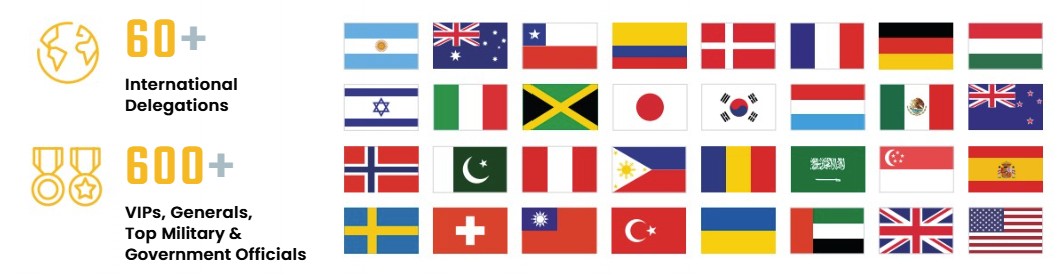
Photo: CADSI image promoting the CANSEC event in Ottawa showing the flags of Saudi Arabia (third row, sixth over), Türkiye (fourth row, fourth over) and the United Arab Emirates (fourth row, sixth over).
The Ottawa-based Canadian Association of Defence and Security Industries (CADSI) has published a partial list of the 60+ international delegations that will be attending the CANSEC “defence, security and emerging technology event” at the EY Centre in Ottawa this coming May 27-28, 2026.
In that list published by CADSI, three countries are listed by the Washington, DC-based Freedom House as “not free”.
Those countries are Saudi Arabia (with a score of 9/100), Türkiye (32/100), and the United Arab Emirates (18/100).
The Dublin-Brussels-Mexico City-based human rights organization Front Line Defenders notes:
Saudia Arabia: “Human rights defenders, activists and individuals who criticise government policies or express dissent or diverging opinion to those of the authorities are subjected to harassment, surveillance, arbitrary detention, smear campaigns, prolonged and unfair trials. Family members of HRDs are also targeted and subjected to intimidation and harassment at the hands of the authorities.”
Türkiye: “Human rights defenders (HRDs) in Türkiye have been subjected to judicial harassment, including criminal prosecution, violent attacks, threats, surveillance, prolonged arbitrary detention, and ill-treatment. In the aftermath of an attempted coup in July 2016, the environment for the work of HRDs deteriorated even further. Through the wide-ranging use of State of Emergency laws, the Turkish government has significantly infringed on the rights to freedom of expression, media, assembly, and association, and has particularly restricted the liberty of those engaged in human rights work.”
United Arab Emirates: “The persecution of human rights defenders (HRDs) in the UAE is systematic. Since 2011, the state has intensified its crackdown on freedom of association, assembly and freedom of expression. HRDs and members of their families are subjected to forced disappearance, prolonged arbitrary detention, torture, judicial harassment and unfair trials, travel ban, physical and digital surveillance and arbitrary dismissal from work.”
“Partly free” countries
Freedom House also ranks seven additional countries that will be at CANSEC as “partly free”. Those countries are Hungary, Mexico, Pakistan, Peru, the Philippines, Singapore, and Ukraine (with an average freedom score of 54/100).
Israel and international human rights law
And while Freedom House gives Israel a score of 73/100 for freedom, we do note that there are concerns about its presence at CANSEC this year given the International Court of Justice ruling (that the claim of Israel committing genocide against the Palestinian people is “plausible”), the International Criminal Court ruling (that has issued arrest warrants for Israeli Prime Minister Benjamin Netanyahu and former defence minister Yoav Gallant citing allegations of war crimes and crimes against humanity), and the UN Independent International Commission of Inquiry on the Occupied Palestinian Territory finding (that concluded that Israeli authorities and Israeli security forces committed four of the five genocidal acts defined by the 1948 Convention on the Prevention and Punishment of the Crime of Genocide).
We further note the expert commentary that these findings trigger State obligations within the Genocide Convention and the Arms Trade Treaty.
We also recall that the Committee to Protect Journalists (CPJ) has documented: “The Israel Defense Forces (IDF) has committed more targeted killings of journalists than any other government’s military since CPJ began documentation in 1992.”
Canada’s position
With respect to arms exports to Saudi Arabia, Canada has previously taken the “no substantial risk” position that while Saudi Arabia’s overall human rights record remains problematic, “officials found no credible evidence linking Canadian exports of military equipment or other controlled items to any human rights or humanitarian law violations committed by the Saudi government.”
But as Amnesty International and Project Ploughshares conclude in their report, No Credible Evidence: Canada’s Flawed Analysis of Arms Exports to Saudi Arabia, the federal government’s assessment is “fundamentally flawed” as it misinterprets, or ignores, key pillars of the Arms Trade Treaty.
With respect to Israel, on August 2, 2025, Anita Anand, Canada’s Minister of Foreign Affairs, stated: “Canada has drawn, and will continue to draw, a hard line: since January 2024, we have refused any new permits for controlled goods that could be used in Gaza. Not one has been approved. We went further by freezing all existing permits in 2024 that could have allowed military components to be used in Gaza, and those permits remain suspended today.”
While investigative reporting by The Maple questions this, the Government of Canada has yet to comment on why Israel (along with Israeli weapons companies Elbit Systems and Plasan) will be at CANSEC this year.
Accompaniment
As part of our commitment to promoting education and awareness and the accompaniment of human rights defenders whose lives are at risk, PBI-Canada continues to monitor the implications of the CANSEC arms show in the context of the safety and security of human rights defenders and journalists.

