Home Blog Page 8

PBI co-founder George Willoughby was on The Golden Rule in May-June 1958 that inspired Greenpeace, other peace protest boats

Photo: The Golden Rule crew (left-right): Albert S. Bigelow, Orion Sherwood, William Huntington, and George Willoughby.

George Willoughby was one of the signatories of a letter dated January 12, 1981, that invited people to help form an organization that would become Peace Brigades International at its founding meeting on Grindstone Island, 100 kilometres south of Ottawa, Canada in September 1981.

Willoughby maintained a long association with PBI and attended the PBI General Assembly north of Toronto, Ontario in June 1992 that approved the first Principles and Mandate statement for the organization.

Photo: Willoughby, with Steve Kaal, at PBI General Assembly, Toronto, 1992.

On May 1, 1958, Willoughby, along with Albert Bigelow (the captain), William R. Huntington (the first mate) and Orion Sherwood set sail on The Golden Rule sailboat from Honolulu towards the Marshall Islands to prevent an atomic weapons test.

The crew was arrested by the US Coast Guard five nautical miles from Hawaii.

On June 4, 1958, with Bigelow still in jail, Willoughby, Huntington and Sherwood were joined by Jim Peck in a second attempt to get to the Marshall Islands but were arrested and sentenced to sixty days in jail.

National Geographic has reported: “The Quakers who planned the Golden Rule’s 1958 voyage designed it as an act of civil disobedience to call attention to atmospheric nuclear weapons testing.”

That article highlights: “The voyage was halted by the U.S. Coast Guard and the captain, Albert Bigelow, a Quaker and former U.S. Navy lieutenant commander, was thrown in jail. The international publicity this confrontation attracted helped spur the growing opposition to nuclear tests and the arms race.”

It further notes: “The public demonstrations these direct actions provoked around the country caused a reluctant [US President Dwight D.] Eisenhower to suspend atomic tests in August 1958.”

The War Resisters League has also commented: “That opposition [generated by The Golden Rule also] eventually lead to the 1963 Partial Nuclear Test Ban Treaty prohibiting nuclear testing in the atmosphere, underwater or in outer space.”

George Lakey (who was a PBI volunteer in Sri Lanka in 1989) has written in Waging Nonviolence: “When the Golden Rule was stopped by the U.S. government near Hawaii, Earle and Barbara Reynolds used their family’s sailing ship the Phoenix to continue the voyage toward the testing area. A decade later, activists with A Quaker Action Group, or AQAG, in turn used the Phoenix to bring medical aid to Vietnamese civilians suffering from the U.S. Naval blockade of the Vietnamese coast. Taking its cue from the Golden Rule voyage a decade earlier, the Phoenix’s voyages to Vietnam had the aim of launching a mass movement at a moment when none existed.”

Other Words has also noted: “The Golden Rule was the forebear of all the peace and environmental protest boats that followed, from the Sea Shepherds to Free Gaza. The connection to Greenpeace is direct.”

That article shares: “In 1971, Golden Rule supporter Marie Bohlen attended a meeting in Vancouver, Canada of people concerned about nuclear weapons testing. She suggested a voyage toward the U.S. nuclear test site in the Aleutian Islands á la the Golden Rule. Soon, the rusty trawler Phyllis Cormack was renamed the Greenpeace and headed north toward the Alaskan Archipelago. The rest, as they say, is history.”

In the spring of 2026, the Greenpeace ship Arctic Sunrise provided support to the Global Sumud Flotilla sailing with aid to Gaza.

On May 2, 2026, PBI-Canada observed rally and march in Ottawa demanding the release of Global Sumud Flotilla human rights defenders from Israeli military custody. We see the link between this presence in 2026 and The Golden Rule in 1958.

On our 45th anniversary, PBI-Canada remembers and reaffirms the role of George Willoughby in the formation of Peace Brigades International and the inspiration his example provided for other initiatives that promote peace with justice.

Further reading

The Golden Rule and Phoenix voyages in protest of U.S. nuclear testing in the Marshall Islands, 1958

Golden Rule Project: Sailing for Peace in a Time of War

Restored Anti-Nuke Sailboat Launches Again on a Peace Mission.

Photo: George Willoughby.

PBI-Guatemala accompanies REDSAG and the Pajales Sis community council on tour, observes damage by local sugar mill to river

The Peace Brigades International-Guatemala Project has posted on social media:

“Today, #PBI is accompanying members of REDSAG [the Network for the Defense of Food Sovereignty] and the Pajales Sis community council on a tour of the community in the municipality of Andrés Villaseca. During the tour, we have observed the damage caused by the construction of gabions by the local sugar mill to divert the river’s course, and the subsequent destruction wrought by the river’s force. This puts the community at risk of potential flooding. We also took the opportunity to see how work is progressing on the road that will connect the community to the main road, as well as the water tank which, thanks to the efforts of the community’s political council, they have managed to secure.”

Gabions can be understood as wire mesh cages filled with materials like rocks, stones, or concrete, commonly used in civil engineering for erosion control, retaining walls, and river bank stabilization.

PBI-Guatemala has previously explained: “The Pajales Sis community is located between the El Pilar and Tululá sugar refineries. José Miguel Sánchez López, a member of the Pajales Sis Community Development Council (COCODE), has been speaking out for years about the consequences of both sugar refineries’ poor practices, which have affected community members’ lives. As a result, he has been targeted for criminalization by the sugar refineries.”

Canada

In April 2026, the United States Department of Agriculture (USDA) noted: “Guatemala’s main raw and refined sugar exports are destined for the United States, followed by Taiwan and Canada.”

This USDA chart suggests the most recent figure is that Canada imported 176,956 metric tons of sugar from Guatemala.

Previous USDA reports indicate Canada imported 52,790 metric tons of sugar from Guatemala in 2023/24, 85,900 metric tons in 2022/23, 87,050 metric tons in 2021/22, 113,650 metric tons in 2021, 269,770 metric tons in 2020, and 292,787 metric tons in 2019.

PBI-Canada visit

On May 2-4, 2023, PBI-Canada visited the South Coast of Guatemala to learn more about the impacts of sugar production on communities and their access to water.

At that time, PBI-Canada saw diminished and polluted rivers attributed to sugar production and visited numerous communities that shared stories about how the water required for sugar mills had dried wells and gardens.

Photo: The entrance to the El Pilar sugar mill. Photo by PBI-Canada.

Photo: PBI-Canada hears testimony in the community of Pajales Sis about the impacts of the El Pilar sugar mill, May 2, 2023.

Accompaniment

PBI has accompanied members of the REDSAG Political Council since September 2025, especially José Miguel Sánchez López from the Pajales Sis community in San Andrés Villa Seca, Retalhuleu, and sisters Carmelina and Estela Chocooj from the Soledad Sayaxut community in Cobán, Alta Verapaz.

We continue to follow this.

Further reading: How does sugar from Guatemala arrive in Canada? (PBI-Canada article, March 3, 2022).

PBI-Colombia accompanies the CSPP at the International Workers’ Day march in Bogota

The Peace Brigades International-Colombia Project has posted on social media:

“On May 1, we accompanied the Committee for Solidarity with Political Prisoners (CSPP) in Bogotá during the International Workers’ Day march.

The CSPP was present at various points along the march as the Verification and Intervention Commission (CVI), as part of the Defend Freedom Campaign, with the aim of denouncing arbitrary arrests, judicial persecution and the criminalization of social protest in Colombia, as well as guaranteeing and defending the right to protest.

We reaffirm that protesting is a fundamental right and that human rights support is essential to protect life, dignity and social mobilization.”

The Spanish news agency EFE reported: “As part of the commemoration of International Workers’ Day, thousands of workers, trade unions and social groups took to the streets of the Colombian capital on Friday [May 1] to participate in a mobilization that traveled along important roads in the city.”

El Pais adds: “The country’s capital is the traditional central axis of the demonstrations.”

The call for the march was made by the National Unitary Command, a coalition of national trade union centres and pensioners federations, with the participation of the Central Union of Workers (CUT), the Confederation of Workers of Colombia (CTC) and the General Confederation of Labour (CGT).

CityTV further notes: “Some attendees pointed out that participating in this day is a personal tradition and an act of vindication. The demonstrators stressed the importance of making community work visible, demanding decent working conditions and promoting respect for workers’ rights, including fair wages and work-life balance.”

Violence against unions

Justice for Colombia has highlighted: “In March 2023, the Petro government made history by formally recognizing the trade union movement as a collective victim of the decades-long armed conflict. …[His government recognized that] trade unions were systematically and violently targeted for decades with governments playing a major role in widespread killing that aimed to eradicate organized labour.”

That article adds: “For over half a century, Colombian trade unionists faced barely comprehendible levels of violence. Between 2018 and 2023, trade unionists suffered 15,810 human rights violations: 3,323 murders, 449 attempted murders, 254 forced disappearances, 7,884 death threats and 1,987 forced displacements. Colombia accounted for over 60 per cent of worldwide killings of trade unionists during this entire period.”

It further notes: “Although attacks on trade unionists have fallen since peaking in the 1990s and 2000s, Colombia remains the world’s deadliest country for organized labour, according to this year’s Global Rights Index from the International Trade Union Confederation (ITUC).”

Accompaniment

Peace Brigades International has accompanied the Committee for Solidarity with Political Prisoners (CSPP) since 1998.

More photos from May 1, 2026.

Webinar – Shut It Down: Global Actions Disrupting the Arms Trade

On May 7, Peace Brigades International-Canada coordinator Brent Patterson moderated the “Shut It Down: Global Actions Disrupting the Arms Trade” webinar featuring movement activists from around the world.

This is part of PBI’s commitment to anticipatory accompaniment, the prevention of violence against human rights defenders around the world, specifically those whose safety is endangered by the police, military and state security forces.

The webinar was organized jointly by the Shut Down CANSEC campaign and the International League of Peoples’ Struggle (ILPS).

To watch the video of the webinar (available until May 15), click here.

The panelists included activists from the United Kingdom, Spain, France and Canada. Click on the bolded links below to follow them on social media.

Rosie Lucente – Shut Down CANSEC (Canada): “A campaign exposing and opposing CANSEC: The largest arms dealer convention in Canada.” Rosie highlighted the community campaign organizing a mass mobilization to shut down the annual CANSEC arms show in Ottawa. The next CANSEC takes place on May 27-28, 2026.

Kirsten Bayes – Campaign Against Arms Trade (United Kingdom): “a UK-based organisation working to end the international arms trade. Nominated for the 2021 Nobel Peace Prize.” Kirsten noted the biannual effort to shut down the DSEI (Defence and Security Equipment International) arms fair in London. The next DSEI takes place on September 7-10, 2027.

Laura Ferrer – Desarma Madrid (Spain): “Platform for the demilitarisation of Madrid. Against arms fairs and other events.” Laura noted the biggest arms fair in Spain is the biannual FEINDEF (International Defence & Security Exhibition). The next FEINDEF takes place in Madrid on May 18-20, 2027.

Laura – Stop Arming Israel (France): “More than 30 Palestinian trade unions have launched the appeal ‘End all complicity. Stop arming Israel’. Let’s spread the word!” Laura said that the biggest biannual arms fair in France is Eurosatory. The next Eurosatory takes place in Paris on June 15-19, 2026.

Simon Black – Labour Against the Arms Trade (Canada): “Coalition of peace and labour activists working to end Canada’s participation in the international arms trade. For arms conversion and a just transition.” Simon highlighted the “hot cargo” resolution at the upcoming Canadian Labour Congress (CLC) convention on May 11-15, 2026, in Winnipeg. Palestinian trade unions have been clear: to stop the genocide, trade unions in the West must refuse all forms of collaboration with Israel.

At this time, we recall that Amnesty International has repeatedly stated: “Canada continued to export arms and military equipment to countries despite lack of accountability for past violations and substantial risks that they could be used in serious violations of international human rights and humanitarian law.”

We continue to follow these issues.

PBI-Colombia accompanies dhColombia at hearing for young man killed by the ESMAD riot police during the 2021 national strike

The Peace Brigades International-Colombia Project has posted on social media:

“Here at PBI Colombia, we are accompanying the Associated Network of Human Rights Defenders (dhColombia) at the hearings in the case of Cristian Castillo de la Ossa, a young man killed by the Esmad [Mobile Anti-Riot Squadron] in 2021.

Today, the Attorney General’s Office dismissed and disqualified two former members of the Esmad for their role in Cristian’s death and in the serious injuries sustained by other people who were at the protest.

DH Colombia will continue to demand the responses it considers most just for this type of crime and, in this way, continue to contribute to the reparation for the families who are still demanding justice for all victims of police repression.

In the photo, his parents Edward and Sixta, alongside members of the Bogotá team.”

In June 2023, dhColombia explained on their website: “Two years ago, the young Cristian David Castillo de la Ossa, 23 years old, was extrajudicially executed. Cristian David is one of the many fatalities of the 2021 national strike. On this occasion, on June 22 in the Suba sector, northwest of Bogotá, Cristian David was killed by a member of the Mobile Anti-Riot Squad – ESMAD – who fired a grenade launcher in a direct and linear manner, violating the parameters and protocols defined nationally and internationally, which hit the young man’s head.”

dhColombia has now commented:

“Although this organization, which advocates for victims of state abuse, regards the length of the sentence imposed as a step forward compared to similar cases, it considers that the disciplinary justice system’s response remains inadequate and re-victimizing, given that the Attorney General’s Office could have extended the sentence to 20 years. For this reason, an appeal will be lodged to secure a fairer outcome at the appeal stage.”

Following the court ruling, Semana reported: “Videos, testimonies, forensic and laboratory reports, and an autopsy led the Attorney General’s Office to impose a sanction of disqualification and dismissal of 12 years against patrolman Gonzalo Moreno, for the death of the young Cristián David Castillo de la Ossa, which occurred on June 22, 2021, in the midst of the demonstrations that were taking place around the Portal de Suba. in Bogotá. The initial ruling said that Patrolman Moreno would have fired a grenade launcher rifle that hit a gas canister at Castillo de la Ossa, who was passing through the area. Despite medical efforts, the young man passed away at 12:38 a.m. on June 23.”

Minuto60 further reports: “The Ordinary Disciplinary Chamber of Trial made the decision to dismiss the patrolman and sanction him with disqualification for 12 years from holding public office and the measure removes him from the Police and prevents him from working with the State during that period.”

That article adds: “The disciplinary process advanced in parallel with other judicial investigations, while relatives of the victim insisted that it was a homicide and not an isolated event. The decision of the Attorney General’s Office comes several years after the events and is interpreted as a step in the recognition of individual responsibilities within a broader context of questioning the actions of the public forces during that period.”

Dismantle ESMAD

Several PBI accompanied organizations – including dhColombia, the Association for Social Research and Action (Nomadesc), the Committee in Solidarity with Political Prisoners (CSPP), and the Regional Corporation for the Defence of Human Rights (Credhos) – have called for the ESMAD to be dismantled.

In May 2021, the Canadian Labour Congress (CLC), the Public Service Alliance of Canada (PSAC) and the National Union of Public and General Employees (NUPGE) supported the call for the dismantling of the ESMAD.

In June 2022, then-presidential candidate Gustavo Petro promised to dismantle the riot squad. Petro was sworn in as the President of Colombia on August 7, 2022. In June 2023, the Petro government changed the name of the ESMAD to the Dialogue and Order Maintenance Unit (UNDMO).

At least three PBI accompanied organizations – including the CSPP, the José Alvear Restrepo Lawyers Collective (CCAJAR), and the Corporation for Judicial Liberty (CJL) – stated that this reform was insufficient.

Accompaniment

Peace Brigades International has been accompanying the Associated Network of Human Rights Defenders (dhColombia) since its founding in 2016, and Jorge Molano, one of its founders, since 2009.

PBI-Colombia accompanies Justice and Peace on visit to Putumayo, including with two days with ADISPA

The Peace Brigades International-Colombia Project has posted on social media:

“At the end of April, we accompanied @justiciapazcolombia in Putumayo. For a week, together with the Inter-Church Commission for Justice and Peace (JyP), we first visited the Nasa people of Putumayo, comprised of 38 communities in Putumayo and one in Nariño, with an approximate population of 8,000 Nasa indigenous people. Then, during our visit, we learned about the organizational processes of the Ancurá Civil Society Reserve Zone (ZRSC) and the Putumayo Peasant Association (ACADISP). Finally, we spent two days with the Association for Integral and Sustainable Development of the Amazonian Pearl (ADISPA) in the participatory development of its Sustainable Development Plan, aimed at improving the quality of life, protecting the environment, and strengthening the organizational structure in a territory of more than 22,000 hectares in the Amazon.

These spaces allowed us to learn about and listen directly to the communities, their processes, and their needs, as well as share who we are at PBI, our mandate, and the work we do.”

We continue to follow this.

PBI-Mexico and PBI-Honduras seek former volunteers to support field teams with May 11 and May 13 deadlines

Two Peace Brigades International entities are seeking former volunteers to support the work of their field teams in Mexico and Honduras.

MEXICO – May 11

PBI-Mexico has posted: “The Mexico Project is seeking former volunteers interested in returning to the field to support the Field Team.”

They add: “Currently, the MEP has only one Field Team based in Cuernavaca, Morelos, from where mobile teams travel to the states of Sonora, Puebla, Michoacán, and occasionally to Oaxaca and Mexico City. However, we are in the process of opening a second Field Team headquarters in Hermosillo, Sonora. The opening will be in the fall, but related activities are already underway. Therefore, we are looking for motivated individuals with a strong commitment to PBI’s mandate and an interest in participating in the process of establishing a new Field Team, as well as a desire to strengthen PBI’s work in Mexico for a period of 6 months.”

The deadline to apply is May 11. Interviews will be held between May 12 and May 22. The start date is preferably between May 25 and June 13, 2026.

Further details are here.

HONDURAS – May 13

And PBI-Honduras has posted: “The PBI Honduras Project is calling on former volunteers with experience of working with PBI in Latin America to join our field team from June this year. The period we need to cover is between 4 and 6  months.”

The deadline to apply is May 13. Interviews will be held between May 18 and 21. The start date is mid-June 2026.

Further details are here.

PBI-Canada disappointed by the BC Court of Appeals decision to uphold conviction of Wet’suwet’en Hereditary Wing Chief Dsta’hyl

Video still: Chief Dsta’hyl in the trailer for the documentary “Yintah”.

Dsta’hyl, also known as Adam Gagnon, is the Wet’suwet’en Hereditary Wing Chief of the Likhts’amisyu Clan and a human rights defender.

JURIST News reports: “The Court of Appeal for British Columbia unanimously upheld the criminal contempt conviction against Chief Dsta’hyl (Adam Gagnon) on Tuesday [April 28]. He was found in breach of a court injunction by protesting against a pipeline project in the territories of the Wet’suwet’en First Nation.”

PBI-Canada laments this decision and is concerned that the continued use of injunctions and marginalization of Indigenous laws further puts at risk the safety and security of Indigenous land and environmental defenders protecting their lands and waters from extractive megaprojects.

The use of injunctions against Indigenous rights

The JURIST News article continues: “At issue in the appeal was whether Chief Dsta’hyl could make a defense on the ground that he was acting in accordance with a co-existing Indigenous legal order.”

The article further explains: “In 2019, the British Columbia Supreme Court issued an injunction banning protests in the construction area of the Coastal GasLink pipeline project. Defying the injunction, Chief Dsta’hyl organized a blockade in an attempt to halt the construction in 2021.”

But University of Ottawa associate law professor Aimée Craft – an expert on Indigenous laws, treaties and water – says: “What the injunction hasn’t addressed … is the conflict of laws issue between Indigenous legal orders and … Western legal systems.”

Further commenting on the use of injunctions, professors Shiri Pasternak and Irina Ceric have written: “It is now increasingly clear that the injunction is a legal tool of political expediency. It has an almost arbitrary authority to empower law enforcement to contain and criminalize people by securing vague geographical boundaries and broad powers of removal, often indefinitely. In the hands of industry and governments alike, the injunction, still billed as an extraordinary legal remedy, has emerged as the all-too-ordinary response to Indigenous assertions of jurisdiction and solidarity.”

After examining 100 cases across Canada, the Yellowhead Institute found that 76 per cent of injunctions filed against First Nations were granted, while 81 per cent filed by First Nations against corporations were denied.

The Yellowhead Institute report comments: “When First Nations contest the authority of the province or the regulatory processes, like environmental assessment, that fail to acknowledge their lack of consent, companies take advantage of a legal system built to protect the interests of property. Injunctions have worked as a blunt instrument in opposition to Indigenous law.”

Chief Dsta’hyl designated a prisoner of conscience

The actions by Chief Dsta’hyl in violation of an interlocutory injunction prohibiting anyone from physically impeding construction of the TC Energy Coastal GasLink fracked gas pipeline took place between October 17 and 26, 2021. He was convicted on February 20, 2024. The Crown had sought 60 to 90 days in jail for him. He was sentenced on July 3, 2024, to two months of house arrest.

On July 31, 2024, Amnesty International stated that it had “made the unprecedented decision to designate Likhts’amisyu Clan Wing Chief Dsta’hyl of the Wet’suwet’en Nation as the first-ever designated Amnesty International prisoner of conscience in Canada.” At that time, Ana Piquer, Americas Director at Amnesty International, commented: “The Canadian state has unjustly criminalized and confined Chief Dsta’hyl for defending the land and rights of the Wet’suwet’en people.”

Land defenders oppose PRGT

We continue to follow this notably in the context of the Government of Canada’s proposed fast-tracking of megaprojects including the construction of the Prince Rupert Gas Transmission (PRGT) fracked gas pipeline opposed by the Gitxsan and Gitanyow nations in northern British Columbia.

If that pipeline receives fast-tracked approval from the Government of Canada-established Major Projects Office (MPO), and if it receives a final investment decision (FID) enabling it to move forward, Gitanyow land and environmental defenders have vowed to establish a blockade to stop its construction.

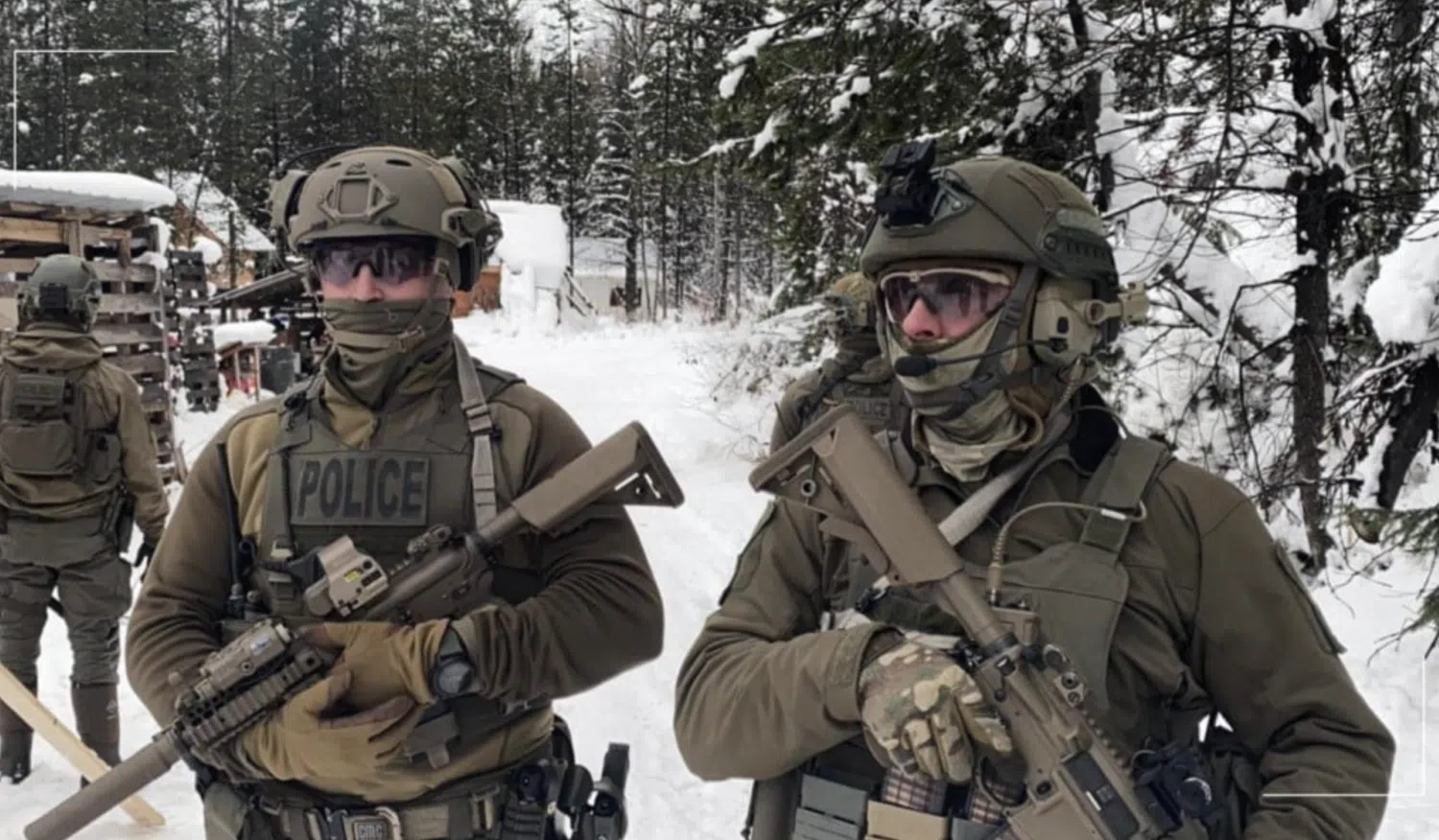
PBI-Canada is concerned that a repeat scenario could unfold in which an injunction is imposed that marginalizes Indigenous rights and the Royal Canadian Mounted Police (RCMP) deploy their Critical Response Unit-British Columbia (CRU-BC) in a militarized enforcement action that uses violence to repress Indigenous land defenders upholding their laws and rights on their territories.

On May Day 2026, workers face threats and attacks in Mexico, Colombia, Honduras and Guatemala

Photo: The Regional Corporation for the Defence of Human Rights (CREDHOS) at the May Day march in Barrancabermeja, Colombia. The t-shirt says: “Workers of the world united in defence of life and dignity.”

On May Day 2026, Peace Brigades International-Canada remembers that union activists continue to face attacks and threats on their lives

Union leader killed in Sinaloa, Mexico

The day before May Day, Homar Salas Gastélum, the elected leader of the Union of Workers at the Service of the City of Culiacán (STASAC), was shot dead at his home in the state of Sinaloa, Mexico.

Journalist Rosario Castagnet comments: “The event does not occur in isolation. In Sinaloa, one of the historical epicenters of drug trafficking in Mexico, violence is articulated with political and economic disputes that exceed the criminal. The unions, in this scheme, function as key spaces of power, since they manage employment, resources and relations with the State. Salas’ death is part of this crossroads between local politics, informal economy and territorial control.”

El Pais also notes: “In one of his last publications, Salas had made a call for Workers’ Day on May 1 with the members of the union to march through Culiacán.”

Video still: The Cerezo Committee and the Labor human rights schools of the Committee Cerezo Mexico (OLEP) march on May Day in Mexico City. The banner says: “Dignified work, just salary/fair pay, security.”

Violence against trade unionists in Colombia

On May 1, El Colombiano reported: “Between 1971 and 2020, more than 20,0000 acts of violence against trade unionists have been recorded in Colombia. The figures were revealed by the Ombudsman’s Office within the framework of Labor Day. Among the types of violence identified are gender-based aggressions, threats against their families, sexual violence, as well as the delegitimization of their leadership and participation in union spaces.”

PBI-Colombia accompanied the Committee for Solidarity with Political Prisoners (CSPP) at the May Day rally in Bogota and is accompanying the Association for Social Research and Action (Nomadesc) as it marks the 5th anniversary of the national strike and social uprising that began on April 28, 2021.

On May 7, 2021, the Canadian union Unifor stated: “Unifor, global labour, NGOs outraged by violent repression of protesters in Colombia since general strikes began Apr 28 against President Iván Duque’s neo-liberal economic plan. According to the New York Times today 24 dead, 87 missing.”

By the time the strike ended on July 15, 2021, there were estimated to be 74 deaths, 111 cases of missing persons, and numerous reports of police brutality. It was also reported that 7 trade unionists were killed that year.

Journalist killed in Guatemala

On April 26, journalist Carlos Humberto Cal Ical was killed in an armed incident in the department of Alta Verapaz.

The International Federation of Journalists (FIP) and the Association of Journalists of Guatemala (APG) condemned this murder.

On May Day, PBI-Guatemala shared on social media a message from the Break the Fear Network Guatemala. That network said: “Behind every news there is effort, vocation and commitment to society. Because reporting isn’t just a job… is a public service that enables people to make decisions, demand rights and build democracy. Journalism is also dignified work. Reporting is not a crime.”

Rural workers at risk in Honduras

And in their International Workers’ Day message, the National Union of Rural Workers (CNTC), which is accompanied by PBI-Honduras, stated: “For us, the farmers, work is not just a daily routine; it is the sacred bond with the land and the tireless struggle for our sovereignty.”

Among the proposals made on May Day by the Confederation of Workers of Honduras (CTH), the General Central of Workers (CGT) and the United Confederation of Workers of Honduras (CUTH), the main labour federations, was the demand for justice in cases of territorial and environmental conflict linked to extractive projects.

The CNTC is affiliated with the Unified Confederation of Honduran Workers (CUTH) which is affiliated with the International Trade Union Confederation (ITUC), along with 150+ labour organizations including the Canadian Labour Congress.

We continue to follow the safety and security situation of union and worker movement activists in Colombia, Mexico, Guatemala and Honduras.

Further reading: PBI-Canada observes vígil for the Toboso 19 outside the Embassy of the Philippines, May Day call to shut down CANSEC in Ottawa (May 2, 2026).

Photo: CREDHOS photo of the Workers’ Trade Union (USO) marching on May Day in Barrancabermeja, Colombia. Between 1986 and 2019, the Truth Commission documented 865 victimizing acts against USO members, including homicides, threats, and exiles. USO is the Canadian union Unifor’s partner union in Colombia.

PBI-Canada observes rally and march in Ottawa demanding the release of Global Sumud Flotilla human rights defenders from Israeli custody

On Saturday May 2, community members gathered outside the Prime Minister’s Office in Ottawa to “defend the Global Sumud Flotilla and continue the global pressure to break the illegal siege on Gaza.”

They later marched through the downtown area on Wellington Street.

Just prior to the departure of the Flotilla from Spain on April 12, Amnesty International stated: “Israeli authorities must ensure safe passage for these unarmed activists and human rights defenders.” Greenpeace International also explained: “Hundreds of medics, teachers, and eco-builders, with expertise in healthcare, education, and sustainable rebuilding, are sailing to support the people of Gaza.”

On the night of April 29-30, Israel intercepted 22 boats from the Flotilla in the international waters of the Mediterranean Sea and detained nearly 180 people from multiple countries, including two Canadians.

The Hellenic League for Human Rights (HLHR), the International Federation for Human Rights (FIDH) and the World Organization Against Torture (OMCT), within the framework of the Observatory for the Protection of Human Rights Defenders, denounced this raid against the Flotilla by the Israeli military.

The Associated Press has further reported that Israeli authorities had taken two leaders of the Flotilla – Spanish citizen Saif Abukeshek and Brazilian citizen Thiago Ávila – to Israel for questioning. They are being held in Shikma Prison in Israel.

The Haifa, Israel-based human rights organization and legal centre Adalah visited the two men in prison on Saturday May 2 and stated that Abukeshek “reported being kept hand-tied and blindfolded, and being forced to lie face-down on the floor from the moment of his seizure until this morning, resulting in bruising to his face and hands”, and that “Avila reported being subjected to extreme brutality by the Israeli military during the seizure of the vessels [including being] dragged face-down across the floor and beaten so severely that he passed out twice”.

In a joint statement, the Governments of Spain and Brazil said: “This flagrantly illegal action by the Israeli authorities outside their jurisdiction constitutes a violation of international law, which may be brought before international courts, and may constitute a criminal offence in our respective national jurisdictions.”

The statement adds: “The Governments of Spain and Brazil demand that the Government of Israel ensure the immediate return of their citizens with full guarantees of safety, and that immediate consular access be granted for their assistance and protection”

The Canadian Press notes the Canadians detained were Marie Tota, a registered nurse from Ontario, and Umir Tiar, a student from Quebec City. A third Canadian, Luiza Noura, was rescued by Greenpeace and Spanish NGO Open Arms after her boat was destroyed and she was left adrift in the sea.

Tota and Tiar have been released in Greece.

Tota says she was subjected to physical and psychological abuse by the Israeli military “for the so-called crime of attempting to deliver humanitarian aid to the people of Gaza”, while Tiar says “some people were beaten, shot at by rubber bullets, some people were dragged on the floor by their arms and by their neck.”

Video stills: Marie Tota and Umir Tiar.

The organization Canadian Boat to Gaza highlights: “Though its own citizens were put into violent danger at the hands of the IOF, the Canadian government has remained absolutely silent.”

While 22 boats were intercepted on April 29-30, there are still 48 boats continuing with the intention of delivering aid to Gaza. One of those boats is the Canadian boat Perseverance that departed from Sicily on Sunday May 3.

PBI-Canada is following the Perseverance and her crew of human rights defenders via the Global Sumud Flotilla tracker here.

Photo: The Canadian crew of the Perseverance is now en route to Gaza.

Video still of First Mate Grace Matheson.