Home Blog Page 250

PBI-Honduras accompanies Committee of Relatives of the Disappeared in Honduras (COFADEH) in call for application of Amnesty Law

COFADEH video: “#Cofadeh accompanied Jose Antonio Torres Meza since he was persecuted by the coup regime in 2009, 12 years later we advocate for his final release, being the first beneficiary of the Legislative Decree 004-2022 for the political prisoners and defenders of National Sovereignty.”

On March 3, PBI-Honduras tweeted: “PBI accompanies @defencofadeh [Committee of Relatives of the Disappeared in Honduras] in the search for the application of the Amnesty Law in cases of human rights defenders. We recall that human rights defenders must be able to carry out their work in conditions of safety and freedom.”

Their Twitter thread adds:

“We applaud the release of José Antonio Torres Meza, the first beneficiary of Legislative Decree 004-2022 for political prisoners and defenders of National Sovereignty.”

Recently @defencofadeh requested the application of Legislative Decree 004-2022 in the case of Vicente Castro, Juan Mejía and Santos Vásquez, defenders of the land and members of the Associative Peasant Company ‘11 de Marzo’.”

Decree 004-2022

COFADEH has explained: “Torres Meza was the first beneficiary of the Legislative Decree 004-2022 for the political prisoners and defenders of National Sovereignty.”

It has also stated: “The Law for the Reconstruction of the State of Law and so that the facts are not repeated, considers Political Amnesty to defenders of the Homeland Sovereignty, among them farmworkers.”

José Antonio Torres Meza

On February 24, Defensores en linea reported: “After 2:00 pm this Thursday, February 24, Torres Meza, 40, met first with his legal defense team from the Committee of Relatives of the Detained-Disappeared in Honduras (COFADEH), then with observers from Peace Brigades International (PBI), with whom he walked to the exit of the ‘El Porvenir’ medium-security prison to merge into a hug with his nephew Mario Joel.”

That article adds: “The lawyers Cynthia Turcios and Dora Oliva, presented the letter of release from prison, so that the first beneficiary of the Political Amnesty according to Legislative Decree 04-2022, can reunite with his four minor children and be able to visit his mother’s grave.”

Torres Meza had lived in exile in El Salvador since 2010 but was arrested on February 11 of this year when he returned to Honduras for his mother’s funeral.

Vicente Castro, Juan Mejía and Santos Vásquez

In March 2019, Business and Human Rights explained: “Two members of the peasant organization Peasant base (Base campesina), located in Siguatepeque, Honduras, José Santos Vázquez and Juan Mejía, were accused of encroachment on land, designated for logging.”

That article adds: “The members of organization are trying to recover the land for the support of their families. The president of the peasant base, Vicente Castro, came to show solidarity with his criminalized comrades, but when he arrived to the court, police arrested him, also, and accused him of the same crimes.”

“The lawyers of the Access to Justice Area of ​​the Committee of Relatives of Detained Persons Disappeared in Honduras (COFADEH), teaming with attorney Elvis Colindres, will assume the defense of the three peasant leaders.”

That article concludes: “According to the president Vicente Castro, at least 120 families that comprise 5 to 6 members each, decided to recover about 90 “manzanas” (blocks) of land in order to plant their crops and support their families.”

We continue to follow this.

Communities protest new permit for Vancouver-based Fortuna Silver Mines in Oaxaca, Mexico

On March 2, Educa Oaxaca highlighted: “Despite the resounding opposition of communities, Minera Cuzcatlán [a subsidiary of the Vancouver-based Fortuna Silver Mines] received permits from SEMARNAT [the Ministry of Environment and Natural Resources] to exploit the territory for ten more years [to 2031].”

It notes the 10-year permit was granted to the mining company on December 14, 2021.

(Avispa clarifies: “The extension of the project was granted for 12 years, being that ‘the useful life will be 10 years’ and two more years for the closing activities.”)

Their post notes: “The 12 communities that make up the Front No to Mining for a Future of All demand the cancellation of the mining project for endangering life, territory and the environment in the region. …The Oaxacan Assembly in Defense of Land and Territory also calls on the Mexican government to cancel the San José mining project.”

This media release further says: “Violent evictions, murders and aggressions against defenders of the territory, hiring of armed groups, community division and polarization, pollution of the environment, mainly of water, invasion of territories, among other violence, have been the ‘benefits’ of the mining project in the region of Central Valleys in the last ten years.”

Estado 20 reports: “Neftalí Reyes Méndez of the Oaxacan Collective in Defense of the Territory, said that this situation represents a betrayal for the peoples because in January 2022 they went to the Semarnat delegation to deliver their signatures and minutes in which they declare their territories as prohibited for mining. And they were never informed that the permits to the mining company had already been delivered since December 2021.”

Reyes Méndez says: “Today we come 12 communities of the Central Valleys to denounce that not only the Semarnat, but also the federal government, has betrayed, lied and stolen from the peoples of the Central Valleys of Oaxaca by granting 12 more years of commercial exploitation of gold and silver in the backs of the communities, behind the backs of the people, behind the backs of the citizens, behind the backs of the communities that are living and suffering the environmental impacts generated by the San José mining project.”

The video of the media conference can be seen here.

Background

In March 2009, residents protested the lack of consultation and consent for the mine by setting up an encampment at the site of the mine. By May of that year, 1,000 state and federal police evicted that encampment using helicopters, tear gas and dogs.

The mine began operating in September 2011.

El Universal reports there have been four deaths and eight people shot in direct relation to the mine between 2010 and 2012.

Community leader Bernardo Méndez was killed on January 18, 2012, after he and others confronted a municipal crew working on a water pipeline they suspected would divert water for use at the mine. And Bernardo Vásquez was killed on March 15, 2012, as he travelled back home from the Oaxaca airport.

The permit for it expired on October 23, 2021. As noted above, the new permit was granted to Fortuna/Cuzcatlan on December 14, 2021.

We continue to follow this situation.

“Twelve communities from the Ocotlán Valley carry out the symbolic takeover of @SEMARNAT_mx in the city of Oaxaca to protest against the 12-year extension of operations granted to the Cuzcatlán mining company. They accuse treason of dependency.”

Front Line Defenders notes the displacement of communities by large-scale agribusiness plantations

Abelino Salvador Mejía will be speaking on this PBI-Canada organized webinar on Sunday March 13 starting at 2:30 pm EDT.

The Front Line Defenders Global Analysis report released today notes: “Communities across the Americas continue to be displaced to make way for corporations to develop large-scale agribusiness plantations, such as for sugar cane and oil palm.”

That report further notes that human rights defenders in Guatemala have been subjected to criminalization for defending their land and territories.

This would include the human rights defenders who have spoken against the environmental harms of the sugar industry on the South Coast of Guatemala.

PBI-Guatemala accompanies Abelino Salvador Mejía, Virgilio García Carrillo, Anabella España Reyes and Flabio Vicente.

They will be in court on Monday March 14.

The day before, Sunday March 13, Abelino will be on a PBI-Canada organized webinar providing an update on their case and situation.

To register for this webinar, click here.

The land given over to sugarcane production in Guatemala has grown by 46 per cent between 2001 and 2012. Notably, sugarcane requires three times more water than corn, the primary subsistence crop for campesinos in Guatemala.

There are eleven sugar mills in Guatemala.

Prensa Comunitaria has reported: “Abelino is one of the four defendants for the crimes of illegal detention, threat and coercion; the person who denounced him claims to be the legal representative of the El Pilar sugar mill.”

That article adds: “Two other sugar mills [Magdalena and Tulula] had also filed charges against him and three other peasants, but they desisted shortly after.”

The Guatemalan Sugar Association (ASAZGUA) has identified Canada as the top export destination for Guatemalan sugar.

And the Canadian Sugar Institute notes: “Raw sugar is transported by ship in bulk cargo to refineries located at deep water ports in Vancouver, Montreal and Toronto.”

Those sugar refineries are Rogers Sugar (Vancouver), Redpath Sugar Ltd (Toronto) and Lantic Inc. (Montreal).

Lantic and Rogers have merged and in June 2021 produced this ESG Report that says: “Rogers’ raw material sourcing is responsible.”

Redpath says its “Corporate Social Responsibility Program is an ongoing commitment to continuous assessment of our supply chain.”

This webinar and continued research will begin to look at the links between Guatemalan sugar exports and Canadian sugar imports.

Abelino says: “We need people to realize that when they consume sugar, it has an impact on the life of the communities and on the right to water for all.”

To register for our webinar happening on March 13, click here.

358 human rights defenders killed in 2021: Front Line Defenders & HRD Memorial

The Guardian: “Mourners carry the coffin of a 14-year-old Colombian environmental activist, Breiner David Cucuñame, who was shot while on patrol with an unarmed group, the Indigenous Guard, in January. Photograph: AFP/Getty.”

In 2021, 358 human rights defenders (HRDs) were killed in 35 countries, including Colombia (where 138 defenders were killed), Mexico (42 killed), Guatemala (11), Honduras (11), Nicaragua (10) and Kenya (1).

The analysis from Front Line Defenders and HRD Memorial found that:

– 59% of HRDs killed worked on defending land, environmental and indigenous peoples’ rights (where their activities disrupted the economic interests of corporations and individuals in mining, logging and other extractive industries)

– 26% of HRDs killed were Indigenous (though they comprise 6% of the global population)

– 18% of HRDs killed identified as women (including trans-women).

Andrew Anderson, the director of Front Line Defenders, says: “In most cases, human rights defenders are threatened. If there was a response when threats are reported and protection measures taken, then surely some of these killings could be prevented.”

He adds: “A lot of the killings in Colombia and Mexico are entirely preventable. They are planned assassinations of people who the perpetrators want to get rid of. They do it with impunity.”

Anderson further notes: “In Colombia, there is a national protection mechanism where the state provides bodyguards and armoured cars to human rights defenders. But that is mainly in the cities. The presence of the Colombian state is limited in rural areas.”

The Americas

The Global Analysis report also notes:

“In Colombia, massive protests in the context of a national strike against a tax reform promoted by the government of President Iván Duque and against police brutality were harshly repressed by police. Local organizations documented at least 47 killings during the nationwide protests.”

“In Mexico, HRD Memorial project partners Comité Cerezo and Red TDT documented a stark rise in the number of killings of HRDs in 2021, with more than 30 dedicated to the defence of land rights, the environment or indigenous peoples’ rights.”

“In Honduras, the attacks against and murders of members of the Afro-descendent Garifuna community of Corozal occur at the intersection of various forms of discrimination and stigma against indigenous and Afro-descent people in the country.”

“Communities across the Americas continue to be displaced to make way for corporations to develop large-scale agribusiness plantations, such as for sugar cane and oil palm. In the Petén region of Guatemala, HRDs have been subject to raids in their homes, threats, and criminalisation for defending their land and territories against the expanding palm oil industry.”

“The regime of President Daniel Ortega [in Nicaragua] continued to take extreme steps to shut down civil society organizations, close civic space and ensure that there was no strength left in the opposition or social movements.”

For more, please see the Global Analysis and HRD Memorial reports.

You can also see The Guardian article: More rights defenders murdered in 2021, with 138 activists killed just in Colombia.

Partners in the HRD Memorial include: ACI-Participa (Honduras), Comité Cerezo (Mexico), El Programa Somos Defensores (Colombia); Red TDT (Mexico), UDEFEGUA (Guatemala), Amnesty International, Global Witness and Front Line Defenders.

COPINH and CEHPRODEC welcome Honduran government’s announcement of territory free of open-pit mining

Photo: PBI-Honduras has accompanied CEHPRODEC at annual marches against extractivism.

Two organizations accompanied by PBI-Honduras have welcomed the Honduran government’s announcement on mining.

On February 28, the Council of Popular and Indigenous Organizations of Honduras (COPINH) tweeted: “The Ministry of Energy, Environment, Natural Resources, Environment and Mines of Honduras @MIAMBIENTE_HN cancels the approval of extractivist exploitation permits and declares the entire Honduran territory free of open-pit mining.”

The Honduran Centre for the Promotion of Community Development (CEHPRODEC) has also tweeted: “Honduras says NO to mining with a radical action to review, suspend and cancel environmental licenses, permits and concessions due to a mining moratorium.”

BBC reports: “The new government of Honduras has announced that it will ban open-pit mining in the Central American nation. The government, which was sworn in last month, also said that it would cancel environmental permits for mining operations across the country. It is not yet clear if the cancellation will apply only to new projects or also to those already operating.”

EFE also reports: “Honduras announced on Monday [February 28] the cancellation of the approval of extractivist exploitation permits for ‘being harmful’ against the State and declared itself a country ‘free of open-pit mining’.”

In this statement, the Honduran Ministry of Energy, Natural Resources, Environment and Mines says: “The approval of extractive exploitation permits is canceled, because they are harmful against the State of Honduras, which threaten natural resources, public health and limit access to water as a human right.”

The Ministry says it has declared “the entire Honduran territory free of open-pit mining.”

Reuters further reports: “Honduras will review mining exploration and exploitation permits and declare its territory free of such open-pit activity, the Central American nation’s government said on Monday, as a move to protect its environment.”

This announcement follows the election of Xiomara Castro, who was sworn in as the President of Honduras on January 27 of this year.

Telesur notes: “The initiative of the government of Xiomara Castro materializes the popular demand that for years has caused death and situations of violence to social leaders. At the same time, it places environmental protection above the interests of transnational corporations in accordance with the international standards established in this regard.”

MiningWatch Canada has stated: “The General Mining Law was developed with technical assistance paid for with Canadian overseas development aid. Its passage in 2013 lifted a seven-year moratorium on any new mining projects.”

It has also noted: “This law was developed and passed with strong diplomatic support from the Canadian embassy, and with contributions from the Department of Foreign Affairs and the former Canadian International Development Agency.”

We continue to follow this.

PBI-Honduras accompanies Arcoiris, the LGBT Association of Honduras, at day of training workshops

On March 1, PBI-Honduras tweeted: “PBI accompanies @arcoirisghn [the LGTB Association of Honduras] during a day of training workshops. On the Day of the #cerodiscriminacion [zero discrimination] we remember the important work of the organization in the defense and promotion of the human rights of sexual diversity.”

UNAIDS explains: “On Zero Discrimination Day, 1 March, we celebrate the right of everyone to live a full and productive life—and live it with dignity.”

“Zero Discrimination Day highlights how people can become informed about and promote inclusion, compassion, peace and, above all, a movement for change. Zero Discrimination Day is helping to create a global movement of solidarity to end all forms of discrimination.”

It adds: “On Zero Discrimination Day this year, under the theme ‘Remove laws that harm, create laws that empower’, UNAIDS is highlighting the urgent need to take action against discriminatory laws.”

PBI-Honduras has accompanied Arcoíris, the LGTB Association of Honduras since July 2015.

PBI-Mexico highlights concerns with the Free Trade Agreement between the European Union and Mexico (TLCUEM)

Photo by PODER.

On February 23, PBI-Mexico tweeted: “Today together with Mexican CSOs [civil society organizations] we attended a meeting with the delegation @EP_Trade [Committee on International Trade] of the @Europarl_ES [European Parliament] in Mexico. It was pointed out the need for any economic agreement to have clauses and instruments of guarantee and protection of human rights.”

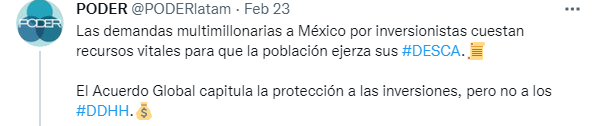
And PODER tweeted: “The multi-million dollar lawsuits against Mexico by investors cost vital resources for the population to exercise their economic, social, cultural and environmental rights. The Global Agreement capitulates investment protection, but not human rights.”

Now, Manuel Perez Rocha further explains in La Jornada:

“Mexican civil organizations held a February 23 conversation with [Bernd] Lange [chair of the European Parliament’s Committee on International Trade] and his entourage of parliamentarians.

Representatives of Peace Brigades International (PBI), Services and Advisory for Peace (SERAPAZ) and the Project on Organization, Development, Education and Research (PODER), presented positions developed by social and civil organizations since the first TLCUEM, signed in 2000, was negotiated.

The meeting was timely, as the negotiations of the renewed TLCUEM ended in 2020 [and] although the final texts are not public, governments seek their ratification by the Senate, the European Parliament and the parliaments of the EU member countries.

PBI, SERAPAZ and PODER delivered to the MEPs [Members of the European Parliament] a document that begins by contextualizing the presidential decree in Mexico that gives preference to projects, which have European capital, that facilitate multiple human rights abuses, without citizen and indigenous consultation processes, in breach of Agreement 169 of the International Labor Organization (ILO).

In this document they denounce how “the global agreement (with the EU) does not reflect any formula for companies to act with due diligence on human rights.”

While Mexico has ratified ILO Agreement 169, only five of the EU’s 27 member countries have done so, so the EU refuses to base its trade relations on consultations.

The organizations exposed how “the multimillion-dollar commercial demands on Mexico by investors are costing the government vital resources for the population to exercise their economic, social, cultural and environmental rights.”

After more than 25 years of failed trade policies, Mexico cannot continue on the path that, far from bringing benefits to the population as a whole, has meant the loss of millions of jobs and the destruction of territories and livelihoods as well as key economic sectors for the country.”

The full article by Perez Rocha can be read at Cuidado con incursiones europeas.

Canada’s “free trade” deals with Mexico

In 2019, the EU’s direct investment in Mexico reached $13.73 billion.

In 2020, Canadian direct investment in Mexico totalled $28.8 billion. Canada holds an estimated $8.930 billion in mining assets and $6 billion in energy assets in Mexico. The Calgary-based pipeline company TC Energy is the largest Canadian investor in Mexico.

Perez Rocha has previously highlighted that with the United States-Mexico-Canada Agreement (USMCA) and the Trans-Pacific Partnership (TPP), “Mexico stands to remain the target of investor-state lawsuits from both the United States and Canada.”

The USMCA entered into force in July 2020, while the TPP entered into force in Mexico and Canada in December 2018.

He further cautions: “U.S. and Canadian (as well as EU) oil and gas companies have a key interest in the Mexican oil market. The strengthening of investment protections under the new agreements will lock in the reforms made by the Mexican government in 2013 allowing for the privatization of the energy sector.”

In March 2021, Sinembargo.mx further reported that: “Mexico tops the list of countries with the highest number of mining conflicts in Latin America, with a total of 58 cases, of which 29 belong to Canadian mining projects, according to the Observatory of Mining Conflicts of Latin America.”

In November 2021, Bloomberg also reported: “American and Canadian companies are ‘deeply concerned’ about Mexico’s efforts to reduce the private sector’s ability to compete in the state-dominated energy industry.” In this context, the Government of Canada has noted that Canadian investments in Mexico’s energy industry total nearly $13 billion.

We continue to follow this with concern.

CAHUCOPANA human rights defender Carlos Morales and his wife shot in Barrancabermeja

Still from PBI-Colombia video.

On February 28, PBI-Colombia tweeted: “#ALERT Carlos Morales, human rights defender with @Cahucopana accompanied by PBI, was shot along with his wife last night in Barrancabermeja. In the midst of a very serious context of violence #NoHayGarantías [no guarantees] and it is #URGENT that the authorities take measures.”

And CAHUCOPANA has now tweeted: “Faced with the events that put the integrity of Carlos Morales at risk and his wife, we express our gratitude for the solidarity. We report that the attack was carried out with a traumatic weapon and the injuries were minor. He and his partner are out of danger.”

The CAHUCOPANA statement on the attack can be read here.

Blu Radio reports: “Carlos Morales, a social leader from Remedios, was the victim of an armed attack in Barrancabermeja, Santander, where he was relocated by the National Protection Unit because his life was in danger in Antioquia.”

The article adds: “The legal representative of the Humanitarian Corporation for Coexistence and Peace of Northeast Antioquia was approached by armed men while he was riding his motorcycle with his wife and five-year-old son. The gunmen, who have not been identified, fired at the two adults, causing them injuries by bullet impacts. Both are out of danger and the leader believes that the attack is due to his political activity.”

PBI-Colombia has accompanied the Humanitarian Action Corporation for Coexistence and Peace in Northeast Antioquia (Cahucopana) since 2013.

In June 2020, CPT Action noted:

“Carlos Morales is a 33 year old Barrancabermeja native, and one of the founders of the Corporation for Humanitarian Action and Peaceful Coexistence of the Northeast of Antioquia – CAHUCOPANA, an organization that works for the defense of human rights, permanence in the territory and dignified life.

Since 2005 CAHUCOPANA has been working with subsistence farmers and miners in the municipalities of Remedios and Segovia in the Northeastern Antioquia region that was suffering from a severe economic blockade by paramilitary groups and military operations. Historically abandoned by the government, this region is in a constant territorial dispute between different legal and illegal armed actors, trapping their civilian population in the middle.

In 2013 he coordinated the Grassroots, Agrarian, and Ethnic National Strike in the municipalities of Remedios and Segovia. Because of their work to defend human rights, Morales and other CAHUCOPANA leaders have received threats against their lives and wellbeing. CAHUCOPANA today is a nationally recognized human rights organization and plays a key leadership role in advocating for human rights at the highest levels of government.

On September 29, 2015, Carlos was wrongfully accused of a crime by the Attorney General’s office and spent eight months imprisoned. Historically, this is a standard method used by the Colombian government to harasses and weaken the leadership of human rights activists.”


Defending the right to water from harm by the sugar industry in Guatemala

I hope you can join us on Sunday March 13 at 2:30 pm ET to hear Abelino Salvador Mejía talk about defending the right to water from harm by the sugar industry in Guatemala.
Notably, Canada is the largest importer of sugar from Guatemala.
The link to register for the webinar with English-Spanish translation is here.
More context on this situation can be read here.
You can also help to make more people aware of this webinar by retweeting our post or inviting your friends via our Facebook event page.
Thanks!
Brent

PBI-Colombia at 7th Festival of Memories marking 25th anniversary of Operation Genesis attack on Afro-Colombian communities

On February 25, PBI-Colombia tweeted: “VII Festival of Memories @Justiciaypazcol [Justice and Peace Commission] From the territory, the communities persist through #peace accompanied by the international community. In the Transgenerational Memory Dialogue, an exercise was made of #CollectiveMemory to #NotForget.”

The Justice and Peace Commission has previously tweeted that the commemoration of the 25th anniversary of Operation Genesis would be held from Friday February 25 to Monday February 28 in Cacarica, Choco.

Operation Genesis began at 5:30 am on February 27, 1997.

PBI-Colombia has explained: “Operation Genesis included the participation of the Army, Navy, Airforce and National Police, in coordination with paramilitaries from the Cordoba and Uraba Self Defence Forces (AUC). The military and paramilitary operation resulted in over 70 crimes, including murders and enforced disappearances. As a result, around 3,500 people from the 23 communities of the Cacarica river basin were forcibly displaced.”

According to a 2003 ruling by the Inter-American Court of Human Rights (IACHR), the armed forces used bombs and machine guns against the inhabitants of the Cacarica river basin during a weeklong offensive.

That ruling found Colombia responsible for not preventing the 1997 displacement of thousands of Afro-Colombians and the brutal murder of Afro-Colombian campesino Marino Lopez Mena. During the incursion, paramilitaries killed Marino accusing him of being a guerrilla before capturing and beheading him.

WOLA has noted: “Operation Genesis formed part of a larger paramilitary political effort to displace Afro-Colombians from their territories to facilitate the entry and expansion of oil palm plantations throughout the department of Choco.”

Two years after their displacement, the communities of Cacarica obtained collective ownership of their lands, to which they returned in 2000. There, they established the Community of Self-Determination, Life, and Dignity of Cacarica (CAVIDA).

In August 2012, retired general Rito Alejo del Río, the 17th Brigade commander of the Operation,  was sentenced to 26 years in prison for the assassination of Marino. Rito Alejo del Río had also repeatedly accused the Justice and Peace Commission of being guerillas.

By September 2017, he was released from prison.

Eighteen years after the traumatic displacement of the residents of the humanitarian zone, the Festival of Memories was held for the first time to bring healing to the community.

As noted in the PBI-Colombia tweet, this year is the seventh festival. It is also the 25th anniversary of the attack.

PBI has accompanied the Inter-Church Justice and Peace Commission since 1994.