Home Blog Page 251

CREDHOS notes imminent risk against social leaders who oppose the expansion of extractivism and the violent appropriation of land

On February 24, CREDHOS issued a statement titled: Humanitarian crisis and crimes against social leaders and human rights defenders in Magdalena Medio.

The statement highlights: “There is an imminent risk against the physical and mental integrity of the social leaders, as well as serious violations of human rights and infractions of International Humanitarian Law faced daily by communities in the territory.”

CREDHOS says: “[These threats come in] the framework of the expansion and reconfiguration of the dynamics of the legal and illegal armed actors – AGC, ELN and post-FARC groups under the command of Gentil Duarte – with the purpose of establishing control over the civilian population and the economies of the region.”

It adds: “The violation of human rights deepens after the interest of the National Government and certain economic sectors to expand and approve mining-energy activities in territories with significant ecological and sociocultural wealth.”

This includes “the accusation, stigmatization, threat and forced displacement of environmental leaders who have opposed the implementation of pilot fracking projects in the municipality of Puerto Wilches, and with the persecution and murder of peasant leaders who have resisted the dispossession of their lands in the face of paramilitarism and the extractivist economy.”

CREDHOS notes the murders of Teofilo Acuña and Jorge Tafur on February 22.
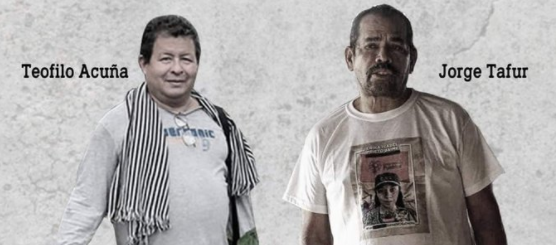
Ecap image.

CREDHOS notes: “Teófilo and Jorge led important processes in defense of the peasantry and their means of subsistence, as well as the natural assets of the territory against the expansion of extractivism and the violent appropriation of land.”

Their statement concludes with a call to “the international community and multilateral organizations (United Nations and Organization of American States – Inter-American Human Rights System) to observe the actions of the Colombian State regarding its obligation to guarantee and respect the fundamental rights of communities.”

The CREDHOS statement can be read in full at Humanitarian crisis and crimes against social leaders and human rights defenders in Magdalena Medio.

PBI-Colombia has accompanied the Regional Corporation for the Defence of Human Rights (CREDHOS) since 1994.
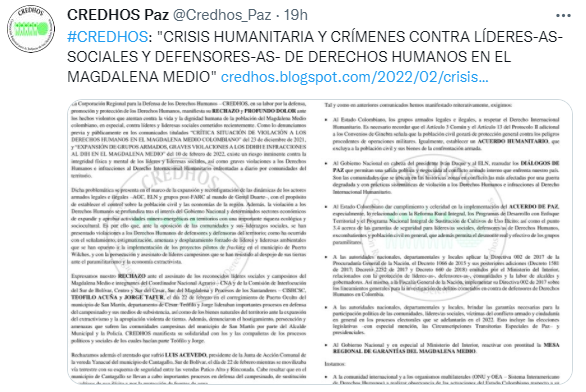
CREDHOS tweet.

PBI-Honduras expresses joy at the release of the Guapinol River defenders after 914 days in prison

Photo: Guapinol River defender Jose Abelino Cedillo released from prison last night is greeted by his wife Juana Zúniga and their children.

On the morning of February 25, PBI-Honduras tweeted: “From @PBIHonduras we join in the joy for the release of the defenders of @guapinolre after 29 months in arbitrary preventive detention for defending the environment. We trust that the defenders will be repaired and their safety and that of their families will be guaranteed.”

The night before, Guapinol Resiste tweeted: “Defenders meet with their families. Finally, after 914 days of illegal, unjust and arbitrary imprisonment.”

On the evening of February 10, PBI-Honduras tweeted: “PBI accompanies the celebration after learning that the Constitutional Chamber grants protection to the 8 defenders of Guapinol, the trial is annulled and they will be released.”

The following day, it also tweeted: “We trust that this release will be immediate and that the safety of the defenders, their families and their communities will be ensured. From the communities they remember that the defense of common goods continues until the mining license is annulled.”

Still, it took two weeks after that Supreme Court of Justice ruling for the Guapinol defenders to be released from prison.

PBI-Canada joins in the celebration of the release of these defenders.

At this moment of celebration, we also recognize that the struggle to defend the Guapinol River from the Los Pinares mining project continues.

EFE reports: “Los Pinares has installed a processing plant for iron oxide pellets in the municipality of Tocoa, department of Colón and has requested an ‘expansion of the area of the concession from 100 hectares to 1,000 hectares.”

PBI-Honduras has accompanied the defenders of the Guapinol and San Pedro rivers for the past three years.

Canal 6 video of their release from prison last night.

Colombian organizations file legal action against fracking pilot projects that have been welcomed by Canadian companies

Still from video of the tutela action announcement.

On February 24, El Espectador reported: “Around 10 peasant and environmental organizations located in Puerto Wilches met this Thursday morning at the Palace of Justice, in Bogotá, to file the document with which they seek to avoid the implementation of pilot projects to give life to this practice in the country.”

That article adds: “The organizations filed a document of more than 24 pages in which they present the violation of their rights to environmental participation, access to information, due process and life and integrity. …The tutela action basically seeks to suspend the implementation of the pilot projects and environmental licensing, until measures are taken to protect the rights that, in the opinion of the organizations, are being violated.”

The El Espectador article further notes: “The peaceful mobilization actions against fracking have had as a response multiple threats and harassment that have forced several women environmental defenders to be displaced.”

Radio Nacional also reports: “In addition, the plaintiffs explain that Puerto Wilches does not have drinking water, which is why ‘running out of water is one of the concerns of the inhabitants due to the fracking pilot that will be carried out in that territory.’”

(For the Kalé pilot project, Ecopetrol says it will draw 47.7 million litres of water that it will mix with chemicals and then inject into the well during the fracking process.)

And Infobae notes: “In the document, the guardians denounce that no prior consultation was carried out, not even through virtual mechanisms for the process of awarding contracts for the Kalé and Platero ‘fracking’ projects.”

Earlier this week, PBI-Colombia tweeted: “Statement from @Credhos_Paz rejecting the fracking pilots in Puerto Wilches and the threats against leaders who reject fracking in the region. This while Colombia does not ratify the Escazú agreement and signs environmental protection agreements with the EU [European Union].”

The CREDHOS statement notes: “In a region where historically extractivism has violated the human rights of communities, the implementation of fracking does not represent an advance for the dignity of life and the environmental sustainability of the territory.”

Canadian companies welcome fracking pilot projects

At this time, we again highlight that Toronto-based Sintana Energy Ltd. welcomed the news of ExxonMobil being granted a pilot project contract for Platero/VMM-37.

In April 2021, Portafolio also reported: “The Canadian multinational Canacol announced in recent days the first exploratory results of an independent prospective evaluation of shale oil in two of its blocks (VMM-2 and VMM-3), in the Magdalena Medio basin.”

Canacol CEO Charle Gamba has also commented that the approval of the Kalé and Platero pilot projects are “positive steps towards realizing the commercial potential of the unconventional shale oil field in Colombia and specifically for the resources prospects that we have through our position in the Middle Magdalena Valley basin.”

We continue to follow this situation closely.

SITU Research and Amnesty International detail the Operation Siloé police attack against vigil in the city of Cali, Colombia

Still from Amnesty International video.

On February 25, PBI-Colombia tweeted: “Watch @amnesty and @situ_research reconstructed the May 3 massacre in Cali. Where the young Kevin Agudelo was murdered among others. The reconstruction shows the responsibility of the police in the events.”

This media release further explains: “An event reconstruction by SITU Research and Amnesty International details how Colombian security forces assaulted peaceful protesters in the Siloé neighbourhood of the city of Cali on 3 May.”

It adds: “[The Operation Siloé] joint incursion by members of the National Police, the Mobile Anti-Riot Squad (ESMAD) and the Special Operations Group of the Colombian National Police (GOES) targeted people taking part in a vigil at the La Glorieta roundabout in the Siloé neighbourhood.”

Three people, including Kevin Agudelo, died of gunshot wounds that evening.

Erika Guevara-Rosas of Amnesty International says: “We hope that the Attorney General’s Office will make advances in the investigation into the death of Kevin Agudelo and the other serious human rights violations committed during Operation Siloé.”

She further highlights: “If there is sufficient and admissible evidence against those suspected of criminal responsibility, [they should be brought] to justice in a fair trial before ordinary civilian courts. This is the first step towards building a Colombia where human rights are respected; it is imperative that impunity does not prevail for these serious crimes.”

The 6-minute video that reconstructs the events of May 3, 2021, can be seen here.

Helicopters used during Operation Siloé

Amnesty International’s Digital Verification Corps also confirmed the presence of two helicopters in the area during Operation Siloé.

Video: “Witness testimony and verified video evidence also confirms that around 9 pm two helicopters, allegedly belonging to the National Police, flew over the area and fired at demonstrators seeking refuge in houses in the neighbourhood.”

Canada sold Bell CH-135 helicopters to Colombia between 1998 to 2000 and Bell 212 helicopters to the Colombian military and police between 1994 to 1996. The Canadian Commercial Corporation, which facilitates such exports, does not conduct any follow-up to ensure Canadian-built equipment is not used to violate human rights.

Bell 212 (UH-1H) helicopter. Photo by Paul Filmer.

PBI-Colombia meets with Embassy of Canada officials

On November 29, PBI-Colombia tweeted: “Today there was an important meeting with victims of police violence accompanied by @dhColombia with the diplomatic corps [including from Canada]. Victims expressed lack of progress in the processes and constant threats against them and requested impulses in their cases to avoid impunity.”

And on December 1, 2021, PBI-Colombia tweeted: “The Canadian embassy @CanadayColombia visits the office of @Nomadesc in Cali to talk about the causes of the protests and learn first-hand about cases of police violence. Nomadesc requested guarantees that Canada does not assist the Colombian police with equipment.”

Canada’s response to police violence in Colombia

On May 9, 2021, then-Foreign Affairs Minister Marc Garneau stated: “Canada condemns the violence, including the disproportionate use of force by security forces, and urges that the violence cease.”

That comment was quickly followed by: “We welcome the Government of Colombia’s commitment to fully investigate and hold accountable those who may be guilty of violating human rights during these events.”

By July 14, 2021, when Garneau met with Colombian Vice-President Marta Lucía Ramírez the readout from that call noted a more generic statement: “Minister Garneau emphasized Canada’s concerns regarding violence in Colombia, both in the context of social protests and against social leaders and ex-combatants working to implement peace.”

At that time, Garneau repeated his message calling “on Colombia to keep its commitment to fully investigate and hold anyone who has violated human rights to account for their actions.”

On October 26, 2021, Mélanie Joly replaced Marc Garneau as Canada’s Minister of Foreign Affairs. We look forward to her response to the call from Amnesty International for advances in the investigation into the death of Kevin Agudelo and other human rights violations during Operation Siloé.

Photo: Prime Minister Justin Trudeau meets with President Ivan Duque, November 2021.

PBI-Colombia accompanies CAHUCOPANA as armed clashes in Northeast Antioquia put communities at risk

Photo: PBI-Colombia accompanies CAHUCOPANA at meeting with United Nations Human Rights representative.

On February 24, PBI-Colombia tweeted: “In Northeast Antioquia communities, leaders and defense organizations such as @CAHUCOPANA at risk due to conflict escalation. Yesterday @CAHUCOPANA traveled to verify possible bombardment between southern Bolivar and Northeast Antioquia.”

The previous day, the UN Office in Colombia tweeted: “[The representative of the UN High Commissioner for Human Rights in Colombia] Juliette de Rivero met with defenders of CAHUCOPANA and PBI-Colombia to analyze the risk situation in peasant communities in Northeast Antioquia and acknowledge the self-protection measures adopted, such as Humanitarian Shelter houses.”

PBI-Colombia adds to that tweet: “The Office in Colombia of @mbachelet High Commissioner of @ONU_es [the United Nations] for human rights expresses its deep concern at the increase in violence since the beginning of 2022 in various regions of #Colombia and emphasizes the impact on human rights defenders.”

Late last month, Blu Radio reported: “Defenders said that they have made multiple alerts and have warned about the situation [in Antioquia] that has been presented by the presence of different actors of illegal armed groups, in addition, they denounced that the authorities have turned their backs on this situation.”

And on February 23, CAHUCOPANA highlighted: “According to information from the community, there were clashes between the ELN [National Liberation Army] and the National Army, in which there was an exchange of bursts and detonations.”

PBI-Colombia has explained: “The abundance of natural resources in these lands and the arrival of multinational companies, such as the Canadian Gran Colombia Gold, has provided the illegal armed groups who are present in the region with an extremely lucrative funding source in mining.”

PBI-Colombia has accompanied the Humanitarian Action Corporation for Coexistence and Peace in Northeast Antioquia (CAHUCOPANA) since 2013.

Caption: “#DefendamosLaVida [defend life] support is provided to organizations such as @CAHUCOPANA in Northeast Antioquia #Colombia, where the implementation of collective and differentiated measures is urgently needed; thanks to [the embassies of Norway, Germany, France and Sweden].”


PBI-Honduras accompanies National Union of Rural Workers (CNTC) at meeting about river contaminated by sugar company

On February 24, PBI-Honduras tweeted: “PBI accompanies @CntcTegucigalpa during a meeting with members of the peasant base of La Unión (Santa Bárbara). We highlight the tireless work of the community in protecting its river from contamination that, according to the community, is caused by a sugar company.”

On Facebook, PBI-Honduras adds: “We express our concern about the risks that pollution poses to the health of the population of the rural bases in the Chumbagua sector.”

In 2020, Canada imported 21,503 metric tons of sugar from Honduras. It is the fourth largest importer of Honduran sugar behind Haiti, the United Kingdom and the United States.

The sugar industry is represented by the Honduran Sugar Producers Association (APAH). Six sugar mills are members of APAH, but only five are currently operational.

Sugarcane production often pollutes freshwater ecosystems with silt and fertilizers washed from farms, as well as plant matter and chemical sludge from mills.

The waste generated from a sugar factory is mostly organic matter with small quantities of inorganic material. Pollutants include wastewater, bagasse (dry pulpy residue left after the extraction of juice from sugar cane), pressmud (waste produced from the filtration of the cane juice) and molasses (the viscous substance produced from refining sugarcane into sugar).

One way in which industrial effluent can pollute rivers, streams and lakes is by increasing the amount of organic matter in the water. Decomposition of this matter in the water requires a lot of oxygen which chokes the water body by reducing the natural presence of oxygen.

It can also take 213 gallons of water to produce 1 pound of refined cane sugar. That’s almost nine gallons per teaspoon.

PBI-Honduras began accompanying the National Union of Rural Workers (CNTC) in May 2018.


PBI-Honduras accompanies the Centre for LGTBI Development and Cooperation (SOMOS CDC)

Photo: Cooperation agreement signing between SOMOS CDC and PBI-Honduras.

The PBI-Honduras Project has tweeted: “We share with joy that since January 2022 we have accompanied a new organization: @somoscdc_hn. It focuses on the development of programs and projects in defense of the rights of the community #LGTB in #Honduras.”

They add: “With the accompaniment to @somoscdc_hn and @arcoirisghn we strengthen our work in the protection of those who defend the rights of sexual diversity.”

PBI-Honduras further explains:

“The Center for LGTBI Development and Cooperation -SOMOS CDC- was founded in 2007 by a group of young people committed to promoting social equity and the full exercise of human sexuality. Currently, the organization focuses on the development of programs and projects in defense of the rights of the LGTBI+ community in Honduras. Within its work plan, proposals for laws, dissemination programs, legal advice and workshops on institutional and economic strengthening stand out.”

This PBI-Honduras report has also noted:

“Between 2015 and 2020, at least 183 crimes against gay, lesbian and trans people. With these figures, the LGTBIQ+ community in Honduras becomes the most punished of Central America. In 2016, the Inter-American Commission on Human Rights (IACHR) pointed out that in Honduras 50% of the crimes against this group of the region.

According to community rights defenders LGTBIQ+, the National Police, the Military Police and the Army continue leading the list of those responsible for violations of rights against the collective, especially against trans women.”

This concern has also been raised by the Arcoíris (Rainbow) LGTB Association of Honduras that PBI-Honduras has accompanied since July 2015.

Arcoiris coordinator Donny Reyes has stated: “The biggest problem that we face is the violence of the state security forces towards the LGBT+ community: the armed forces, the police, the criminal investigation police, military police, municipal police.”

Reyes adds: “The research studies that Arcoiris and other organizations have done reflect the same pattern — more than 60 per cent of hate crimes have been committed against us by those forces who should be guaranteeing our safety.”

Canada’s UPR recommendation

The PBI-Honduras report also notes this recommendation made by the Government of Canada during the Universal Periodic Review (UPR) of Honduras at the United Nations:

“Investigate and bring to justice cases of human rights violations involving the military forces and create a well-designed plan to complete police reform and eliminate militarization as a form of citizen security.”

At the UN Universal Periodic Review of the human rights situation in Honduras on November 5, 2020, Canada’s intervention, made by Rory Raudsepp-Hearne, the First Secretary at the Permanent Mission of Canada to the United Nations, stated:

“Canada thanks Honduras for its presentation and welcomes the creation of the Ministry of Human Rights represented today by Minister Cuevas. While this is an important step, we remain concerned about the overall human rights situation in Honduras.

Canada recommends that Honduras:

1- Strengthen measures for the prevention, investigation, and punishment of all sexual and gender-based violence including most specifically domestic violence and violence against LGBTI persons.

2- Protect freedom of expression by promptly investigating and prosecuting acts of intimidation, harassment and attacks against journalists, human rights defenders and Indigenous, Afro-descendant and community activists.

3- Increase efforts to ensure the independence of the judicial system, strengthening the investigation and prosecution of acts of corruption and human rights violations and prevent the criminalization of human rights defenders as well as community and Indigenous activists to ensure they are able to operate in a safe environment.

4- Investigate and bring to justice cases of human rights violations implicating military forces and create a well-defined plan to complete the reform of the police and remove the military from civilian security duties.”

Canada’s presentation can be viewed at item #31 at the 2:32:10 mark here.

We look forward to highlighting the work of SOMOS CDC in more posts.

Comité Cerezo México reflects on 20 years of PBI accompaniment

Francisco and Emiliana Cerezo founded the Comité Cerezo when their brothers Alejandro, Hector and Antonio along with Pablo Alvarado Flores were arrested on August 13, 2001. Alejandro was released on February 28, 2005. Pablo completed his sentence on August 13, 2006. Antonio and Héctor were freed on February 16, 2009.

The Cerezo Mexico Committee has published this article titled PBI, 20 years of accompaniment to the Cerezo Mexico Committee:

“On 14 February 2002, Peace Brigades International (PBI) informed the comrades of the Committee for the release of brothers Cerezo Contreras and Pablo Alvarado Flores that they would accompany them in their activities to secure the freedom of their families.

Alejandro, Héctor and Antonio Cerezo Contreras and Pablo Alvarado Flores had been arrested and tortured on 13 August 2001 and were serving 6 months’ imprisonment in the maximum security prison of Almoloya de Juárez; on 19 October 2001, our lawyer Digna Ochoa y Plácido had been extrajudicially executed and in December of the same year some members of the Committee had received the first death threat by telephone and had been monitored and harassed by the military police forces responsible for carrying out these unworthy tasks.

The accompaniment of PBI showed us another facet of international solidarity, over 20 years we have been fortunate to meet dozens of people born in Europe, America and Oceania; with all our treatment has been respectful and kind and with some we have managed to forge bonds of friendship that have extended beyond their participation in PBI.

The friendship and fraternal ties that unite us to many women and men who from PBI have accompanied us and contributed in this way so that we are alive today, have as their basis that we have never lost sight of the fact that those who wear vests or shirts with those acronyms are first of all people, they are not human “shields”, they are not workers, they are not machines, they are human beings who by their own decision face risks in a country that is not their own with human rights defenders of whom they have heard or read something in their trainings prior to arriving on the ground.

From PBI we have learned a lot from its experience accumulated over the years in different countries and continents, except what PBI says we consider ourselves good learners and we identify with the ideas and reasons that made PBI emerge more than 40 years ago.

We have tried to the extent of our capabilities to share the experience and knowledge that PBI generously provided to other organizations and human rights defenders, thanks to them and the generosity of other popular organizations we maintain the principle of not charging our workshops, consultancies or trainings, because those who shared that knowledge did so without charging anything in return.

PBI is aware of the hard times we have lived as a Committee, they lived in the house-office of the organization for a few days, when high intensity threats arrived. It is aware of the threats, follow-ups, harassments and all campaigns of defamation and criminalization against members of the Committee; we have shared intense moments of uncertainty and risk and moments of great joy to be participants in the moment of our liberation in February 2009 and before in August 2006 and March 2004, we have shared a good pozole, a pleasant talk or an analysis of the national reality.

Walking with PBI 20 years have made it possible for the Cerezo Mexico Committee to be today the human rights organization that it is today, and although some things have changed since 2002 to date, the presence of PBI is still necessary, unfortunately, in the country due to the risk that human rights defenders live in general and some with greater intensity in particular.

This brief reflection aims to express our gratitude to each and every one of the people who have integrated PBI and celebrate the 20 years they have accompanied us.

The work of advocacy and physical accompaniment that we have had to receive from PBI is of vital importance, thank you, because PBI and thanks to those who have shared a brief or wide space of their life with us.“

Hugs always, Cerezo Mexico Committee.

To read the article in Spanish, please see: PBI, 20 años de acompañamiento al Comité Cerezo México.

Photo: PBI-Canada Board member Paul Bocking along with PBI-Mexico advocacy representative Virry Schaafsma met with Antonio Cerezo in Mexico City on June 28, 2019.

PBI-Colombia accompanies Peace Community at commemoration of massacre in the Mulatos and La Resbalosa settlements

On February 22, the Peace Brigades International-Colombia Project tweeted: “PBI accompanied @cdpsanjose [Peace Community of San José de Apartadó] in commemoration of the massacre of #Mulatos and #Resbalosa, perpetrated on February 21, 2005, by the Army and AUC [United Self-Defences of Colombia] paramilitaries. 7 members of the @cdpsanjose were killed, including 4 minors and founding leaders.”

Their Twitter thread adds:

“This serious crime deeply marked the resistance of the @cdpsanjose, and highlighted the degradation of a war that, more than fighting the rebels, was merciless with peasants who bet on the #peace in the midst of so much violence.

The belligerent actions against @cdpsanjose were not new nor would they cease after #massacre. After this, there were constant accusations and attacks against the @cdpsanjose, as a result of its refusal to have a military presence in its territory.

Of the 66 soldiers investigated for their possible participation in the #massacre, only 6 were convicted and most of the high-ranking officers were released. Despite this, the @cdpsanjose has not lost hope that one day the truth will be clarified.”

PBI-Colombia has previously explained: “The final decisive moment for the break with the State occurred following the massacre in the Mulatos and La Resbalosa settlements in February 2005. For the Community, the lack of any substantial response from the Government or the entities in charge after this brutal massacre, was the ultimate proof that the Colombian State was not going to provide protection or justice for the Peace Community.”

PBI-Colombia has also noted: “Of the 66 military personnel who were investigated for their possible participation in the massacre, only 6 were convicted and most of the high commanders who were in charge of the operations in San José de Apartadó were cleared. …During all these years the Peace Community has not lost hope that one day the truth will be revealed and all of those responsible will be made accountable.”

For more, please see The massacre that transformed the Peace Community forever.

On March 23, the Peace Community will mark its 25th anniversary in struggle for life and territory. This photo is from the community’s 24th anniversary.

PBI-Colombia has accompanied the Peace Community of San José de Apartadó since 1999.

PBI-Canada to co-sponsor World Water Day screening of Berta Didn’t Die, She Multiplied!

PBI-Canada is co-sponsoring a screening at the Water & War virtual film festival being organized by World Beyond War.

World Beyond War notes: “The festival finale features Berta Didn’t Die, She Multiplied!, a celebration of the life and legacy of Honduran Indigenous, feminist, and environmental activist Berta Cáceres.”

They add: “The film tells the story of the Honduran military coup, the assassination of Berta, and the victory in the Indigenous struggle to protect the Gualcarque River. The insidious agents of the local oligarchy, the World Bank, and North American corporations continue to kill but that will not stop the social movements. From Flint to Standing Rock to Honduras, the water is sacred and the power is in the people.”

To get your ticket for the film festival, click here.

As co-founder and leader of the Council of Popular Indigenous Organizations of Honduras (COPINH), Cáceres fought against the Agua Zarca hydroelectric dam being built by Desarrollos Energéticos on the sacred Gualcarque River without the free, prior and informed consent of the Lenca people.

Cáceres was killed on March 3, 2016.

In July 2021, Roberto David Castillo – the former head of the dam company Desarrollos Energéticos, or Desa – was found guilty of being co-collaborator in ordering the murder. Castillo has not yet been sentenced.

In March 2019, Vice reported: “All three foreign investors—including Dutch [entrepreneurial development] bank FMO, Finnish finance company FinnFund, and the Central American Bank of Economic Integration (CABEI)—have withdrawn from the [Agua Zarca] project, putting the construction project on indefinite hold.”

However, that Vice article adds: “DESA owns the concession for 50 years, [COPINH general coordinator Bertha Zúñiga Cáceres] says, meaning the company has the exclusive right to work the land until 2059.”

Zúñiga Cáceres has highlighted: “They have not given up and apparently have no intention of abandoning the project altogether.”

We also recall at this time that in January 2015 COPINH issued a condemnation of a dam being built without Lenca consent on the Canjel River by Montreal-based Hydrosys and Vancouver-based Blue Energy. In April 2015, Cáceres said “men close to Blue Energy” were behind death threats against her.

PBI-Honduras began accompanying COPINH in May 2016, two months after the assassination of Cáceres.

You can watch the powerful trailer for the film here.

This screening is also being co-sponsored by Mutual Aid Media.

Photo: In November 2021, PBI-Honduras accompanied COPINH coordinator Bertha Zúñiga Cáceres in her office.