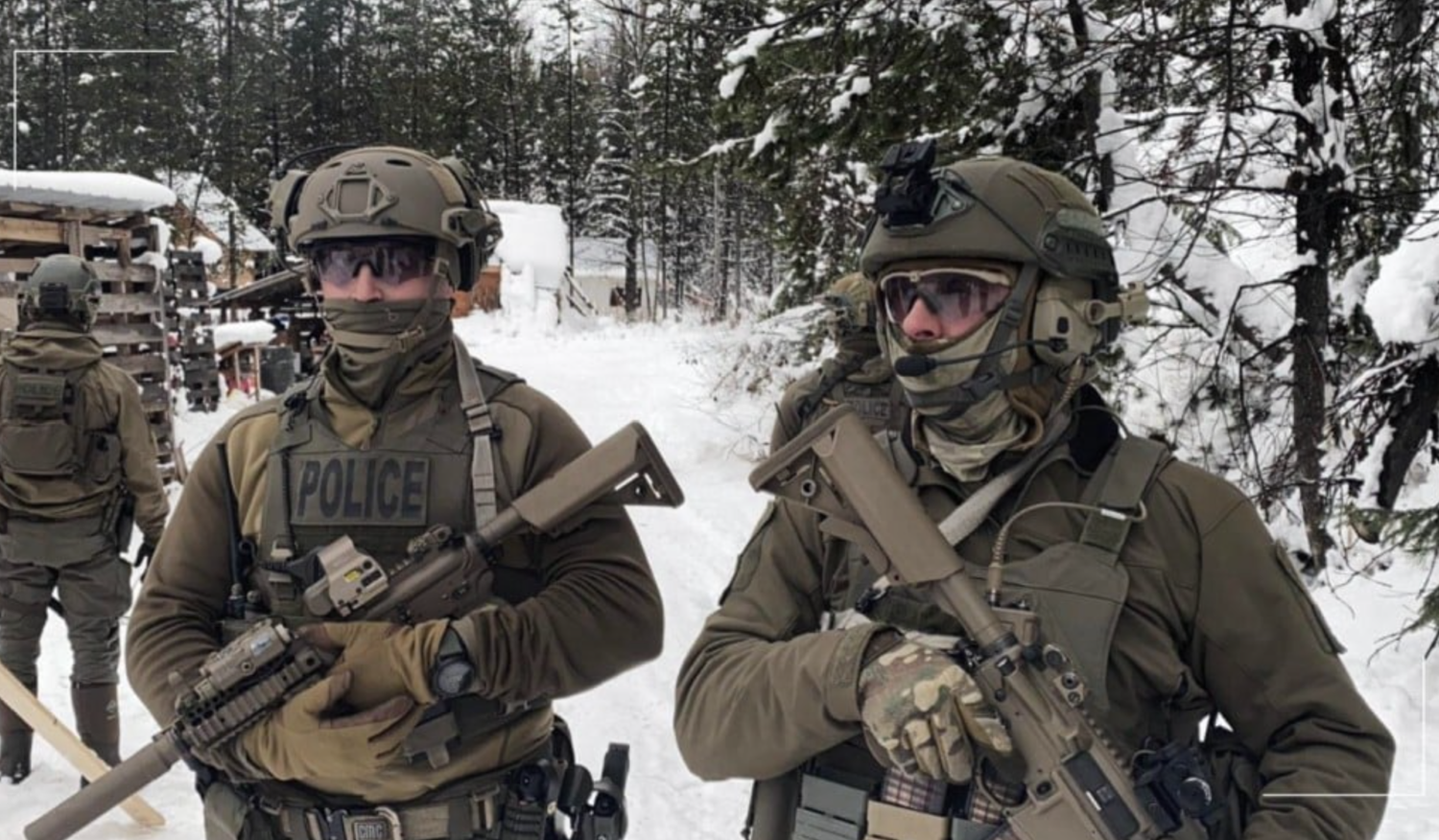
Photo: Heavily-armed RCMP C-IRG officers on Wet’suwet’en territory in November 2021. Photo by Michael Toledano.
Peace Brigades International-Canada is in the process of evaluating the protection needs and safety risks faced by Indigenous land and environmental defenders opposing major projects on their territories on Turtle Island.
Standing Rock
CBC News journalist Brett Forester has reported: “The RCMP [Royal Canadian Mounted Police] used the anti-pipeline resistance at the Standing Rock reservation [in the United States] in 2016 to justify creating a unit in British Columbia to police similar opposition to the Trans Mountain pipeline expansion…”
That article adds: “Internal files, recently released to CBC News through access to information laws, show the RCMP cited the Sioux-led opposition as ‘supporting evidence’ when creating the force’s Community-Industry Response Group (C-IRG).”
The Guardian has also reported: “Twenty-six people were hospitalized and more than 300 injured after North Dakota law enforcement officers trained water cannons, teargas, and other ‘less-than-lethal’ weapons on unarmed activists protesting against the Dakota Access pipeline in below-freezing weather on Sunday night [November 20, 2016], according to a group of medical professionals [the Standing Rock Medic & Healer Council] supporting the anti-pipeline movement.”
Formation of the C-IRG
Just over two years later, on January 7, 2019, during the first RCMP C-IRG raid on Wet’suwet’en territory, “Canadian police were prepared to shoot Indigenous land defenders blockading construction of a natural gas pipeline in northern British Columbia, according to documents seen by the Guardian.”
“Lethal overwatch”
The Guardian reports: “Notes from a strategy session for a militarized raid on ancestral lands of the Wet’suwet’en nation show that commanders of Canada’s national police force, the Royal Canadian Mounted Police (RCMP), argued that ‘lethal overwatch is req’d’ – a term for deploying an officer who is prepared to use lethal force.”
Allegations against the C-IRG
By June 2022, an APTN investigation of the C-IRG “uncovered allegations against the unit that includes ‘intimidation, torture, brutality, harassment, racism, theft, destruction of property, arbitrary detention, inhumanity, lying and deceit.’”
It further found evidence of “vast spying — including casual surveillance of law-abiding groups engaged in the democratic process — collusion with private security, collaboration with industry lawyers and wilful violations of RCMP policy.”
The third major raid by the RCMP C-IRG on Wet’suwet’en territory took place on November 18-19, 2021.
YintahAccess.com has noted: “When we rise up to defend the Yintah [Wet’suwet’en territory], we are criminalized. For many months and many years, we have face militarized raids of our village sites on the Yintah. In three large-scale police actions in January 2019, February 2020, and November 2021, a total of 74 people were arrested and detained, including legal observers and members of the media.”
They were also able to document: “Since late February 2022, individual RCMP and C-IRG officers, many armed with semi-automatic weapons, have entered Gidimt’en territory hundreds of times, with near constant patrols at Gidimt’en Checkpoint and Tsel Kiy Kwa. RCMP and C-IRG officers attended our village sites 94 times in March, 97 times in April, and 78 times in May.”
CRCC “systemic investigation”
In March 2023, the Civilian Review and Complaints Commission (CRCC) launched a “systemic investigation” of the RCMP C-IRG after receiving more than 500 public complaints about the unit.
On December 11, 2023, Amnesty International released a report tracing “the years-long campaign of violence, harassment, discrimination, and dispossession against Indigenous Wet’suwet’en land defenders”.
At that time, Amnesty International called on the RCMP, its Critical Response Unit (the rebranded name for the C-IRG), and Forsythe Security to “immediately halt the harassment, intimidation, and unlawful surveillance of Wet’suwet’en land defenders and withdraw from the Nation’s territory”.
The C-IRG model across Canada
University professors Shiri Pasternak and Tia Dafnos have also cautioned: “With its policing of pipeline and logging demonstrations having been deemed a ‘national best practice’ by the RCMP [Royal Canadian Mounted Police Community-Industry Response Group/C-IRG in British Columbia], there is potential that this model—and its criminalization of Indigenous and climate protest—could be replicated in other provinces, as resistance heats up against a wave of environmental deregulation being pushed by Prime Minister Mark Carney and several premiers.”
The Ring of Fire
The replication of the RCMP C-IRG model could be seen in the province of Ontario with the major extractive mining project known as the Ring of Fire.
Grand Chief Fiddler of the Nishnawbe Aski Nation, a political territorial organization representing 49 First Nation communities within northern Ontario, has previously told CBC News: “There will be conflict on the ground, and those that oppose it will most likely end up in jail. That is where we’re heading.”
And Ontario Member of the Legislative Assembly (MLA) Sol Mamakwa has cautioned: “What is the OPP [Ontario Provincial Police] going to do to the First Nations, once they start fighting on the land? That’s the scary part.”
We continue to follow this.
PBI-Turtle Island
Peace Brigades International-Canada is developing a “transformative proposition” to develop an accompaniment project, based on the PBI accompaniment model in Latin America and other regions, to accompany Indigenous land and environmental defenders at risk of violence from the RCMP, private security, and others, as they peacefully oppose major projects on their lands and territories within Canada.
For now, we are monitoring the situation for Gitanyow and Gitxsan land defenders opposed to the construction of the Prince Rupert Gas Transmission (PRGT) pipeline, Wet’suwet’en land defenders opposed to the construction of compressor stations on the lands through LNG Canada Phase 2, and Secwepemc land defenders opposed to the construction of the Pacific Link oil pipeline on their lands.
Further reading
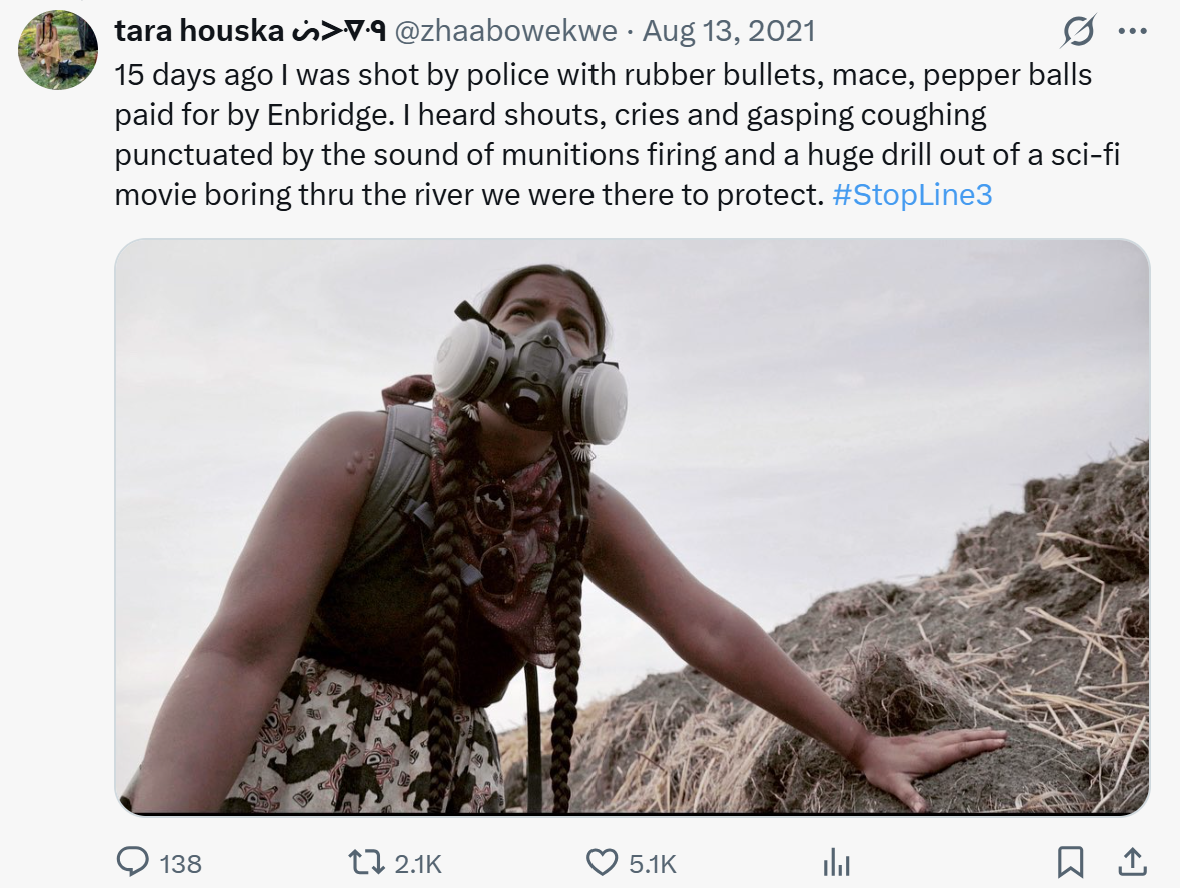
–Ojibwe water protector Tara Houska on police violence paid for by Canadian pipeline company (PBI-Canada, August 13, 2021)
–Giniw Collective meets with UN Special Rapporteur Lawlor, discuss Canadian company funding police in Minnesota (August 17, 2021)
–CBC News reports CSIS may have falsely claimed Indigenous land defenders were armed days before Dudley George was killed (PBI-Canada, September 12, 2025)
–Wet’suwet’en land defender Sleydo’ to Dublin Platform: “Canada’s reconciliation with our people is a mockery” (PBI-Canada, November 1, 2022)
–Three land defenders receive suspended sentences for their defence of Wet’suwet’en territory against CGL megaproject (October 17, 2025).
Social media post from Tara Houska.