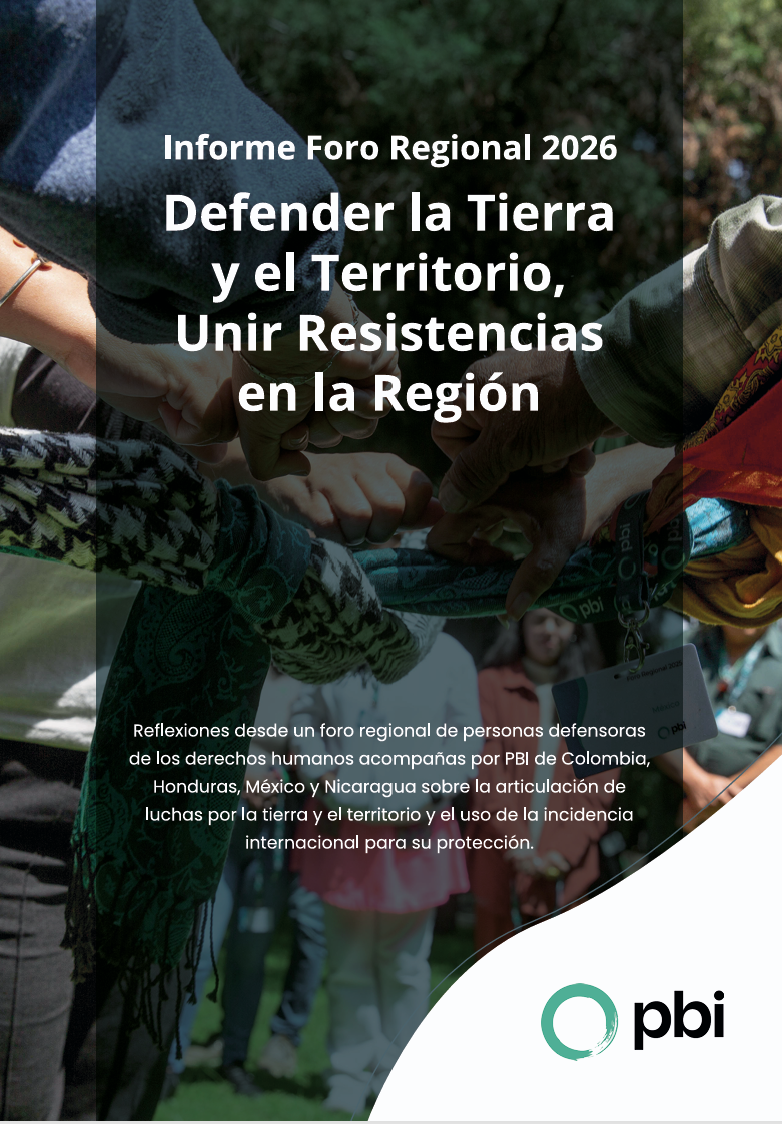
Peace Brigades International has published a 32-page report titled 2026 Regional Forum Report: Defending Land and Territory, Uniting Resistance in the Region.
The front cover of the 2026 Regional Forum report explains: “Reflections from a regional forum of human rights defenders – supported by PBI in Colombia, Honduras, Mexico, and Nicaragua – on the coordination of struggles for land and territory, and the use of international advocacy for their protection.”
The report includes recommendations on page 23-25:
Comprehensive protection for human rights defenders
a) Promote and recognize a holistic vision of protection. Various stakeholders increasingly acknowledge that protecting human rights defenders requires implementing a range of strategies—going beyond mere “hard” security measures—such as developing and strengthening public policies to prevent violence, investigate it when it occurs, punish those responsible, and provide reparation for harm. Furthermore, this includes physical, digital, and psycho-emotional protection, while respecting the defenders’ cultures and languages.
b) Respect and promote the right to defend human rights, acknowledging that this right is exercised in diverse ways and adapts to the needs of the specific context. In this regard, it is recommended to support local initiatives that seek to build peace from within the territories themselves.
c) Ensure flexibility in protection programs for human rights defenders. For states that have established programs and funds to protect human rights defenders in emergency situations, it is essential to recognize that protection strategies must be diverse and tailored to each specific territory. There is no “one-size-fits-all” solution for every context.
d) Promote comprehensive assessments that allow for the analysis of the context and the actors involved in the violence experienced by human rights defenders. This is important, as it is based on the recognition that networks of macro-criminality and common aggressors exist within the region.
e) Facilitate international observation missions – in collaboration with local actors – to support the work of land and territory defenders and their communities, as well as to document events occurring in these territories. A diplomatic presence brings visibility to these issues, deters violence, lends legitimacy to community demands, and promotes processes of transparency and accountability.
f) Expand the “Protect Their Voices” campaign to other countries. Given the impact this campaign has had in Mexico and Colombia, it is believed that a similar initiative in countries such as Honduras, Nicaragua, or Costa Rica could be highly beneficial. It would help foster the recognition that human rights defenders come from diverse backgrounds and that their work takes many different forms.
g) Support efforts to bring visibility to human rights violations against defenders of land and territory—particularly those from Indigenous and Afro-descendant communities and backgrounds in Latin America—through reports and public statements.
h) Guided by the principle that networks save lives, international cooperation agencies are encouraged to promote projects that facilitate the coordination of local, national, and/or regional initiatives to strengthen protection networks.
i) Publicly recognize the contributions made by defenders of land and territory, and issue statements in support of their right to self-determination and the recognition of their ancestral practices.
j) Facilitate the issuance of special visas for human rights defenders—specifically those defending land and territory—as both a protection mechanism and a tool for international advocacy. This can be vital for individuals forced to flee their countries of origin.
Businesses and Human Rights
a) Promote public policies that ensure greater oversight, requiring extractive companies operating outside their home countries to respect the right of peoples to self-determination – specifically by guaranteeing the right to information and the right to free, prior, and informed consultation.
b) Advance mechanisms that strengthen the transparency and accountability of foreign companies operating in countries such as Mexico, Honduras, Nicaragua, and Colombia, in order to prevent human rights violations. This includes scrutinizing the reports that these companies submit to their own governments and to their shareholder assemblies.
c) Promote projects that strengthen civil society actors affected by corporate practices, enabling them to act as long-term guarantors of accountability and, in doing so, prevent funds from continuing to benefit actors who incite violence within these territories.
d) Advance recommendations and proposals for technical cooperation within high-level dialogue forums with Latin American countries, aimed at strengthening autonomous institutions that serve as a counterweight, combat corruption, and act as guarantors of human rights – thereby preventing these institutions from arbitrarily favoring economic interests.
e) Strengthen and disseminate information regarding mechanisms established in international treaties – particularly those within “democratic clauses” – to ensure they function as tools for oversight and political pressure, preventing extractive projects from fostering human rights violations.
f) Monitor working groups focused on business and human rights to ensure greater transparency and accountability, as well as to establish minimum standards for comprehensive reparation of the harm caused to the lives of communities and their environment.
Rights of Indigenous Peoples: Colombia, Honduras, Mexico, and Nicaragua
a) Respect, protect, promote, and guarantee the right of peoples to self-determination, as well as the right to defend human rights—rights enshrined in various international instruments, such as ILO Convention 169, the Escazú Agreement, and the American Convention on Human Rights, among others.
b) Promote and fund capacity-strengthening strategies for initiatives, networks, and coalitions aimed at defending and promoting human rights. This includes initiatives focused on sharing ancestral practices within a territory as a tool for defense, as well as those centered on fostering dialogue regarding gender and intersectionality.
c) The exercise of autonomy is crucial; therefore, communities defending their territories must move beyond mere defense toward proposing alternative ways of sustaining their lives and their land. Consequently, it is recommended to support projects aimed at developing local economies, thereby reducing dependence on the resources or ways of life imposed by extractive industries operating within these territories.
Access to Justice
a) Advance projects that provide support and capacity-building to dismantle the discrimination faced by land and territory defenders within judicial and legal institutions.
b) Provide technical cooperation to assist investigative and judicial bodies in overcoming impunity and ensuring the right to access justice in accordance with international standards. Guaranteeing an independent, impartial, and effective justice system is essential to halting the criminalization of human rights defenders and safeguarding democracy.
c) Participate directly in – or provide support to – organizations that implement monitoring strategies for hearings and trials involving the criminalization of human rights defenders.
d) Support and promote projects focused on investigating corporate entities—particularly extractive companies—to map their operations, identify their clients, and gather other key information. This helps determine when companies are involved in networks of large-scale criminal activity, thereby enabling the prevention of human rights violations.
e) Support initiatives and accompaniment processes that promote memory, truth, and justice as guarantees of non-repetition in the wake of the killing of any human rights defender.
Forced displacement and exile
a) Pay special attention to cases of land and territory defenders who are victims of internal forced displacement or exile abroad, in order to bring visibility to their situations and provide appropriate accompaniment, where possible. In particular, special attention should be given to cases of defenders in exile from Nicaragua.
b) Promote – through dialogue and technical cooperation – appropriate policies and regulatory frameworks to prevent displacement and address its root causes. This includes establishing reception policies that ensure individuals forced to relocate – whether internally or abroad – have access to safe, non-discriminatory environments that help mitigate the impacts of their displacement.
c) Support coordination efforts aimed at securing protection for individuals both within and outside their territories, as well as advocating for the restoration of rights and the provision of reparations.
d) Specifically, regarding individuals in exile from Nicaragua, it is proposed that a parliamentary dialogue be promoted to address the human rights crisis in that country and to speak out against the lack of justice and freedom there.
e) Monitor, document, and analyze the actions of the State of Costa Rica – including its use of stigmatizing rhetoric, as well as investigations, legal proceedings, and the general criminalization of human rights defenders in exile from Nicaragua – and, where deemed appropriate, issue statements regarding these matters.
To read the full report in Spanish, go to 2026 Regional Forum Report: Defending Land and Territory, Uniting Resistance in the Region.