Home Blog Page 247

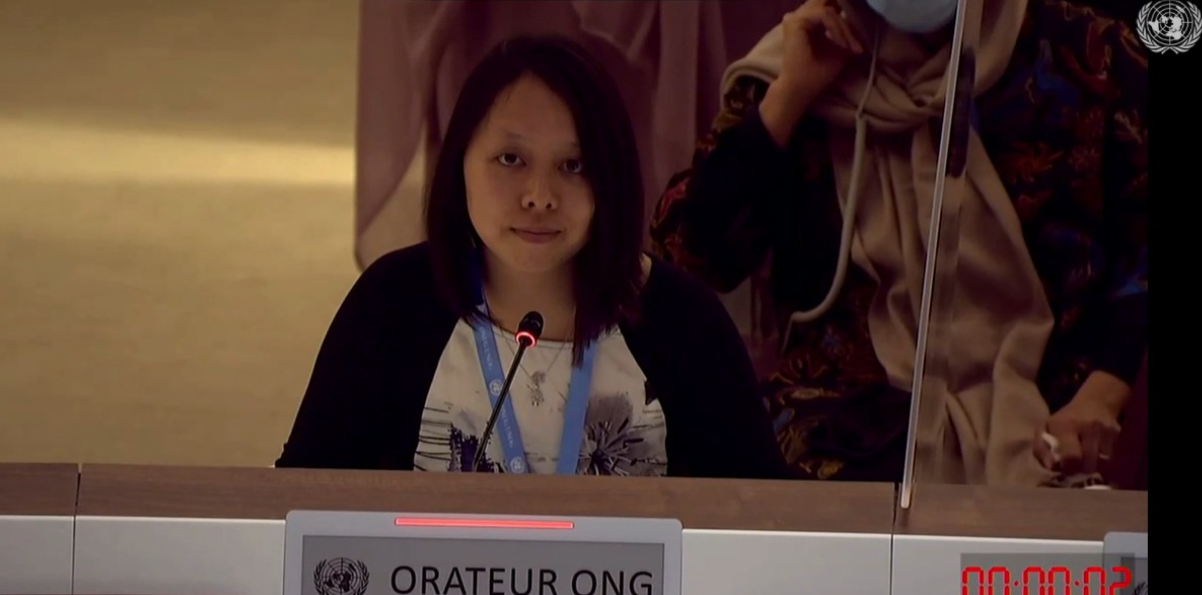
PBI highlights Samir Flores and defenders of the Metlapanapa River in presentation to the UN Human Rights Council

On March 16, Kim-Mai Vu of Peace Brigades International delivered a statement to the UN Human Rights Council on the situation of human rights defenders in Mexico.

“Thank you, Mr. President.

PBI welcomes the report of the Special Rapporteur on the situation of human rights defenders on corruption.

With at least 47 journalists and 94 defenders murdered between December 2018 and September 2021, Mexico is among the most dangerous Latin American countries for defend human rights. As stated by High Commissioner Michelle Bachelet, reporters working on local political issues, corruption issues or crime face huge risks of attack.

We highlight the murder of the social communicator Samir Flores in 2019, which remains unclear while the implementation of the Morelos Comprehensive Project, which he openly opposed to government authorities one day before the tragic event.

Likewise, we agree with Rapporteur Mary Lawlor on the high risks faced by defenders of the environment by denouncing cases of corruption in projects business.

In Santa María Zacatepec (Puebla), members of Pueblos Unidos de la Cholulteca and Volcanoes Region, defenders of the Metlapanapa River have been attacked physically, defamed and criminalized in critical moments of social protest and during holding assemblies.

To achieve effective protection, the Mexican state must put all its efforts into promote a public policy of comprehensive protection, built from dialogue with the defenders, including indigenous communities and women defenders.

Thank you very much.”

The video of this presentation starts here at the 33:17 point.

PBI-Canada calls for Canada-Colombia free trade agreement review of investment, trade in oil field technologies

To: Global Affairs Canada

Re: Public call for submissions regarding Canada’s Annual Report on Human Rights and Free Trade between Canada and the Republic of Colombia.

We welcome the opportunity to speak to the need to include Canadian investment in the fossil fuel industry in Colombia in this annual review, as well as to provide greater transparency on the trade in services and technology that supports this sector.

The need to review the human rights implications of investment

For the upcoming annual human rights review associated with the Canada-Colombia Free Trade Agreement, we encourage you to reconsider the exclusion of investment provisions, especially with respect to fossil fuel and mining investment.

When the agreement came into force in August 2011, the Government of Canada stated: “[Colombia] is a strategic destination for Canadian direct investment, especially in the mining and oil and gas sectors.” That media release added: “The free trade agreement with Colombia will benefit Canadian workers and businesses across the country and many sectors of the Canadian economy, including … mining, oil exploration.”

Canadian investment in oil exploration is not insignificant. Natural Resources Canada has reported that at $8 billion in 2018, Colombia was second largest location for Canadian Energy Assets Abroad (CEAA).

We have also noted that of the 69 oil and gas exploration blocks awarded between 2019 and 2021 in Colombia, 39 of those blocks went to Canadian companies (and 26 of those 39 blocks went to Calgary-based Parex Resources Inc.). In the 2021 round, Parex secured the most area allocations with an investment of more than USD $85 million.

Parex Resources in Santander

Parex Resources securing 26 new blocks in Colombia is a concern given the unresolved issues related to its Aguas Blancas oil field in Bajo Simacota, Santander.

We have outlined concerns about the lack of the needed environmental documents, the lack of an archaeological management plan, and the contamination of water by oil spills in this overview following a visit to the community in July 2021.

This situation in Bajo Simacota, Santander is of particular concern to the Regional Corporation for the Defence of Human Rights (CREDHOS) that Peace Brigades International has been accompanying since 1994.

Gran Tierra in Putumayo

The absence of investment as a consideration also means the annual report may not respond to the killing of a campesino and the wounding of an Indigenous Nasa leader on May 31, 2021, during a protest against Gran Tierra in Villagarzon, Putumayo.

The Justice and Peace Commission (also accompanied  by Peace Brigades International) stated on that day: “Protesters tried to enter the Costayaco field owned by the oil company Gran Tierra Energy, in order to block its operation.”

Giving context for the protest, the Sub-regional Strike Committee of the Villagarzón Resistance Point has explained: “Since May 16, the social protest moved to the Costayaco Field of GTE, demanding the immediate suspension of oil operations due to the historical environmental liabilities generated by this multinational.”

It has also been noted that: “Community blockades in 2019 and 2020 impacted Gran Tierra’s operations in the Putumayo Basin.”

And Las2orillas has previously reported on Inga opposition to the Gran Tierra APE – La Cabaña project near Villagarzón.

That article highlights that the San Miguel reservation, 500 metres from the project, opposed the exploration phase in 2015 because the proposed project “directly affected its territory and the resources of subsistence.” It also notes that the Association of Indigenous Councils of the Municipality of Villagarzón (Acimvip) asserted their rights to prior consultation had been violated by Gran Tierra.

El Espectador has also reported on the Inga’s concerns related to water and medicinal plants in relation to oil extractivism in the area.

Extractivism in the Magdalena Medio

Last month, CREDHOS stated: “The violation of human rights deepens with the interest of the National Government and certain economic sectors to expand and approve mining-energy activities in territories with significant ecological and sociocultural wealth.”

It further explains these violations include “the accusation, stigmatization, threat and forced displacement of environmental leaders who have opposed the implementation of pilot fracking projects in the municipality of Puerto Wilches, and with the persecution and murder of peasant leaders who have resisted the dispossession of their lands in the face of paramilitarism and the extractivist economy.”

One of those fracking pilot projects, the Platero project near Puerto Wilches, is on an exploration block co-owned by Toronto-based Sintana Energy.

Carolina Agón and Ramón Abril, CREDHOS

Threats against Carolina Agón and Ramón Abril have been made due to their opposition to fracking in the Puerto Wilches area. Carolina is a member of CREDHOS. Ramón is a Board member of CREDHOS. Amnesty International Canada has highlighted the threats against these environmental defenders in this Urgent Action.

Yuvelis Morales, Aguawil

Twenty-one-year-old Afro-Colombian activist Yuvelis Natalia Morales of the Committee for the Defence of Water, Life and Territory in the community of Puerto Wilches (Aguawil), a youth group accompanied by CREDHOS.

The death threats against her have forced her to flee to France.

When she met with French president Emmanuel Macron earlier this month, she asked him “to influence the international community so that the Colombian State provides the guarantees to defend the land, without that costing us our lives and so that the companies involved in these projects respect human rights.”

The French government welcomed Morales through an initiative they said is consistent with “France’s feminist diplomacy.”

We ask that the review of the implications of the Canada-Colombia trade agreement similarly reflect Canada’s stated commitment to a feminist foreign policy.

Trade in services and technology

We also ask that you provide details and analysis on the trade in products and services related to service the oil and gas industry in Colombia, including in mature fields and hydraulic fracturing (fracking).

In recent years, Global Affairs Canada has supported a trade mission to Colombia “showcasing Canada’s mature fields technology and expertise” as well as promoting the “technologies related to oil recovery and mature fields are much sought after, as well as in the development of unconventional resources, like fracking and deep-water exploration.”

Greater specificity and transparency on this trade in technologies, expertise and services would provide the means to better assess its human rights implications.

Ongoing concerns in Buenaventura

Last year’s Annual Report on Human Rights and Free Trade between Canada and the Republic of Colombia, noted:

“One written submission was received in response to the public call for submissions. This submission highlighted the increased violence and forced displacements in the city of Buenaventura, as well as the negative impact of the city’s port activities and infrastructure development on human rights and the living conditions of the local community.”

In that submission, we raised concerns that have been expressed by the Association for Research and Social Action (NOMADESC), the Inter-Church Commission on Justice and Peace, and the Nydia Erika Bautista Foundation for Human Rights (FNEB).

The annual report noted: “The information shared has been taken into consideration in the elaboration of the relevant section of this report.” It’s not clear to us how our submission was “taken into consideration”.

This situation continues to be of urgent concern.

Last month, the mayors of the Special Districts of Buenaventura and Cali and the municipalities of Jamundí and Palmira highlighted their continuing concerns about the situation in Buenaventura and invited the international community to “accompany the development of a peace agenda in the region and the coast, consistent with the geostrategic reality of the territory and with the social needs of communities and inhabitants.”

Closing words from CCAJAR lawyer Yessika Hoyos Morales

We close with words from Colombian lawyer Yessika Hoyos Morales. She made these comments in January of this year on a webinar organized by Lawyers’ Rights Watch Canada, the Law Society of Ontario’s Human Rights Committee and Human Rights Watch Canada marking the international Day of the Endangered Lawyer:

“Colombia and Canada have signed a free trade agreement and before that free trade agreement was signed Colombia established concrete commitments which included the respect of human rights, and a reduction in impunity, a responding to previous violations that have taken place. These commitments have not been fulfilled and so I think it’s very important to note that this lack of action, this non-fulfillment, is sending a very clear message. This clear message is that business and money are more important than human lives. And so, it’s extremely important for you all to remind your government that they do have obligations, that commitments have been made that have not been fulfilled and that in the end people’s lives are more important than money.”

We look forward to your response.

Canadian company welcomes Platero fracking pilot project in Colombia; CREDHOS members threatened

Image from Corporación Observatorio de Desarrollo Territorial (Territorial Development Observatory Corporation).

Toronto-based Sintana Energy Inc. operates in Colombia through its wholly-owned subsidiary Patriot Energy that holds a 30 per cent interest in the VMM-37 block where ExxonMobil will conduct the Platero fracking pilot project.

Environmental defenders in the Magdalena Medio region of Colombia continue to be threatened for their opposition to fracking.

Last month, Carolina Agón and Ramón Abril were named in pamphlets circulated by paramilitary groups. Carolina and Ramón were told to leave the area or face the consequences. Ten days later the home of Yuvelis Natalia Morales was broken into.

Carolina is a member of CREDHOS, Ramón is a Board member of CREDHOS, and Yuvelis is with a youth group accompanied by CREDHOS.

This Amnesty International Canada Urgent Action talks more about the situation they face.

The Peace Brigades International-Colombia Project has accompanied the Regional Corporation for the Defence of Human Rights (CREDHOS) since 1994.

Yesterday, Vanguardia reported that Carolina is still in the Magdalena Medio region, but away from her children and family, and Yuvelis is in exile in France.

That article further notes: “Carolina Agón, 34, was born in Rionegro, Santander but arrived four years ago in Puerto Wilches. There she learned artisanal fishing, an activity from which she and many villagers manage to survive.”

“With her leadership she became the vice president of the Federation of Fishermen of Puerto Wilches, two years ago, when it was founded.”

The article adds: “Carolina has been a visible opponent of the fracking pilot project at the Kalé well on the Magdalena River. In March 2021 she summoned a large caravan down the river. The fishermen went out in their canoes not to fish but to protest.”

Carolina says: “On that occasion they released the engine of the canoe and damaged it. First, they started with threatening calls, then with pamphlets and [then harassed by two men who were travelling on a motorcycle]. I am a single mother and I had to leave my children. I have passed it from one place to another living on mercy.”

The Workers’ Union of the Oil Industry (US0), which rejects fracking, has issued a statement rejecting the displacement of Carolina by paramilitary groups.

In November 2019, PBI-Canada organized a meeting between CREDHOS president Ivan Madero and Global Affairs Canada officials in Ottawa. Madero highlighted to them his concerns about fracking in Colombia.

PBI-Colombia now notes: “Since the start of 2022, CREDHOS has warned about the increasing control of armed groups in the territory, in particular, the expansion of the Autodefensas Gaitanistas de Colombia (AGC) – a group inherited from paramilitarism -which is active in several municipalities of Magdalena Medio.”

It adds: “The constant threats which defenders receive from the AGC and other armed groups are framed within a context where strong social leadership is clashing with the interests of the armed actors and the extractive industry.”

There are presently two fracking pilot projects that are proceeding in 2022-23, the Kalé and Platero projects, and both are located near Puerto Wilches.

Toronto-based Sintana Energy Ltd. has welcomed fracking in the Puerto Wilches area. It owns a 30 per cent stake in the block where Platero is situated.

Sintana says: “The Company’s support for Project Platero is made even though the Government’s process excluded an important segment of the petroleum industry by not allowing smaller companies, such as companies the size of Sintana, to participate in CEPI [Special Contracts for Research Projects] bids.”

We continue to follow this situation closely.

In the coming months, we plan to organize a webinar on fracking in the Magdalena Medio region featuring Carolina Agón and Yuvelis Morales. We also plan to visit Puerto Wilches before the summer to document the situation happening in the area.

More on all this soon.

Image from Podion Corporacion.

Organizations express concern following the permit granted to Vancouver-based Fortuna Silver Mines in Mexico

The Mining Injustice Solidarity Network, MiningWatch Canada and the Blue Planet Project are among the organizations that have signed this statement:

“We are greatly concerned about the extreme situation lived by peasant and indigenous communities of the Ocotlán Valley. For the past 11 years, the Cuzcatlán mining company, owned by the Canadian company Fortuna Silver Mines, has been extracting silver and gold without permission from local communities, and now the Ministry of the Environment and Natural Resources (SEMARNAT) is about to approve an extension of this company’s environmental permit.

It is important to remember the assassinations of Bernardo Méndez Vásquez and Bernardo Vásquez Sánchez ten years ago, both citizens of San José del Progreso, the mining project’s center of operations. Both were territory, life, and environmental defenders, as well as opponents to the Cuzcatlán mining project, owned by Fortuna Silver Mines.

In 2018, the tailings dam of this mining project overflowed twice, spilling polluting waste into the El Coyote riverbed.

The environmental authorities, for their part, visited the mining project but did not, at any time, reach out to the affected communities. There was no remediation nor restoration process to El Coyote, and polluting residues are still present in the river three years later. The affected communities did not receive any reparations from the damage.

These past years, the company has irregularly built 75 projects, in disregard for the original environmental impact statement. In 2019 and 2020, it requested the “San José II” environmental permits, both of which were denied by SEMARNAT for disregarding the cumulative, synergistic, and residual impacts of these projects and for having violated the communities’ right to a healthy environment.

In 2021, the company once again applied for a “new” environmental permit with SEMARNAT, calling it a “works and activities update,” while requesting for an expansion to the original environmental impact statement.

In the midst of a dialogue process with the affected communities, on December 14, 2021, SEMARNAT notified the mining company it had authorized environmental permits for another 12 years of commercial exploitation.

In its resolution, SEMARNAT did not mention the assassinations, irregular practices, water contamination, nor the aquifer’s hydric stress.

Faced with this situation:

We express a deep concern for the climate of insecurity and threats against defenders, whose lives are at risk. We urge the Mexican authorities to guarantee their physical and psychological integrity.

We demand the Mexican State to safeguard the rights of the communities defending water and their territories.

We remind the authorities that, among other international commitments, Mexico signed the Escazú Agreement in 2021, which mandates the country to promote the protection of defenders of the environment and their territories.

We will be on the lookout in the coming weeks for actions from the Oaxaca communities in their legitimate defense against this mining project.“

The full statement can be read in Spanish and in English.

For an additional context, see our article here.


Wet’suwet’en Chief Na’Moks calls for RCMP to leave the Yintah before talks with Canadian and British Columbia governments

Photo: Hereditary Chief Na’Moks addresses the United Nations Permanent Forum on Indigenous Issues in New York, April 22, 2019.

On March 14, Postmedia reported that British Columbia’s Minister of Indigenous Relations and Reconciliation, Murray Rankin, and the federal Minister of Crown-Indigenous relations, Marc Miller, have requested to meet with Wet’suwet’en Hereditary Chiefs and elected band chiefs.

That news article further reports:

“The meeting, proposed to take place in Prince George in late February 2022, would have occurred with no specific agenda on the federal or provincial governments’ part.

In a joint Feb. 15 letter by Rankin and Miller sent directly to elected chiefs — who have control over reserve land covering small pockets of the 20,000 sq. kilometre Wet’suwet’en Yintah — they suggested the meeting take place in Prince George over three days.

In an interview with The Post, Rankin said the majority of elected leaders — all of whom have signed off on the Coastal Gaslink pipeline running through Wet’suwet’en Yintah — agreed to the late-February meeting.

Chief Na’Moks (John Ridsdale), one of 13 hereditary chiefs, said hereditary leaders were preparing to meet with the Crown and province before RCMP officers arrested 29 people on two separate occasions in mid-November.

“That was the end of it. Like, how can you have any kind of a discussion when our people are staring down the barrel of a gun?”

Ridsdale said the primary condition under which hereditary chiefs would accept a meeting is that RCMP  leave the Yintah.

Ridsdale also said it’d be preferable to not have elected band council at the table because, as a governance system created by the Canadian government, they represent an “entity of Canada.”

The elected council system was created by the Canadian government under the Indian Act; before European contact, hereditary leaders were the sole governing body across the territory.

In his Dec. 17 letter, Rankin said he is “of the view that there is a role for Wet’suwet’en elected leaders in this meeting.”

The full article can be read at Talks between Wet’suwet’en hereditary chiefs and provincial, federal government reach standstill.

At this time, we recall that the UN Committee on the Elimination of Racial Discrimination passed this resolution that:

“Calls upon the State party to immediately halt the construction and suspend all permits and approvals for the construction of the Coastal Gas Link pipeline in the traditional and unceded lands and territories of the Wet’suwet’en people, until they grant their free, prior and informed consent, following the full and adequate discharge of the duty to consult.”

That resolution further:

“Urges the State party to guarantee that no force will be used against Secwepemc and Wet’suwet’en peoples and that the Royal Canadian Mounted Police and associated security and policing services will be withdrawn from their traditional lands.”

Canada was required to submit a report to the UN Committee by November 15, 2021, on its compliance with the Convention on the Elimination of All Forms of Racial Discrimination, including a fulsome response to this resolution.

Instead, on the eve of the third militarized raid on Wet’suwet’en territory on November 18-19, 2021, Canada sent an email to the Committee stating: “Canada is currently aiming to submit its combined reports to the United Nations in 2022.”

PBI-Canada was present on Wet’suwet’en territory in November 2021 and continues to closely follow this situation.

PBI highlights concerns about the right to food in Honduras and Colombia at UN Human Rights Council

On March 14, Peace Brigades International’s advocacy coordinator Kim-Mai Stéphanie Vu presented to the United Nations Human Rights Council in Geneva, Switzerland during an Interactive Dialogue with the Special Rapporteur on the right to food.

She stated:

“We welcome the Rapporteur’s report and share his concern about the concentration of power entrepreneurship in food systems and the vulnerability of the peasantry.

Honduras

In Honduras, the changes in agrarian policy approved during the pandemic have aggravated the food crisis, making invisible the demands of the peasant populations. the executive decrees on the management of water sources and access to land, especially in the indigenous territories and protected areas, have raised the concern of civil society since suppose a re-concentration of land and natural resources in the hands of the great landowners and large agro-export companies.

As we salute the recent cancellation by the Honduran government of open pit mining throughout the territory and the declaration of unconstitutionality of the Law for the Protection of Plant Varieties, known as the ‘Monsanto Law’ that prohibited farmers from keeping, exchange and give away seeds, it is urgent that the peasantry can participate in the elaboration of the agrarian policies of the country.

Colombia

In Colombia, an extremely unequal country with a high concentration of land, the right to food, especially for indigenous, Afro-descendant and peasant peoples and communities, is subsequently affected by the humanitarian crises that are shaking the country: massacres, persistence of paramilitary structures and armed conflicts between various legal and illegal armed groups, have generated the displacement and forced confinement of more than 120,000 people in 2021 and seriously affected their right to food: an example of this are the ethnic communities of the Pacific (particularly Chocó and the rural area of ​​Buenaventura, Valle del Cauca).

Likewise, the lack of progress in the integral rural reform, foreseen in the Peace Agreement, the insufficiency of prevention and protection measures, little or no response to Early Alerts and the absence of state civil institutions in the territories, completely leave unprotected communities without their basic rights satisfied. Humanitarian agreements global, requests by ethnic communities and the international community itself should be implemented now.”

The video of this presentation can be seen here (starting at the 51:00 minute mark).

PBI-Guatemala accompanies Council of Communities of Retalhuleu to Public Ministry as court hearing is postponed

On March 14, PBI-Guatemala posted: “PBI accompanies members of the Council of Communities of Retalhuleu (CCR) criminalized for defending the right to water to sign the book in the MP [Public Ministry]. The hearing scheduled for today was suspended.”

Abelino Salvador Mejía Cancino, a member of the CCR, spoke on a PBI-Canada organized webinar that took place yesterday. It focused on the defending the human right to water from harm by the sugar industry in Guatemala.

To watch the Facebook live video of that webinar (mostly in Spanish), please click here.

A 14-minute audio clip of Abelino’s introductory comments (translated into English) on that webinar can be heard below.

During the webinar Abelino highlighted the importance of visibility and stated: “We ask that the international community watch very closely what happens. You can send diplomatic support for the hearings so that they see we do have support.”

We continue to follow this situation closely.

Brigadista webinar, March 20

Want to be a PBI field volunteer?

This coming Sunday March 20 at 2:30 pm EDT join us to hear from Clara van Tienhoven, the incoming Field Coordinator for PBI-Mexico’s South Team, to find out more about our accompaniment of human rights defenders.

Whether you are thinking about applying this year, sometime in the future or just want to learn more about what it is like to be a PBI field volunteer, this webinar is for you!

To register, click here!

I hope you can join us for this discussion.

Brent, PBI-Canada

PBI-Mexico accompanies Indigenous consultation in the town of Santa Maria Zacatepec

Photo by IEE Puebla.

On March 13, La Jornada Oriente reported that with a total of 526 votes from the 5,000 residents in the town of Santa Maria Zacatepec (which is part of the municipality of Juan C. Bonilla in the state of Puebla), 417 people voted to elect their authorities through the method of ballots, while 109 people voted in favour of uses and customs.

La Jornada Oriente further reports:

“The locals accused that the municipal president of Juan C Bonilla, José Cinto Bernal, intervened in the electoral process not only with the carrying of people from other communities, but also exhibited that the Bonafont company gave away “trays” of water to the voters, an action that was described as an act of provocation and interference by the bottler.

Prior to the elections, they pointed out that José Cinto Bernal gave away boxes of dairy products from the Danone Group – a company to which Bonafont belongs – and carried out a smear campaign against the consultation.

Santa María Zacatepec is a town in resistance against megaprojects, such as the Morelos Gas Pipeline, and the Bonafont bottling plant, a plant that it kept taken for almost a year in demand of the exit of the company from the community, due to the overexploitation of water.”

That article also notes: “Due to the level of risk that has suffered the defense of the autonomy of indigenous peoples and nature in the region, the consultation process was observed by national and international human rights organizations, such as envoys of the Office of the UN High Commissioner in Mexico, Peace Brigades International, National Human Rights Commission, Network of All Rights for All, among others.”

The full article can be read at En Zacatepec deciden que elecciones sean por plebiscitos.

Photo via En Foque.

Photo via Twitter.

Video.

The PBI-North America Project on structural violence against Indigenous peoples

Photo: “I helped to start the North American Project together with Alaine Hawkins from Canada, and other returned volunteers from the Guatemala Project (pictured left with Steve in purple).” – Steve Molnar, PBI-NAP

The Toronto-based Peace Brigades International-North America Project (PBI-NAP) functioned between April 1992 and December 1999.

Formation after the Siege on Kanien’kéha:ka territory

PBI began exploring the possibility of a North America Project in September 1990 after the 78-day July-September 1990 the Siege on Kanien’kéha:ka territory.

Commonly referred to as the Oka Crisis, this was a confrontation between the Canadian army and Mohawk land defenders who opposed the expansion of a golf course onto Indigenous burial grounds.

Toronto-based author-activist Len Desroches has written: “The summer after the ‘Oka crisis,’ some members of Peace Brigades International and myself spent an intense week in Kanesatake and Kahnawake [and] explored the possibilities of active nonviolence with members of the Mohawk community.”

The PBI Annual Report further explains: “Part of the training was held in The Pines, site of the armed confrontation between the Sûreté du Québec and Mohawk Warriors a year before. PBI’s internationalism was especially valued, above all because one of the trainers was himself an Indigenous person from Central America.”

The year after that, the Peace Brigades International-North America Project (PBI-NAP) was established with a focus on Indigenous rights.

Principles and mandate

PBI-NAP’s “principles and mandate” statement highlighted: “The North America Project is concerned about and committed to working against racism and structural violence. We recognize that the problems faced by many Indigenous communities are outcomes of structures that do not represent their culture or tradition, and whose imposition is experienced as violence – an ongoing experience of conquest.”

Training on Stó:lō territory – 1992

Its work began with a training that took place in March-April 1992 on Stó:lō territory in British Columbia. The training was informed by Elizabeth Little Elk, a member of the Lakota Sioux Nation and a member of the PBI-USA national coordinating committee.

At that time, Alaine Hawkins of PBI-NAP wrote: “The training was organized to prepare people in Western Canada to do PBI-type observing within the North American context, particularly applied to Native peoples’ struggle for justice.”

PBI-NAP observation missions

From 1992 to 1999, PBI-NAP visited various frontline struggles including Nitassinan, Ipperwash, Barriere Lake and Esgenoopetitj (Burnt Church).

The Sainte-Marguerite III hydroelectric dam – 1992

In an April 1993 PBI-Canada newsletter, Steve Molnar wrote: “Rivers play an important role in the Innu lifestyle by providing salmon, a staple of the Innu diet. Hydro-Quebec, a government owned corporation of the province, has already built 19 dams in Nitassinan and plans to build one more on the Sainte-Marguerite River.”

On December 7, 1992, the Coalition for Nitassinan asked Peace Brigades International to provide observers for a barricade it was setting up in Maliotenam. It also asked PBI to escort Coalition spokesperson Gilbert Pilot when he spoke at the United Nations in New York and upon his return to the community of Maliotenam.

Two PBI volunteers maintained a 24 hour a day presence at the barricade that was set up between December 12 and December 16, 1992.

NATO over Nitassinan – 1994

Flight training over Nitassinan, the ancestral homeland of the Innu, began in the 1950s with the Royal Air Force flying out of Goose Bay, Labrador.

By 1981, the German Air Force began low level flight training there, followed by the United States and the United Kingdom in 1986, and the Netherlands in 1987.

In 1996, the Multinational Memorandum of Understanding with the UK, Germany and the Netherlands was renewed for a 10-year period that allowed for up to 15,000 low level and 3,000 medium/high level training flights annually.

Innu Elder Tshuakuesh Elizabeth Penashue has stated: “Canada sees our land as uninhabited land. It is inhabited by the Innu, and it is inhabited by wildlife. This is hunting territory, nomadic territory. It is not for war games.”

In October 1994, the Peace Brigades International-North America Project commented: “A continuing issue for the Innu of both Labrador and Quebec is low-level flight training over their hunting territory by Canada and other NATO countries.”

Meeting with Innu communities – 1995

A PBI-NAP team two and a half months with Innu communities in Goose Bay, Labrador (Nitassinan), beginning in March 1995, to research and document the ongoing structural violence experienced by the Innu peoples.

They interviewed Innu Nation President Peter Penashue who told them: “The Canadian judicial system has failed the Innu. The European colonizers set up institutions and laws which came from a foreign European perspective. They didn’t consider the economic, cultural or social needs [of our peoples].”

Land defender Dudley George killed by police – 1995

Indigenous land defender Dudley George was killed by an Ontario Provincial Police (OPP) sniper on September 6, 1995.

George had been part of a land reoccupation action at a provincial park.

On September 10, the Peace Brigades International-North America Project (PBI-NAP) was invited to “be observers for First Nations people if needed [and] do accompaniment for anyone fearing further violence on the part of the police.”

By the following year, PBI-NAP had made at least four visits to the area.

Reflections

In 2016, Steve Molnar, a U.S.-based coordinator of PBI-NAP, reflected: “We were bringing our experience from other Projects and trying to use that in the North American context. There were a lot of things that we did in Guatemala that were quite applicable and then some things that were just totally new.”

“We explored creative strategies. PBI worked with indigenous people in El Salvador, for example, and we brought some of these people to meet indigenous people in North America to have exchanges, so they could share their struggles with one another.”

Molnar also noted: “In Guatemala, we might see massacres or open violence. We didn’t see as much of that in North America, but we did witness a type of genocide, a cultural genocide. A lot of our work was spent recording that.”

Ongoing human rights violations

Years after the PBI-NAP concluded, former Canadian prime minister Paul Martin (in 2013), former Supreme Court Chief Justice Beverley McLachlin (in 2015), and the Truth and Reconciliation Commission (in 2015) have all stated Canada committed “cultural genocide” against Indigenous peoples in this country.

By the UN definition, it was/is a genocide.

Wet’suwet’en land defenders are currently peacefully struggling against the construction of the Coastal GasLink fracked gas pipeline on their territory. It is being built without free, prior and informed consent. Gidimt’en water protector Sleydo’ has described the megaproject as part of the ongoing genocide against Indigenous peoples.

PBI-Canada was present on Wet’suwet’en territory when 29 land defenders were arrested on November 19-20, 2021.

Photo: PBI-North America Project trainer Karen Ridd at “North America training” from March 26 to April 24, 1992, near the town of Hope in the Sunshine Valley on Stó:lō territory in British Columbia.

Photo: Innu Elder Tshuakuesh Elizabeth Penashue and Peace Brigades International-North America Project activist Anne Harrison in 1995.

Photo: Excerpt from PBI newsletter, April 1993.