Home Blog Page 220

PBI-Colombia accompanies CREDHOS and FEDEPESAN at mobilization in defence of the environment and water

On July 13, PBI-Colombia tweeted: “We accompany @Credhos_Paz [the Regional Corporation for the Defence of Human Rights] and Fedepesán [the Federation of Santander Fishers for Tourism and Environment] at the mobilization in defense of life and the permanence in the territory. Fedepesán, and its president Yuli Velásquez, are exposed to very high risk for defending the environment and water in Barrancabermeja. Urgent guarantees.”

Just prior to that, CREDHOS tweeted: “Now. Credhos accompanies and supports the Mobilization called by Fedepesan of Artisanal Fishermen and Women for the Defense of Life and Permanence in the Territory. 35 years of defending life.”

Joint Statement

PBI-Colombia also tweeted: “Read joint statement @Credhos_Paz and #Fedepesán who #hoy protest because there are no guarantees for the lives of those who, like environmental leader Yuli Velásquez, defend their uses, customs and fishing culture, water and the environment. Defender of water and life.”

The joint statement from CREDHOS and FEDEPESAN highlights: “We recognize that the protection and conservation of our bodies of water is not only guarantee for the welfare of the artisanal fishermen, but also for the good living of entire communities that take advantage of its ecosystem services.”

It also highlights: “The frequent presence of crude oil in Caño Rosario, a tributary of the San Silvestre swamp, product of the industrial activities of ECOPETROL [and] the expansion of agricultural and commercial activities in the water rounds and floodable lowlands of the San Silvestre swamp and its tributaries.”

And it concludes: “Taking into account the important role of the international community as observers in our country of the Human Rights situation, we respectfully request multilateral organizations (UN Mission 2, OAS, MAP OAS, IACHR), carry out monitoring of the situation of social and environmental leaders in Magdalena Medio.”

Third attack against Yuli

On the morning of Thursday June 30, PBI-Canada visited the San Silvestre wetland ecosystem in Barrancabermeja with Yuli, CREDHOS and PBI-Colombia and witnessed the impacts of Ecopetrol and large-scale agribusiness (buffalos and palm) on the water, wildlife and livelihoods of artisanal fishers.

On the afternoon of Tuesday July 5, we learned that Yuli had experienced an armed attack against and that her guard had been shot.

We continue to follow this situation closely.

“Peace Brigades International-Canada thank you very much for your unconditional support, sadly in Colombia we do not receive support. They stigmatize our work as human rights defenders. Protect and preserve life. The water belongs to more than 300,000 people in Barrancabermeja, not just fishermen.”

PBI-Honduras report highlights Canadian-backed Mining Law as “the most regressive in the region”

PBI-Honduras has published an English version of its report: Breaking Down In Order to Rebuild. The Human Rights Situation in Honduras.

The report reflects on the current situation in Honduras following the swearing-in of its new president Xiomara Castro on January 27, 2022.

The 60-page report has eight chapters including on corruption and impunity, freedom of expression, LGBTI+ rights, and access to a clean and healthy environment.

In that last chapter, the report notes (on page 34): “According to an analysis by researchers from the University of Wageningen [in the Netherlands], Honduras’s General Mining Law is one of the most regressive in the region.”

It continues: “The law, which was approved in 2013 and reformed in 2019 when six articles were declared unconstitutional, continues to suffer from numerous issues.”

Then on page 35, the report adds: “In a message published by MiAmbiente in February 2022, the government of Honduras declared a ban on open-pit mining. It also stated its intention to revise, suspend, and cancel the environmental licenses of existing mining projects, a very important initiative in light of the 130 concessions located within or next to indigenous territories, according to data from FOSDEH.”

It then cautions: “However, the lack of an executive decree leaves the initiative without the official support of the executive branch, and with little clarity on when and how the decision will be applied.”

Canada and the General Mining Law

MiningWatch Canada has explained: “The General Mining Law was developed with technical assistance paid for with Canadian overseas development aid. Its passage in 2013 lifted a seven-year moratorium on any new mining projects.”

It also noted: “This law was developed and passed with strong diplomatic support from the Canadian embassy, and with contributions from the Department of Foreign Affairs and the former Canadian International Development Agency.”

Tyler Shipley in his book Ottawa and Empire also writes: “By 2012, Canada’s role in developing the new mining code was public knowledge.”

Among the concerns expressed by Honduran groups including PBI-Honduras accompanied CEHPRODEC: “The law fails to ensure the protection of natural areas and water sources vital for human consumption and other uses health” and “imposes limits on citizen participation and contradicts provisions for environmental conservation by prohibiting areas free of mining from being created for any length of time.”

The Escazu Agreement

On page 37, the PBI-Honduras report notes among the “opportunities and the role for the international community” is to “call upon the government of Honduras to sign and ratify the Regional Agreement on Access to Information, Public Participation and Justice in Environmental Matters in Latin America and the Caribbean (The Escazú Agreement).”

It highlights: “Honduras is one of nine countries in the region that have neither signed nor ratified the agreement.”

Ambassador Norton

On March 5, 2021, Canada’s Ambassador to the UN Leslie E. Norton stated at a session of the UN Human Rights Council in Geneva: “Some states have established specific protection mechanisms to prevent risks and attacks against HRDs and to intervene when need be. Canada wants to stress these important milestones such as the Escazu Regional Agreement in Latin America and the Caribbean.”

We encourage Canada to continue to publicly endorse the Escazu Agreement.

The Declaration on the Rights of Peasants

Additionally, in the chapter on the food crisis, PBI-Honduras highlights (on page 31) that the international community should “promote the incorporation of the United Nations Declaration on the Rights of Peasants and other People Working in Rural Areas into national legislation.”

That Declaration was adopted by the UN General Assembly in December 2018.

The resolution in support of the Declaration was approved by 119 votes in favour, 7 votes against and 49 abstentions.

Canada was one of the abstentions.

We encourage Canada to review its position and support the incorporation of the Declaration into national legislation in Honduras.

The full PBI-Honduras report can be read here.

PBI-Guatemala accompanies imprisoned Maya Q’eqchi’ defenders Marcelino Xol Cucul and Jorge Coc Coc at court hearing

On July 12, PBI-Guatemala posted:

“PBI accompanies the public visit of Jorge Coc Coc and Marcelino Xol Cul criminalized members of the CCDA [Campesino Committee of the Highlands]. Magistrates are familiar with the casation [annulment] appeal raised by the defense of the two defendants.”

On July 10, PBI-Guatemala has also posted:

“PBI accompanies the defenders of the land Marcelino Xol Cucul and Jorge Coc Coc of the Ccda Verapaz.

This Tuesday, July 12, they will have their casation hearing before the CSJ [Supreme Court of Justice]. His attorney and the attorney will present arguments to prove the lack of due process that led to a 35-year sentence against the two.

Here we share more information about criminalization, the assessments of lawyer Wendy Lopez and messages from Jorge and Marcelino: https://cutt.ly/oLkN2gV.”

In their December 2021 monthly update, PBI-Guatemala explained: “Jorge Coc Coc and Marcelino Xol Cucul [are] human rights defenders and community leaders from Choctún Basilá, who have been criminalized and imprisoned since 2018.”

Both are Maya Q’eqchi’ defenders with the Campesino Committee of the Highlands (CCDA) in the Verapaz region that fights for access to land and against continued evictions and dispossession from ancestral lands.

In January 2022, the German newspaper Junge Welt also reported: “Jorge Coc Coc and Marcelino Xol Cucul, local indigenous authorities from the Choctun Basilá community in Cobán County and members of the CCDA, were sentenced to 35 years in prison in 2019 on fabricated charges of murder and attempted murder.”

PBI-Guatemala has accompanied the Campesino Committee of the Highlands (CCDA) Verapaz since July 2018.

Photo: Marcelino Xol Cucul and Jorge Coc Coc, June 2019.

What are the implications of Petro’s win on the sale of Canadian-manufactured LAVs to the Colombian military?

Photo: General Dynamics Land Systems exhibits its 8×8 LAV III at Expodefensa 2017 arms show in Bogota, Colombia.

On June 15, El Observador reported: “[President-elect Gustavo] Petro’s plans imply a reorientation of spending that could mean cuts to the Colombian military budget – US $11 billion, 12% of the total – which is second only to Brazil’s. The priority will be marked by the resources destined to combat the 40% poverty that prevails in the country.”

Petro has stated: “I am not going to waste resources on weapons and bombs.”

Infobae also reported that Petro (after his second-round election win on June 19) called on the current president Ivan Duque to suspend the purchase of new military aircraft, stating: “Any plane that is bought for public institutions in these weeks, will be sold again.”

And Pagina 12 has reported: “”The mistrust between the president and the military is significant,” says [Sergio] Guzmán [from the Colombia Risk Analysis consultancy], adding that [President-elect Petro] “must select a defense minister who has the respect and trust of the members of the military forces.” Otherwise, he stresses, the transition will be a “disaster.” So far, the president-elect has only revealed that he will hand over that portfolio to a woman specialized in human rights.”

A deal to sell Canadian LAVs?

It’s unclear at this time what the implications are for the sale of Canadian-manufactured Light Armoured Vehicles (LAVs) to Colombia.

On May 20, Infodefensa.com reported: “Yesterday, May 19, the Colombian Government, through the Ministry of Defense, approved the purchase of 50 General Dynamics Land Systems (GDLS) 8×8 LAV III DVH armored vehicles.”

The article adds: “The LAV III DVH is manufactured by the Canadian subsidiary of General Dynamics Land Systems.”

This is not the first time LAVs have been sold to Colombia.

In January 2013, GDLS-Canada announced: “The Colombian Ministry of National Defence has awarded a USD $65.3 million contract to General Dynamics Land Systems-Canada for 24 Light Armoured Vehicles for the Colombian Army.”

In July 2015, Lee Berthiaume reported in the Ottawa Citizen: “Questions are being raised over the Conservative government’s push to sell arms to developing countries following explosive allegations linking Colombian military officers to the killing of hundreds of civilians during the country’s bloody civil war.”

This refers to false positives/falsos positivos.

“False positives” refers to innocent people extrajudicially killed by members of the Colombian army, and then falsely labelled as enemy combatants. It is now believed that 6,402 people were murdered by the army in this way between 2002 and 2008.

In an interview with El País, Petro commented: “We must put an end to the policy built on the internal enemy that has led to tremendous human rights violations, such as the murder of 6,402 young people to pass them off as guerrilla casualties.”

Petro will be sworn into office on August 7.

PBI-Canada has filed an Access to Information request with the Canadian Commercial Corporation to find out more about the sale of Canadian LAVs to Colombia.

PBI-Mexico says “modernized” EU-Mexico Free Trade Agreement should not be ratified

The Peace Brigades International-Mexico Project has signed this open letter that calls on policy makers in Mexico and the European Union (EU) not to ratify the “modernized” EU-Mexico Free Trade Agreement (EU-Mexico FTA).

Among the letter’s 121 signatories are: Alianza Sierra Madre A.C., Consultoría Técnica Comunitaria,  A. C., Organización Familia Pasta de Conchos, and Proyecto sobre Organización,  Desarrollo,  Educación e Investigación (PODER).

The letter highlights:

“Worryingly, the proposed Investment Court System (ICS) does not address the worst parts of the classic investor-state dispute settlement (ISDS) mechanism. This means that EU investors will be able to sue Mexico (and vice versa) in a parallel justice system that prioritizes their private interests, while environmental, social and general regulations take a back seat.”

“European companies have a long history of violating human and environmental rights in Mexico with almost total impunity. …In the cases of the water bottling companies, Bonafont/Danone are accountable for dispossession and devastation in the Choluteca Zone, where the resistance of the United Peoples is being criminalized and repressed. The new treaty will also deepen the impunity of European corporations involved in the construction of large-scale projects with serious socio-environmental impacts on the territory, such as the Morelos Integral Project (PIM), the mega wind farms, the Interoceanic Corridor in the Isthmus of Tehuantepec, or the Mayan Train, among others. In these cases, either the right to prior, free, informed and culturally appropriate consultation and consent or refusal has been directly violated, or the implementation, which does not adhere to international standards, is generating major divisions and conflicts between communities.”

The full letter can be read here.

Further reading: PBI-Mexico highlights concerns with the Free Trade Agreement between the European Union and Mexico (TLCUEM)

Focus on profit and ignoring benefits of nature linked to killing of environmental leaders

The Guardian reports: “A market-based focus on short-term profits and economic growth means the wider benefits of nature have been ignored, which has led to bad decisions that have reduced people’s wellbeing and contributed to climate and nature crises, according to a UN [United Nations] report.”

“This means properly valuing the spiritual, cultural and emotional values that nature brings to humans, according to the report by the Intergovernmental Science-Policy Platform on Biodiversity and Ecosystem Services (IPBES).”

“The review highlights four general perspectives that should be taken into account; “living from nature” which refers to its ability to provide us with our needs like food and material goods; “living with nature”, which is the right of non-human life to thrive; “living in nature” which refers to people’s right to a sense of place and identity, and finally, “living as nature”, which treats the world as a spiritual part of being human.”

The article continues: “The report builds on the Dasgupta review, which found the planet is being put at “extreme risk” by the failure of economics to take account of the true value of nature. Incorporating diverse worldviews and knowledge systems will be key to leading to a more sustainable future, the report says.”

Patricia Balvanera

The Guardian also highlights: “There are consequences of not taking other values into account, such as environmental leaders being killed because they had claims to land that have been ignored, says Professor Patricia Balvanera, of the National Autonomous University of Mexico, who co-chaired the assessment.”

These concerns have previously been expressed by other UN representatives.

Michel Forst

In November 2019, Michel Forst, then the UN Special Rapporteur on the situation of human rights defenders, commented: “[The] killings of defenders and a lot of those who condemn the bad practices of businesses have increased and are now happening daily. It’s an epidemic which is spreading as business tries to conquer new markets, as natural resources are found in areas that had been until then untouched.”

He then noted: “States must go to the root of environmental conflicts, such as imbalance of power, making nature into a commodity, impunity and the current development model in order to ensure long-term solutions.”

Leo Heller

In October 2019, Leo Heller, then the UN Special Rapporteur on the human right to water, highlighted: “Mega-projects are promoted through the narrative of contributing towards the enhancement of the livelihood of the people, but they often impede the enjoyment of the human rights to water and sanitation.”

His report cautioned: “Communities affected by such negative impacts protest against mega-projects in various ways ranging from peaceful protest to occupation of the project premises. These situations often generate reactions from the related actors, involving private military and security contractors or public security forces, as well as confrontations with employees working on the project which may lead to physical conflicts.”

António Guterres

And in December 2020, UN Secretary-General António Guterres also stated: “More and more people are recognizing the limits of conventional yardsticks such as Gross Domestic Product, in which environmentally damaging activities can count as economic positives.”

Guterres emphasized: “Making peace with nature is the defining task of the 21st century. It must be the top, top priority for everyone, everywhere.”

Peace Brigades International has also affirmed: “[Human rights defenders] are at risk due to the powerful economic and political interests that lie behind environmental destruction, whether that be through the imposition of mineral extraction projects, agri-business or other sectors that seek to exploit natural resources for economic gain. In a system that favours profit over rights, economic models that encourage the forced displacement of those defending their resource-rich territories will continue and those at the forefront will remain at risk of violence.”

The 37-page IPBES summary report can be read here.

Page 4

PBI-Guatemala accompanied CCDA Maya Q’eqchi’ defenders Marcelino Xol Cucul and Jorge Coc Coc in court on July 12

Photo: Marcelino Xol Cucul and Jorge Coc Coc, June 2019.

On July 10, PBI-Guatemala posted:

“PBI accompanies the defenders of the land Marcelino Xol Cucul and Jorge Coc Coc of the Ccda [Community Council of the Highlands] Verapaz

This Tuesday, July 12, they will have their casation [annulment] hearing before the CSJ [Supreme Court of Justice]. His attorney and the attorney will present arguments to prove the lack of due process that led to a 35-year sentence against the two.

Here we share more information about criminalization, the assessments of lawyer Wendy Lopez and messages from Jorge and Marcelino: https://cutt.ly/oLkN2gV.”

Furthermore, in the PBI-Guatemala monthly information package for June, they note: “This month we paid two visits to the criminalized and imprisoned human rights defenders, Jorge Coc Coc and Marcelino Xol Cucul, who are also members of the CCDA.”

In their December 2021 monthly update, PBI-Guatemala also explained: “Jorge Coc Coc and Marcelino Xol Cucul [are] human rights defenders and community leaders from Choctún Basilá, who have been criminalized and imprisoned since 2018.”

Both are Maya Q’eqchi’ defenders with the Campesino Committee of the Highlands (CCDA) in the Verapaz region that fights for access to land and against continued evictions and dispossession from ancestral lands.

In January 2022, the German newspaper Junge Welt also reported: “Jorge Coc Coc and Marcelino Xol Cucul, local indigenous authorities from the Choctun Basilá community in Cobán County and members of the CCDA, were sentenced to 35 years in prison in 2019 on fabricated charges of murder and attempted murder.”

PBI-Guatemala has accompanied the Campesino Committee of the Highlands (CCDA) Verapaz since July 2018.

PBI-Honduras accompanies Olanchano Environmental Movement in Defense of Life (MAODVI) on environmental walk

PBI-Honduras has tweeted:

“On July 7, International Soil Conservation Day, we accompanied MAODVI (Olanchano Environmental Movement in Defense of Life) in the great environmental walk in Olancho for the protection of the natural assets of the Sierra de Agalta.”

On Facebook, PBI-Honduras adds: “According to CEHPRODEC more than 700 people participated in the walk. From PBI, we applaud MAODVI’s efforts to conserve natural assets in the department, heavily impacted by mining and tree felling.”

Sierra de Agalta is a mountain range in Eastern Honduras. It includes a National Park and is almost entirely located within the department of Olancho.

Tiempo also recently reported:

“According to councilman Sergio Campos, there is currently concern in Catacamas, Olancho, due to the decay of the Talgua River.

Likewise, Campos reported that the Talgua River provides between “70% to 80% of the water we consume in Catacamas, and it is dying.”

Campos also mentioned the Sierra de Agalta, where 70% is in the territory of Catacamas, but we have turned our backs on it. The problem is the previous authorities and now we are practically doing the same.”

Campos also referred to the current situation of rivers in Honduras. “Despite the fact that President Xiomara Castro made a law, all that only remained on paper. What is happening is that we are fighting an organized group of criminals who are leaving us without natural resources,” Campos said.”

Last month, HCH also reported: “Environmental crime! Merciless logging slowly kills the Talgua River in Olancho.”

And last September, HCH reported: “The Talgua River is in danger if it exists, since the indiscriminate felling of trees is causing droughts. Surrounding residents accuse ranchers of carrying out the felling and ask the authorities to punish the forest murderers.”

We continue to follow this situation.

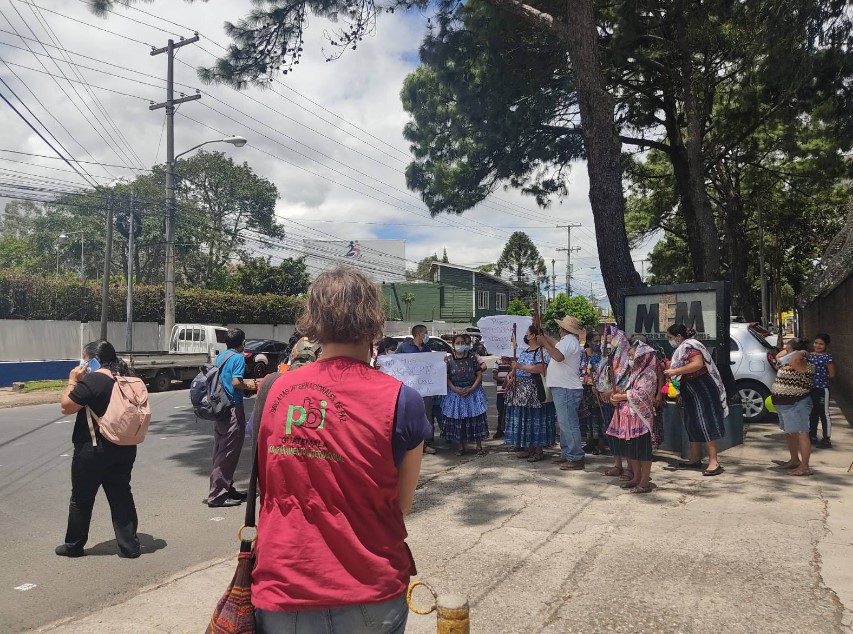
PBI-Guatemala accompanies Multisectoral Chinautla resistance to the renewal of sand extraction licences

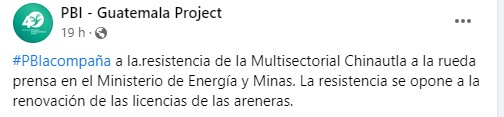
On July 9, PBI-Guatemala posted: “PBI accompanies the Multisectoral Chinautla resistance at a press conference at the Ministry of Energy and Mines. The Resistance opposes the renewal of sand licenses.”

The Chinautla Multisector Urban Platform advocates for the human right to water to be respected and raises concerns about the nearby resource (sand) extraction that endangers homes and a massive garbage dump that pollutes water.

PBI-Guatemala has previously explained, “Since 1989, the Chinautla Multisector Urban Platform has defended its right to be consulted on the projects of several sand companies operating in its territory.”

It adds, “The region has been a sand area for decades, but it was in 1995 when large-scale sand extraction began with heavy machinery” with major consequences.

In May 2018, the Guatemalan newspaper Prensa Libre reported that the extraction of sand from the channel of the Chinautla River and the confluence of the Tzaljá and Las Vacas tributaries, in an area where there are already geological faults, accelerates the cracking of walls and the sinking of some homes in the community.

Chinautla Multisector Urban Platform member Martín Catalán has stated that the group had called for the extraction of the sand to be moderated to stop the erosion of the soil, but that their proposals were not taken into account by local authorities.

Prensa Libre has also noted that the residents of Santa Cruz Chinautla are additionally impacted because during rainy season the floods from three rivers drag trash from (the dump in zone 3 in) Guatemala City into their community.

The Urban Platform proposal is to “Create a water law and government and municipal agreements that guarantee community and indigenous peoples’ participation to guarantee equal rights to water” within a two-year period.

The PBI-Guatemala Project has accompanied the Chinautla Multisector Urban Platform since December 2018.

Could Calgary-based Parex Resources file an investor-state challenge if the Colombian government bans fracking?

Photo: PBI-Canada was present as CREDHOS president Ivan Madero introduced a session with residents of Puerto Wilches opposed to fracking, June 28, 2022.

Colombian President-elect Gustavo Petro has made it clear that he intends to ban fracking once he is sworn into office on August 7.

Now, Infobae reports: “This announcement by the leader of the Pacto Historico [Historical Pact] would become a problem for the four oil multinationals that signed the contracts with the Colombian State, for the commercial and experimental development of crude oil and gas in unconventional fields in Colombia.”

The article continues: “These are: ExxonMobil, with whom Ecopetrol will carry out two pilot projects of Integral Research, in Puerto Wilches; Drummond Energy (with four contracts), ConocoPhillips (with two contracts) and Parex Resources (with one contract), these companies would enlist their legal artillery, given the fact that the new government announced its veto on fracking.”

Parex Resources is a Calgary-based company that operates in Colombia.

Earlier this year, Parex noted: “On September 18, 2014, Parex Colombia signed an E&P Contract with the ANH for Block VMM-9. Block VMM-9 is approximately 152,314 gross acres in size and is subject to an initial base royalty of 9%. The first phase of the agreement has a term of 36 months, which has since been extended, and a current commitment of approximately $89 million. Currently the E&P Contract is suspended due the lack of regulations to explore and exploit unconventional hydrocarbons.”

The outgoing Minister of Mines and Energy Diego Mesa has commented: “If the measure is taken [by Petro], the country is exposed to large lawsuits for breach of contractual agreements. Both the seven contracts that were active with the ruling of the Council of State, and the two agreements for fracking pilots, were granted rights to the interested companies that are scheduled to develop them, and by ignoring them, the country would be badly placed in international courts.”

Reuters has also noted: “A decision by Colombia’s top administrative court [the Council of State], which ruled against a lawsuit seeking to nullify regulations affecting fracking, will allow seven non-conventional energy contracts worth $517.4 million to move forward, Mines and Energy Minister Diego Mesa said on Friday [July 8].”

That article further explains: “While Thursday’s ruling has no bearing on the pilot projects, it will allow seven contracts [signed between 2013 and 2016] for non-conventional energy projects to advance to the next step, Mesa said in a video shared with journalists.”

It is conceivable that Parex Resources could use the investor-state dispute settlement (ISDS) mechanism in the Canada-Colombia Free Trade Agreement (CCFTA) to sue for lost investment and future profits if Petro bans fracking as promised.

Transnational corporations could claim that their rights related to “indirect expropriation”, “national treatment” and a “minimum standard of treatment” have been violated.

As Public Citizen explains: “Foreign corporations have used ISDS to attack an increasingly wide array of climate, financial, mining, medicine, energy, pollution, water, labor, toxins, development and other non-trade domestic policies.”

Beyond the seven contracts, Ecopetrol has also stated that it will proceed with the two fracking pilot projects in Puerto Wilches.

Ecopetrol says: “We currently have two contracts signed and in force with the [hydrocarbons agency] ANH for the execution of the pilots … from which legal obligations are derived for the company with which we must comply.”

Semana has reported that Ecopetrol and the National Hydrocarbons Agency (ANH) signed a contract for the Kalé pilot in December 2020, while a contract between ExxonMobil and the ANH for Platero was signed in June 2021.

In April 2021, after the ANH awarded a contract to ExxonMobil for a fracking pilot project, Toronto-based Sintana Energy Inc. stated: “Regarding Project Platero, Sintana has been and continues to be in positive communications with both ExxonMobil and the ANH to ensure that the integrity of both the Company’s commercial arrangements with ExxonMobil and the Contract for VMM-37 with the ANH are honored.”

The Canadian company owns a 30 per cent non-operating share in VMM-37.

We continue to follow this situation closely.