
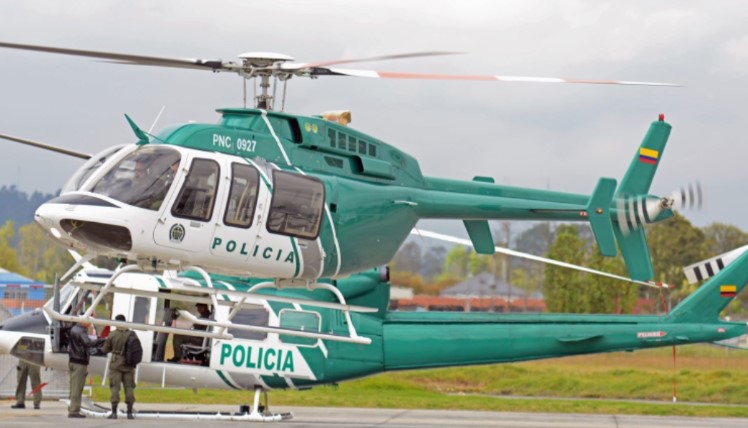
Photo: On November 20, 2019, Semana reported that the Bell 407 Halcón (Falcon) helicopter would be used by the National Police to monitor National Strike protests in Bogotá with high resolution cameras with facial recognition technology.
Peace Brigades International-Canada is working with Research for the Front Lines to better understand the approval process, sale and use of Canadian-manufactured armoured vehicles and other “military goods” to the Colombian military.
We are specifically looking into the possible use of Canadian-manufactured military goods – including INKAS and GDLS armoured vehicles and Bell 407 surveillance helicopters – against the social protests/national strike that took place in Colombia from 2019 to 2021.
This includes the issue of “substantial risk”. As Global News has reported: “According to Canadian law, Ottawa is required to deny export permits ‘if there is a substantial risk that the export would result in a serious violation of human rights.’”
To begin this process, we have looked at the example of the sale of Canadian-manufactured Light Armoured Vehicles (LAVs) to Saudi Arabia.
Following the murder of journalist Jamal Khashoggi on October 2, 2018, at the Saudi consulate in Istanbul, Canada’s Minister of Foreign Affairs announced in November 2018 that Global Affairs Canada would conduct a review of arms exports to Saudi Arabia.
Notably, the review looked at whether the armoured vehicles had been used to suppress an uprising and in human rights abuses.
As the CBC reported: “A review that examined whether the Saudis had violated the terms of the 2014 contract by using the armoured vehicles to suppress an uprising in the eastern part of the country, and in combat in Yemen, was carried out for over a year by the Liberal government. It found no evidence that Canadian-made equipment was used in alleged human rights abuses.”
By April 2020, the Government of Canada published its Final Report: Review of export permits to Saudi Arabia.
It found that the export of armoured vehicles to Saudi Arabia posed “no substantial risk” of facilitating any of the “negative consequences” referred to in subsection 7.3(1) of the Export and Import Permits Act (EIPA).
That subsection refers to whether the exported military goods “could be used to commit or facilitate … a serious violation of international human rights law” among other considerations such as “serious acts of gender-based violence or serious acts of violence against women and children.”
Following that report, the suspension on new export permits to Saudi Arabia was lifted and the Canadian government announced that permits would be reviewed on a case-by-case basis.
The National Post has also reported: “Canadian weapons manufacturers need government-issued export permits to sell “controlled goods” — which can include anything from sniper rifles to military-grade body armour — outside the country. When a manufacturer reaches a deal to sell such goods, Global Affairs Canada sometimes conducts a “consultation,” or review, that is supposed to be completed within 40 days.”
While a review is reportedly conducted “sometimes” prior to a sale of military goods, follow-up after the sale appears sparse.
The Ottawa Citizen has reported: “The Ottawa-based CCC [Canadian Commercial Corporation], which helps Canadian exporters get contracts with foreign governments acknowledges it conducts no follow-up to ensure exported Canadian-built equipment isn’t being used to abuse human rights.”
When asked specifically about Colombia by Radio Canada International, Global Affairs Canada spokesperson Jason Jung commented: “Canada is monitoring developments in Colombia and will take appropriate action if credible evidence of the inappropriate use of any controlled Canadian product or technology is identified, including to perpetrate or facilitate serious violations of international human rights law.”
What does that monitoring include?
In an email obtained by Peace Brigades International-Canada through an Access to Information request, Global Affairs Canada states: “Officials from BGOTA [the Embassy of Canada in Colombia] asked the Colombian National Police (CNP) whether these armoured vehicles were being used in response to the social protests that began in late April. CNP officials responded that no Canadian armoured vehicle was being used for such a purpose.”
As such, Canada appears to have been to ask the police – implicated in human rights violations against the social protests – if they had used Canadian-made vehicles in that repression and then accepted their response without additional scrutiny.
The questions that emerge from this brief review include:
1- Did the terms of the contracts with Colombia note a prohibition on internal repression as the contract with Saudi Arabia may have included?
2- What was the review process for these sales?
3- Did the sales of military goods to Colombia include a “consultation” or review within a 40-day period? If so, were any concerns flagged?
4- Was the Colombian military’s role in the falso positivo killings of 6,402 civilians between 2002 and 2008 noted in any reviews that may have been conducted? (Maclean’s magazine reported on this as early as August 2010, prior to the sale the armoured vehicles and helicopters.)
5- Are there any requirements on the part of the Canadian Commercial Corporation or Global Affairs Canada for independent verification if there are concerns that Canadian-manufactured military goods have been involved in human rights violations?
6- Following the concerns expressed about arms sales to Colombia by numerous entities including the NDP, has Canada taken any additional steps in reviewing its sales to Colombia (including the reported sale of 50 more GDLS LAVs to Colombia)?
With Research for the Front Lines, we continue to seek the information to help answer to these questions.
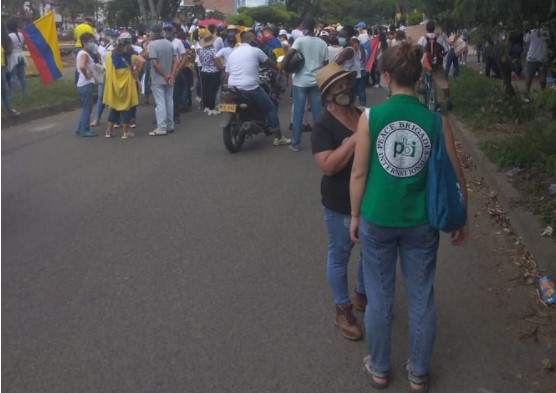
Photo: On May 8, 2021, PBI-Colombia accompanied Berenice Celeita of the Association for Social Research and Action (NOMADESC) at a mobilization of mothers and women in the city of Cali in opposition to the murders of young people by the police and other armed actors during the national strike social protests.