Home Blog Page 210

Coastal GasLink says a “trenchless watercourse crossing” is underway underneath the Morice River (Wedzin Kwa)

Photo of drill pad site by Kris Statnyk.

Houston Today reports: “Coastal GasLink has resumed work to run its natural gas pipeline through a tunnel underneath the Morice River [Wedzin Kwa]…”

The article continues: “The company would not release details other than to say two ‘trenchless watercourse crossings’ are underway underneath the Morice River south of Houston and at Crocker Creek in northeastern B.C.”

On September 8, Defend Our River and Yintah Access had also posted: “Did you know that the CGL Pipeline will be drilling under our river starting as early as next week? …Our beautiful river is in imminent danger.”

Houston Today further notes that RCMP Inspector Ken Floyd, the commander of the Community-Industry Response Group (C-IRG) spoke to the Board of Directors of the Regional District of Bulkley-Nechako this past summer.

The article adds: “Minutes of the meeting kept by the regional district indicate that as CGL increases activity, there will be a requirement by the police to escalate care of the workers and to improve response times ‘in the area to accommodate the risk’.”

Tweet by Michael Toledano.

The article also notes: “Once preparations have been completed, the actual tunnelling time is expected to take two and half to three months.”

In a separate article, Houston Today also reports: “Coastal GasLink (CGL) says it needs to beef up its workforce to more than 1,200 people at a camp south of Houston…”

That article indicates that CGL has applied to the Regional District for a temporary use permit to increase its Huckleberry camp from 800 to 985 workers. Another camp, outside of the District’s jurisdiction, has accommodations for 244 people.

According to this CGL map, Huckleberry Lodge is in Section 7 of the pipeline route.

Photo: Huckleberry Lodge.

We recall that the United Nations Committee on the Elimination of Racial Discrimination has repeatedly called on Canada to stop the construction of the pipeline and “that the Royal Canadian Mounted Police and associated security and policing services will be withdrawn from their traditional lands.”

YintahAccess.com has noted: “In three large-scale police actions in January 2019, February 2020, and November 2021, a total of 74 people have been arrested and detained, including legal observers and members of the media.”

Photo by Dan Loan of RCMP raid on Wet’suwet’en territory, November 18, 2021.

Stand.earth has also highlighted: “RBC is among top commercial banks providing the CGL project with working capital, including CAD $275 million in project finance, a co-financed $6.5 billion loan, a $40 million corporate loan, and $200 million in co-financed working capital – while acting as financial advisor for the pipeline.”

Photo: This week RBC announced a partnership agreement that involves adding their logo to the Montreal Canadiens’ home jerseys beginning next season.

For more on the ongoing campaign calling on RBC to defund Coastal GasLink, please see Decolonial Solidarity on Twitter.

Photo: Banner by Decolonial Solidarity – RBC at Bank St and First.

Canadian mining companies have USD $1.7 billion in pending investor-state dispute settlement (ISDS) claims against Colombia

Chart from Institute for Policy Studies.

Of the six pending mining company arbitration claims against Colombia, four relate to Canadian companies.

Those are Vancouver-based Eco Oro Minerals and Red Eagle Mining and Toronto-based Galway Gold and GCM (formerly Grand Colombia Gold).

The US dollar amount of those pending claims total $1.7 billion.

NPR has reported: “[Colombian president Gustavo Petro] wants to make changes to Colombia’s relations with the United States by seeking a renegotiation of a free trade agreement.”

While the free trade agreement between Canada and Colombia (that came into force on August 15, 2011) may not have appeared in recent news articles, there are numerous references to concerns about Colombia’s free trade agreement with the United States.

The Canada-Colombia free trade agreement was signed on November 21, 2008.

One of those who came to Canada to speak against the free trade agreement was Yessika Hoyos Morales who is a lawyer with the PBI-Colombia accompanied José Alvear Restrepo Lawyers’ Collective (CCAJAR).

During a visit to Ottawa in May 2009, she stated: “If Canada ratifies the free trade agreement it will give a message to Colombians and to the whole international community that Canada supports a government that violates human rights.”

Despite this, Prime Minister Stephen Harper’s minority Conservative government passed the implementation act for the Canada-Colombia Free Trade Agreement with the support of the opposition Liberals (under then leader Michael Ignatieff) on June 14, 2010.

The Liberals sought an annual human rights report as part of their support, but notably it specifically excludes the deal’s foreign investment chapter and focuses instead on the potential impacts of tariff reductions.

At that time, the NDP stated: “It’s a sham. Investment is a very big part of our trade with Colombia and to arbitrarily exclude that is another indicator that the government has no intention of producing a real report.”

We continue to follow this.

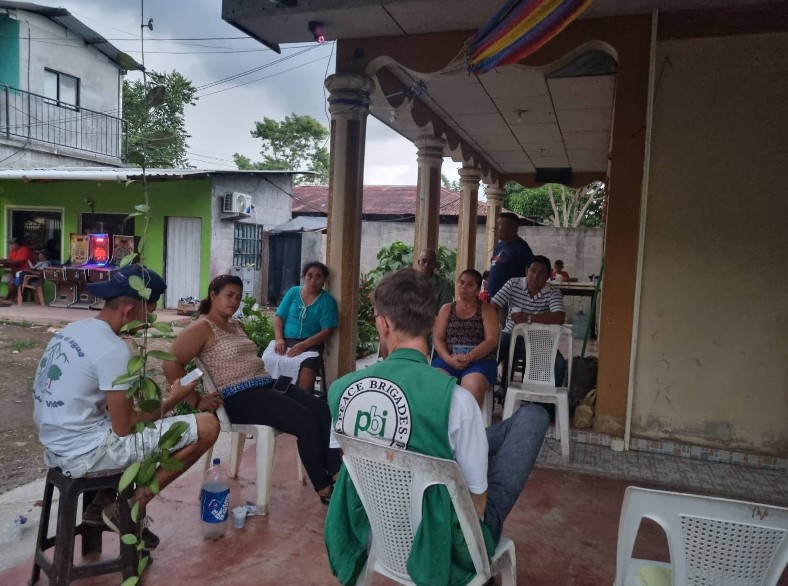
PBI-Honduras meets with Guapinol River defenders as mining activities cause contamination of rivers in the area

On September 13, PBI-Honduras tweeted:

“We met with #Guapinol, the San Alonso Rodríguez Foundation and COPA [the Coordination of Popular Organizations of Aguan]. Human rights defenders continue to denounce the contamination caused by the mining activities of Inversiones Los Pinares in the rivers of the area that eventually flow into the Aguán.”

They also posted on Facebook:

“Recently, we met with defenders of the Guapinol community and the Municipal Committee for Defense of Public and Public Property of Tocoa.

Despite the release of the eight defenders in March, the communities of Guapinol, San Pedro Sector and other communities of Tocoa continue to denounce the pollution caused by the mining activities of the company Inversiones Los Pinares e n the rivers of the area, which at the end they flow into the Aguán River.

We highlight the bravery of the defenders of the Municipal Committee, Copa Aguan, the Guapinol Despierta, Fundación San Alonso Rodríguez and other organizations that continue to vindicate the rights of communities affected by extractive projects.”

The Guapinol and San Pedro rivers are both tributaries of the Aguán River that flows into the Atlantic coast.

The Guapinol River defenders oppose the Inversiones Los Pinares open-pit iron oxide mine in the Montaña de Botaderos Carlos Escaleras Mejía National Park.

When the company began building an access road to the planned mine site in March 2018, the tap water in Guapinol turned brown and thick with muddy sediment.

By August 2018, the community established a Camp in Defence of Water and Life that blocked the construction of the access road.

Then in October 2018, more than 1,500 police officers and military personnel began the forceful expulsion of the protest camp and the criminalization process against the Guapinol River defenders began.

On February 9 of this year, six of the river defenders were convicted for alleged actions against the mining operation.

The next day, the Constitutional Chamber annulled their convictions and they were then released on February 24.

Lenir Pérez and Inversiones Los Pinares (ILP)

Guapinol Resists has stated: “Lenir Pérez and his wife Ana Facussé, daughter of the late Honduran oligarch and businessman Miguel Facussé, are the owners of ILP. Lenir Pérez is a businessman previously linked to the execution of construction contracts illegally granted by the government of President Hernández (Global Witness 2017).”

EFE has also reported: “Los Pinares has installed a processing plant for iron oxide pellets in the municipality of Tocoa, department of Colón and has requested an ‘expansion of the area of the concession from 100 hectares to 1,000 hectares.”

We continue to follow this situation from Canada.

PBI-Mexico expresses concern about Mexican state’s request to withdraw precautionary measures for Cerezo Committee

On September 13, PBI-Mexico tweeted:

“We express our concern about the Mexican state’s request to @CIDH [the Inter-American Commission on Human Rights] to withdraw precautionary measures to @comitecerezo [Comité Cerezo México]. @PBI_Mexico continues to receive information about security incidents such as harassment and surveillance that raise their level of risk.”

On September 12, the Cerezo Mexico Committee posted:

“The Inter-American Commission on Human Rights (IACHR) informed us that the Mexican State requested the withdrawal of the Precautionary Measures (MC-246-06) to Alejandro, Francisco and Emiliana Cerezo Contreras and other members of the Cerezo Committee.”

Pie de Pagina also reports:

“The Cerezo Committee, together with the Until We Find Them Committee, has been key in denouncing the forced disappearance in 2007 of two EPR [Popular Revolutionary Army] militants in Oaxaca, Edmundo and Gabriel. Just a few weeks ago, and after a very intense legal effort, the SCJN [Supreme Court of Justice of the Nation] determined that the Mexican State must look for Edmundo and Gabriel in the number one military camp, as well as interrogate the soldiers linked to the case. And just at this moment, it is that the Mexican State requests that precautionary measures be withdrawn from the Cerezo Committee.”

For more on that, please see PBI-Mexico accompanies Cerezo Committee at sit-in protest at Supreme Court (August 11, 2022).

PBI-Mexico began to accompany the Cerezo Committee in 2002.

CREDHOS denounces the murder of USO union leader Sibares Lamprea Vargas in Barrancabermeja

Photo: Sibares Lamprea Vargas

On September 12, Unión Sindical Obrera/Workers Trade Union (USO) posted on Facebook:

“Since this morning, our Trade Union Organization has declared a Permanent Assembly in protest against the assassination of our colleague and leader of the Barrrancabermeja sub-directorate, SIBARES LAMPREA VARGAS, an event that occurred last Friday, September 10, in the heart of the city.

The president of the national USO, John Rodríguez, urges not only the oil workers at the Barrancabermeja refinery, but also those throughout the country to reject this criminal act and abide by the Union’s guidance.”

Lamprea Vargas was the Secretary of Administrative Affairs of USO and a member of the Association of Security Guards of Barrancabermeja and Magdalena Medio.

David Gómez, vice president of the USO, has stated: “We demand that Ecopetrol and the authorities of Barrancabermeja carry out the respective investigations so that this crime does not go unpunished.”

This morning, the Barrancabermeja-based Regional Corporation for the Defence of Human Rights (CREDHOS) also tweeted:

“PROFOUND REJECTION BEFORE THE MURDER OF SOCIAL AND UNION LEADERS OF MAGDALENA MEDIO!

CREDHOS, in its work for the defense, promotion and protection of Human Rights, expresses its REJECTION and DEEP PAIN in the face of violent acts that threaten life and the human dignity of the population of the Colombian Magdalena Medio, especially against human rights defenders, social and trade union leaders committed recently.

We express our REJECTION of the murder of comrade SABARIS LAMPREA VARGAS, 42-year-old trade union leader, who worked as Secretary of Administrative Affairs of the Barrancabermeja sub-directorate of the Petroleum Industry Workers’ Union -USO.”

According to the International Trade Union Confederation (ITUC), 22 unionists were murdered in Colombia between April 2020 and March 2021.

The previous year, 14 trade union activists were killed in Colombia.

The Human Rights Information System of the National Trade Union School (ENS) has also recorded 15,430 violations of trade unionists’ rights to life, freedom and integrity in Colombia between January 1, 1971, and September 29, 2021.

Around a fifth of the cases reported were murders: 3,288 trade unionists have been assassinated over the last five decades in Colombia.

The Peace Brigades International-Colombia Project has accompanied CREDHOS since 1994.

USO has declared a week of mourning and protests nationwide.

PBI-Honduras meets with National Union of Rural Workers (CNTC) on the agrarian conflict in Bajo Aguán

On September 12, PBI-Honduras tweeted:

“We met with the CNTC [National Union of Rural Workers] in the community of Guadalupe Carney, highly affected by the agrarian conflict of #BajoAguán. According to the CNTC, the proposal to grant the land seized by the OABI [the Office for Confiscated Property] to the peasantry can promote a more equal distribution of the land in #Honduras.”

On Facebook, PBI-Honduras adds:

“At the moment, several farmworkers groups have agreements with the OABI to be able to work these seized lands, which usually belong to people involved in corruption and drug trafficking cases. In March of this year, however, Congressman [Jari] Dixon [of the governing Libre party] presented a proposal to grant these lands to farmworkers groups through the National Agricultural Institute (INA) and for the benefit of Agricultural Reform.”

The Peace Brigades International-Honduras Project began accompanying the National Union of Rural Workers (CNTC) in May 2018.

Context

In July, La Tribuna reported:

“More than a hundred peasants from Bajo Aguán (northern part of the country) asked the government to put an end to the historic land conflict and criminal persecution by the landowners of the sector, during their first day of peaceful protests in the capital.

Jaime Cabrera, one of the spokesmen of the movement, explained that they are still waiting for the government to give them their property titles and put an end to the judicial and physical persecution they frequently suffer from agricultural entrepreneurs in the sector.

They are also calling for a review of the liquidation process of peasant cooperatives over the past 30 years and whose land ended up in the hands of landowners.

Cabrera complained that the current agricultural authorities (INA) have not been able to resolve their demands, so they prefer to continue the dialogue with President Castro.”

In December 2021, Reuters also explained:

“Nearly 150 murders and disappearances in connection with the land conflict have convulsed the Aguán Valley since 2008, when violence first intensified here.

Convictions have been reached in just 25 of those killings, according to a government summary of the cases reviewed by Reuters.

Disputes still rage over some of the land now growing with palm. The Honduran government hasn’t verified many of the contested titles or resolved allegations by local residents, human rights groups and others that farms were acquired by force and at unfair prices.

At times, the perpetrators have allegedly included private security guards working on behalf of large palm growers, small farmers ostensibly defending their plots, would-be landowners seeking to muscle in amid the chaos, and armed gangs increasingly moving cocaine through Central America.”

We will continue to follow this situation.

Photo: Franklin Almendares, General Secretary, National Union of Rural Workers (CNTC)

Haudenosaunee land defender Skyler Williams in Ontario court on September 12-13 to argue treaty and inherent rights

Haudenosaunee land defender Skyler Williams has tweeted:

The Hamilton Spectator also reports:

“Things have been quiet at 1492 Land Back Lane, the planned subdivision in Caledonia that has been occupied by Indigenous land defenders since July 2020.

The site has seen clashes with police by land defenders who claim the territory as unceded Haudenosaunee land on the Haldimand Tract [950,000 acres of land granted to Six Nations of the Grand River in 1784] — a claim the developers reject.

But the legal dispute between Foxgate Developments and the Haudenosaunee-led group continues, with the developers set to return to court on Monday seeking to reclaim the 25-acre property on which they had planned to build over 200 homes.

The OPP has arrested dozens of supporters who visited the disputed property, most of whom have had their charges dropped. These days, about 20 people live on the land in tiny homes set up near community gardens and young trees.

[Haudenosaunee land defender Skyler] Williams and his lawyers, Meaghan Daniel and Aliah El-houni of the Community Justice Collective, are expected to argue the Canadian Constitution guarantees Indigenous treaty and inherent rights, and governments have corresponding duties to First Nations where those rights are engaged.

[If] the court grants Foxgate the injunction, Williams said he and others at Land Back Lane are worried about the police again trying to clear the site as they did in August 2020, when officers fired at least one rubber bullet while making arrests.”

The full article by J.P. Antonacci is at Land defenders, developers prepare for next legal stage of Caledonia dispute.

Photo: An OPP police officer at 1492 Land Back Lane, October 22, 2020.

Williams has also posted on Instagram: “Court will be open for people to go in but also there has been a zoom link for people to tune in remotely.”

1492 Land Back Lane has also tweeted:

More on that here.

For additional information and updates, please see the 1492 Land Back Lane on Twitter, Instagram and Facebook.

PBI signs Joint Statement in support of temporary relocation visas to the EU for at-risk human rights defenders

Peace Brigades International has signed this Joint Statement that says: “Human rights defenders have the right to carry out their legitimate work safely and to access support and protection when they are at risk, especially those who operate in the most difficult contexts.”

The statement continues:

“Human rights defenders often carry out their work at great personal risk, and increasingly face killings, attacks, threats, and acts of intimidation because of their peaceful activities, in addition to being subjected to repression, restrictive legislation, and judicial harassment.

For these at-risk human rights defenders, the possibility of accessing a visa to a European territory emerges as an essential security and protection tool, which empowers them to carry out their activities in their countries in a more secure and protected way.

Visas and multiple-entry visas are widely regarded by the international human rights defenders community as a vital element of a comprehensive security strategy, one that enables defenders to consider the possibility to move in and out of their country in a way that allows them to manage the level of risk that they face as a result of their work, and to continue to work in their communities without forcing them to resort to permanent asylum paths when facing aggravated threats.

[The] lack of reliable, predictable, and coherent access for human rights defenders to EU visas unnecessarily aggravates the risk, isolation, and vulnerability they face as a result of their work – which is exacerbated for those defenders belonging to particularly threatened groups – such as women human rights defenders, LGBTI rights defenders, or indigenous rights defenders; for those facing spurious criminalisation processes aimed at impeding their mobility, or for those without secure access to basic travel documents.”

The statement calls on EU stakeholders to:

1- Propose a specific facilitated procedure for human rights defenders within the EU Visa Code, setting common criteria and defining the elements of a facilitated procedure;

2- Include instructions in the EU Visa Handbook on granting facilitations to HRDs and their family members;

3- Work towards amending the legal instruments on visas, particularly the Visa Code, and

4- Introduce amendments to the Temporary Protection Directive that allow temporary protection status in the EU to be granted to defenders at risk.

To read the full text, go to 50 organisations call the European Union to facilitate visas for human rights defenders.

Canada lacks a Temporary Protection Directive

In February 2021, PBI-Canada asked: Could Canada implement a relocation program for human rights defenders as Germany, the Netherlands and Ireland have done?

In June 2021, Canadian Prime Minister Justin Trudeau announced: “This year, we will launch a dedicated refugee stream for human rights defenders at risk, which will enable Canada to become one of the first countries to offer dedicated protection spaces to this population of refugees.”

Along with this stream for the permanent relocation of human rights defenders, a temporary relocation program for 3-6 month stays would also be a welcome addition to the range of protection strategies for at-risk human rights defenders.

PBI-Honduras warns of repeated threats against Indigenous Tolupán leader Benedicto Hernández

“They harass, intimidate and threaten a social fighter who is a member of the Broad Movement in the Luquigüe tribe of the Tolupan people.”

On September 10, PBI-Honduras tweeted:

“At PBI we are concerned about the repeated threats against members of the Tolupán people, who carry out important work in defense of common goods in #Honduras.”

PBI-Honduras is amplifying this social media message from the Broad Movement for Dignity and Justice (MADJ) that says:

“WE DEMAND FROM THE AUTHORITIES IMMEDIATE PROTECTION FOR OUR COMPANIONS IN THE LUQUIGÜE TRIBE. Our companion and general coordinator of the community center of the Luquigüe Tribe, Benedicto Hernández, is being harassed, threatened and intimidated in his Tribe.”

PBI-Honduras has previously explained: “The Tolupán people are one of the nine indigenous peoples of Honduras, during their process of struggle against dispossession and looting they have been one of the most martyred, from 1990 to date approximately 120 of their members have been murdered, most of them linked to the defense of the territory. ”

Now Criterio.hn further explains:

“The Broad Movement for Dignity and Justice (MADJ) denounced on Thursday that the coordinator of the community nucleus of the Tolupán de Luquigüe tribe, in the department of Yoro, Benedicto Hernández, is being harassed, threatened and intimidated.

The tribes of the Tolupán people in Honduras face structural challenges that include: illegal cutting of the forest, the delivery of management plans through supplementary titles, the absence of recognition of ancestral title, lack of access to basic rights such as health, food and education

The organization Peace Brigades International expressed concern about “the repeated threats against members of the Tolupán people, who carry out an important work of defense of the common goods in Honduras.””

The full article can be read at Denuncian amenazas contra integrante de tribu Tolupán de Luquigüe.

Tierra de Resistentes has also reported:

“The Tolupan San Francisco de Locomapa Tribe, in Yoro, Honduras, has suffered murders, judicial harassment and attacks due to its opposition to power generation projects.

Within the best Honduran Pine forests and a land rich in minerals such as iron oxide, silver and antimony, over 40 murders have occurred in indigenous communities in the last 20 years, according to a report submitted by the Working Group on Mining and Human Rights in Latin America before the Inter-American Commission on Human Rights (IACHR).

In San Francisco de Locomapa, murders linked to the mining conflict started in 2013. From that moment, the Broad Movement for Dignity and Justice (MADJ, in Spanish) has recorded 10 murders not only linked to the wood conflict but also to an antimony mine.”

And Front Line Defenders has reported:

“On 25 August 2013, environmental and indigenous people’s rights defenders María Enriqueta Matute, Armando Fúnez Medina and Ricardo Soto were killed in the village of San Francisco de Locomapa (Yoro) in Honduras.

All three defenders belonged to tribes of the Tolupán indigenous people, who have faced centuries of discrimination and violence – from Spanish colonizers in the 1500s to mining companies in 2016. Before their assassination, María, Armando and Ricardo were peacefully protesting against a mining operation and the construction of a hydroelectric dam on their indigenous land.

Their killing followed years of threats and attacks by sicarios, people hired by mining companies, loggers and landowners to intimidate the local community.”

We continue to follow the situation of the Tolupán peoples in Yoro.

On June 10, PBI-Honduras tweeted: “According to our worldview, our life depends on the forest and the land” We accompanied @Cehprodechn [the Honduran Centre for the Promotion of Community Development] to a meeting with the coordination of the Tolupan people in Las Vegas de Tepemechín. The Tolupan people defend their identity which is rooted in their territory.”

PBI-Guatemala carries out observation mission on extractivism and the right to water in Retalhuleu and Champerico

Photo by PBI-Guatemala, March 2022.

In their most recent Bulletin, PBI-Guatemala notes:

“We carried out an observation mission to the Retalhuleu and Champerico municipalities in March 2022, accompanying defenders from the Community Council of Retalhuleu (CCR) and the National Network for the Defense of Food Sovereignty of Guatemala (REDSAG).

During the mission we verified the negative impacts that sugarcane plantations and other extractive projects are having on the health, food and environment of these communities. They also shared their appeals to the relevant Guatemalan authorities, the sugar mills and other companies operating in the area with us.

According to data from the International Sugar Organization, Guatemala is the third largest exporter of sugar in Latin America and the sixth largest in the world.

This data demonstrates the economic weight of this sector (most of the sugar mills are concentrated in the South Coast) and, therefore, the power wielded by the families who own them. They are an essential branch of Guatemala’s agroindustrial elite and participate in the energy matrix as well as in the country’s financial and political system.

Studies conducted on the sugarcane sector over the last decade have brought to light several concerns regarding the impact of this crop on the lives of the local population and the environment. These include the drastic reduction in the availability of land and water for peasant families, as well as the worsening of the climate crisis, which is a consequence of the accelerated deforestation process to make space for the monoculture crops.

These impacts were evident during our visit to the department of Retalhuleu.

The Pajales Sector Sis community (municipality of San Andrés Villa Seca) is located on the road between the departmental capital of Retalhuleu and the municipality of Cuyotenango. Upon arrival, José Miguel Sánchez López, a water defender and member of the community, which is made up of 65 families, is waiting for us.

As soon as we get out of the car, we notice a strong odor. José Miguel explains that the smell comes from an open channel that carries water which has been polluted by waste from two sugar mills which discharges into the river that flows through the community, the Sis.

Several people in the community have been criminalized for defending their right to water. José Miguel himself has been accused of threats and coercion by the El Pilar sugar mill and has had a case open against him since 2017.

According to Abelino Mejía Cancino, a member of the CCR’s Board of Directors and one of those criminalized, the purpose of this criminalization is to wear people down physically and psychologically, so that they abandon their demands.

Since its founding in 2015, the CCR has focused on denouncing the increase in monocultures in the region and the impacts on the population. Through this work, they have managed to get 10 sugar plantations to abandon the land in the municipality of Champerico and three more are in the process of doing so.

Behind sugar and the devastation caused in the region by this monoculture, there are companies with big interests, for example companies producing luxury items such as well-known brands of rum that are exported in large quantities.”

To read the full article, go to Journey to the green desert: Retalhuleu communities reclaim their right to water (pages 8-13).

Photo: PBI-Guatemala meets with frontline community defending water, July 2021.

Upcoming report: As noted in the UN Comtrade Database chart below, Canada is a significant importer of sugar from Guatemala. In the coming weeks, PBI-Canada, utilizing research generated by Research for the Front Lines, will be producing a short report on how and where that sugar arrives in Canada and the companies that import it.