Home Blog Page 166

PBI-Guatemala accompanies Human Rights Law Firm at hearing for 21-year-old student accused of graffiti inside Congress building

On April 5, PBI-Guatemala posted:

“#PBI accompanies the Human Rights Law Firm in the first evidentiary hearing of the #DulceMaria case.

Dulce María is accused of violation of cultural property, for allegedly having participated in a graffiti of the Congress, carried out in the framework of the demonstrations of 21 November 2020, when the population mobilised against corruption and impunity, denouncing, among others, several members of Congress.”

Dulce Archila is a 21-year-old university student.

Dulce Archila: “The streets are ours, we are not afraid, we are still fighting.”

On April 4, Festivals Solidarios explained:

“Archila is accused of having made ‘graffiti’ in internal environments of the Congress of the Republic building in the demonstrations of November 21, 2020, for the approval of the 2021 budget.

In the hearing of first statement, on November 29, 2021, the Public Ministry (MP) presented images that give the perception that the young woman is the one who allegedly appears making graffiti.

The defense requested an indictment hearing on May 27, 2022. This hearing sought to ask the judge that the process be carried out for a fault and not for a crime.

During the end of 2022, the defense of Dulce Archila, lawyer Edgar Perez and lawyer Diana Elizabeth of the Human Rights Law Firm (BDH) presented a recall, this same to challenge judicial resolutions, which was not resolved and that the date is ignored during the process of Archila’s audiences.

On March 30, he scheduled the mid-stage hearing of the case against the artist and activist Dulce Archila, where the opening of the trial and coercive measure was announced.

In follow-up to the process, the judge mentioned that Archila “attacked and violently attacked the peace of Guatemalan citizens” for the alleged deterioration of the walls of the Congress of the Republic.

Even without having clear evidence from the Public Ministry, Judge Sonia Martínez Obregón sends Dulce to begin with oral and public trial for the alleged damage.”

On April 4, Ruda also reported: “Today, the judge accepted approximately forty of the evidence presented by the Public Ministry (MP) that may be used during the oral and public debate on May 10, 2023.”

Prensa Libre reports that Mayan Kaqchikel activist Nanci Sinto has also been linked to criminal proceedings for “depredation of cultural property” at the same protest on November 21, 2020. Plaza Publica adds: “Nanci Sinto acknowledged that she did write on the wall of the Legislature, but argues that she did not deteriorate it because what she wrote was removed the next day with soap and water.”

PBI-Guatemala has accompanied Édgar Pérez Archila since August 2010 and the Human Rights Law Firms since late 2013.

PBI-Honduras accompanies Guapinol community in artistic workshop that sows seeds of hope to continue fight against mega-mining

On April 5, PBI-Honduras has posted:

“Recently, we were visiting the community of Guapinol, in the department of Columbus, which condemns the pollution of the river waters, due to the presence of a mega mining project established next to their lands, against which the community continues to resist. #GuapinolResists

We accompany the community in an artistic workshop, an occasion to share, gather ideas and talents, which sowed seeds of hope to continue in the fight and defense of life. The natural dyes used were collected and transformed from the muddy lands of the Guapinol River itself.

From PBI we express our concern for the situation in which the community of #Guapinol is and emphasize the work and determination of all environmental advocates.”

Status of the mine

Guapinol River defenders oppose the Inversiones Los Pinares open-pit iron oxide mine in the Montaña de Botaderos Carlos Escaleras Mejía National Park. When the company began building an access road to the planned mine site in March 2018, the tap water in Guapinol turned brown and thick with muddy sediment.

In February 2022, EFE reported: “[The company] Los Pinares has installed a processing plant for iron oxide pellets in the municipality of Tocoa, department of Colón and has requested an ‘expansion of the area of the concession from 100 hectares to 1,000 hectares.”

In July 2022, Criterio.hn reported: “[Guapinol River defender Reynaldo] Dominguez pointed out [that] environmental pollution is being created by the installation of a stone crusher on the banks of the San Pedro River, which at the same time has contaminated the Guapinol and San Pedro rivers with a high percentage of iron.”

In September 2022, the Office in Honduras of the United Nations High Commissioner for Human Rights (OHCHR) visited the area “to observe the environmental and social impacts of the mining projects that are installed in the National Park and the consequences of these on the rights of the surrounding communities related to the human right to water [Resolution 64/292] and to a clean, healthy and sustainable environment [Resolution 76/300].”

OACNUDH photo.

On December 4, 2022, PBI-Honduras accompanied the Municipal Committee for the Defense of Common and Public Property of Tocoa (CMDBCPT) as they traveled to Tegucigalpa to request that the state entity known as the Honduran Institute of Geology and Mines (INHGEOMIN) resolve the two requests made for cancellation of open-pit mining contracts signed between INHGEOMIN and Inversiones Los Pinares.

We continue follow this situation with concern.

Front Line Defenders Global Analysis report notes threats against Juan Carlos Flores Solís and Miryam Vargas Teutle

Miryam Vargas Teutle and Juan Carlos Flores Solís.

The Front Line Defenders Global Analysis 2022 report notes (on page 39):

“Juan Carlos Flores Solís and Miryam Vargas Teutle, environmental defenders and members of the Frente de Pueblos en Defensa del Agua y de la Tierra de Morelos, Puebla and Tlaxcala (FPDATMPT) in east-central Mexico were targeted with repeated break-ins to their office, death threats and a possible attempted killing in connection with their struggle against mega-projects and the extraction and contamination of water in the region.”

Miryam Vargas Teutle is a Nahua indigenous communicator and woman human rights defender from the Choluteca region. Juan Carlos Flores Solís is a lawyer, human rights defender and former political prisoner.

In April 2022, Front Line Defenders released this Update about their situation. Red TDT also released this Urgent Action.

The Peace Brigades International-Mexico Project has accompanied the FPDTA Morelos, Puebla, Tlaxcala since 2020.

People’s Front opposes PIM megaproject

The PIM megaproject was built by the Spanish companies Abengoa, Elecnor and Enagas and the Italian company Bonatti.

In December 2021, Enagás and Elecnor sold their ownership of the pipeline to the Sydney, Australia-based Macquarie Group. Macquarie has offices in Toronto, Montreal, Calgary and Vancouver.

The People’s Front has also linked Toronto-based Alamos Gold to the PIM megaproject (its Esperanza Gold Project mine is situated in Morelos). In February 2022, that mine was sold to Vancouver-based Zacatecas Silver.

The call to boycott Bonafont

In February 2022, the Peoples’ Front also posted on their Facebook page this statement that concludes:

“We call on all communities and people who defend the struggles for life and who believe that another world is possible, to mobilize and join the campaign of BOYCOTT the Bonafont company, through calls on social networks, talks, memes, stickers, manifestos, caricatures, graffiti, murals, songs, dances, plays and any possible means, telling people NOT TO BUY AND NOT TO CONSUME Bonafont water.”

Bonafont is owned by Danone, whose water brands include:

45 HRDs killed in Mexico in 2022

In total 45 human rights defenders were killed in Mexico last year.

The Front Line Defenders report adds: “Across Mexico, as recorded by the HRD Memorial, 18 indigenous peoples’ rights defenders were killed because of their work in 2022, including eight in Oaxaca, five in Guerrero, and three in Chihuahua.”

To read Global Analysis 2022, click here.

401 human rights defenders killed in 2022: Front Line Defenders Global Analysis 2022 report

Front Line Defenders has released its Global Analysis 2022.

It reports: “In 2022, the HRD Memorial investigated and verified the killings of 401 HRDs in 26 countries.”

Notably, of the 401 human rights defenders killed in 2022, 186 were in Colombia, 45 in Mexico, 17 in Honduras, and 4 in Guatemala, countries where PBI physically accompanies at-risk human rights defenders. That figure represents 62% of the global total.

The report also says: “Colombia recorded the highest number of lethal attacks against human rights defenders in 2022, with 88 environmental and indigenous rights defenders killed, 47% of the national total of 186.”

Furthermore, this chart reveals key overall numbers:

The report further notes: “In 2022, criminalisation in all its forms was one of the most pervasive and complex threats facing HRDs and their organisations globally. According to Front Line Defenders data, criminalisation of HRDs, in the form of arrest, detention and legal action, was the most prominent form of attack – comprising 34% of all violations recorded against HRDs during the year.”

And with respect to climate change, it highlights:

“A stark disconnect persisted between the urgency for climate action and the glaring absence of political will to ensure the protection of land, environmental and indigenous peoples’ rights defenders on the frontlines of the global climate justice movement. As world leaders, business elites and experts gathered to negotiate climate change mitigation at the 27th session of the Conference of the Parties of the UNFCCC (COP 27), communities and defenders dedicated to environmental protection and climate justice continued to be relentlessly and violently persecuted and excluded from decision-making spaces, while their collective ancestral knowledge was frequently disregarded.”

The full 88-page can be read here.

Abolish C-IRG webinar, April 16

Be sure to join our second webinar supporting the call for the abolition of the RCMP community-industry response group (C-IRG).

It will take place on Sunday April 16 at 1 pm PT/ 4 pm ET.

Learn about the C-IRG and hear from frontline defenders and a journalist about their direct experiences with this controversial police unit.

Speakers will include Molly Murphy on the C-IRG at the Fairy Creek watershed blockades, and Louis Bockner on the C-IRG at the blockade on the Salisbury Creek Forestry Road. A Gitxsan land defender will be announced shortly.

There will also be an explanatory overview of the C-IRG and an update about the new Abolish C-IRG coalition.

To register for the webinar, click here.

If you can, please also help us promote the webinar by retweeting this:

More updates coming soon!

Canadian newspaper article reports on concerns about Frontera Energy’s past operations in Peru

Photo: “Natanael Sandi’s job as an environmental monitor is to track and report the oil contamination. On this excursion in December, 2022, he stops by Frontera’s abandoned offices.” Photo by Patrick Murayari.

In a feature article titled Hollow core, Tavia Grant reports in The Globe and Mail on Frontera Energy operations in Peru.

The Calgary-based company currently operates in Ecuador, Guyana and Colombia, where it has been implicated in the criminalization of social leaders who raised concerns about the impact of the company’s oil operations on the community of San Luis de Palenque.

Grant notes that Peru awarded Frontera operations in an area known as Block 192 in the northern Amazon region – home to the Quechua, Achuar and Kichwa peoples – in 2015 and that their contract expired in February 2021.

Grant highlights: “Environmental emergencies in Block 192 have not been uncommon over the decades, but during Frontera’s time in the area, Peru’s environmental regulator recorded 113 of them. Although it can be difficult to know when specific oil contamination occurred, the oily water [Natanael] Sandi [n environmental monitor for the village of Jose Olaya] brought The Globe and Mail to is a few minutes’ drive from a facility formerly used by Frontera.”

She also explains: “Frontera was hit with 33 environmental fines from Peru’s Agency for Environmental Assessment and Enforcement, between 2017 and 2022, in part for spills and their potential impacts on water, flora, fauna and human health.”

And she notes:

“In 2021, two United Nations special rapporteurs on human rights sounded the alarm over the dearth of efforts to clean up oil pollution in the block. Decades of contamination “has threatened absolutely everything these communities need for survival – their crops, water, fish, forest and sacred sites,” said the experts. “At the same time, these communities do not have proper health facilities to adequately address their medical issues.”

That same year, as Frontera’s contract was expiring, the company faced criticism among communities in the Amazon about its environmental record.

The actions of Frontera “have caused great indignation and discomfort as well as serious concerns due to the continued impact that the five years of activity has generated in our fragile territories and Indigenous communities,” noted an open letter from Indigenous leaders in the territory to Frontera, adding that this has damaged the lives of the nearly 7,000 people who live in the area.

The company declined The Globe’s interview request with its chief executive officer, Orlando Cabrales Segovia, as it said it no longer operates in Peru.”

The article also includes a critique of the Canadian Ombudsperson for Responsible Enterprise (CORE) and highlights that some non-governmental organizations “are actively discouraging people from filing complaints.”

It adds: “They say it’s a waste of time and effort, owing to the CORE’s lack of power to investigate, its lack of independence from the federal government, and – if an abuse is deemed founded – its inability to force a company to fix the harm.”

And it quotes Catherine Coumans, research co-ordinator of MiningWatch Canada, who says: “We’re advising against using the CORE [as it] could actually deepen the harm that they’ve already experienced, because she doesn’t have the powers to actually level the playing field with the company.”

The full article in The Globe and Mail newspaper can be read at Hollow core: In 2018, Ottawa announced a new watchdog to probe alleged abuses by multinationals. It has yet to complete a single investigation. The Globe went to Peruvian oil country to see the effects of missing Canadian oversight.

Frontera Energy will hold its virtual annual shareholders meeting on Thursday May 18 this year.

We continue to follow the situation for the Colombian social leaders accompanied by the Committee for Solidarity with Political Prisoners (CSPP) and the Social Corporation for Community Advice and Training (COSPACC).

VIDEO of PBI field volunteer outreach webinar

If you missed yesterday’s PBI field volunteer outreach webinar, you can watch it here (it’s about an hour in length).

Thank you once again to Francesca (PBI-Honduras), Maria, Laura (PBI-Guatemala) and Faith (PBI-USA) for speaking on this panel.

As a reminder, PBI-Guatemala is seeking new volunteers (deadline for applications is April 9) and PBI-Honduras is also seeking new volunteers (deadline is April 30).

While the live webinar had simultaneous translation, the video is almost entirely in Spanish.

Be sure to follow us on Twitter for updates on volunteer openings, webinars and accompaniments.

Thanks for your interest in PBI!

Un artículo de un periódico canadiense informa sobre la preocupación suscitada por las anteriores operaciones de Frontera Energy en Perú

Foto: “El trabajo de Natanael Sandi como monitor medioambiental consiste en rastrear y denunciar la contaminación por petróleo. En esta excursión en diciembre de 2022, se detiene en las oficinas abandonadas de Frontera”. Fotografía de Patrick Murayari.

En un artículo titulado Hollow core, Tavia Grant informa en The Globe and Mail sobre las operaciones de Frontera Energy en Perú.

La empresa, con sede en Calgary, opera actualmente en Ecuador, Guyana y Colombia, donde se ha visto implicada en la criminalización de líderes sociales que expresaron su preocupación por el impacto de las operaciones petroleras de la empresa en la comunidad de San Luis de Palenque.

Grant señala que Perú adjudicó a Frontera operaciones en un área conocida como Bloque 192 en la región amazónica del norte -hogar de los pueblos quechua, achuar y kichwa- en 2015 y que su contrato expiró en febrero de 2021.

Grant destaca: “Las emergencias ambientales en el Lote 192 no han sido infrecuentes a lo largo de las décadas, pero durante el tiempo que Frontera estuvo en la zona, el regulador ambiental de Perú registró 113 de ellas. Aunque puede ser difícil saber cuándo se produjo una contaminación petrolera específica, el agua aceitosa que [Natanael] Sandi [n monitor ambiental del pueblo de José Olaya] llevó a The Globe and Mail se encuentra a pocos minutos en coche de una instalación utilizada anteriormente por Frontera.”

También explica: “Frontera fue golpeada con 33 multas ambientales de la Agencia de Evaluación y Aplicación Ambiental de Perú, entre 2017 y 2022, en parte por derrames y sus posibles impactos en el agua, la flora, la fauna y la salud humana.”

Y señala:

“En 2021, dos relatores especiales de las Naciones Unidas sobre derechos humanos dieron la voz de alarma por la escasez de esfuerzos para limpiar la contaminación petrolera en el bloque”. Décadas de contaminación “han amenazado absolutamente todo lo que estas comunidades necesitan para sobrevivir: sus cultivos, agua, peces, bosques y lugares sagrados”, dijeron los expertos. “Al mismo tiempo, estas comunidades no disponen de instalaciones sanitarias adecuadas para atender adecuadamente sus problemas médicos”.

Ese mismo año, cuando expiraba el contrato de Frontera, la empresa se enfrentó a las críticas de las comunidades de la Amazonia por su historial medioambiental.

Las acciones de Frontera “han causado gran indignación y malestar, así como serias preocupaciones debido al continuo impacto que los cinco años de actividad han generado en nuestros frágiles territorios y comunidades indígenas”, señalaba una carta abierta de los líderes indígenas del territorio a Frontera, añadiendo que esto ha perjudicado la vida de las casi 7.000 personas que viven en la zona.

La empresa declinó la solicitud de entrevista de The Globe con su director general, Orlando Cabrales Segovia, pues dijo que ya no opera en Perú”.

El artículo también incluye una crítica al Defensor canadiense de la empresa responsable (CORE) y destaca que algunas organizaciones no gubernamentales “disuaden activamente a la gente de presentar denuncias”.

Y añade: “Dicen que es una pérdida de tiempo y esfuerzo, debido a la falta de poder del CORE para investigar, su falta de independencia del gobierno federal y -si se considera fundado un abuso- su incapacidad para obligar a una empresa a reparar el daño”.

Y cita a Catherine Coumans, coordinadora de investigación de MiningWatch Canada, quien afirma: “Desaconsejamos recurrir al CORE [ya que] en realidad podría agravar el daño que ya han sufrido, porque no tiene poderes para igualar realmente las condiciones con la empresa”.

El artículo completo en el periódico The Globe and Mail se puede leer en Hollow core: En 2018, Ottawa anunció un nuevo organismo de control para investigar los presuntos abusos de las multinacionales. Todavía no ha completado ni una sola investigación. The Globe fue al país petrolero peruano para ver los efectos de la falta de supervisión canadiense.

Frontera Energy celebrará su junta anual de accionistas virtual el jueves 18 de mayo de este año.

Seguimos la situación de los líderes sociales colombianos acompañados por el Comité de Solidaridad con los Presos Políticos (CSPP) y la Corporación Social de Asesoría y Capacitación Comunitaria (COSPACC).

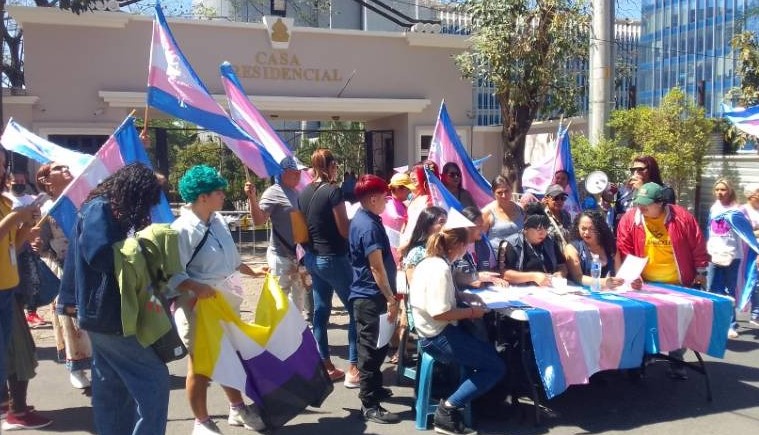
PBI-Honduras accompanies Somos-CDC and Arcoiris at Transgender Day of Visibility sit-in

On March 31, PBI-Honduras tweeted:

“Today, on #TransVisibilityDay, we accompany @arcoirisghn [the LGTB Association of Honduras] and @somoscdc_hn [the Centre for LGTBI Development and Cooperation] in a sit-in. 2 years ago, the IACHR [Inter-American Court of Human Rights] held the State of #Honduras responsible for the murder of trans defender Vicky Hernández and called for several reparation measures.”

Their Twitter thread adds:

“Several measures are still pending, such as the creation of a system to collect data on violence against the LGTBI+ community and the adoption of a procedure for the recognition of self-perceived gender identity.

In the country with the highest level of internal displacement in the region, where many people still live in situations of severe violence and are forced to leave or are forcibly displaced from their homes, the approval of the above-mentioned law, is of vital importance.”

In June 2021, The Guardian reported: “In a landmark ruling for transgender rights, the Honduras government has been found responsible for the 2009 murder of the trans woman and activist Vicky Hernández.”

“Hernández was killed on the first night of the June 2009 coup d’état, in which the Honduran military ousted President Manuel Zelaya.”

“Lawyers working on Hernández’s case argued that state agents actually committed the murder. …The court ruling, which ordered Honduras to restart its investigation into Hernández’s death, found ‘several indications of the participation of state agents.’”

“The court [also] ordered Honduras, which has the world’s highest rate of murders of trans people, to pay reparations to Hernández’s family and implement a sweeping range of measures designed to protect trans people, including anti-discrimination training for security forces and state collection of data on violence against LGBTQ+ people.”

“[And the IACHR] ruled that the state must allow people to alter their gender identity on identification documents and public records.”

The Trans Legal Mapping Report notes that in Honduras it’s “not possible” to change your name and that it’s “forbidden by law to make any modification of the sex assigned in the original birth certificate.”

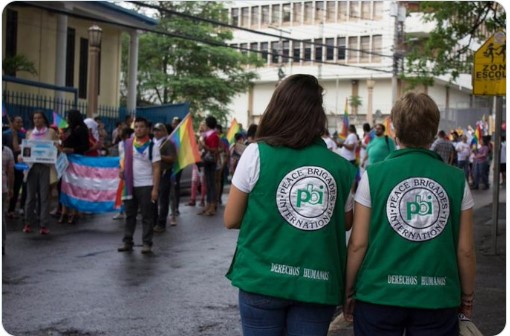
The Peace Brigades International-Honduras Project has accompanied Arcoíris, the LGTB Association of Honduras, since July 2015.

Photo: Accompanying the International Day against Homophobia Transphobia and Biphobia march in Tegucigalpa, May 2019.

Breakfast action on Lkwungen territory calls for the abolition of the RCMP “community-industry response group” (C-IRG)

Photo by Torrance Coste.

An “Abolish C-IRG” breakfast took place outside the provincial Ministry of Public Safety in Victoria on Lkwungen territory on the morning of March 30.


The Capital Daily reports: “About 100 people gathered Thursday morning in front of the offices of the Ministry of Public Safety for freshly cooked breakfast.”

The then article notes: “Community organizer and UVic student Kennedy Willier said that it is important to support Indigenous sovereignty and Indigenous-led movements, which are often the subject of C-IRG’s paramilitary-like policing.”

Molly Murphy

Capital Daily also highlights:

“At the rally, Molly Murphy detailed her experiences of being arrested by C-IRG while participating in the Fairy Creek blockades.

“Media was pushed so far away that we knew there was no independent vision on what was going to happen to us that day,” Murphy recalled. “That was the day where they just basically beat the crap out of us.”

Murphy said that her memories of what happened to her that day are blurry from trauma. But she distinctively remembers the moment where a “200-pound-plus cop” dropped a knee into the back of her friend while she was face down in gravel.

“Her face changed from being angry to just excruciating agony,” she said. Attempts at finding justice and more information regarding their treatment by police have so far been unsuccessful, due to a lack of charges from the arrests that day, Murphy said.

Murphy said that her experience is minor compared to what’s happening up north in Wet’suwet’en territory.

“It’s a whole different caliber of aggression when they’re dealing with a much more Indigenous-led movement,” Murphy said. “There’s much more money involved in CGL compared to Teal Jones.””

Photo by Michael John Lo/Capital Daily.

Webinar on the C-IRG, April 16

To hear Molly Murphy and others speak more about their direct experiences with the C-IRG, join us on Sunday April 16 at 4 pm ET for a webinar titled: C-IRG violence against the frontlines. To register, click here.