Home Blog Page 154

Maya Q’eqchi’ journalist Carlos Choc to appear in court on August 21 for his reporting on the Fenix mine in Guatemala

Join us on Friday August 18 for a conversation with criminalized journalist Carlos Choc. Register here.

This report published on June 22, 2023, by Article 19, the Committee to Protect Journalists (CPJ) and other organizations notes: “Carlos Choc has had two arrest warrants against him and is currently under substitute measures, for which he must appear before the MP [Public Ministry] every 30 days and is prohibited from approaching the mining plant and its workers.”

His next court appearance is scheduled for Monday August 21.

This started with a Canadian mine

Choc has reported on the Fenix nickel mine now operated by the Russian-owned Swiss-based Solway Investment Group.

Toronto-based INCO Ltd. was granted a 40-year licence to establish this mine in 1965. Vancouver-based Skye Resources bought the mine from INCO in 2004. Skye Resources then merged with Toronto-based Hudbay in 2008.

The mine was purchased by Solway Investment Group in 2011.

Newsweek now reports that Montreal-based Central America Nickel (CAN) could purchase the mine with the support of the U.S. (and presumably Canadian) embassies in Guatemala.

Carlos Maaz killed at protest

Choc took the photo below of 27-year-old Maya Q’eqchi’ fisher Carlos Maaz who was shot dead on May 27, 2017, by police at a protest against the pollution of Lake Izabal by the mine.

Forbidden Stories has reported: “On the pretext that he had participated in the protest, Choc, along with a journalist colleague and five fishermen, was accused of six crimes and misdemeanors by Solway Group. An arrest warrant was submitted against him in August 2017, forcing him into hiding for several months.”

October 2021 protest at the mine

Forbidden Stories also notes: “Months of exile wasn’t punishment enough for the local journalist. When he reemerged months later, the company put him under surveillance, documents in the leak show. After Carlos Choc returned to El Estor to cover the protests in October 22-23, 2021, his house was ransacked by local security forces.”

Photo: Carlos Choc reporting on October 2021 protest.

Investigative reporting on the mine

On March 6, 2022, more than 20 media outlets, including Prensa Comunitaria Kilómetro 169, participated in the Mining Secrets investigation, coordinated by Forbidden Stories, a French organization that publishes the stories of journalists facing threats or censorship.

The investigation revealed that Solway channels money to the National Civil Police (PNC). In turn the PNC carry out evictions of Maya Q’eqchi’ communities that the mining company has identified as opponents, employing strategies that include surveillance and bribes.

Incitement charge against Choc dismissed

On March 25, 2022, just weeks after the publication of the Mining Secrets/Forbidden Stories report, Choc was informed that he was the subject of a complaint filed by 13 members of the PNC and the Public Prosecutor’s Office (MP) on the charge of “incitement to commit a crime” in relation to the protest in October 2021.

Choc was exonerated of the incitement charge in September 2022.

Hearing on August 21

As noted above, Choc will be in court on Monday August 21 in relation to the substitute measure he was given in January 2019 on the August 2017 charges stemming from his May 2017 reporting on the police killing of Maya Q’eqchi’ fisher Carlos Maaz.

We echo the call in the Article 19, Committee to Protect Journalists et al report that says the Guatemalan state must: “Defend the rule of law and ensure full respect for the independence of powers, in particular the independence of the judiciary, and put an end to its instrumentalization for the criminalization of the press and acting to ensure due process in all the cases that involve journalists.”

We also highlight that the report calls on the international community to “affirm your duty to promote and defend the rights of human beings, and continue denouncing the arbitrariness and outrages of the Guatemalan State against the independent press.”

We met Choc in Guatemala City in May and continue to follow his situation with concern.

WEBINAR, August 18

To hear Carlos Choc speak about the situation he is facing, just a few days before his next court appearance, please register for our webinar here.

Further reading: “Judicial harassment and criminal prosecution have exhausting effects” (Interview with Carlos Choc, May 3, 2023).

PBI-Mexico seeks field volunteers, deadline to apply is August 20

The Peace Brigades International-Mexico Project is seeking field volunteers for a one-year term to accompany human rights defenders.

The application deadline is August 20.

For more information about how to apply, click here.

After a pre-selection process, a personal online interview will take place. There will then be a training week (the first in November with a second option in April 2024). It is during that training week that a final selection of field volunteers will take place.

The entries of new field volunteers will take place every 2-3 months throughout the year. In 2024, arrivals are expected from the month of March. As such, interested persons must have flexibility regarding the date of entry into the team.

Among the key qualifications is fluency in Spanish.

One also must be 25 years of age.

The expenses covered for field volunteers include a round trip from your country of residence, all work travel and stay expenses (accommodation, food, medical insurance), monthly economic support of about CAD $365 for personal expenses, and a repatriation payment based on CAD $65 per month worked once the stay is completed (about CAD $780 after 12 months).

For articles on recent PBI-Mexico accompaniments:

– PBI-Mexico helps document abuses against Indigenous territorial defenders opposed to Interoceanic Corridor of the Isthmus project (July 29, 2023)

– PBI-Mexico accompanies hearing of criminalized Indigenous Nahua water protector Alejandro Torres Chocolatl (July 26, 2023)

– PBI-Mexico accompanies Mother’s Day events as the situation of enforced disappearances continues (May 10, 2023)

– PBI-Mexico accompanies Indigenous Nahua water defender Miguel López Vega, criminalized for his defence of the Metlapanapa River, at court hearing (April 27, 2023)

– PBI-Mexico accompanies the People’s Front in Defence of Land and Water at March against the Dispossession of Water (March 23, 2023)

For more information about how to apply to be a PBI-Mexico field volunteer accompanying these frontline struggles, click here.

Extension of The National Dream railway has implications for Indigenous land defenders opposing megaproject in Mexico

Photo: The Last Spike completed the CPR railroad in 1885.

The Canadian Pacific Railway (CPR) company was integral to the colonization of Indigenous lands and the creation of the country called Canada.

The National Dream refers to the construction of the CPR railway from Central Canada (Ontario) to British Columbia. The first spike was hammered at Bonfield (near Sudbury, Ontario) in 1881. The ceremonial Final Spike was driven by CPR director Donald Smith on November 7, 1885, in Craigellachie (near Revelstoke, British Columbia).

In ‘The railways got very wealthy on our land’: How rail’s colonial past made it a target for blockades (The Globe and Mail, March 2020), Eric Andrew-Gee writes: “While rail interruptions [in solidarity with Wet’suwe’ten land defenders following the RCMP C-IRG raid in February 2020] have roiled Canada’s economy for nearly a month, the link between railways and the removal of Indigenous land is at the root of Canada’s national story.”

Photo: RCMP C-IRG raid on Wet’suwet’en territory, February 2020.

Photo: Solidarity blockade of CPR rail line at Chase, British Columbia, February 2020.

Andrew-Gee adds: “Construction of the CP railway was seen as essential to the growth and defence of the country in the years after Confederation – but First Nations sometimes stood in the way. Roughly 5,000 Indigenous people were expelled from the Cypress Hills of Saskatchewan in the 1880s alone to make way for the CPR. One tactic used by local Indian agents against recalcitrant bands was to withhold rations [food].”

And in Uncovered tracks: The bloody legacy of Canada’s railways (National Observer, December 2020), Joe Bongiorno commented: “Although the railway has always been a private corporation, it was — and remains — a wrought iron symbol of Confederation. But for First Nations peoples, Canada’s railways are vehicles for expropriation.”

Bongiorno adds: “To those who feel excluded from the grand designs of Macdonald’s dream, railways, pipelines and future infrastructure projects may erode what remains of their nations within Canada, rather than bind them all together.”

It has also been documented that the CPR was instrumental in the suppression of Métis and Cree peoples during the North-West Rebellion (that included the Battle of Batoche in 1885) by Canadian militia and the North-West Mounted Police (NWMP).

CBC has noted: “On March 19, 1885, [Métis leader Louis] Riel formed a provisional government and armed force, centred in the small Saskatchewan town of Batoche. The strategy was to gain the Canadian governments attention regarding a list of grievances in the Saskatchewan Valley about land rights and political power. A week later, about 100 North West Mounted Police and volunteers marched towards Batoche. [Canadian prime minister John A.] Macdonald also mobilized a militia and used the fledgling railway to quickly transport troops west. The quick mobilization of federal troops marked the beginning of the end of the Rebellion.”

Photo: The Battle of Batoche, May 1885.

Riel was hung at the NWMP Depot in Regina, Saskatchewan on November 16, 1885, a week after the ceremonial driving of The Last Spike on November 7, 1885, in British Columbia. The present-day RCMP (including members of the C-IRG) are still trained at the Depot near the spot where Riel was hung by the Canadian state.

The CPR in Mexico

Now the CPR (rebranded as the CPKC in April 2023) may be implicated in a controversial megaproject in Mexico that has seen the suppression of Indigenous rights.

CPKC photo: “The final spike. On April 14, 2023 in Kansas City, Mo., we connected a continent, driving the ceremonial Final Spike celebrating the creation of CPKC, the first and only single-line transnational railroad linking Canada, the U.S. and Mexico.”

Mexico News Daily has explained: “The so-called Interoceanic Corridor will include 10 new industrial parks across the Isthmus of Tehuantepec — the narrow ‘waist’ of southern Mexico between Salina Cruz, Oaxaca and Coatzacoalcos, Veracruz.”

That article adds: “Another key component of [Mexican President Andrés Manuel López Obrador] AMLO’s industrial strategy for southern Mexico is a 300-km transoceanic freight rail line that would link the proposed industrial parks.”

Radio Fórmula has also reported: “The Canadian Pacific Kansas City (CPKC) will seek to be a strategic partner and offer connections to North America with two of the flagship infrastructure projects of Q4: the Trans-Isthmus Corridor and the Mayan Train.”

It further notes: “According to its president in Mexico, Óscar del Cueto, who announced the recent integration of Canadian Pacific and Kansas City Southern, stressed that this new measure will allow the company to make ‘seamless’ connections between the ports of Mexico, those of the eastern United States and all of Canada.”

Bnamericas also reported in May: “Following a meeting [pictured below] between President Andrés Manuel López Obrador, US officials and CPKC executives in Mexico City, the government unveiled that it invited the company to participate in the 1,500km Maya train that will connect five states in the southeast and to the rehabilitation of the 300km Tehuantepec isthmus rail corridor between Oaxaca and Veracruz states.”

Significantly though, Proceso further notes: “During its three-day tour, the Civilian Observation Mission recorded human rights violations, framed in the Interoceanic Corridor of the Isthmus megaproject, against members of indigenous peoples and communities, most of which involve the Navy and the National Guard.”

This week, La Jornada reported: “The most worrying thing, [the civilian observation mission] said, is that there has been an increase in attacks this year and the integrity of defenders who resist this mega-project is at risk.”

The Observation Mission also says: “Among the authorities responsible for the human rights violations identified during the mission are the National Guard, the Navy, the Sedena [the Mexican Secretariat of National Defense], [and] the State Police…” As PBI-Canada has previously documented, Canada has exported more than $18.8 million in “military goods” to security forces in Mexico over the past five years.

We continue to follow this with concern.

Further reading: PBI-Mexico helps document abuses against Indigenous territorial defenders opposed to Interoceanic Corridor of the Isthmus project (July 29, 2023).

Video: PBI-Mexico speaks at the observation mission media conference, July 27.

PBI-Mexico helps document abuses against Indigenous territorial defenders opposed to Interoceanic Corridor of the Isthmus project

Video: PBI-Mexico speaks at the observation mission media conference, July 27.

PBI-Mexico recently participated in an international observation mission that documented abuses against Indigenous territorial defenders opposed to the Interoceanic Corridor of the Isthmus (CIIT) megaproject in the state of Oaxaca.

On July 27, PBI-Mexico tweeted: “PBI accompanies the observation mission in the Isthmus. It will continue to monitor the risk situation in which the indigenous peoples affected by the construction of the Interoceanic Corridor in their territory find themselves. Here we share the press release.”

That press release notes the CIIT is implicated in “at least: 21 cases of intimidation, harassment and threats against defenders, their families or groups; 11 cases of physical and psychological violence, as well as forced evictions; 3 killings of defenders between October 2022 and July 2023; 2 cases of defamation through wide-ranging public media; and 43 cases of criminal complaints against local authorities and community defenders.”

The mission also noted that 31 aggression events were recorded between October 2022 and July 2023 that were mainly against Indigenous Mixes and Zapotec peoples “of which in 21 cases they were intimidation, harassment or threats.”

What is the Interoceanic Corridor?

Mexico News Daily has explained: “The so-called Interoceanic Corridor will include 10 new industrial parks across the Isthmus of Tehuantepec — the narrow ‘waist’ of southern Mexico between Salina Cruz, Oaxaca and Coatzacoalcos, Veracruz.”

“Another key component of [Mexican President Andrés Manuel López Obrador] AMLO’s industrial strategy for southern Mexico is a 300-km transoceanic freight rail line that would link the proposed industrial parks. The ports of Coatzacoalcos and Salina Cruz would be expanded, and a new gas pipeline would be constructed in the oil-rich region. There are also plans for four new wind farms across the region to support the boom in industry that the government hopes will follow investment.”

Photo: The Interoceanic Corridor of the Isthmus (CIIT).

What Canadian companies are involved in this megaproject?

The Mexico News Daily article further explains that companies from Canada, the United States and Germany are being encouraged to become investors in this project.

On July 27, Mexican Secretary of Economy Raquel Buenrostro stated that 100 companies were interested in participating in the CIIT tender, of which 65 complied with the procedures and registrations.

Just a few weeks prior to this, on May 20 in Washington DC, Buenrostro met with Canadian Minister of International Trade Mary Ng and Industry Minister François-Philippe Champagne, along with US Secretary of Commerce Gina Raimondo, to promote the Interoceanic Corridor of the Isthmus of Tehuantepec.

Photo:  Buenrostro, Champagne, Ng, Raimondo.

And in April of this year, Radio Fórmula reported: “[The Calgary, Alberta-based] Canadian Pacific Kansas City (CPKC) [railway company] will seek to be a strategic partner and offer connections to North America with two of the flagship infrastructure projects of Q4: the Trans-Isthmus Corridor and the Mayan Train.”

That article adds: “According to its president in Mexico, Óscar del Cueto, who announced the recent integration of Canadian Pacific and Kansas City Southern, stressed that this new measure will allow the company to make ‘seamless’ connections between the ports of Mexico, those of the eastern United States and all of Canada.”

Photo: The merger of Canadian Pacific Railway Ltd. (founded in 1881) with Kansas City Southern Railway Co. was finalized in April 2023.

Interoceanic Corridor connected with the Tren Maya megaproject

Radio Fórmula has also reported: “AMLO has confirmed that the Interoceanic Corridor would connect with the Mayan Train, in order to expand the rail network in the south and southeast of the country.”

The Mexico City-based Project on Organizing, Development, Education and Research (PODER) has published a report titled The train of the elites that lists the companies and energy projects that would benefit from the Tren Maya megaproject.

Their report highlights (on page 34): “The main source of income for the Mayan Train will be the transportation of fuels, it seems clear that the Mayan Train will function as a platform infrastructure for the energy sector.”

The chart below from the PODER report notes Vancouver-based Renaissance Oil Corp. and Regina-based provincial Crown corporation Sask Energy Incorporated.

Who is committing the human rights violations?

The Observation Mission says: “Among the authorities responsible for the human rights violations identified during the mission are the National Guard, the Navy, the Sedena [the Mexican Secretariat of National Defense], the State Police, the Secretariat of Communications and Transportation, municipal authorities and the Agrarian Attorney’s Office. Various companies, armed groups and local chieftains were also identified.”

As PBI-Canada has previously documented, Canada has exported more than $18.8 million in “military goods” to Mexico over the past five years. We remain concerned about these arms exports and the violations by the Mexican military documented by the mission.

Photo: Mexican military featured in CADSI promotional video for the CANSEC 2023 arms show in Ottawa.

We continue to follow this with concern.

Further reading: Con Jara Cruz, aumento exponencial de ataques a defensores del territorio (La Jornada, July 28, 2023) and Con el Corredor Interoceánico aumentaron agresiones a comunidades y defensores sociales (Proceso, July 27, 2023).

Today marks the 55th anniversary of the displacement of an Indigenous community for a military base in Guatemala

“This land is ours”

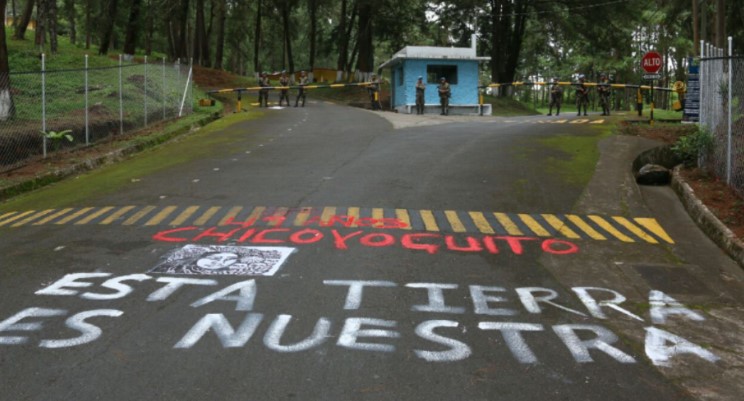
On May 5, a Peace Brigades International-Canada delegation met with Olivia, a representative of the Residents Association of Chicoyogüito, Alta Verapaz (AVECHAV) at a café in the city of Cobán in the department of Alta Verapaz.

She told us about the eviction and displacement of her community so that a military base could be constructed on those ancestral lands.

That eviction took place on July 28, 1968 – 55 years ago today.

The 200 families of the Indigenous Q’eqchi’ community of Chicoyogüito were violently displaced that day so that an army base – then known as Military Zone 21 – could be established in the department of Alta Verapaz.

After the eviction of the community, the military base became a clandestine centre for illegal detention, torture, extrajudicial executions, enforced disappearance, and rape committed from 1978 to 1990.

At least 565 Indigenous people were disappeared at that base. The bodies identified are of Mayan Achí, Q’eqchi’, Pomochí, Ixil, and Kiché peoples.

The military base is considered the largest clandestine cemetery in Latin America.

The military base that displaced his community was rebranded in 2004 as Creompaz, a training base for UN peacekeepers funded by Canada and other countries.

Dawn Paley has written: “Regardless of the mass graves at the base, military and police training continues there, supported by countries like the US and Canada.” The support from Canada has included a CAD$250,000 grant in 2009 and the purchase of specialized equipment in 2014 for a training program at Creompaz.

Photo: CREOMPAZ, March 20, 2021.

At the bottom of this website (dated 2023), the Peace Operations Training Institute that partners with CREOMPAZ “to provide e-learning on peacekeeping courses” thanks Global Affairs Canada’s Peace and Stabilization Operations Programme for their funding.

Domingo, a member of AVECHAV, highlighted on a PBI-Canada webinar on July 15, 2021: “We know Canada has provided a lot of support for [the Creompaz peacekeeping base on our land]. But where is the peace that they say they are creating?”

Video: PBI-Canada webinar with Olivia and Domingo from AVECHAV, Santiago Choc Cu of the PBI-Guatemala accompanied Human Rights Law Firm (BDH) and Rachel Small of World Beyond War Canada.

On September 15, 2021, Domingo also presented to 4th year students at the University of Victoria about the situation for his community.

PBI-Guatemala began accompanying AVECHAV in 2015.

Canada promises to announce an implementation plan by Fall 2024 to phase-out public financing of the fossil fuel sector

Video: The construction of EDC financed Coastal GasLink and Trans Mountain pipelines has been facilitated through RCMP C-IRG violence.

The Canadian government recently announced its (somewhat awkwardly titled) Inefficient Fossil Fuel Subsidies Government of Canada Self‑Review Assessment Framework and the Inefficient Fossil Fuel Subsidies Government of Canada Guidelines.

These guidelines could affect about $1 billion in subsidies to the fossil fuel industry.

Notably, the guidelines do not impact Export Development Canada (EDC) which provided $19 billion in financing for fossil fuel projects in 2022. Loans and guarantees are not technically considered by the government to be subsidies.

The Glasgow Statement

The Glasgow Statement holds some promise though.

The Canadian government signed the statement at the UN COP26 climate conference in Scotland in December 2021. The statement is essentially a pledge to stop financing new fossil fuel projects in other countries by the end of 2022.

In December 2022, EDC stated it was “on track to no longer provide new direct financing to international fossil fuel companies and international projects as of Jan. 1, 2023, in line with Canada’s commitment at COP26 last year.”

But The Financial Post has reported that while “the self-imposed Glasgow Statement deadline kicks in on Jan. 1, 2023”, EDC “may still provide billions of dollars in support for fossil fuel projects in other countries in 2023.”

EDC acknowledges that amount to be $2.5 billion of “exposure” that had not yet reached maturity (and that would not be renewed).

Oil Change International has also noted: “Just days after [our Promise Breakers] report was finalized [in March 2023], it appears Canada’s export credit agency, Export Development Canada is already in breach of their policy by approving four international oil and gas transactions totaling at least USD 5.5 million already in 2023.”

National security exemption

Oil Change International has also highlighted one other potential concern about Canada’s promised implementation of the Glasgow Statement: “Canada’s policy leaves the door open for fossil fuel projects on national security grounds. In the Canadian policy, ‘national security’ includes not only the energy security requirements of Canada, but also of an ally, or other recipient country deemed important to Canada’s national interests. The policy provides little detail on how this should be interpreted.”

Natural Resources Canada has also noted: “[The Glasgow Statement] allows for support for projects on national security grounds, including ensuring the energy security requirements of Canada, an ally, or other recipient country deemed important to Canada’s national interests, on a case-by-case basis.”

It remains to be seen if fossil fuel projects in Colombia and Mexico, for instance, could be deemed in Canada’s national interests.

There are already concerns that Mexican President Andrés Manuel López Obrador has defined unpopular extractivist megaprojects, including the Dos Bocas Refinery, as being of “national security and public interest”.

The meeting of high-level Canadian and Mexican ministers in July 2021 already suggests that TC Energy pipelines in Mexico are seen as “crucial”.

Photo: Canadian Trade Minister Mary Ng meets with Jennifer Pierce, Senior Vice President of Pipelines in Mexico and President of TC Energía, and Tatiana Clouthier, Secretary of Economy of the Mexican government, at the TC Energy offices in Mexico City.

Photo: In January 2022, PBI-Mexico accompanied the National Meeting of Struggles against Gas Pipelines and Death Projects that expressed opposition to the TC Energy Tuxpan-Tula gas pipeline (across the states of Veracruz, Puebla and Hidalgo).

Public financing announcement expected in 2024

Earlier this week, CBC News reported: “[Canada’s environment minister Steven] Guilbeault said the government is [now] working on identifying all remaining sources of public financing — including Crown corporations [like Export Development Canada] — and will announce a plan to phase those subsidies out by the end of 2024.”

And a Government of Canada media release stated: “Canada is also committed to phasing out public financing … beyond the scope of today’s fossil fuel subsidies commitment. The Government’s work will identify current public financing by 2024 and announce by fall 2024 the implementation plan to phase out public financing of the fossil fuel sector.”

The promise is that “by fall 2024” – about a year from now – an “implementation plan” could be announced that would address EDC domestic financing of fossil fuel projects (like its up to $500 million loan to Coastal GasLink in April 2020  and a $3.75 billion – $4 billion guarantee to the Trans Mountain Corporation in March 2023).

We recall though that Prime Minister Justin Trudeau has stated the TMX pipeline is in “the national interest” and Jim Carr, his special representative for the Prairies, said the same of the CGL pipeline in January 2020.

Reparations?

It also remains unresolved if there is any pathway for redress for the climate damage and human rights violations involved in EDC’s financing of oil and gas pipelines constructed on Wet’suwet’en and Secwepemc territories without consent.

The millions EDC has provided for Coastal GasLink and billions for Trans Mountain are for oi and gas pipelines not yet completed, but when operational will emit carbon and put at risk waterways for the pipelines’ lifespan of approximately 40–50 years.

What culpability does EDC hold for that? What remedy or reparation is available for EDC’s financing of pipelines that the United Nations Committee for the Elimination of Racial Discrimination has repeatedly called on Canada to halt?

Are there similar obligations to consider with fossil fuel projects financed by EDC in other countries?

These may be questions that could be asked of the Minister of Canadian Heritage (who is responsible for Canada’s international human rights reporting) and the Minister of Small Business, Export Promotion and International Trade (who is responsible for Export Development Canada).

We continue to follow this with concern.

Photo: PBI-Canada en route to the Unist’ot’en Healing Centre on Wet’suwet’en territory on November 20, 2021, just after an RCMP C-IRG raid.

PBI-Honduras accompanies Guapinol river defenders as they call for cancellation, not temporary suspension, of Los Pinares iron oxide mine

On July 26, PBI-Honduras tweeted:

“Yesterday we were present at the call issued by the Municipal Committee in Defense of Common and Public Goods of Tocoa addressed to social organizations and the media in front of the Secretary of Natural Resources and Environment.

The Committee demands the definitive cancellation of the mining project that was established in the protected area of the Carlos Escaleras Montaña de Botaderos National Park.

From PBI we highlight the work of defending the community and the organization in favor of common goods.”

On July 25, Guapinol Resiste had tweeted:

“Defenders of Guapinol, San Pedro Sector and Tocoa present opposition against the temporary suspension of mining exploitation in the Carlos Escaleras national park.

The *definitive* cancellation is required now!”

They also tweeted:

“It is not possible that with all the technical and documentary evidence -including falsified public documents to obtain an environmental license and illegal exploitation in a protected area- that Grupo Emco/Lenir Perez and Ana Facusse benefits from a 2-year temporary suspension.”

This follows Criterio reporting on June 29:

“The head of the Secretariat of Natural Resources and Environment (Serna), Lucky Medina, made official the beginning of the process of suspension of the Los Pinares Investments mine that was installed without consultation in the Carlos Escaleras National Park, in Tocoa, Colón, northern Honduras.

Medina’s brief message left more questions than answers and was raised by [CESPAD] socio-environmental analyst, Lucía Vijil, who through a tweet pointed out that the ecological ways in which the suspension and closure of the mine will be carried out should be explained.

Vijil told Criterio.hn that her comment is directed to the fact that Medina’s tweet [announcement of the suspension process] “is so brief, that you do not know if it is going to be partial or total closure, the closure measures, indicators for the closure, compensation and restoration measures, why it is closed,” among other points.

The socio-environmental analyst recalled that the mining megaproject has other components to which Medina does not refer, such as the iron oxide pelletizing plant, operated by Inversiones Ecoteck – always of the Emco Holding Group and parent company of Inversiones Los Pinares – built and also located in the Carlos Escaleras National Park.”

We continue to follow this situation.

Further reading: PBI-Honduras concerned by the murder of Guapinol water defender Oqueli Domínguez who resisted the Los Pinares iron oxide mine (June 17, 2023) and “Rather than die of thirst, it is better to fight standing up” – Guapinol River defender Reynaldo Domínguez (April 7, 2023).

Sagkeeng warrior/protector Tre Delaronde arrested at Camp Marcedes as the call to search the landfill continue

Photo of Tre Delaronde by Radio-Canada/Maxime Beuachemin.

From social media reports we see that Sagkeeng warrior/protector Tre Delaronde was arrested by Winnipeg police yesterday and released this afternoon (but now faces several charges).

APTN tweets: “Winnipeg police are cleaning up their headquarters after what they call an ‘incident’ overnight. Handprints can be seen smeared across the glass in the front of the station and on the sign out front. People are upset with the arrest of protestor Tre Delaronde at Camp Marcedes.”

Photo: Winnipeg police have refused to search Prairie Green landfill for the remains of Marcedes Myran, Morgan Harris and Mashkode Bizhiki’ikwe (Buffalo Woman), but apparently have deployed a forensics team to study the handprints left on their police station from the protest last night.

Photo: Jorden Myran at Camp Marcades. Her 26-year-old sister Marcedes (right) was murdered in May 2022 and her remains are believed to be at the Prairie Green landfill.

Photo of Camp Marcedes (at the Canadian Museum for Human Rights) by Celeste George.

Video still of Camp Marcades from APTN.

APTN journalist Dennis Ward also tweets: “Presumably, part of the ‘incident’ last night as numerous protestors showed up at police HQ following the arrest of Tre Delaronde, who has been at Camp Morgan at Brady landfill since December 2022. He was arrested at Camp Marcedes.”

Photo: The partial remains of 24-year-old Rebecca Contois were found at the Brady Road landfill in June 2022.

Photo of the Camp Morgan blockade (at the Brady Road landfill} dismantled by the Winnipeg police on July 18, 2023.

And Terrill Tailfeathers tweets: “Tre Delaronde arrested last night by @wpgpolice at Camp Marcedes outside the Canadian Human Rights Museum. Via @ClintonNabess on TikTok. Link here: https://vm.tiktok.com/ZM2p66axc/ Please share widely.”

Delaronde, 28, is a member of the Sagkeeng Anicinabe Nation and of the First Nation Indigenous Warriors watchdog group.

In an October 2021 article about Delaronde, the Winnipeg Free press explains: “The name Warrior in the title derives from the Anishinabe word for warrior, ogichidaa, in much the same way as the ancient Hindu word Ksatriya means warrior or protector of society.”

Warrior criminalized with charges

It appears that Delaronde was released about 12:30 pm ET on Wednesday July 26. The Winnipeg Sun reports: “An online video shows that Delaronde has since been released and police have yet to reveal why Delaronde was arrested or if he faces any charges.”

(The Canadian Press now reports: “Police allege the man threatened two private security guards, and have charged him with uttering threats, mischief and possessing body armour without a permit.” The Winnipeg Police Service has also just posted this media release about the arrest. A response to this from Cambria Harris can be read here.)

The two camps

Just last week, El Jones wrote about Camp Morgan and Camp Marcedes in The Breach:

“Out of the violence and horror of the murders of Morgan Harris, Marcedes Myran, Rebecca Contois and a fourth unidentified woman known as Mashkode Bizhiki’ikwe (Buffalo Woman) and the compounded trauma of the government’s refusal to search for their remains, residents of the camp have worked to bring life and healing back to the land. A ceremonial fire burns behind us; as I climb to join the wiigwaam, I can see across the camp: to the women’s tent where elders and children rest, to the tipis erected, to the artwork created. All in the shadow of death and violence.”

This camp was established not only to demand action on searching the landfill, not only to pay respect and remember, but to transform pain and grief in the face of ongoing genocide into community, love and support.

[On Tuesday July 18], I go over to the Canadian Museum for Human Rights, where a new camp called Camp Marcedes, is already being built. The fire has been brought over from Camp Morgan. A barbeque is going. Rudolph, who I met the night before, introduces me to his daughter. People smudge the food. It starts to rain, and they hold a tarp over the fire and continue on.”

We continue to follow this.

Further reading: MP Leah Gazan writes UN Expert Mechanism calling for international oversight of Canada’s failure to search landfills (July 19, 2023)

PBI-Mexico accompanies hearing of criminalized Indigenous Nahua water protector Alejandro Torres Chocolatl

PBI-Mexico has tweeted:

“Today, July 25, from @PBI_Mexico we are accompanying the linkage hearing against defender Alejandro Torres Chocolatl, a member of @fpdtampt [the Peoples’ Front in Defence of Land and Water] who has been criminalized for his work in defense of land and water.

We welcome the opinion of the judge, who ordered the non-binding process and the withdrawal of the arrest warrant immediately. It is a victory for the peoples fighting to defend their rights, land and territory.”

Today, La Jornada Oriente reports:

“Yesterday afternoon the defender of the territory in the area of Cholula and the volcanoes, Alejandro Torres Chocolatl was released from the three false accusations made against him since 2020 by the State Water and Sanitation Commission of Puebla (Ceaspue), for his opposition to a collector of the Industrial Park of Huejotzingo that would pollute the Metlapanapa River.

Video by La Jornada Oriente.

Miriam Huerta Lechuga, head of the Criminal Oral Hearing and Execution Court of the Central-West Judicial Region, determined that the State Attorney General’s Office (FGE) could not prove the accusations of attacks to communication routes, security in means of transportation and obstruction of public works made by Ceaspue to Torres Chocolatl.

Throughout the proceedings, it became evident that the supposed investigation by the FGE was based only on statements made by four employees of the accusing agency and that not a single piece of evidence was provided to support its accusations against Torres Chocolatl, a chicane that was widely used during the six-year term headed by the late former PAN governor, Rafael Moreno Valle Rosas, to fabricate crimes and persecute his adversaries, opponents, dissidents and critics, as was the case, for example, of Enedina Rosas Vélez, the courageous peasant farmer who led the opposition to the Morelos Gas Pipeline.

Video by La Jornada Oriente.

Finally, it also became evident that none of the declarants who accused Alejandro Torres Chocolatl or his partner Miguel López Vega could sustain their claim that they were the ones who allegedly threw “Molotov cocktails” at a Ceaspue truck, which is why this accusation also fell apart.

On his way out of the House of Justice of San Andrés Cholula, Torres Chocolatl said that not only was his innocence clear, but that his victory in court is also a triumph for the women and men who defend the territory.

The Guardians of the Metlapanapa River, the Peoples’ Front in Defense of Land and Water Morelos, Puebla, Tlaxcala (FPDTA-MPT), Peace Brigades International, representatives of the Finnish Embassy, members of the Tiyat Tlali Council – who defend the territory in the Sierra Norte – and emissaries of the Otomí people were there.”

Further reading:

PBI-Mexico accompanied Indigenous Nahua water protector Alejandro Torres Chocolatl arbitrarily detained by state agents (July 1, 2023)

PBI-Mexico visits Radio Zacatepec, a community radio station under threat for reporting on dangers to the Metlapanapa River (January 3, 2022)

Complaint to the CRCC claims the RCMP C-IRG established an illegal exclusion zone on unceded Ditidaht lands

Video: BCCLA staff counsel Veronica Martisius encounters C-IRG officers, June 2021.

The BC Civil Liberties Association (BCCLA) has submitted a complaint to the Civilian Review and Complaints Commission (CRCC) about actions by the RCMP community-industry response group (C-IRG) in the Caycuse watershed.

Their media release explains: “The BCCLA’s complaint focuses on an interaction between BCCLA Staff Counsel, Veronica, and the RCMP at an exclusion zone checkpoint within the Caycuse watershed on unceded Ditidaht lands on June 8, 2021.”

CFNR adds: “The BC Civil Liberties Association has accused the C-IRG of illegally stopping people from accessing an injunction order area. That order was granted to prevent people from interfering with Teal Cedar’s logging activities on Vancouver Island. However, the order stated that they could not prevent peaceful protesting, and could not stop people from accessing the injunction area.”

This video posted by the BCCLA shows the C-IRG being informed that the injunction allows people to pass but still threatening Martisius with arrest for obstruction.

Martisius later received written confirmation from RCMP lawyer Bobby Bharaj that the exclusion zone established by the C-IRG was established exclusively for the benefit of Teal Jones’ active logging operations.

Martisius says: “It is deeply disturbing and unjust for individuals who are intimately aware of their rights to be denied those rights by RCMP officers who are clearly ignorant about the law as it stands yet wield tremendous power and potential for violence in enforcing their interpretation of the law for the benefit of a logging company.”

The CRCC launched a systemic investigation into the C-IRG on March 8 of this year.

The terms of reference include reviewing C-IRG actions with respect to the Teal Cedar Products Ltd injunction in the Fairy Creek watershed.

Three months after the launch of the investigation, the CRCC told us:

“At the launch of our systemic investigation on March 8, 2023, the CRCC submitted a request for extensive information to the RCMP.  We have received some of that information so far, and are awaiting confirmation on when the RCMP will be able to compile and provide the remainder. …The CRCC strives to complete its systemic investigations within 12-18 months; however, the timely provision of requested information and access to RCMP personnel will largely determine when the CRCC’s report will be available.”

PBI-Canada will seek to provide a status update on this at the six-month mark of the investigation on September 8, 2023. As noted above, the investigation could be completed at some point between March and September 2024.