Home Blog Page 131

Gitxsan Huwilp to rally in Smithers against the C-IRG and sentencing of Wet’suwet’en Hereditary Wing Chief Dsta’hyl, March 6

The Gitxsan Huwilp Government will be rallying against the Royal Canadian Mounted Police (RCMP) Community-Industry Response Group (C-IRG) and the sentencing of Hereditary Wing Chief in Smithers on Wednesday March 6.

They have posted on Facebook:

“RCMP C-IRG – as you are aware – is under investigation for corruption by their federal oversight agency – as they beef up their ranks as a funded military solution to perpetrate industry greed. For the RCMP C-IRG to extinguish Indigenous peoples’ fulsome rights on their lands, threaten our lives with military tactical weapons, terrorize our women and children, weaponize our land defense is indefensible.

On March 6th at 9am the BCSC [British Columbia Supreme Court] will make an example of this, sentencing a Wet’suwet’en Hereditary Wing Chief for criminal contempt for protecting his traditional territory against industry raiding. Hereditary Chiefs have a fiduciary responsibility to protect the lands for current and future generations.”

Two of the demands of this rally are to “stop industry-led injunctions that allow industry looting of Indigenous lands” and “dismantle the RCMP C-IRG (only militarized unit in Canada).”

On February 20, Amanda Follett Hosgood of The Tyee tweeted: “BC Supreme Court has found Wet’suwet’en Chief Dsta’hyl guilty of criminal contempt, rejecting a novel defence that rather than bringing the law into disrepute he was upholding Wet’suwet’en law on his traditional territory when interfered with pipeline construction.’”

She had previously reported: “Chief Dsta’hyl … was arrested Oct. 27, 2021, following an interaction with Coastal GasLink security on his clan’s traditional territory. Although he was originally taken into custody for mischief and theft over $5,000, Dsta’hyl now faces a charge of criminal contempt.”

WEBINAR TODAY AT 5:30 PM PT

This news release from the Likhts’amisyu, one of five clans within the Wet’suwet’en nation, stated: “On October 27, 2022, Likhts’amisyu Hereditary Chief Dsta’hyl was arrested and forcibly removed from unceded Likhts’amisyu territory, along with Kolin Sutherland-Wilson of the Gitxsan Git’luuhl’um’hetxwit wilp. In observance of Wet’suwet’en trespass laws, Dini ze’ Dsta’hyl decommissioned 10 pieces of heavy construction equipment.”

Kolin will be one of the speakers on a webinar today (Tuesday March 5) titled Gitxsan and Gitanyow Resistance to Colonial Mega Projects.

To register for that webinar, click here.

We continue to follow this.

PBI-Honduras with COPINH on the 8th anniversary of the murder of Indigenous Lenca water protector Berta Cáceres

Near midnight on March 2, 2016, assassins hired by DESA, a company seeking to build a hydroelectric dam opposed by the Council of Popular and Indigenous Organizations of Honduras (COPINH), broke into the home of COPINH’s general coordinator, Indigenous Lenca water protector Berta Caceres, shot her, and escaped. She died minutes later in the arms of friend Gustavo Castro, who was also shot in the attack.

In Honduras, there is a saying: “blood of martyrs, seed of freedom.” 18th century martyred Aymara leader Tupac Katari is also attributed to saying: “I will come back, and I will be millions.” Following Berta’s murder, a popular saying emerged: “They wanted to bury her, but they didn’t know that she was a seed” and thus “Berta multiplied”.

PBI-Honduras has posted:

“We agree with @COPINHHONDURAS during the 8th sowing of #indigenous #defender #lenca Berta Cáceres. It is important to advance the #justice process for Berta, COPINH and the community of Rio Blanco. Berta will return and will be millions. #JusticeForBerta.”

On March 2, PBI-Honduras also tweeted:

“Yesterday, we observed the premiere of the documentary ‘The Illusion of Abundance’ in Utopia (La Esperanza) as well as the subsequent dialogue between the communities of the @COPINHHONDURAS. ‘This film was made to generate debate and raise awareness’ (Bertha Zúniga Cáceres).”

“The screening of ‘The illusion of abundance’ took place in the framework of our project ‘Walking together: comprehensive protection for women and people of sexual and gender dissidence, defenders of #HumanRights in #Honduras’, funded by @AECID_Honduras [the Spanish Agency for International Development Cooperation].”

Our friend Amnesty International Canada Latin America Campaigns Coordinator Kathy Price also tweeted: “The legacy of #BertaCáceres is alive in Canada. In the words that surround Berta’s tree! In the commitment of all who make their call their own: ‘Let’s wake up, there is no time’! Solidarity with @COPINHHONDURAS #JusticeForBerta #TheStruggleContinues #BertaMultiplied #BertaSeed”

Solidarity with Palestine

And we take note that COPINH expressed solidarity with the Palestinian people at this 8th anniversary gathering. They tweeted:

“At the #8yearAniversary of the Sowing #BertaCáceres, we stand in solidarity with the people #palestine, who face a painful humanitarian and environmental crisis on the part of the State of Israel.”

“We firmly believe in the importance of people’s solidarity and support in such adverse times, therefore, from these Lenca lands we join the global action for Gaza and Palestine.”

Further reading: Peace Brigades International urges Israel to implement ICJ decision to prevent genocide in Gaza; calls on international community to increase efforts to guarantee peace.

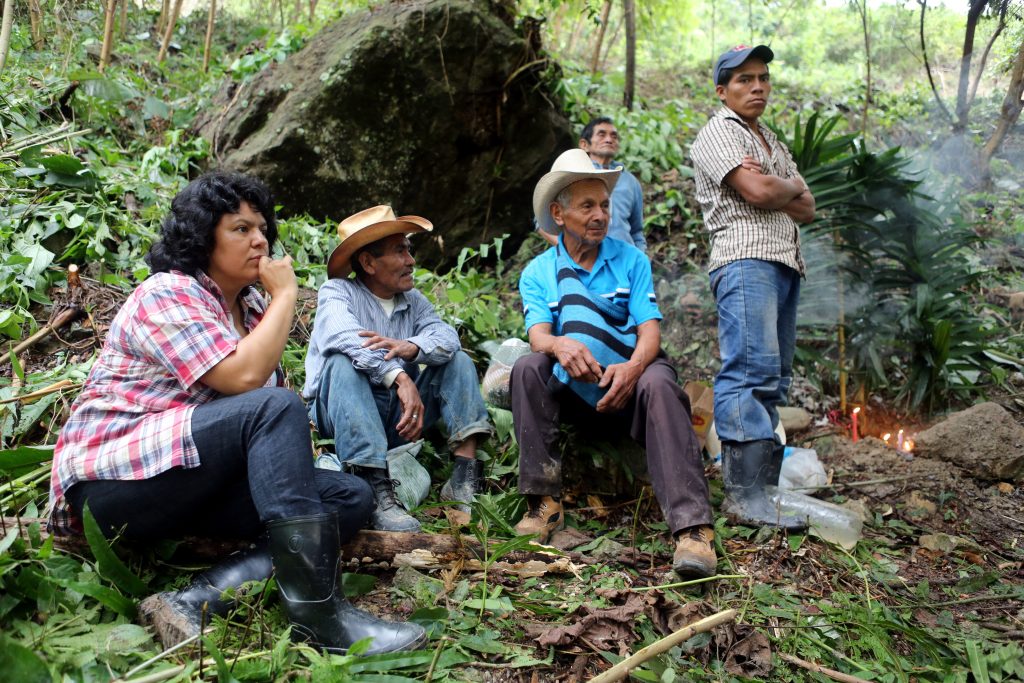
Berta Cáceres in her own words

Photo: Berta Caceres.

In the preface to this interview with Berta Caceres from 2015, Asís Castellanos and Adrienne Pine comment in Toward Freedom:

“Berta’s close relationships with Zapatista organizers and anti-hierarchical Indigenous movements throughout the Americas, as well as her collaborations with non-Indigenous-identified anarchist-leaning organizers were mutually beneficial and constitutive. Though her leadership, revolutionary clarity and vision were undeniable (as her words demonstrate), her praxis centered on building broad-based, radically democratic, horizontalist movements and coalitions capable of confronting the murderous power of capital and creating in its stead a profoundly different model of social organization.”

To read that interview in full, click here.

Video: “Let us wake up! We’re out of time. We must shake our conscience free of the rapacious capitalism, racism and patriarchy that will only assure our own self-destruction. Our Mother Earth – militarized, fenced-in, poisoned, a place where basic rights are systematically violated – demands that we take action.” – Berta Caceres

Video: On March 8, 2016, people gathered in front of the Embassy of Honduras in Ottawa, Canada to demand justice just days after the murder of Cáceres.

COPINH’s coordinators have been accompanied by PBI Honduras since May 2016.

PBI-Honduras accompanies ARCAH at Crawfish Rock meeting as Honduras exits World Bank investment dispute body

PBI-Honduras has posted:

“We accompany ARCAH [the Honduran Alternative for Community and Environmental Vindication] in the second meeting of the National Movement Against ZEDE [Zone for Employment and Economic Development] and in Defense of Sovereignty in the community of Crawfish Rock (Roatan, Bay Islands).

We stand in solidarity with the Crawfish Rock community, OFRANEH [the Black Fraternal Organization of Honduras] and ARCAH in their advocacy work against ZEDE and show concern for the risks they face.”

The National Movement also posted:

“On February 24, we held the Second Meeting of Resistance Against ZEDE, in the community of Crawfish Rock, This day of agreement, solidarity and denunciation, brought together organizations from 13 departments of the country.

We continue denouncing the advances of ZEDE Prospera, as a neocolonial invasion project that today bets to experiment genetically with our corporealities.”

What is a ZEDE and Prospera?

In July 2022, The Guardian reported:

“The controversy dates back roughly a decade, when the Honduran government reformed the constitution and passed a law that paved the way for the creation of Employment and Economic Development Zones (ZEDE). The idea was ripped from economist Paul Romer’s proposal of charter cities, which the Nobel-prize winner theorized could promote development in areas plagued by poor governance.

Romer proposed that a foreign nation act as a guarantor for the governance of charter cities. But the Honduran law instead allowed corporations to build a private city.

The issue fell into the background until 2020, when word spread that the first charter city had been established in Crawfish Rock – to the surprise of the village’s residents.

Roatán, located about 65 kilometers (40 miles) north of the mainland, is one of the Caribbean’s top tourist destinations and an expat haven, renowned for its white-sand beaches and world-class diving. Up and down the beach, there are vacation homes and resorts owned by foreigners.

Representatives of Próspera have said that they informed the community of their intentions in June 2019, citing a document that was signed by 49 residents. The ‘community resolution’ document refers to the Próspera ZEDE as a ‘real estate and community development project’, but does not go into further detail.

As the controversy spread across the nation, a movement was born that demanded the protection of land rights and decried the concession of sovereign territory to foreigners and corporations.

President Xiomara Castro, who was elected in a landslide in November [2021], made the ZEDE a signature issue of her campaign. When Castro sanctioned the repeal in April [2022], she called it the most important day in her presidency thus far.

But the elation was short-lived. Just before the repeal, Próspera announced a new round of investments totaling $60m and the adoption of the cryptocurrency bitcoin as legal tender. In the weeks and months since, the company has continued to operate as if nothing has changed, moving ahead with construction projects.

Government officials said that any ZEDE currently operating has one year to conform to another kind of legal framework. But investors cite a sunset clause in the ZEDE law that gives them a term of at least 10 years, as well as other international trade agreements that they claim grants them decades more.”

Investment protections in trade agreements

The Próspera Group has stated: “Honduras Próspera, Inc., the Promoter & Organizer of Prospera ZEDE, is a U.S. company with rights under the Central American Free Trade Agreement (CAFTA-DR) and the U.S.-HN Bilateral Investment Treaty, which extend to investments made in Próspera ZEDE the highest degree of legal protection in Honduras. Many other investors from other countries likewise enjoy powerful treaty rights.”

Ryan C. Berg, a senior fellow at the Center for Strategic and International Studies, had also cautioned: “If the Honduran government insists on moving forward with abolishing the ZEDE law, investors have a number of legal mechanisms at their disposal [including] Chapter 10 of the CAFTA-DR to seek interim injunctive relief to preserve the status quo, as well as damages for any lost investment and future profits.”

The latest

Last year, the Bretton Woods Project reported: “Honduras is threatening to withdraw from the World Bank’s International Centre for Settlement of Investment Disputes [ICSID] over an $11 billion claim by Honduras Prospera, a US company.”

Now, BNN reports: “On February 24, 2024, a pivotal development unfolded as the Republic of Honduras formally announced its withdrawal from the [ICSID Convention], signaling a significant shift in the global investment arbitration framework. This move, set to become effective on August 25, 2024, has sparked discussions on the future of international investment disputes and the broader implications for global economic relations.”

Accompaniment

The Honduran Alternative for Community and Environmental Vindication (ARCAH) is a space for community articulation and an anti-capitalist, anti-racist, anti-patriarchal, anti-colonialist and anti-classist social movement that seeks to defend territories and common goods from any project that threatens the peace and cosmovision of communities.

PBI-Honduras has accompanied ARCAH since September 2022.

PBI calls for respect for international law, protection of human rights defenders and an immediate cease-fire

Contact: governance@peacebrigades.org

PBI calls for respect for international law, protection of human rights defenders and an
immediate cease-fire

Peace Brigades International (PBI), an organization that seeks to create space for peace
and participate in the protection of human rights, shares the words of the UN Secretary
General that “only a negotiated peace that satisfies the legitimate national aspirations of
Palestinians and Israelis alike (…) can bring long-term stability to the people of this land and
the broader Middle East region “.

➢ PBI stands in solidarity with all victims; when human rights are violated in one part of
the world, they are violated everywhere. War is not the solution, armed confrontation will only
increase the death and destruction and will take away the possibility of finding a negotiated
and stable solution.

➢ PBI urges Israel to implement the provisional order of the International Court of Justice
(ICJ) of January 26, 2024, to take measures to prevent genocide in Gaza. PBI also reiterates
its call for an immediate ceasefire.

In our 40 years of existence, the many human rights organizations and communities that we
have accompanied in different countries have taught us to give importance to historical
memory, so it is important to recognize the roots of the current situation: the Arab-Israeli war
of 1948-1949 following the adoption of the United Nations Plan for the Partition of Palestine of
1947 and the consequent displacement of more than 700,000 inhabitants of Palestine. Since
then, the violent conflict has not ceased. The Hamas attack on October 7, 2023 left around
1,200 people killed and at least 240 kidnapped, and the State of Israel responded. Four
months later, Israel’s military operation, according to sources considered by the ICJ, led to
25,700 Palestinians killed, more than 63,000 people injured, more than 360,000 homes
destroyed or damaged and some 1.7 million people forcibly displaced inside Gaza.

Numerous UN statements have repeatedly warned of the grave risk of genocide of the
Palestinian people by the conduct of the Israeli government and public forces in Gaza, and
have also reminded all governments of their duty to prevent it. In January 2024, eight UN
rapporteurs insisted: “Israel is not only killing and causing irreparable harm to Palestinian
civilians with its indiscriminate shelling, but is also knowingly and intentionally imposing a high
rate of disease, prolonged malnutrition, dehydration and starvation by destroying civilian
infrastructure.” Despite this, the situation continues to deteriorate and every day we lament
new civilian casualties, attacks on health centers, educational centers, humanitarian
equipment, as well as new forced displacements. On December 29, 2023, the Republic of
South Africa submitted an application to the ICJ against Israel for alleged non-compliance in
the Gaza Strip with its obligations under the Convention on the Prevention and Punishment of
the Crime of Genocide.

In light of the foregoing, the Court considers in its decision on provisional measures, and
before rendering its final judgment, that there is a real and imminent risk of irreparable harm to
the rights contemplated by the Convention on the Prevention and Punishment of the Crime of
Genocide. It therefore calls upon the State of Israel to take all measures within its power to
prevent the commission, against the Palestinians in Gaza, of any act falling within the scope
of Article II of the Convention, in particular it must ensure, with immediate effect, that its army
does not commit any of the acts prohibited by the Convention. The Court also insists that the
State of Israel must take all measures within its power to prevent and punish direct and public
incitement to commit genocide against members of the Palestinian group in the Gaza Strip.

PBI asks for:

● An immediate ceasefire and that the international community concentrate all its efforts
to open a phase of dialogue that seeks a sustainable and lasting peace.

● The international community to demand respect for International Humanitarian Law by
all armed actors involved in the conflict. In particular the cessation of indiscriminate bombing
of the Gaza Strip, the cessation of bombing of medical, educational and humanitarian
institutions, as well as free access to food and drinking water and allow access to
humanitarian aid to civilian populations.

● To the international community in its mediating role to insist on the release of all
persons kidnapped by the Hamas group and Palestinian persons arbitrarily detained
by Israel.

● To the international community to show its strong support for such important
institutions for global justice as the International Court of Justice.

● The international community to maintain its support for UN agencies and
humanitarian organizations working in the Gaza Strip.

● We call on the international community to suspend the supply of arms to Israel and
the armed groups involved in the conflict.

Peace Brigades International seeks to be faithful to its principle of non-partisanship
which “does not mean neutrality or passivity in the face of injustice or the violation of
human rights, and the violation of the right to freedom of expression, on the contrary:

PBI is fully committed to these values and fights against violence – physical or
structural – as a means to establish lasting peace.”

28-2-2024

Peace Brigades International

International Office Village Partenaire

15 Rue Fernand Bernier 1060 Brussels, Belgium

Tel: +32 (0) 25434443

PBI-Canada webinar on Gitxsan and Gitanyow Resistance to Colonial Mega Projects, March 5

We know that settler colonialism aims to eliminate Indigeneity, either through incorporating Indigenous people into colonial structures, or forcing access to territory through injunctions and RCMP CIRG-sponsored terror.

And at the same time, Indigenous people continue to live their laws, practice collective governance structures that entwine communities with each other and the land, and renew spiritual relationships that defend the sacred.

On Tuesday, March 5th at 5.30PM PT, please join this hour-long webinar to hear Kolin Sutherland-Wilson, Tara Marsden, Kai Nagata and Maryam Adrangi speak on colonial projects facing Gitxsan and Gitanyow peoples:

https://us02web.zoom.us/webinar/register/WN_Lq42mv9-Q0-XfOBOrjJkfA#/registration

We will try and get a sense of the details of new colonial mega-projects as we emerge into a more coercive post-TRC moment, even as we also try to highlight continued anti-colonial resistance and ways to expand and support it.

Lots to do in an hour; come check it out!!

– Seb Bonet, Peace Brigades International-Canada

PBI-Guatemala accompanies Alaska Summit Massacre trial of soldiers who killed six Mayan K’iche’ men

PBI-Guatemala has posted: “An hour after the reading of the sentence on Caso de la Masacre de la Cumbre de Alaska the room was filled with the plaintiffs, relatives and authorities of the 48 Cantons of Totonicapán and the Ixil people.”

Reuters reports:

“A Guatemalan court on Wednesday [February 28] convicted seven soldiers for their roles in the killing of six Indigenous protesters in 2012, while a colonel and another soldier were acquitted. Of those convicted, six of the soldiers were found guilty of bodily injury caused in a fight while another was convicted of murder. They were sentenced to nearly eight years in prison while the soldier found guilty of murder was sentenced to more than nine.”

Agence France-Presse reported earlier in the week:

“A Guatemalan court will hand down the verdict Wednesday [February 28] in the trial of nine military officers accused of killing six indigenous people during the eviction of a blocked road on Oct. 4, 2012, in a case known as the ‘Alaska Summit Massacre’.

Colonel Juan Chiroy, Sergeant Edin Agustín and seven soldiers are accused of having shot at demonstrators who were blocking the Inter-American Highway in protest of the increase in the electricity rate and other social demands.

Six men of the Mayan K’iche’ ethnic group died in this event that occurred under the government of then-right-wing President Otto Pérez (2012-2015), sentenced in 2022 to 16 years in prison for corruption, in what indigenous leaders describe as the first massacre perpetrated by security forces after the end of the civil war (1960-1996).

‘I ask for justice and reparation because the soldiers killed our husbands’, Celestina Aguilar, 50, the widow of one of the six dead, told AFP.

Video: “Celestina Aguilar Soc, widow of Francisco Puac Ordóñez, points out that the death of her husband changed their lives.”

The incident occurred at the site known as the Alaska Summit because of the altitude and cold climate on that stretch of the route between the departments of Totonicapán and Sololá, about 100 km west of the capital.

Before the hearing, about 50 indigenous people performed a brief Mayan ceremony, with flowers and lit candles, outside the courthouse.

The trial began on June 15 in a high-impact court in the capital, after almost 11 years of waiting due to appeals that delayed the process.

The nine soldiers face charges of ‘extrajudicial execution’ and ‘attempted extrajudicial execution’ (for the wounded) and face sentences of between 20 and 50 years in prison.

[Those killed included] Jose Puac, a 33-year-old-shoemaker, Félix Sapón, Santos Hernández, Rafael Batz and Jesús Caxaj.

Photo: Santos Hernández Menchú.

More than 90 witnesses, mostly locals, testified at the trial, some 300 documents were presented and there were almost 30 forensic expert reports.

The defense of the victims is seeking that the court also order reparation measures and prohibit the military from repressing demonstrations.”

The Spanish news agency EFE also reported:

“’I want justice, my life will never be the same. They left us alone,’ Enrique Faustino Garcia, 54, who lost a leg to a gunshot by the armed forces when he was with a group of peasants protesting on a highway against the increase in the price of electricity in the western department of Totonicapán, told EFE.

Prior to the hearing where the future of the accused will be decided, dozens of family members went to the Plaza de los Derechos Humanos, in the Supreme Court of Justice, to make a Mayan invocation and with prayers asking for justice.

Among the accused soldiers is Colonel Juan Chiroy Sal, who is accused by the Public Prosecutor’s Office (MP) of being in charge of the military contingent that acted that day.

Sgt. Edin Agustin and seven other lower-ranking soldiers are also among those who could face prison sentences of more than 50 years.”

Canada and Otto Pérez Molina

As noted above by Agence France-Presse, the Alaska Summit Massacre occurred under the government of President Otto Pérez (2012-2015).

In this feature article, The Walrus magazine has reported: “According to geographers Catherine Nolin and Jacqui Stephens, who studied the work of Canadian mining companies in Guatemala from 2004 to 2008, Canada’s ‘pro-business, pro-mining stance, through its embassy’s activities’, have shaped Guatemala’s development model and, in turn, have helped plunder the resources of Indigenous and local communities.”

“Documents received through Access to Information requests show that the embassy was active in creating a favourable environment for the operation of Canadian companies. This included forming ties with Otto Pérez Molina, Guatemala’s president from January 2012 to September 2015.”

That article adds: “According to the National Security Archive, Pérez Molina was allegedly involved in ‘scorched earth campaigns’, which annihilated entire Indigenous villages during the country’s civil war.”

In 2007, Democracy Now reported on allegations that Pérez Molina may have been involved in the assassination of Bishop Juan Gerardi in April 1998 just days after the release of a human rights report he helped prepare for the United Nations’ Historical Clarification Commission.

To listen to a Democracy Now interview with Peace Brigades International following the murder of Bishop Gerardi, please click here.

Global Affairs Canada photo and text: “October 11, 2012 – Guatemala City – The Honourable Diane Ablonczy, Minister of State of Foreign Affairs (Americas and Consular Affairs), and Guatemala’s President Otto Pérez Molina, met in Guatemala City today. They discussed  security and justice reform issues, as well as opportunities for expanding commercial engagements between Canada and Guatemala. Minister Ablonczy reinforced Canada’s support for stability and democracy in the region. Minister Ablonczy attended President Perez’s inauguration in January 2012.”

On December 7, 2022, a Guatemalan court sentenced Perez to 16 years in prison. He was found guilty of leading a massive customs fraud scheme while in office.

We continue to closely follow the situation in Guatemala.

PBI-Guatemala accompanies walk by Q’eqchi’ communities who demand OXEC be removed as member of COMUDE

PBI-Guatemala has posted:

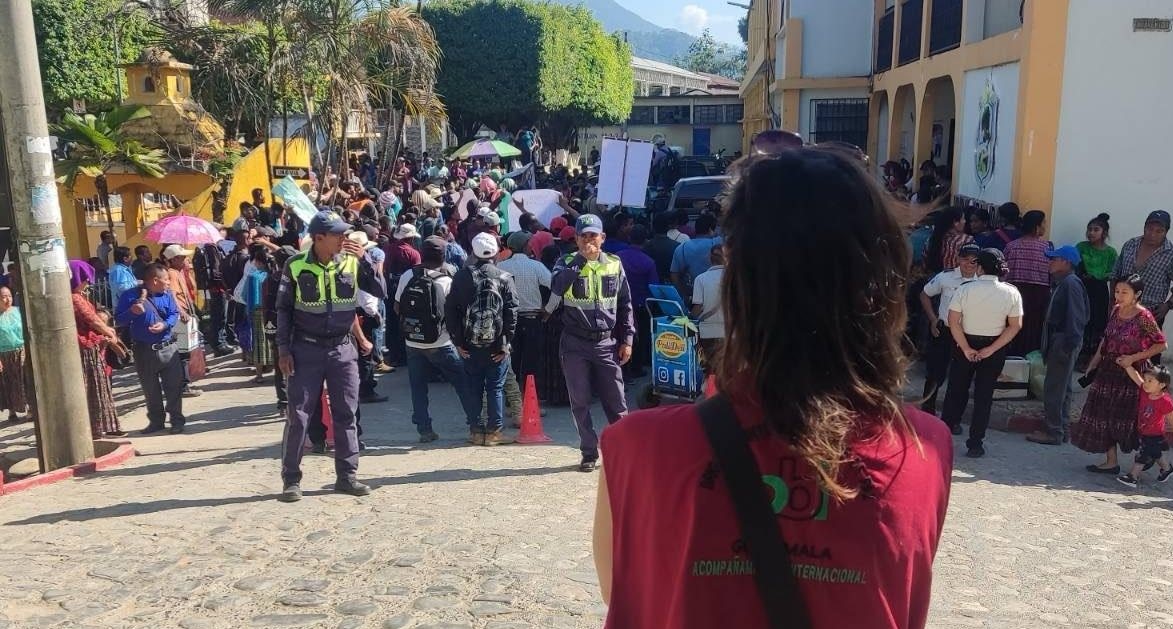
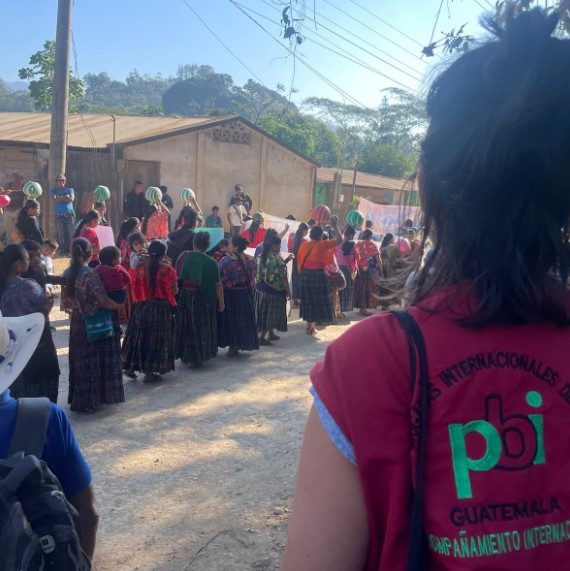
“[On February 26], #PBI accompanies the peaceful walk carried out by the Q’eqchi’ communities of Santa María Cahabón.

Around 300 people mobilized towards the municipality to demand the removal of the accreditation of the hydroelectric company OXEC as a member of the Municipal Development Council (COMUDE), and that no more licenses continue to be granted to hydroelectric companies.

The mayor received them to listen to their demands, to which he pledged to respond over the next month.

“Respect the good faith consultation in which 25,000 people participated” and “No more hydroelectric plants in Cahabón”, were some of the demands that could be read on the banners of the demonstrators.

It should be recalled that the region continues to suffer the effects of the hydroelectric company that has restricted the Cahabón river,”

Maya Q’eqchi’ journalist Carlos Ernesto Choc also tweeted:

“#Alta Verapaz Peaceful Walk in the municipality of Cahabón, Alta Verapaz, Maya Q’eqchi’ communities, hold a peaceful demonstration against Oxec hydroelectric projects.

They demand from the municipal mayor Abraham Chiquin, who won for the VAMOS party the cancellation of the Oxec 3 project and that the representatives of the COMUDE hydroelectric company resign.”

The Peace Brigades International-Guatemala Project has previously explained: “The Peaceful Resistance of Cahabón is made of more than 190 Q’eqchi’ communities who live in the Cahabón River basin. Since 2015 they have organized around defense of territory and against the launch of the OXEC I and OXEC II hydroelectric projects installed on the Oxec River, a tributary of the Cahabón River.”

PBI-Guatemala has accompanied the Peaceful Resistance Cahabón since July 2017.

Hatch and OXEC II

NS Energy has reported: “Hatch would be engaged to deliver the conceptual design and detailed design-build-engineering for the Oxec II Hydroelectric Project.”

Hatch was founded in Toronto, Canada, by W.S. Atkins as W.S. Atkins & Associates in 1955. It has offices around the world with its headquarters in Mississauga, Ontario.

From list of Hatch Ltd. office locations in Canada.

Commenting on OXEC II, Ian Ainslie, a Hatch project manager based in Niagara Falls, Ontario, noted: “Hatch has been active in developing hydroelectric sites in Guatemala for over 20 years.” And Hatch’s managing director of power, Jim Sarvinis, says: “Projects like Oxec II are exactly why we do the type of work we do at Hatch.”

OXEC II became operational in September 2018.

OXEC III

In April 2023, Power Technology noted: “Oxec III is a 75MW hydro power project. It is planned on Cahabon river/basin in Alta Verapaz. The project construction is likely to commence in 2025 and is expected to enter into commercial operation in 2027.”

On May 10, 2023, PBI-Canada observed a march by the Peaceful Resistance of Cahabón in Guatemala City that included a banner that read: “We demand that the Oxec 3 licence be cancelled.”

Breakbulk Magazine has previously reported Hatch’s project manager for Oxec II Hooman Ghassemi “has been working on Oxec II since 2015 and finished the conceptual design for Oxec III [in 2017].”

We continue to follow the Q’eqchi’ resistance to dams on the Cahabon River.

Photo: Maya Q’eqchi environmental defender Bernardo Caal Xol spent four years in prison for his peaceful resistance to dams being built on ancestral territory without consent. He was released from prison in March 2022. PBI-Canada met with him on May 5, 2023, in Cobán, Alta Verapaz, Guatemala.

PBI-Guatemala accompanies the Maya Ch’orti’ Indigenous Council of Olopa Chiquimula as it peacefully resists Canadian mining company

The PBI-Guatemala Project has posted: “Yesterday [February 25], #PBI accompanies the Maya Ch’orti’ Indigenous Council of Olopa Chiquimula in its eighth anniversary, which took place in a natural water birth. During the act, claims were made in defense of water and land through indigenous authorities and through their spirituality.”

Poster: Consejo Indígena Maya Ch’orti’ de Olopa Chiquimula.

In April 2023, the Regional Business and Human Rights Platform noted in their report Fourth Cycle of the United Nations Universal Periodic Review of Canada:

The Gold and Silver Extraction Project of the corporate structure of [the Vancouver, Canada-based] Gold Group Management Inc; that in Guatemala operate in a joint venture between Radius Gold Inc. and Volcanic Gold Mines Inc. through Minerales Sierra Pacífico S.A., did not comply with the consultation and prior consent procedures of the communities of the Maya Ch’orti’ territory of Olopa. In the face of opposition to the project, the defenders of the territory have suffered threats, criminalization, and processes of community division. Furthermore, the company, with the support of the Municipality of Olopa, has hindered the recognition of ancestral authorities to favor community authorities elected by the municipal council and try to limit the historical forms of Organization of the Ch’orti’ Mayan people.

Sierra Pacífico S.A. mineral project

Summary case information: Project name: Minerales Sierra Pacífico S.A (part of the Holly Banderas project)

Location: Olopá, Chiquimula, Guatemala

Companies involved: Gold Group is founder of Volcanic Gold Mines Inc. and Radius Gold Inc., all Canadian companies that they operate in Guatemala through the subsidiary Minerales Sierra Pacífico S.A. (Exploration company).

Financial entity: The Volcanic Gold Mines company is financed by shareholders; the main internal shareholder is Simon Ridgway and the external shareholder is True Independence LLC. In the case of Radius, the main external shareholder is the U.S. Global Investors Fund-World Precious Minerals Fund and the main internal shareholder is Simon Ridgway. They are looking for more financiers and shareholders for the development of the project.

Sector: Mining

Project Status: 4 exploration licenses requested (Arely, Ava, María Elena for which the Ministry of Energy and Mines -MEM- requests an extension of the Work Plan and Karen, in the cadastral opinion phase; the company has waived 6 applications in the 14 communities organized in the Ch’orti’ Mayan Indigenous Council of Olopa

Population or groups affected: The population of the Mayan Ch’orti’ indigenous people of the municipality of Olopa, Chiquimula.

Impacted natural environment: Cerros La Bandera, Cerro de Tituque and La Montañita; The water sources are: the Cayur ravine, the Lempa river and the Jupilingo river, in addition to the Espíritu Santo Natural Reserve.

Main human rights abuses: Right to information, consultation, right to freedom of expression and movement; rights at risk: to water, to life, to food; economic, social and cultural rights.

Organization responsible for documenting the case: Ch’orti’ Mayan Indigenous Council of Olopa/Extractive Industries Observatory

Organizations that subscribe to the report: Mayan Ch’orti’ Indigenous Council of Olopa.

Brief description of the relevance of the project:

Olopa is located in a border region of Guatemala with Honduras and El Salvador. There is a regional organization called “Plan Trifinio”, but it does not integrate the care of Mother Earth from the worldview of the indigenous communities, but rather from the extractivist vision of the authorities of the 3 countries involved.

Following the OIE investigation into another mining project that operates and impacts Chiquimula, more exploration licenses appeared from the Canadian company Minerales Sierra Pacífico S.A. They had to go to the Ministry of Energy and Mines to obtain information about the companies and their activities, because no information was disclosed in the territory impacted by these licenses. The company – from Gold Group – has already carried out exploration activities on private land, without informing, under deception and with the support of the municipality, saying that soil studies were being carried out for access to community water and the construction of tanks. distribution.

Due to the impacts already suffered with the imposition of other mining projects in Olopa, the Ch’ortí Mayan communities began to organize to inform themselves, formulate their demands to demand compliance with their rights and the rights of nature213. These communities are concerned about the number of licenses, and the impacts that all these metal mineral exploitations could generate if they are carried out, in addition to the acts of corruption that preceded the licenses.

Main human rights abuses:

The mining legal framework has not been built from the territories, nor consulted, and does not take into account the environmental, social and cultural impacts of mining exploitation. Decisions to grant environmental and mining licenses are made within ministries (such as the Ministry of Energy and Mines) without notifying the affected populations of the interests that exist over their territories. Reliable information is not shared about the impacts, benefits and reparations that exploration and exploitation activities could generate.

The Mining Law and environmental regulations favor the exploitation of territories by multinationals. In Guatemala, the right to consultation of indigenous peoples is systematically denied.

Right of access to information; right to consultation; right to free expression and peaceful mobilization

In the Ch’orti’ Mayan territory of Olopa, we have an antimony mining operation, the Cantera Los Manantiales mining company215. Faced with the actions of the Mayan Ch’orti’ Council to denounce all the illegalities and impacts generated by this mining activity (mainly on the water and health of the surrounding communities), the State and the company have responded with the criminalization and judicialization of the Mayan Ch’ortí’ authorities, events that break community harmony, increase violence and persecution. For this reason, the defense of the territory is strengthened to prevent further impacts on the ways of life of the communities and it is hoped that action will be taken legal against the company’s exploration licenses.

Actions of cooptation and community division are already being suffered. For example, the municipality prevents the recognition of ancestral authorities to favor community authorities elected by the municipal council and try to limit the historical forms of organization of the Ch’orti’ Mayan people.

Right to a clean environment

Right to water: The communities of the department of Chiquimula are seeing the loss of water resources due to the presence of numerous mining concessions, most of them in the exploration stage, but which are being exploited illegally, without an environmental license. This puts other human rights of the Ch’orti indigenous people at risk.

Right to life and a healthy environment: Linked to the right to water and the possibility of enjoying a healthy environment, the community of Olapa views with concern the mining advance that is articulated with negative impacts already visible in neighboring communities, due to the contamination of the air, soil and water.

Right to health: Exposure to heavy metals and other toxic substances, a product of mining activity, puts the population’s health at high risk, already precarious due to the little or no presence of state services, with differential effects on girls and boys. , women and older adults from the Ch’orti’ ethnic community.

Right to food: The communities have preserved their food traditions, based on agroecology, thanks to their ancestral knowledge, the conservation and exchange of native seeds and the use of medicinal plants, which have become an alternative for survival in the face of advance of the mining companies, stripping the forests and biodiversity of this Guatemalan region.

Cultural rights: As established in the international human rights instruments that Canada is obliged to protect and respect, in the territory where its mining projects are located, the indigenous right to identity is denied, their cultural integrity is affected , its spirituality, its practices based on reciprocity and the community and peasant economies of the region.

Methodology

The documentation of the cases responds to a systematic follow-up of the case by the Ch’orti’ Mayan Indigenous Council of Olopa and the investigation by the Extractive Industries Observatory. Additionally, an investigation of secondary sources has been carried out on official pages such as those of the Ministry of Energy and Mines, the Ministry of Environment and Natural Resources, and the Ministry of Public Health and Social Assistance. In addition, information on judicial processes has been obtained from indigenous jurisprudence. In the Las Pomas community, meetings were organized with the Ch’orti’ Mayan Indigenous Council of Olopa to expose the risks of mining and the community began a process of electing its representatives. The 14 communities of Olopa that are organized in the Ch’orti’ Mayan Indigenous Council of Olopa are in peaceful resistance against mining exploitation and defend their cultures, values, spirituality, physical territory, the community and its forests, hills, rivers, mountains. They protect the territory from development models that exploit Mother Earth and allow progress towards climate justice. They carry out social actions (such as community organization and the election of their authorities and representatives), political, legal (such as community acts for the rejection of mining activities in their territories) and communication. It is expected to be able to file a legal action for the exploration licenses in process in the Maya Ch’orti’ communities.

The full report in Spanish can be read at Cuarto Ciclo del Examen Periódico Universal de las Nacionales Unidas República de Canadá (Plataforma Regional de Empresas y Derechos Humanos, Abril de 2023).

PBI-Guatemala has accompanied the Maya Ch’orti’ Indigenous Council of Olopa in June 2021, following their request, which is based on the serious increase in security incidents, defamation and criminalization processes they are experiencing.

MLA Olsen asks the BC Minister of Public Safety if he still has confidence in the controversial RCMP C-IRG unit

On Thursday February 22, there was this exchange in the Legislative Assembly of British Columbia in Victoria between Green Party MLA Adam Olsen and Mike Farnworth, the Minister of Public Safety.

Olsen refers to testimony that emerged last month at an ongoing abuse of process court hearing in Smithers, BC that highlighted C-IRG officers could be heard in an audio recording from November 19, 2021, saying: “They all had the fuckin’ paint like, are you an orc?”, and the previous day saying: “That big fuckin’ ogre-looking dude, he’s actually like, autistic.” and “Apparently the sergeant grabbed his balls and twisted.”

ADAM OLSEN

Last fall I drew a comparison between the amount of money that the Minister of Public Safety and Solicitor General has invested in the RCMP’s controversial community-industry response group, the C-IRG, and the implementation of the calls for justice in the missing and murdered Indigenous women and girls report.

The minister was furious with this line of questioning, yet transcripts released during court proceedings illustrate perfectly how the RCMP’s C-IRG unit has dehumanized Indigenous people. Much of the language used in the recordings is inappropriate for this House, Mr. Speaker.

Basically, the C-IRG officers were calling Indigenous people ogres and orcs. They made fun of a neurodiverse person and openly described a high-ranking member of that unit sexually assaulting somebody.

Human rights violations, excessive force, illegal tactics, unprofessional behaviour, racism, discrimination. A shame on the RCMP. A shame on this minister. A shame on this House.

To the Minister of Public Safety, is there an ongoing investigation of the alleged sexual assault described by the C-IRG members?

MIKE FARNWORTH

What I can tell the member is that the kinds of comments the member references are absolutely, obviously, and completely unacceptable. I think all members in this House would agree with that.

At the same time, there are processes and protocols in place for complaint procedures and to deal with this kind of thing, some of which are underway — as you acknowledge, a court case.

I can also tell the member that part of the work that has been underway in terms of the reform of the Police Act is to deal with these kinds of things and to extend accountability and oversight on our police forces in this province.

ADAM OLSEN

 I would imagine that when the police forces in this province are made aware of a potential sexual assault…. Perhaps an investigation would be necessary and not the requirement of the person who was involved in that to have to file a complaint. It seems like the conversation between the members of these units was quite open about what was going on there.

The C-IRG has vastly exceeded their projected budget, year over year. In their first year, in 2019-2020, they were budgeted $920,000, yet they spent $10 million. Each year this unit continues to receive funding and then blow past their budgets.

The RCMP’s Civilian Review and Complaints Commission is currently undertaking a systemic investigation of the C-IRG unit, an investigation that has experienced significant delays because the RCMP is not giving them information.

The B.C. Civil Liberties Association and the Union of B.C. Indian Chiefs have called for the C-IRG to be disbanded due to the ongoing human rights violations and harm to Indigenous communities.

To the Minister of Public Safety and Solicitor General. If the allegations that we heard on tape, the racist and demeaning comments on the record, the picking on neurodiverse people, laughing about an incident that basically amounts to sexual assault…. Does the C-IRG still have the confidence of this minister?

MIKE FARNWORTH

I appreciate the question. As I said a moment ago, we expect police to conduct themselves in line with the standards that are in place for policing. If they are not, then they should be held accountable for that. Again, I’d say that every member of this House agrees with that.
At the same time, the member talks about the budget for the C-IRG. Well, the C-IRG was established to assist those communities that have been dealing with some of the challenges that we’ve been facing in terms of protests and in terms of enforcing court-ordered injunctions in this province. The result of….

The budget is based on the amount that has actually had to have been spent in order for police to be able to do that job. The amount is based on a rolling average over the last three years. It started off, as the member said, at $900,000. What we have seen in some different parts of the province, particularly on some of the LNG pipelines, is a significant amount of resources required in order to deal with some often extremely violent protests.

Our expectation is that those engaged in law enforcement are obeying the laws and the standards in the province of British Columbia and Canada and, at the same time, recognize that they have an important job to do in enforcing sometimes court-ordered injunctions to ensure that legal, lawful activity is allowed to take place in our province.

—

We continue to follow this and support the calls for the abolition of this RCMP unit.

Notably, March 9 will mark the one-year anniversary of the Civilian Review and Complaints Commission (CRCC) systemic investigation of the RCMP (with no indication of when this investigation will be completed and a report released) and the abuse of process hearing will resume June 17-21 in Smithers.

Further reading: Twelve concerning things we learned about the RCMP C-IRG during the first week of the abuse of process hearing (January 20, 2024).

REGISTER NOW

Gitxsan and Gitanyow Resistance to Colonial Mega Projects webinar

Tuesday March 5 at 5:30 pm PT

featuring Tara Marsden, Kai Nagata, Kolin Sutherland-Wilson and Maryam Adrangi

PBI-Canada co-organizes webinar encouraging applications to be a PBI-Colombia field volunteer

On February 27, PBI-Colombia, PBI-UK and PBI-Canada collaborated on a webinar to help encourage people to be a field volunteer with PBI-Colombia.

They are currently seeking new volunteers with an application deadline of March 2.

For more about that, click here.

This webinar featured former PBI-Colombia field volunteers Marie Zeller (there from 2019 to 2023) and Sophia Kerridge (2012 to 2013) along with PBI-Colombia accompanied Associated Network of Human Rights Defenders (dhColombia) lawyer Germán Romero.

Key excerpts from that webinar include:

Sophia Kerridge: “What PBI really offers is an international presence. And that can be in the form of physical accompaniment or observation in the field, or it can be through our huge support network that spans a number of different levels in various different countries. And what that provides, it essentially shines a light on the threats that those human rights defenders face in order to dissuade the people who are behind those threats from continuing with those threats or from taking things further. And the way that it works is essentially by PBI drawing attention to those security problems it puts pressure on governments and international authorities to take responsibility for the safety of those human rights defenders.”

Germán Romero: “I feel something really deep in my heart for PBI and so does my whole team, we always have you in mind.”

“My work as a lawyer [includes] working with campesino or peasant and Indigenous communities and Afro-Colombian communities to be able to stay in their territory, to defend their territory and to have access to land and to guarantee the protection of natural resources from the threat of megaprojects. …With the Rios Vivos movement in Antioquia which is working to save a river that has been messed up by a hydroelectric project [financed in part by Export Development Canada]. …There is nothing more important to me than being able to be in the field and being able to be directly with the families, with the communities and be able to bring forward strategic litigation.”

“[Before I was with dhColombia] PBI accompanied us directly in the communities in which I was working doing popular education, judicial, legal, political formation, and strategic litigation in the field and that was the only way that I was able to move about in the territory. There was one situation where I wasn’t able to be accompanied by PBI and I was attacked. They had me detained. They had me against the ground. They were going to assassinate me.”

“If PBI wasn’t accompanying us [now with dhColombia] in certain areas of the country we couldn’t go in, we couldn’t work there, and we couldn’t carry out our work, it’s that easy to understand. If PBI didn’t come along with us and accompany us at different hearings that happen in Bogota, it would be impossible for us to have enough safety and security to be able to work as lawyers in those spaces.”

Marie Zeller: “It was wonderful to find an organization that was doing what was just necessary with the principle of not getting involved in the decisions of the organizations that operate there who are really the experts, the ones who had the experience and the pain. That’s what I really liked about PBI, that’s why I applied. …I accompanied German, like he was saying, we are part of a movement, always as outsiders, but we get included. …[Within PBI] there isn’t a boss, there isn’t a decision coming from above, you listen to all of the parties from within to reach a consensus and to reach the best solution. …Horizontality is the most beautiful way of working, it just needs patience. …There’s also a lot of looking after internally, internal support to carry on because we can be emotionally affected [by the situations we accompany]. It’s very important to look after each other. …There are many things you can’t be prepared for, and I think knowing that is a good way to prepare because the situation in Colombia is very volatile, and there are many things you won’t be able to plan.”

During the question-and-answer session, Romero was asked: “For those who can’t work with PBI in the field, what can they do to support your work?”

Romero replied: “I think there are several options. The first is to learn more about the situation that is of the greatest importance. Not just the situation in Colombia, but the human rights situation in general. I think we have some very serious problems in the Western hemisphere in terms of human rights, follow PBI on social media that’s really important. To be totally honest nowadays with the crises we are seeing across the world, for example the genocide being committed against the Palestinian people, the very serious crisis of human rights violations that we are seeing against immigrants and migrants who are coming up to the EU and UK and US border, and now we can add Australia, it can be really important going in on a political and economic support campaign, that’s of great importance.”

In total, 78 people registered for this webinar with participants joining from the United Kingdom, Canada, Colombia, Mexico, the Netherlands, Australia, USA, Germany, Italy, Belgium, Switzerland, Kenya and Cameroon.

The webinar also included the short film In the Company of Hope. To watch that, click here.

To apply to be a PBI-Colombia field volunteer, click here.