


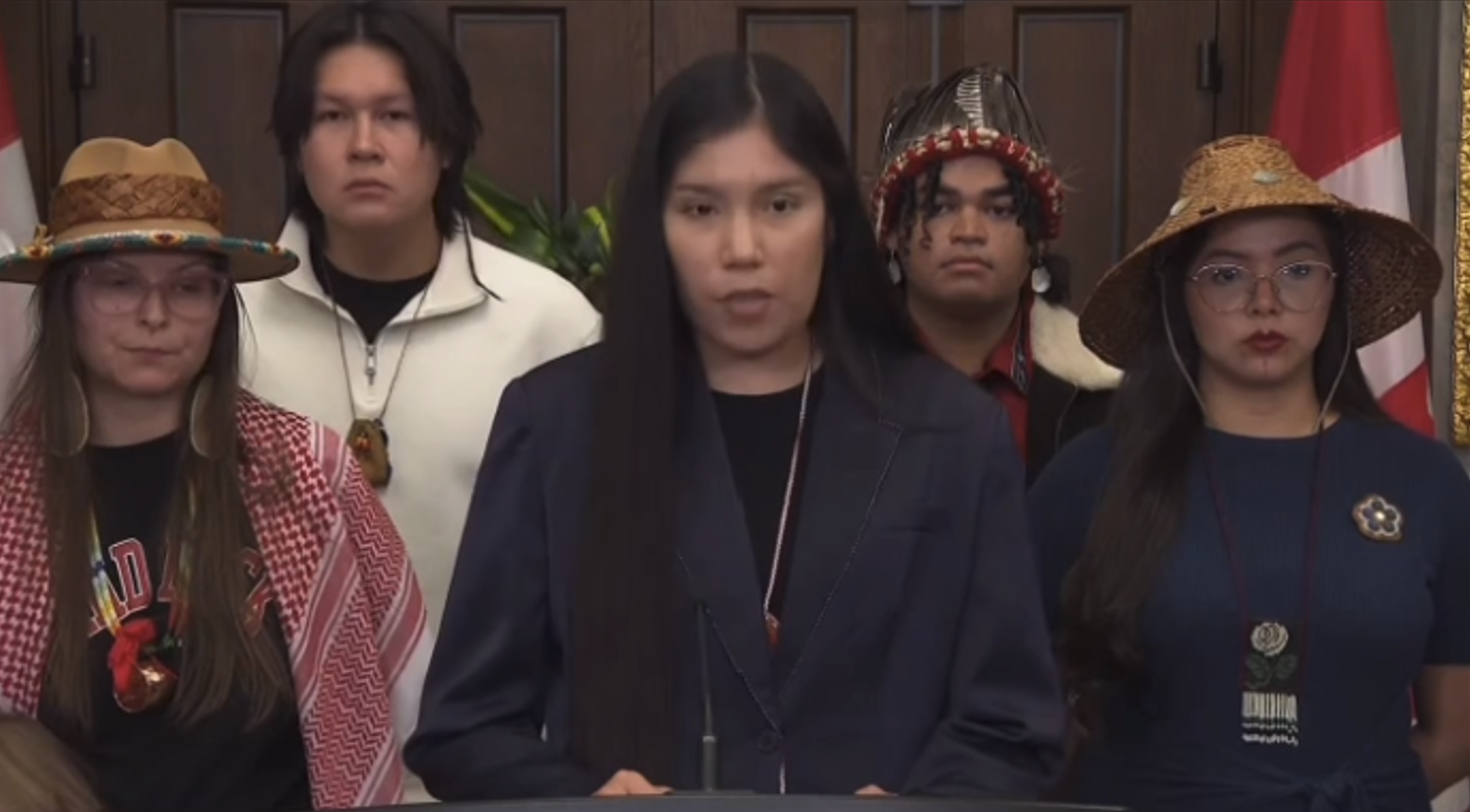
Video still: Attawapiskat land defender Cedar Iahtail.
On Parliament Hill in Ottawa, Attawapiskat land defender Cedar Iahtail from the Assembly of Seven Generations (A7G) spoke about her concerns with
Iahtail commented:
“We are here today to bring awareness to many bills that are being passed by the Carney government such as Bill C-39, C-37 and C-5.
We understand that you are scared because the future is so uncertain right now, but pushing unethical bills forward without proper due diligence is not the answer.
Uncertainty breeds fear and fear breeds hatred. Hatred breeds fascism. Historically, the worst violence towards humanity has been witnessed during the Great Recessions and after plagues and our world today after COVID is no exception.
We are witnessing genocidal levels of violence around the world that have been fueled by western countries including Canada.
The minerals extracted go to make bullets that political powers use against marginalized communities here in North America through police brutality. It also affects places like Palestine where our tax dollars go to fund the weapons in the genocide happening in Gaza that is being live streamed on devices that innocent lives are risked for the extractions of minerals in Congo.
Our liberation is connected and our fight against the system is intersectional for true liberation for all on Mother Earth.
Despite being systematically targeted by governments, Indigenous youth remain on the front lines, always standing up for their communities, the land, and future generations. From Oka to Fairy Creek to Wet’suwet’en to here right now, Indigenous youth have always been the ones defending our lands, our cultures, and our futures. When Indigenous youth stand for the land, they are standing for everyone.
The truth is that Bill C-5, Bill C-37, and Bill C-39 may look different on paper, but the message they are telling Indigenous children and youth is that your voices don’t matter, your rights are negotiable, your futures are disposable.
What happens to the land happens to us, and we will not stand by while our rights are written away in legislation.”
Her full comments can be seen here.
The Ring of Fire and risks to Indigenous environmental defenders
The Ring of Fire could open the Attawapiskat First Nation’s Traditional Territory to mineral exploration activities.
The area known as the “Ring of Fire” in the northern part of the Canadian province of Ontario has an abundance of rare-earth/critical minerals including cobalt, lithium, manganese, nickel, graphite and copper.
The area covers more than 5,000 square kilometres.
Grand Chief Fiddler of the Nishnawbe Aski Nation, a political territorial organization representing 49 First Nation communities within northern Ontario, has previously told CBC News: “There will be conflict on the ground, and those that oppose it will most likely end up in jail. That is where we’re heading.”
And Ontario Member of the Legislative Assembly (MLA) Sol Mamakwa has cautioned: “What is the OPP [Ontario Provincial Police] going to do to the First Nations, once they start fighting on the land? That’s the scary part.”
University professors Shiri Pasternak and Tia Dafnos have also cautioned: “With its policing of pipeline and logging demonstrations having been deemed a ‘national best practice’ by the RCMP [Royal Canadian Mounted Police Community-Industry Response Group/C-IRG in British Columbia], there is potential that this model—and its criminalization of Indigenous and climate protest—could be replicated in other provinces [including Ontario], as resistance heats up against a wave of environmental deregulation being pushed by Prime Minister Mark Carney and several premiers.”
We continue to follow this.

