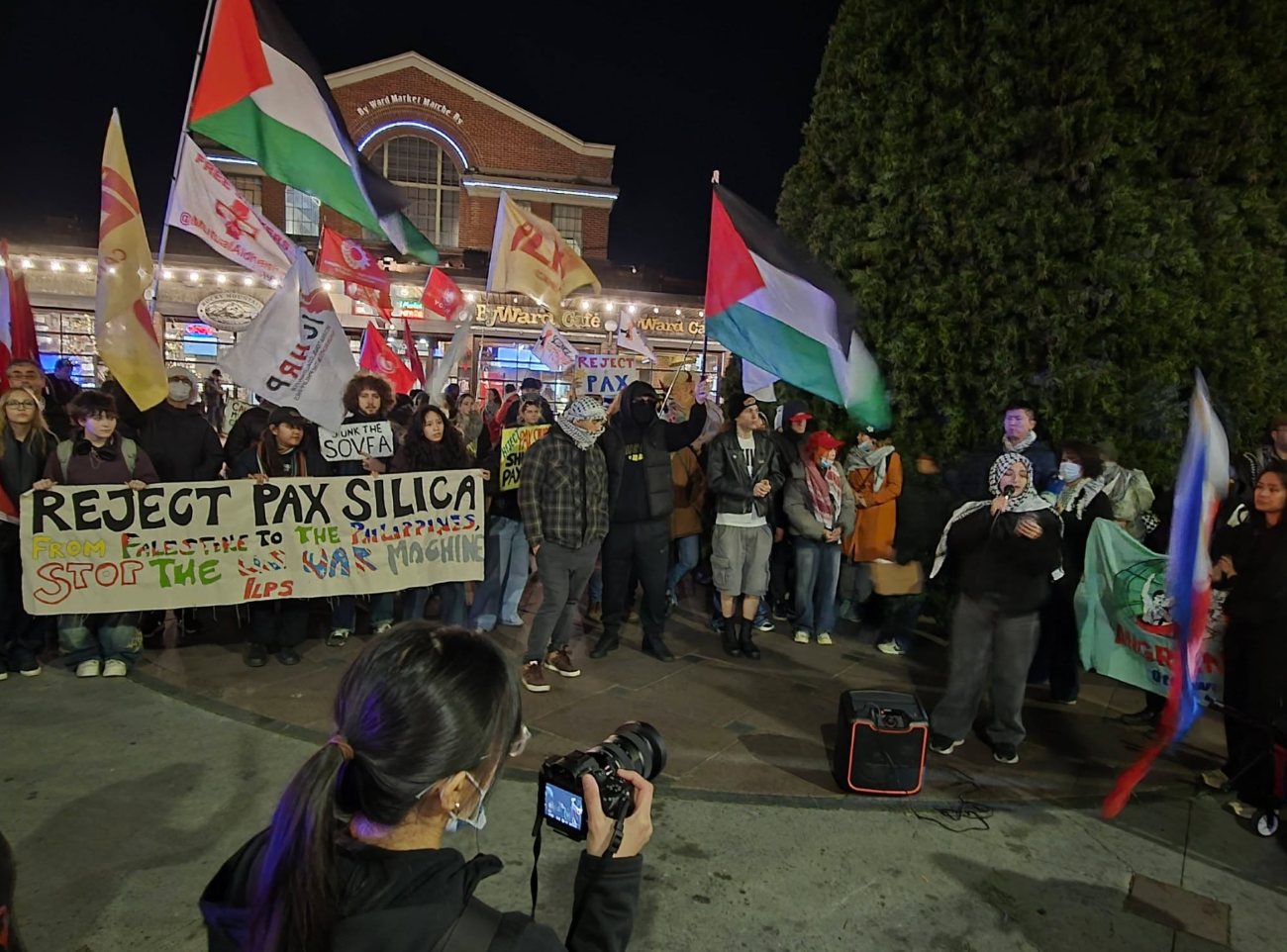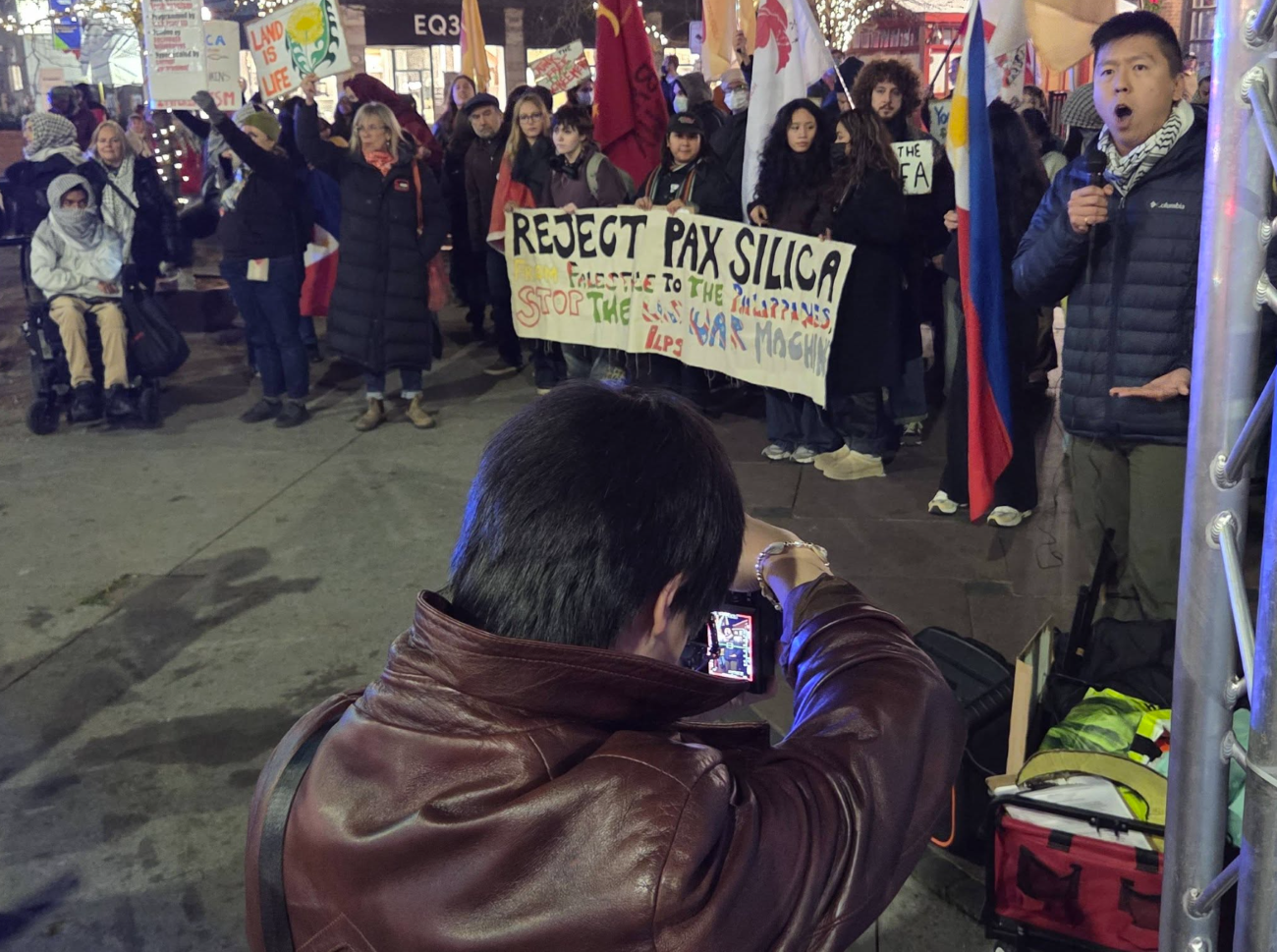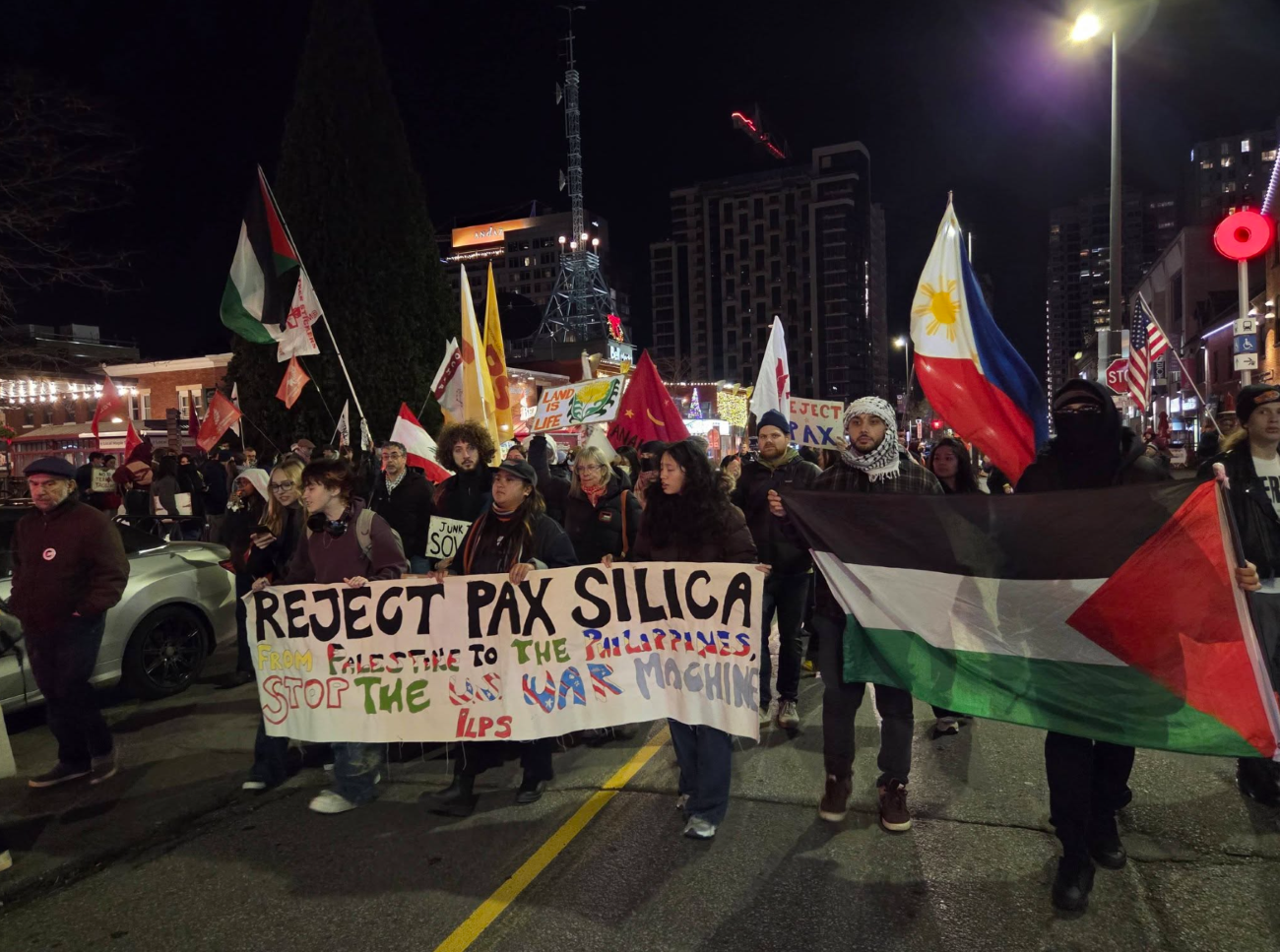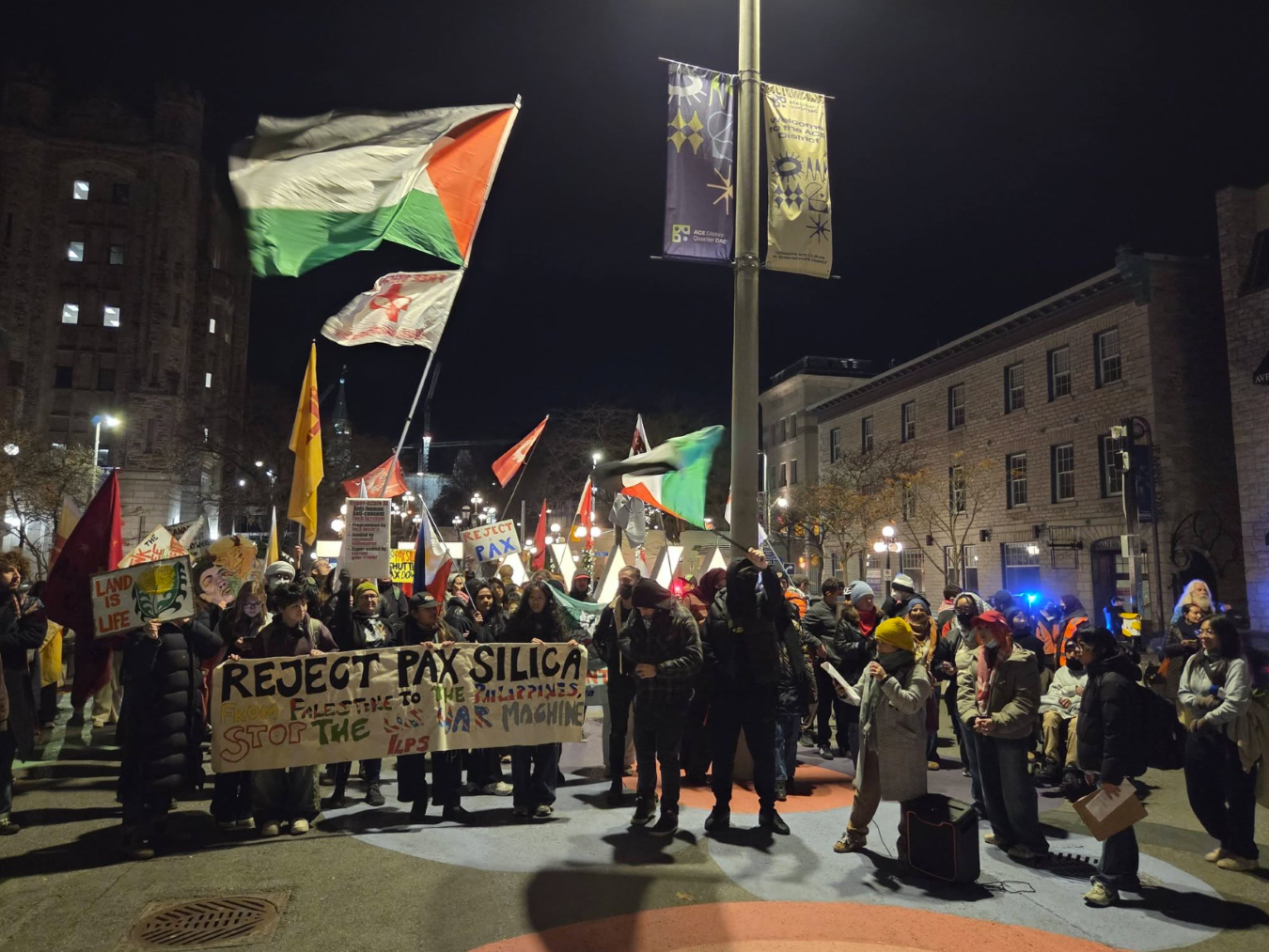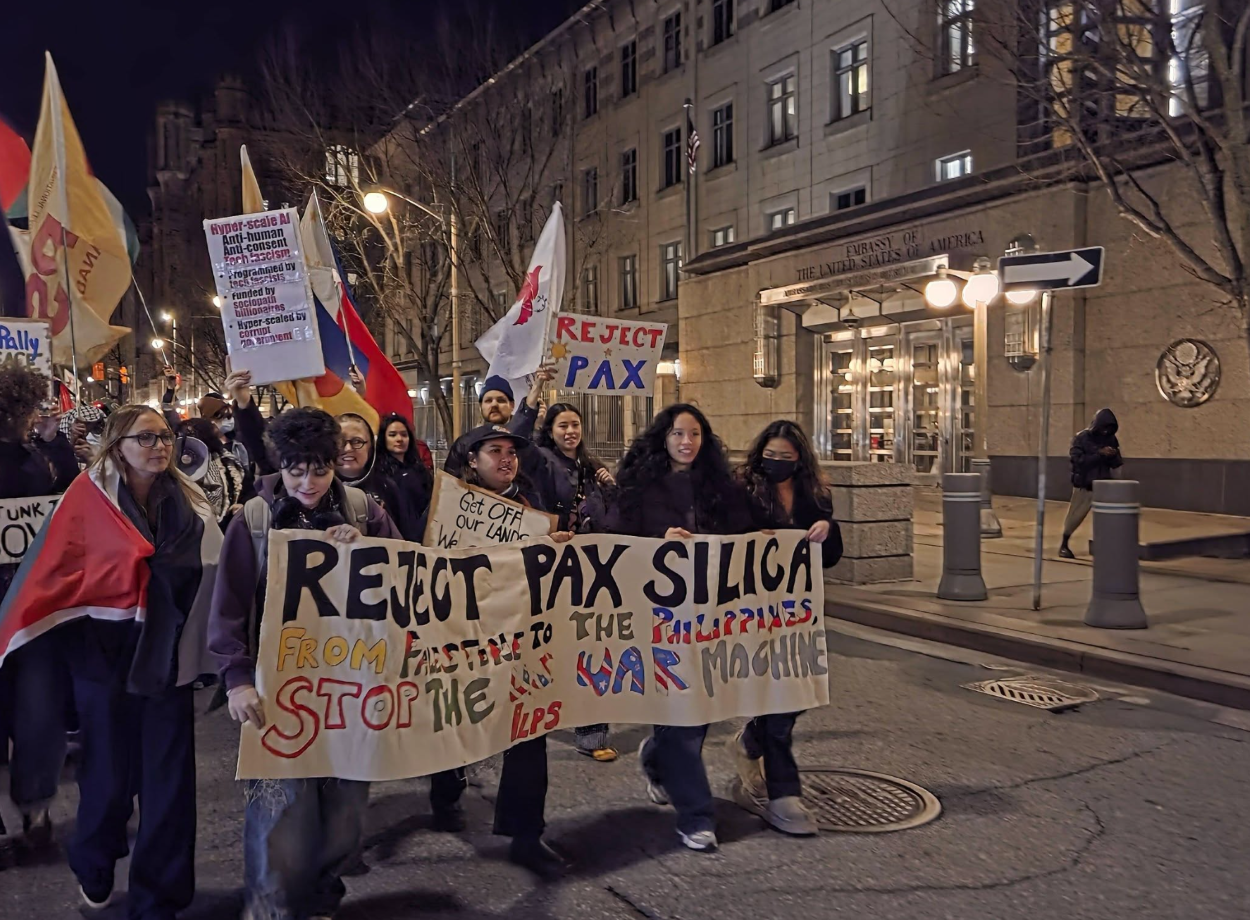
On November 17, numerous organizations, including Anakbayan, Migrante Ottawa, the Ottawa Committee for Human Rights in the Philippines (OCHRP), Shut Down CANSEC, and the International League of Peoples’ Struggle (ILPS) joined the Global Day of Action against Pax Silica with a protest that began next to the US Embassy in Ottawa.
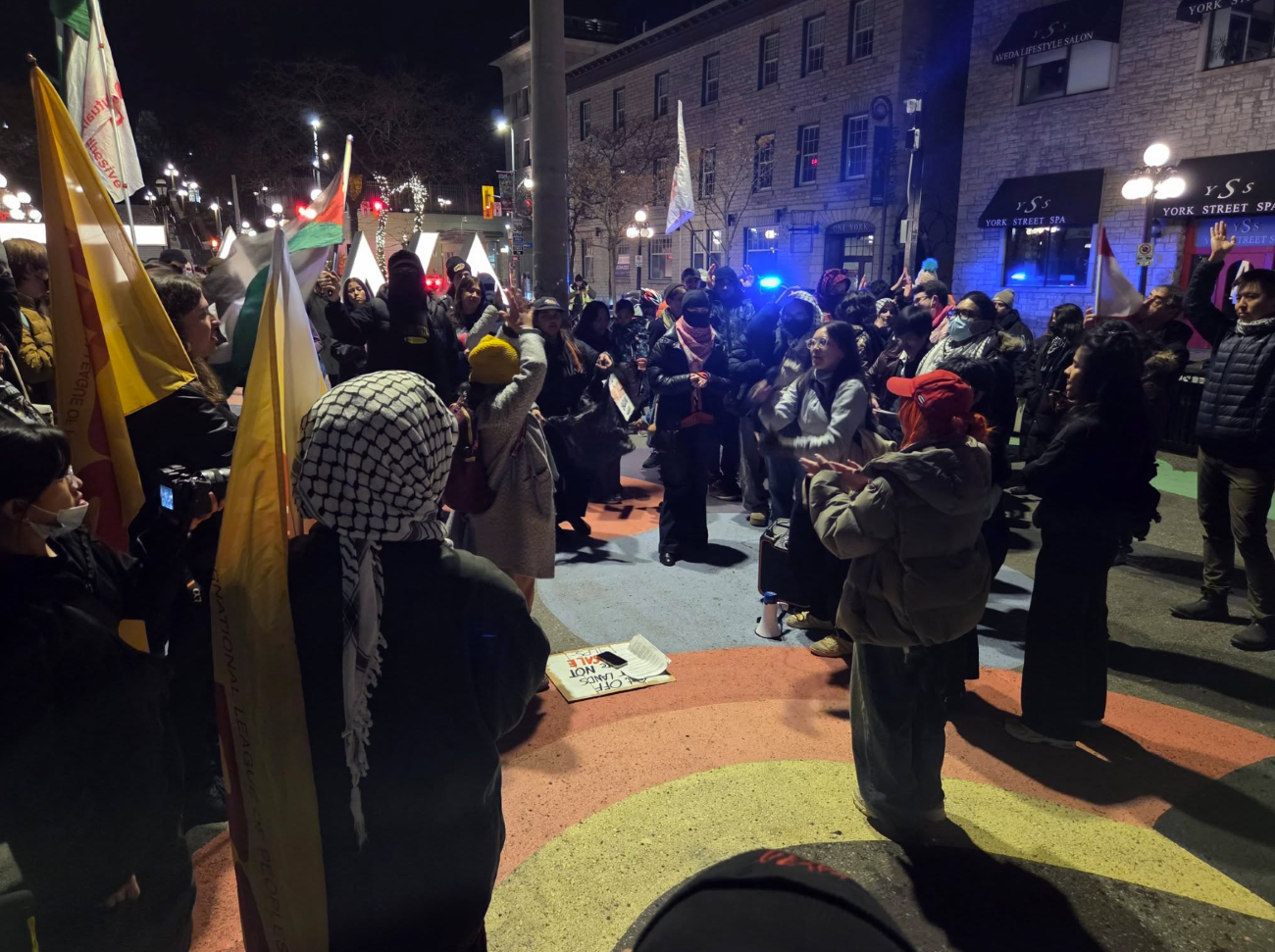
The protest later marched to the nearby Embassy of the Philippines, then through the ByWard Market area where more speeches were heard, then marched again to conclude at the “OTTAWA” sign at York Street Plaza.
The protest in Ottawa was in solidarity with the protests happening in Manila. Yesterday, The Diplomat reported: “Over the past week, thousands of students, activists, indigenous community members, and others opposing Pax Silica have held protests in Metro Manila and other parts of the country, taking aim at the initiative’s potential social and environmental impact.”
The Guardian has explained: “Pax Silica has sparked tensions in the Philippines over plans to build a tech hub outside Manila that critics say will affect water and energy supplies, and displace members of the Ayta Indigenous community. …Intended to bolster western stocks of AI technology and reduce ‘excessive dependencies’ on single source supply chains, including from China, Pax Silica will provide chips and critical minerals to 26 participating signatory governments.”
CBS News has also reported: “In the opening salvo for Pax Silica, a U.S. State Department-led international initiative to secure non-Chinese supply chains for high-tech manufacturing, a more than 4,000-acre manufacturing hub is planned to be built in the Philippines. …Critics argue the proposed industrial hub will displace farming communities and the Indigenous Aeta tribe, harm the country’s water supply and represent U.S. imperialism over the Philippines.”
And Human Rights Watch has noted: “Pax Silica is a US initiative that began in December 2025 to secure US technology supply chains. …The Philippines joined Pax Silica in April 2026 and agreed to host a 1,618-hectare semiconductor hub in the town of Capas in Tarlac province, north of Manila, largely for mineral processing and semiconductor manufacturing. …The framework agreement between the Philippines and the United States is yet to be signed [but planned for by year-end].”
Canada-Philippines
On November 14, 2026, Canadian Prime Minister Mark Carney met with Philippines President Ferdinand Marcos Jr. in Manila and announced the conclusion of negotiations for a Canada-Philippines free trade agreement.
The Prime Minister’s Office further notes: “Both countries are now working toward its signature in 2027.”
The Canadian Press report on the conclusion of the Canada-Philippines free trade talks notes: “During consultations, corporations were broadly supportive of the deal to increase trade, but civil society raised concerns about the Philippines’ track record on the environment, labour and human rights.”
Canada is currently an observer in the Pax Silica initiative, but Juniorstocks, a service of the London, UK-based Piccadilly Capital Group Ltd., has speculated: “[Canada’s] full integration [into Pax Silica] seems more a matter of when than if, as the initiative operationalizes projects and aligns policies.”
Last week, the Prime Minister also announced investment and support for the Luzon Economic Corridor. The proposed Pax Silica manufacturing hub would be located in the Luzon Economic Corridor and Inquirer.net has reported that the corridor is being positioned as a “critical node” linked to Pax Silica.
Implications for land and environmental defenders
Global Witness has documented that at least 318 land and environmental defenders have been killed in the Philippines between 2012 and 2025.
Global Witness and Kalikasan People’s Network for the Environment (Kalikasan PNE) have also reported: “Since 2012, the Philippines has been ranked as the deadliest country in Asia for people protecting land and the environment, with mining linked to a third of all killings documented by Global Witness. …The military has been linked to the highest number of documented killings and detentions of land and environmental defenders in the Philippines over the past decade.”
The International Coalition for Human Rights in the Philippines (ICHRP) has cautioned: “Communities have reported experiences of military red-tagging when raising concerns about the [Pax Silica hub] project.”
Earlier this year, Peace Brigades International (PBI) launched a Southeast Asia Project to accompany human rights defenders in the Philippines, Cambodia, Malaysia, Myanmar, and Thailand. This project is focused on the acute exposure to extractive industries, land conflicts, and climate-related violence defenders face.
We continue to follow this.