


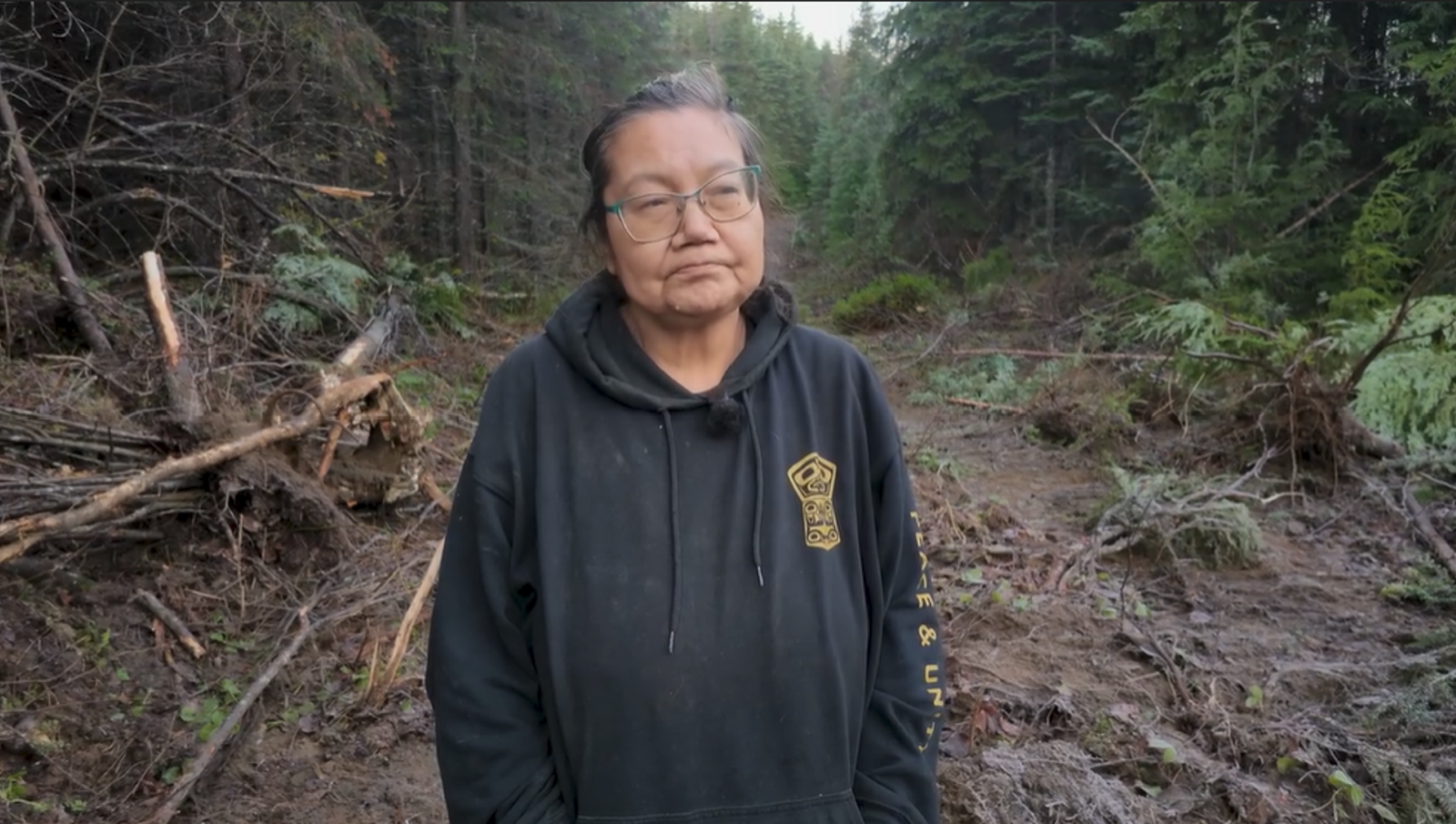
Video still of Maas Gwitkunuxws.
Gitxsan land and environmental defender Kolin Sutherland-Wilson has posted a 10-minute video and commentary about the Prince Rupert Gas Transmission (PRGT) fracked gas pipeline in northern British Columbia.
For context, Maas Gwitkunuxws (Teresa Brown) of Wilp Gitludahl has established a dog rescue sanctuary and camp a few dozen metres from the projected right-of-way of the Prince Rupert Gas Transmission (PRGT) pipeline.
In the posted video, Brown says: “This is unceded territory. This is not Crown land. …They’re not going to be allowed to continue to do this. We need to stand together. Stand together and say no. …This land is what’s been holding us and giving birth to us for generations. It’s fed us, it’s clothed us, it’s given us shelter. …It’s priceless. It cannot be sold. We’re all going to need to stand together.”
Sutherland-Wilson also writes: “On November 16, 2026, an excavator was observed clearing a path through the forest proximate to the Dog Sanctuary, along the proposed PRGT pipeline route.”
“The excavator had pushed approximately 100 metres west of the existing road into the forest, creating a corridor approximately 10–14 metres wide, as well as a second spur extending approximately 40 metres southwest before encountering steep terrain. The total disturbed area is estimated at approximately 1,500 m².”
“Workers initially reported that they had been contracted by McElhanney and associated contractors to investigate a potential gravel source. Subsequent discussions confirmed that the work involved gravel test pitting.”
Sutherland-Wilson also writes: “The excavator was removed from the territory at approximately 8:00 a.m. on November 17, following the initial questioning of workers the previous day.”
In the video, Sutherland-Wilson states: “They’re moving ahead, even if they’re not being honest about it. And this project is beginning to enter into its construction phases. It looks like we’re getting to the 11th hour now.”
‘People ready to fight this project’

Sutherland-Wilson also highlights: “I know there’s a lot of people out there who are ready to fight this project, who are ready to protect the interests of the people who are living out on the Lax’yip. I count myself among a pretty wide community of Gitxsan people who are ready to defend the land. …You can’t write it off. It’s not just a handful of troublemakers who are going to be making a stink about it. No. I’ve been a part of this issue for years and years and years. And I’ve seen hundreds of people in countless community meetings who have basically vowed to protect their interests as Gitxsan and to fight this project.”
Sutherland-Wilson concludes: “We need people out on the Lax’yip. We need people supporting the land defenders.”
His full social media post can be read here.
‘Currently under construction, awaiting FID’
On October 28, 2026, the Vancouver Sun quoted Ksi Lisims spokesperson Rebecca Scott stating: “[The project is continuing] to advance with significant commercial and project progress, including sales agreements in mature stages. …We are closely monitoring local and global investment conditions, along with trade and tariff discussions, and remain optimistic that an FID is possible in the coming months.”
On July 29, 2026, Capital News reported: “The 750-kilometre pipeline − currently under construction although also awaiting a final investment decision − is proposed to run from the northeast B.C. gas fields to the north coast near the Nisga’a village of Gingolx, then underwater to the floating facility at the northern tip of Pearse Island.”
And Hydrocarbon Processing has reported: “Pending a Final Investment Decision by the project co-developers, construction could begin by early 2027.”
Risks to land and environmental defenders
PBI-Canada is following this situation with concern in the context that the Royal Canadian Mounted Police (RCMP) were “prepared for the possible use of lethal force against Indigenous land defenders” who opposed the construction of the Coastal GasLink fracked gas pipeline on their territory.
We are also monitoring this in the context of the United Nations Committee on the Elimination of Racial Discrimination (CERD) raising concerns about “violent evictions and arbitrary detentions” on Wet’suwet’en territory.
We are expecting the release this month of the report by the Civilian Review and Complaints Commission that launched a “systemic investigation” into the RCMP Community-Industry Response Group (C-IRG) and their actions against against Indigenous land defenders and allies opposing major extractive projects.
We continue to follow this.

