


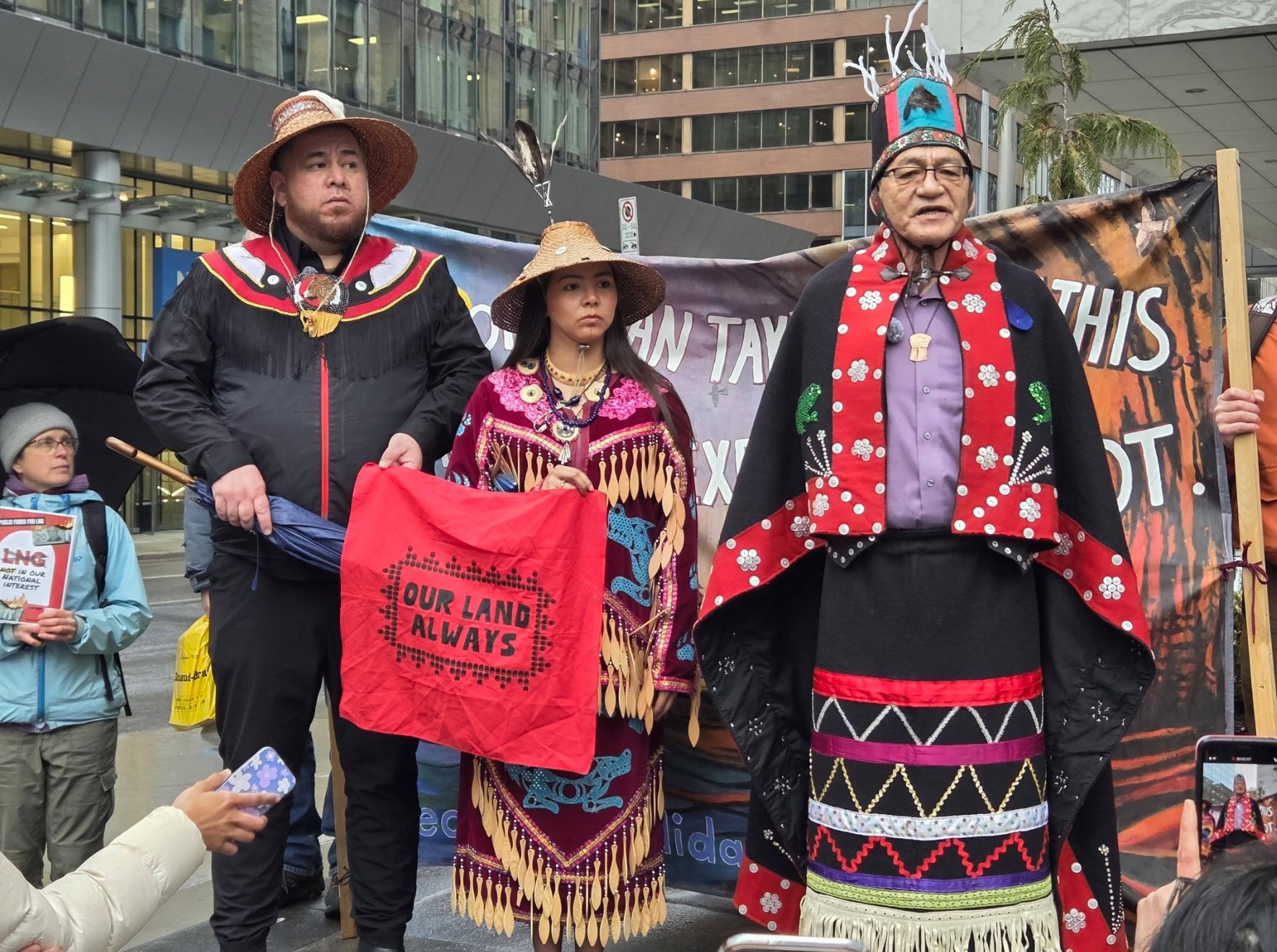
Photo: On April 14, 2026, PBI-Canada observed Wet’suwet’en and Gitxsan hereditary leaders calling on Export Development Canada (EDC) in Ottawa to reject public dollars being spent on the LNG Canada Phase 2 expansion.
LNG Canada announced the final investment decision (FID) to proceed with LNG Canada Phase 2 on September 28, 2026.
In that announcement, LNG Canada CEO Chris Cooper stated: “With FID secured, Phase 2 will double LNG Canada’s capacity from 14 to 28 million tonnes a year…”
That announcement additionally explained: “LNG Canada has also entered into commercial agreements to act as execution manager, working with Coastal GasLink to expand the capacity of the existing 670-kilometre pipeline through the construction of five new compressor stations. Phase 2 builds on the current Phase 1 footprint and infrastructure that were designed and engineered from the outset to support the first large-scale, four-train LNG export facility in Canada.”
The environmental impact of the compressor stations
Wet’suwet’en hereditary leaders have previously stated: “We are aware that CGL is pursuing Phase 2 of the project alongside LNG Canada, seeking to build additional compressor stations as part of a plan to increase capacity of the pipeline. …This includes the Titanium Peak Compressor Station in the Regional District of Bulkley-Nechako, one of two stations in unceded Wet’suwet’en territory, approximately 85 km southwest of Houston, BC. This station would be near the Unist’ot’en healing centre bordering Gidimt’en territory and on Liksamysu territory.”
Wet’suwet’en leaders have also stated: “The proposed footprint of one compressor station is approximately 20 hectares, which is equivalent to 17 soccer fields.”
They further noted: “Wet’suwet’en Hereditary Chiefs oppose and do not give consent to build these compressor stations and will pursue avenues to challenge these permits and construction.”
“Repression of First Nations land defenders”
In their letter of opposition to LNG Canada Phase 2 (dated June 12, 2026), Wet’suwet’en hereditary chiefs highlighted “serious concerns about the repression of First Nations land defenders and the diminishment of civil liberties” in the context of the construction of the Coastal GasLink pipeline on their lands.
On October 28, 2026, Chief Na’Moks further lamented: “Ottawa’s cheerleading for LNG Canada Phase 2 and Coastal GasLink Phase 2, despite our hereditary leadership withholding free, prior and informed consent, tells us how little this government values Indigenous rights.”
“Compressor stations risk further police presence”
On October 29, Amnesty International posted this petition that says: “British Columbia and the company Coastal GasLink (CGL) are building pipeline infrastructure known as compressor stations on Wet’suwet’en territory. Tell Premier Doerkson to halt construction immediately and respect the rights of the Wet’suwet’en people.”
That Amnesty International petition highlights: “Wet’suwet’en land defenders have already faced militarized police raids, arbitrary arrests and unlawful surveillance for their opposition to the project. Amnesty International’s research has documented how Canadian federal and provincial authorities have repeatedly used policing and other measures to impose the pipeline, putting both Indigenous rights and fundamental rights guaranteed under Canadian and international law at risk. The construction of additional compressor stations risks further police presence and criminalization of Indigenous people for defending their lands and rights.”
Early 2027
OilPrice.com has reported: “Construction is expected to begin in early 2027, with the expanded system targeted to enter service in the early 2030s.”
Risks for land and environmental defenders
PBI-Canada recalls that the Royal Canadian Mounted Police (RCMP) Community-Industry Response Group (C-IRG) were “prepared for the possible use of lethal force against Indigenous land defenders” at the time of their first raid on Wet’suwet’en territory in January 2019. We also note that the United Nations Committee on the Elimination of Racial Discrimination (CERD) has raised concerns that the RCMP C-IRG and private security firms had “escalated their use of force” against land defenders on Wet’suwet’en territory, further noting “violent evictions and arbitrary detentions”.
An Amnesty International report has already documented “militarized raids” by heavily armed RCMP officers, land defenders reporting they had been assaulted by during arrests, as well as “a pattern of ongoing intrusive and aggressive surveillance, harassment and intimidation experienced by Wet’suwet’en land defenders, including discriminatory, degrading and highly culturally insensitive conduct”.
Within this context, the Civilian Review and Complaints Commission for the RCMP launched a “systemic investigation” into the RCMP C-IRG in March 2023. That report is expected to be released later this month.
Further reading: Wet’suwet’en hereditary leaders have opposed the construction of CGL Phase 2 compressor stations on their territory in British Columbia (PBI-Canada, September 29, 2026).

