Home Blog Page 68

PBI-Mexico accompanies Red Solidaria DH at cultural rally in Morelia for disappeared environmental defender José Gabriel Pelayo

PBI-Mexico has posted on Facebook:

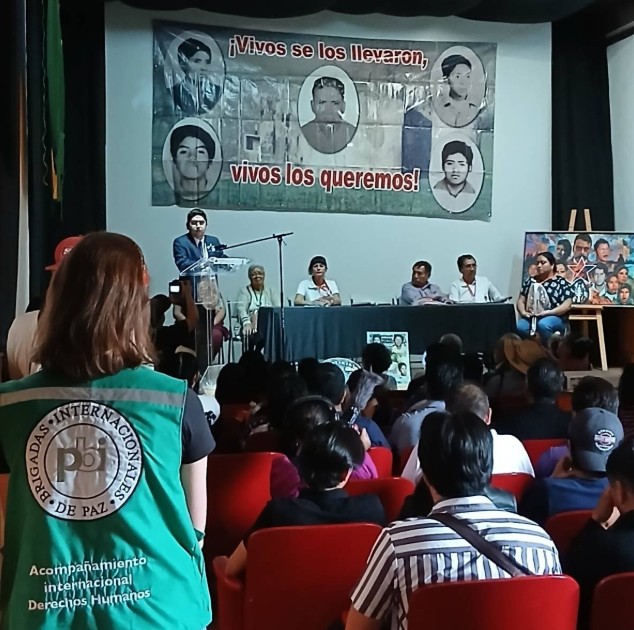
“On Saturday, February 8, #PBI accompanied the Human Rights Solidarity Network in Morelia, Michoacán, to a cultural rally to draw attention to the disappearance of the environmental defender José Gabriel Pelayo Zalgado. During the activity there were readings of stories and poems, a memory tree and a speech to draw attention to the situation of widespread violence facing the Sierra Costa region and the disappearances of several environmentalist defenders. From PBI we were present as an international observation and will continue to support the Michoacán Human Rights Solidarity Network.”

Cultural rally with “tree of memory and a living anti-monument”

Cambio de Michoacán reports: “Almost a year after the disappearance of teacher and environmentalist José Gabriel Pelayo Zalgado, the Searching for Pelayo collective held a cultural rally in the Plaza Melchor Ocampo in Morelia. As part of the event, a tree of memory and a living anti-monument were placed in tribute to the disappeared environmentalists in the Sierra-Costa of Michoacán and Mexican territory.”

That article adds: “The group has warned about the unpunished operation of armed groups in the Sierra-Costa, the forced displacement of communities and the dispossession of territories for extractivist purposes.”

Tree and memorial memorial plaque removed

By February 12, El Sol del Morelia reported that the tree and memorial plaque had been removed by that morning.

That article adds “So far it is unknown if it was the Morelia City Council or an external person who removed these two symbols that were placed in memory not only of this environmentalist, but of others that have disappeared throughout the state.”

Extractive companies in Michoacán

Cambio de Michoacán has previously reported: “The acts of insecurity, [the Searching for Pelayo collective said] are taken advantage of by companies for extractivist purposes, such as mining companies that operate in the area, which generates a context of dispossession and forced displacement.”

Animal Politico has also reported that Pelayo was threatened by the Jalisco New Generation Cartel (CJNG) before being disappeared.

Canadian mining companies in Michoacán

In October 2024, EL PAÍS América reported: “The indigenous peoples of Michoacán have faced collusion between companies, organized crime and the government, according to the organization Peace Brigades International (PBI), organizer of the meeting in Madrid in which [María Eugenia Gabriel Ruiz is an Indigenous Purhépecha lawyer and member of the Human Rights Solidarity Network] participated.”

That article further highlighted: “14.61% of the state’s surface is exploited by 12 national and six foreign mining companies, according to official figures from 2018.”

That official report from the Mexican Geological Service (SGM), an agency of the Mexican government, lists addresses of 18 “companies exploring in the state – metallics” (see pages 24-25). That chart shows that 5 of the 6 foreign mining companies have addresses in Canada: Catalyst Cooper Corp., Terra Nova Gold Corp., Fischer Watt Gold Company Inc., Rome Resources LTD-IMMSA and Candente Gold Corp. The sixth foreign company listed in that chart, Silver Shield  Resources Corp., is based in Burlington, Ontario, Canada (the chart just does not provide an address for the company).

Accompaniment

The Human Rights Solidarity Network (Red Solidaria DH) is accompanied by the Peace Brigades International-Mexico Project.

José Gabriel Pelayo Zalgado, 49, is an environmental activist and rural teacher who has been a member of the Popular Council of Chinicuila for three decades. He has been missing since March 19, 2024.

PBI-Colombia accompanies Board of Directors of ASCAMCAT during the Humanitarian Caravan to Catatumbo

PBI-Colombia has posted on Instagram:

We accompanied the Board of Directors of ASCAMCAT [the Catatumbo Peasant Association] in the Humanitarian Caravan for Peace: ‘Let’s embrace Catatumbo’ in the municipality of El Tarra, Norte de Santander, in the context of the escalation of violence that has been unleashed in Catatumbo since January 16, causing a humanitarian crisis in the region that has not been seen for a long time.
Organizations and leaders expressed their rejection of the harassment and conduct in violation of International Humanitarian Law by the armed actors and demanded:
1) Immediate cessation of all hostilities by all armed actors, as well as any aggression, threat or stigmatization of leaders and civilian population.
2) Demilitarization of daily life in the region,
3) Full compliance with the Peace Agreement and the basic norms of International Humanitarian Law.
4) Implementation of humanitarian aid mechanisms in an immediate and effective manner.
5) Compliance with the Humanitarian Minimums and the Social Pact for the Territorial Transformation of Catatumbo.

The Caravana

Prensa Latina further explains: A humanitarian caravan made up of human rights associations and social groups arrived today [February 4] in the Catatumbo region, to call for an end to the violence that shakes that area of northeastern Colombia. …The humanitarian caravan departed from the municipality of Ocaña on February 2 and will conclude tomorrow its campaign of solidarity with the residents of El Catatumbo, where more than 52,000 people were displaced from their homes and more than 24,000 remain confined, according to data from the Ombudsman’s Office.

The call for transnational solidarity

Adriana M. Pérez Rodríguez, a Colombian feminist researcher and PhD candidate at the University of Toronto, and Priscyll Anctil Avoine at the Swedish Defence University in Stockholm have co-authored an article published by the New York City-based North American Congress on Latin America (NACLA) that highlights:

Historically, the response of the Colombian state in Catatumbo has oscillated between glaring negligence in social and educational terms and a heavily militarized presence. However, as several feminist scholars and activists have argued, ‘militarized peace’ will only increase insecurities, make humanitarian protection more complex, and escalate violent conflicts.

A crucial step of transnational solidarity is accountability. Violence in Catatumbo is a globalized violence that is sustained through the international criminalization of drug use, disputes between neighboring states, profits from drug trafficking by armed groups, the sexual exploitation of national and migrant women as a form of territorial control, the state’s unleashing of femicides, and land dispossession in the name of ‘progress’ for oil, coal, and palm oil.

From this perspective, what is happening in Catatumbo is not isolated from political and economic decisions taken at national and international levels.

Transnational solidarity implies above all else that affected populations are not forgotten. We cannot stop talking about Catatumbo. As the leaders of ASCAMCAT, the Catatumbo peasant association, have clearly stated: ‘the Catatumbo region cannot bear any more suffering.’

Their article can be read in full at In the Face of Violence, Catatumbo’s Communities Call for Solidarity (NACLA, February 11, 2025).

We continue to follow this situation.

Previous reading: PBI-Colombia accompanies Humanitarian Caravan that seeks an end to armed violence against civilians in Catatumbo (PBI-Canada, February 5, 2025).

Listen to 35-minute Spanish-language Proceso “Surviving Violence” podcast on Peace Brigades International in Mexico

Proceso notes: “Episode 2. With the Zapatista uprising in Chiapas in 1994, international brigadistas began to arrive in Mexico. Empathy with the indigenous rebellion led many to want to know directly about social injustices and protect – even as human shields – the Indigenous peoples who have taken up arms. 30 years have passed since then and international observers are still active on Mexican soil. Their task has changed. Now they observe, accompany and seek to make the whole world aware of the human rights crisis in Mexico. And for many Mexican organizations, their presence is essential to be able to carry out their work under a cloak of a certain security.”

To listen to this 35-minute podcast in Spanish, click here.

“Surviving violence. Mexico, international urgency. Brigadistas”

As has been noted on the PBI-Mexico website: “PBI’s activities in Mexico began in 1994 when, following the Zapatista uprising, it received requests for an international presence in the state of Chiapas. In 1996 PBI started working with Mexican organizations as a member of the International Service for Peace (SIPAZ) coalition.”

Presently, one of the organizations that PBI-Mexico accompanies is the Peoples’ Front in Defence of Land and Water (FPDTA) that opposes the PIM megaproject and seeks justice for the murder of Samir Flores.

As NACLA has explained: “Flores was a vocal advocate for Indigenous rights and land protection, a member of the FDPTA and the Indigenous Governance Council (CIG), a Zapatista-affiliated organization of Indigenous groups across Mexico.”

On April 10, 2021, PBI-Mexico accompanied the Peoples’ Front on a march on the 102nd anniversary of the assassination of Emiliano Zapata, killed by soldiers in Ayala, Morelos in 1919, from whom the Zapatistas took their name.

For more about PBI-Mexico, please see their website.

PBI-Colombia regrets death of Wounaan baby due to mobility restrictions in the context of the armed conflict

PBI-Colombia has posted on social media: We deeply regret the death of little Iker Andrés of the Humanitarian Biodiverse Reservation of the Wounaan community of Santa Rosa de Guayacán, and we extend our solidarity to the family and the entire community, who, with the Inter-Church Commission for Justice and Peace, we have accompanied on several occasions. We reiterate the demand for the return to the territory with full guarantees to the right to life, integrity, survival and permanence It is urgent that progress is made in #HumanitarianAgreements that reduce the serious affectations to the communities in the midst of the conflict and territorial control of the different armed groups.

On February 10, the Commission for Justice and Peace further explained: Report – Urgent. Baby Wounaan dies in the Biodiverse Humanitarian Reservation of the Wounaan community of Santa Rosa de Guayacán in the lower Calima, due to restrictions on mobility and control of armed structures.

That article continues:

Our Commission learned of the unfortunate death of a two-month-old baby at the Reservation last Sunday, February 9 at night.

The baby YKER ANDRÉS CEBALLOS MOÑA had a viral picture of fever and intestinal infection for more than eight days that could not be treated with traditional medicine nor do they have an adequate health center to attend emergencies or permanent medical assistance.

Given the seriousness of the symptoms, the community tried to take YKER to Buenaventura to be treated at a medical center, which was impossible due to the control of river mobility by the armed groups.

Indigenous and black communities along the banks of the Calima River have been victims of increasingly aggressive territorial control by illegal armed structures, including the Gaitanista Self-Defense Forces of Colombia and the National Liberation Army, and most recently by the FARC’s Jaime Martínez column. In view of which they have declared themselves in confinement.

Their full article can be read here.

Previous accompaniment

On December 20, 2023, PBI-Colombia had posted: “We accompany @Justiciaypazcol [Justice and Peace] in the significant return of the Wounaan Community of Santa Rosa de Guayacán to its territory after two years of forced displacement. It is important to guarantee all security and protection measures so that the community can remain in #peace.”

Video clip: “At this moment the definitive return of the Santa Rosa de Guayacán community to its territory in Bajo Calima begins.”

PBI-Colombia has accompanied Justice and Peace since 1994.

We continue to follow this situation.

COPINH celebrates “popular victory” as DESA manager sentenced as “instigator” in the murder of Berta Caceres

Photo: The text says: “Alert! Popular Victory! Judges of the Supreme Court of Justice confirm the sentence of Sergio Rodriguez as author of the assassination of Berta Caceres and sentence him to 30 years in prison.”

The Civic Council of Popular and Indigenous Organizations of Honduras (COPINH) has posted:

Popular victory!

Supreme Court judges confirm the conviction of Sergio Rodriguez as the perpetrator of the murder of Berta Caceres. 30 years in prison!

COPINH reaffirms its commitment to justice in Honduras and to the vindication of the rights of Indigenous peoples for which Berta Cáceres fought. We will not lower our guard until all those responsible for her murder, including the Atala family, face the consequences of their crimes.

HCH Televisión Digital reports: “The Plenary of Magistrates of the Supreme Court of Justice CSJ ratifies, in a decision by majority vote, the sentence of 30 years imprisonment to DESA company manager, Sergio Rodriguez, for considering him ‘inducer’ in the murder of environmentalist Berta Caceres.”

Criterio.hn further notes: “Although the conviction against Rodríguez was ratified, his role from ‘co-author’ to ‘instigator’ of the murder was changed.”

COPINH states: “After more than 6 years of waiting, the plenary of the Supreme Court of Justice of Honduras has confirmed the conviction of Sergio Ramón Rodríguez Orellana, ratifying that he is guilty of aggravated murder of the crime against our sister Berta Cáceres and the sentence of 30 years in prison. The plenary session has reclassified his responsibility as an author by inducement.”

The Criterio.hn article also reports that at the time of the crime, the majority shareholder of DESA was the company ‘Inversiones Las Jacarandas’ owned by the Atala Zablah family (“one of the most powerful family-owned business conglomerates” in Honduras, “a key shareholder in the DESA project” and “one of the most powerful families in Honduras, with numerous investments in finance, construction, and sports”.)

Contra Corriente also explains: “The Atala clan owns financial institutions, soccer teams, real estate, and other companies; a business empire that has made them one of the wealthiest families in the country. Daniel Atala Midence, Jacobo Atala Zablah, Pedro Atala Zablah, and José Atala Zablah are all prominent family members, and all served on DESA’s board of directors.”

For additional background, see  Corte de Honduras ratifica sentencia de autor del asesinato de Berta Cáceres (Avispa Midia, February 10, 2025).

COPINH’s coordinators have been accompanied by PBI-Honduras since May 2016.

Photo: On November 23, 2021, PBI-Honduras accompanied COPINH in their offices after DESA executive David Castillo was found guilty – but not yet sentenced – of “being co-collaborator in ordering the murder” of Berta Caceres.

PBI-Honduras accompanies sit-in at Supreme Court of Justice demanding justice in the femicide of Keyla Martinez

PBI-Honduras has posted:

“ Today, 4 years after the murder of Keyla Martinez, we have accompanied the sit-in in front of the Supreme Court of Justice where they have requested that the judicial authorities resolve the appeals filed.

From PBI, we emphasize the importance of achieving comprehensive justice in Keyla’s case.”

Criterio.hn reports: “During the morning of this Friday, February 7, Norma Martínez in the company of representatives of human rights organizations, appeared at the facilities of the Judiciary demanding justice for the femicide of [26-year-old] Keyla Martínez, typified as negligent homicide.”

Almost one year ago, on February 17, 2024, El Pais reported: “Norma Rodríguez, mother of Keyla Martínez … expressed her disagreement with the five-year sentence imposed on the person responsible for the murder of her daughter. …The victim’s mother regretted the sentence and said that she will continue to fight for all those responsible for her daughter’s death to be convicted in a transparent manner.”

Proceso Digital now explains: “Keyla Martínez, who was a nursing student, was arrested on the night of February 7, 2021, [during the pandemic] for violating the curfew imposed to prevent the spread of COVID-19. She was found dead inside a cell of a police post in the municipality of La Esperanza, Intibucá.”

That article adds: “Doña Norma Rodríguez, mother of the young woman … reiterated that she did not agree with the five-year sentence imposed on her daughter’s murderer and described the Honduran judicial system as ‘rotten’.”

“The Sentencing Court of Siguatepeque convicted the police officer, Jarol Rolando Perdomo Sarmiento, for the crime of reckless homicide in its degree of commission by omission and not for aggravated femicide, as initially proposed. [Keyla’s mother] indicated that it is not only Jarol Perdomo who was involved, but also more members of the police such as Deputy Commissioner Melvin Alvarenga, Edgar Velásquez, who is supposed to be one of the main accomplices in this murder.”

We continue to follow this.

Further reading:

PBI-Honduras laments a police officer has not been sentenced in the femicide of Keyla Martinez in February 2021 (PBI-Canada, February 15, 2024).

PBI-Honduras accompanies COFADEH at trial of police officer accused in the murder of Keyla Martinez (PBI-Canada, October 18, 2022)

PBI-Honduras accompanies the Committee of Families of the Detained-Disappeared at trial in the murder of Keyla Martinez (PBI-Canada, October 3, 2022)

PBI-Honduras accompanies COFADEH at trial of police femicide of nursing student Keyla Martinez (PBI-Canada, September 26, 2022)

PBI-Honduras accompanies the National Network of Women Human Rights Defenders at memorial for Keyla Martínez (PBI-Canada, February 8, 2022).

The film “I’m Still Here” and PBI accompaniments in support of the families of the forcibly disappeared

Photo: “I’m Still Here” is at the Bytowne Cinema in Ottawa.

The film “I’m Still Here” has received several Academy Award nominations including for Best Picture. That ceremony will be on March 2.

The film tells the story of Eunice Paiva whose 41-year-old husband Rubens, a civil engineer and former member of congress, was forcibly disappeared on January 21, 1971 during the military dictatorship in Brazil. Eunice, a 42-year-old mother of five children, was also held for twelve days (her teenage daughter Eliana was held for 24 hours). Eunice later enrolled in law school and led campaigns to open the government’s archives on the victims of the regime. She became a symbol of the fight against military rule. She was surveilled by state agents from 1971 until 1984, just before the end of the dictatorship.

Stills from the film: “Forced disappearances were one of the cruelest acts of the regime.”

Peace Brigades International accompanies several women who have also led campaigns following the forcible disappearance of loved ones.

Bertha Oliva is the founder of the Committee of Relatives of the Disappeared in Honduras (COFADEH). This organization promotes the rights of the relatives of the victims of forced disappearances between 1979 and 1989. Bertha’s husband Tomás Nativi was taken from their home by State forces in June 1981. At that time, Bertha was 25 years old and three months pregnant. Tomás has not been seen since he was taken.

Yanette Bautista is the founder of the Nydia Erika Bautista Foundation (FNEB). This PBI-Colombia accompanied organization is dedicated to the fight against forced disappearance. Yanette’s 32-year-old sister Nydia Erika was forcibly disappeared on August 30, 1987. Nydia Erika’s body was exhumed on July 26, 1990. An intelligence unit of the Colombian National Army was responsible for the crime.

Valentina Augustine says: “I demand the judiciary and public ministry tells where and why they took my daughter.” Valentina’s 25-year-old daughter Luz Leticia was taken on November 21, 1982, by Guatemalan special operations and intelligence services. More than 42 years later, the whereabouts of Luz Leticia are unknown.

The parents of the Ayotzinapa students who were forcibly disappeared in Mexico continue the search for their children. On September 26-27, 2014, more than 50 students from the Ayotzinapa Rural Normal School were forcibly disappeared by police in collaboration with organized crime. Forty-three of the students are still missing. In Mexico it is said: “Mother’s Day is not a party, it is a struggle and a protest.”

The trailer for “I’m Still Here” can be seen here.

Another highly recommended film in “Missing”. This 1982 film directed by Costa-Gavras tells the story of the forcible disappearance of 31-year-old American journalist and filmmaker Charles Horman in the days after the US-backed September 11, 1973, coup in Chile and the search by his wife Joyce and father Edmund. Charles was executed on September 19, 1973, in the National Stadium in Santiago.

PBI-Colombia accompanies campesina Jani Silva in the Amazonian Putumayo region where oil companies operate

Montreal-based journalist Lital Khaikin writes that the Calgary-based oil company Gran Tierra operates in the Putumayo region of Colombia.

She further notes that campesina leader Jani Silva is accompanied by “volunteer, unarmed bodyguards with the Peace Brigades.”

Khaikin’s article also explains:

“Brent Patterson, director of Peace Brigades International—Canada, said the Comandos de la Frontera and the Carolina Ramírez Front, non-state armed groups active in the region, are suspected by human rights monitors [of threats against Silva, including a threat to blow up an armoured car provided to her by a state protection agency].”

“Javier Gárate, U.S. Policy Advisor at Global Witness explained that oil companies in Putumayo have long collaborated with armed groups who control territories, transport corridors, and charge extortion fees. ‘[Without that collaboration] oil companies wouldn’t be able to function in Putumayo,’ he said.”

“Silva herself has recently stated, ‘We can’t deny the evident complicity between armed groups and oil companies, through the company’s sub-contractors.'”

The full article can be read at Justice for Jani Silva: Colombian campesina activist Jani Silva threatened in Putumayo (by Lital Khaikin, rabble.ca, February 7, 2025).

Commission investigation of the RCMP C-IRG nears 2-year anniversary as PRGT pipeline decision nears

Photo: An RCMP cruiser blocks the Morice River Service Road on Wet’suwet’en territory in November 2021. Photo by Lee Wilson/APTN.

As the B.C .Supreme Court is set to rule on February 18 on an abuse of process allegation about RCMP C-IRG actions on Wet’suwet’en territory, the two year anniversary on March 9 of the CRCC systemic investigation into the C-IRG, and a decision on the Prince Rupert Gas Transmission pipeline coming as early as next month, we look at the status of the formal public complaints against the C-IRG.

The Ottawa-based Civilian Review and Complaints Commission for the RCMP (CRCC) has now posted on its website: Update on the status of C-IRG-related public complaints and reviews (as of September 30, 2024).

The C-IRG is the controversial Community-Industry Response Group of the Royal Canadian Mounted Police (RCMP).

The CRCC “Update” includes a table on the “Breakdown of Public Complaints Received” on complaints received in relation to RCMP C-IRG “enforcement operations” on Wet’suwet’en territory (the construction of the Coastal GasLink pipeline), the Fairy Creek watershed (Tea-Jones Group logging of old-growth forest), and Argenta-Johnson’s Landing (Cooper Creek Cedar logging of forested mountainside).

Focusing on public complaints about the C-IRG on Wet’suwet’en territory, the chart reveals that only 5 of the 302 complaints received were accepted.

Those 5 complaints appear to have contained 35 allegations relating to Neglect of Duty (12), Oppressive Conduct (7), Mishandling of Property (5), Improper Attitude (4) Improper Use of Force (3) and Irregularity in Procedure (3).

Then in the “Breakdown of Allegation Outcomes” chart, it says that 22 of the 35 allegations of complaints about C-IRG actions on Wet’suwet’en territory were investigated by the RCMP. The next chart provides the “breakdown” that 0 of the 22 allegations were supported following a formal investigation.

Another chart then shows that the CRCC received 1 request for a review of a complaint relating to Wet’suwet’en territory.

From another chart, it would appear that the CRCC made 15 recommendations related to that 1 complaint reviewed on Wet’suwet’en territory. It then notes that 8 of those recommendations were supported by the RCMP, 4 were partially supported, and 3 were not supported.

Then on another webpage that has a search function, the CRCC provides a summary of the reviewed public complaints.

There one can find a 6-page “Final Report” on “RCMP members enforcing the Coastal GasLink injunction against Indigenous land protests unreasonably prevented a journalist from entering a large exclusion zone, threatened him with arrest without grounds, and detained him without authority (24-207)”.

The complaint specifies: “The media editor complained that the RCMP’s use of access control points and exclusion zones interfered with the reporter’s access to the area, violating the reporter’s individual constitutional rights as well as the constitutionally protected freedom of the press. The editor also complained that the RCMP arbitrarily detained the reporter, interfering with his ability to cover the story.”

The ”RCMP’s investigation and decision” section of this final report by the CRCC (the Commission) notes: “The RCMP investigated the allegation and determined that the restrictions on journalists were within the authority of the police, and that they did not unreasonably interfere with the reporter’s ability to take photographs or report on the situation. The Commission was asked to review the matter.”

The ”Commission’s review” notes: “The reporter travelled to the first of the Wet’suwet’en protest camps. He walked five more kilometres to the next camp and stayed the night. He was awakened before 5 a.m. by news that the RCMP had moved in and made arrests at the first camp, including two journalists.”

Fast-forwarding to the conclusion, the final report says: “The RCMP Commissioner wrote that he could not fully support the Commission’s recommendation about a standardized national policy for accrediting media access, although he supported the intention behind the recommendation. The RCMP Commissioner did not believe that this would be feasible for unplanned events. He acknowledged that there was little clarity or consistency in how the reporter was treated in this case. He stated that, as a result, he would direct RCMP policy centres to study the creation a standard method of accrediting journalists that would be useful for both planned and unplanned events.”

“The Commission welcomed the RCMP Commissioner’s response.”

CRCC systemic investigation

The CRCC notes: “The CRCC’s systemic investigation [of the RCMP C-IRG] does not replace the public complaint and review processes. These processes are separate, though findings and outcomes from one process may inform the other.”

That systemic investigation was announced 23 months ago on March 9, 2023. On June 7, 2023, about four months into the investigation, the CRCC told Peace Brigades International-Canada: “The CRCC strives to complete its systemic investigations within 12-18 months; however, the timely provision of requested information and access to RCMP personnel will largely determine when the CRCC’s report will be available.”

Photo: On March 22, 2023, PBI-Canada hand-delivered to the CRCC office in Ottawa this letter calling for the suspension of the C-IRG during the CRCC systemic investigation.

As the 24-month mark now approaches we continue to wait for the conclusion of that investigation or at least an “investigation update” (the last update provided by the CRCC was 14 months ago on November 23, 2023).

Abuse of process court decision, February 18

In the meantime, an abuse of process allegation was launched by three Indigenous land defenders arrested by the C-IRG on Wet’suwet’en territory on November 19, 2021. Court hearings took place in Smithers, British Columbia in January, September, November and December 2024. Justice Michael Tammen of the B.C .Supreme Court will read his decision on this application this coming February 18.

Image by Yintah Access.

 PRGT pipeline decision could come in March

Pipeline Technology Journal reports that a BC government decision on the Prince Rupert Gas Transmission pipeline “is expected by March 2025”. That pipeline would cross Gitxsan, Gitanyow and Nisg̱a’a territories.

On August 22, 2024, Gitanyow land defenders established a blockade on a forest service road to stop trucks working on this project.

Gitanyow Hereditary Chief Gamlakyeltxw has commented: “We saw years and years of fighting [on Wet’suwet’en territory], the [RCMP C-IRG] police violence, and even the company [TC Energy/Coastal GasLink] with harassment and surveillance of land defenders. We don’t want none of that to happen here.”

On January 21 of this year, Gitxsan Hereditary Chiefs met with BC government cabinet ministers to ask for “an immediate independent review” of the “militarized RCMP unit” that “terrorizes land defenders” and to say that they “want the militarized RCMP CRU [the rebranded name for the C-IRG] to be dissolved”.

We continue to follow this situation.

Still from RCMP video of arrest of Sleydo’ on Wet’suwet’en territory, November 19, 2021.

Photo: PBI-Canada was on Wet’suwet’en territory on Saturday November 20, 2021, the day after eleven people (land defenders and journalists) were arrested at Coyote Camp at the 63-kilometre mark on the Morice River Service Road).

Zeferino Ladrillero Human Rights Center calls for the release of Indigenous Amuzga rights defender Kenia Hérnandez

The Zeferino Ladrillero Human Rights Center (CDHZL) “accompanies processes of struggle of different Indigenous communities, peoples and collectives that seek a dignified life through the exercise of the demand of their human rights.” Zeferino Ladrillero is based in the municipality of Atizapán, in the state of Mexico, Mexico.

As one of fifteen member groups within the Civil Society Organizations’ Space for the Protection of Human Rights Defenders and Journalists (Espacio OSC) it is accompanied by Peace Brigades International-Mexico.

Fabiola Vite is a lawyer and the national coordinator of Zeferino Ladrillero.

Kenia Inés Hernández Montalván

Fabiola Vite represents Kenia Inés Hernández Montalván.

The World Organization Against Torture (OMCT) explains: “Kenia Hérnandez is a speaker of the Amuzga language, she graduated with a degree in law to defend the human rights of her community, dedicating herself to the defense of the territory in Guerrero, defending women victims of gender violence, and supporting the cause of political prisoners, for which she is co-founder of the Movement for the Freedom of Political Prisoners of Guerrero (MOLPPEG). In addition, she founded the Zapata Vive Libertarian Collective, which focused on carrying out work with young people from the Guerrero coast.”

Hérnandez is also a beneficiary of the Federal Mechanism for the Protection of Human Rights Defenders and Journalists.

Hérnandez was arrested on October 18, 2020, for the alleged crime of “robbery with violence” at a demonstration at the La Hortaliza highway tollbooth. She has been held in at least three different prisons over the past 4+ years. She is now being held in the Neza Sur Prison in Nezahualcóyotl, in the state of Mexico.

Front Line Defenders has documented that Hernández was sentenced on February 19, 2022, to ten years and six months in prison. It further notes that Hernández was then sentenced on March 10, 2022, to 11 years and 3 months.

On January 27, 2025, it was reported that Hernández could be released from prison after a possible “reparation agreement” with the Federal Roads and Bridges Police (CAPUFE, an entity of the Ministry of Communications and Transportation).

The role of Aléatica

Cambio 22 has reported: “Hernández faces two convictions promoted by the OHL company, which later changed its name to Aléatica.”

Aleatica SAB de CV “is a Mexico-based company engaged in the management of transportation and airport infrastructure. The Company’s concessions portfolio comprises a number of toll roads, which interconnect the urban zones of the Federal District and the states of Mexico and Puebla. Furthermore, it is also involved in the integral management of Toluca International Airport. Aleatica SAB de CV operates in Mexico through a number of subsidiaries.”

Fabiola Vite from Zeferino Ladrillero says: “It is clear to us that, as long as there is no will from Aleatica and subsequently from CAPUFE and the Attorney General’s Office not to stop, Kenia will continue to have up to 50 cases against her.”

And José Antonio Lara Duque from Zeferino Ladrillero has denounced that an investigation of Hernández was carried out by Concesionaria Mexiquense (Conmex), operator of the Circuito Exterior Mexiquense (concessioned to OHL, now Aleatica).

Photo: Jose Antonio Lara.

US, Canadian funds invested in IFM

Empower has reported: “Aleatica, S.A.B. de C.V. (BMV:ALEATIC) operates in Mexico through various subsidiaries generally associated with a concession awarded to each firm. It currently has interests in seven federal and state highways, and receives investment from U.S. and Mexican pension funds.”

Empower highlights: “IFM GIF, Aleatica’s parent company and owner of its controlling shareholder, [the Madrid-based] Magenta Infraestructura, S.L., receives investment from future U.S. retirees.”

This IFM Investors media release notes: “IFM GIF’s investors include a diverse range of pension funds and institutional investors across Australia, the United States, Canada, Asia, the United Kingdom and Europe.”

In this November 26, 2024 report, the University of Windsor (located in southern Ontario, Canada) disclosed that it had CAD $59.9 million invested with IFM. It also appears that IFM subsidiary Atlas Arteria and the Ontario Teachers’ Pension Plan (OTPP) co-own the Chicago Skyway Toll Road (“a 7.8-mile-long toll road that connects the Indiana Toll Road to the Dan Ryan Expressway on Chicago’s South Side”).

Criticism of the Sheinbaum government

As a member of Espacio OSC, Zeferino Ladrillero has also signed a letter that, as La Prensa reports, says that: “A little more than 100 days into the new government [of Mexican president Claudia Sheinbaum], there is a lack of a clear strategy to address the risks faced by human rights defenders and journalists, ranging from homicides, criminalization, smear campaigns, forced displacement, judicial harassment, [and] digital violence…”

The SEMARNAT proposal for the protection of environmental defenders

Zeferino Ladrillero has also spoken about “the murders of environmental human rights defenders Homero Gómez González and Raúl Hernández Romero [in January 2020], who were working for the protection of the Monarch butterfly” and commented that “the recent measure proposed by SEMARNAT [the Ministry of Environment and Natural Resources], to create a special body for the protection of environmental defenders, with the participation of the National Guard, is a reactive and insufficient measure.”

Photo: The deaths of Hernández and Gómez González have been linked to illegal logging and the illegal clearcutting associated with avocado orchards. Canada is the second largest market for avocados exported from Mexico.

The Espacio OSC collective statement issued at that time highlighted: “This proposed measure does not delve into the structural problems generated by policies in relation to megaprojects and that result in serious human rights violations. On the contrary, it is a reactive and limited measure. In addition, it is not focused on generating better conditions for the defense of human rights, but rather consolidates the militarization of territories, thus privileging a development model that prioritizes the overexploitation of natural and cultural heritage, putting these elements above the human rights of people, such as the right to land and territory. water and a healthy environment, among others.”

Militarization

In September 2022, Sociedad Noticias reported that José Antonio Lara, a member and co-founder of Zeferino Ladrillero, recalled that human rights mechanisms around the world clearly state that “the armed forces should only intervene in public security temporarily, in exceptional circumstances, as a last resort, and always under the effective supervision of independent civilian bodies.”

Photo: Since the “War on Drugs” was declared in 2006, Canada has exported $28.8 million of military goods to Mexico ($16.9 million in just the last 5 years). This includes the Newmarket, Ontario-based Terradyne-manufactured armoured vehicles used by the Saltillo Operational Reaction Group (GROMS).

To follow Zeferino Ladrillero

For more on the work of the Zeferino Ladrillero Human Rights Center, you can visit their website and them on Facebook, X and Instagram. We draw particular attention to their work with The Popular Front of the Mountain, the “Make My Freedom Count” and “Together for Freedom” collectives against unjust imprisonment, and the Otomi Indigenous People of San Francisco Magú (who are situated in the municipality of Nicolás Romero) and their struggle to defend their forests against real estate interests.