Home Blog Page 67

RCMP C-IRG snipers repeatedly deployed against Wet’suwet’en land defenders and water protectors

Photo by Gidimt’en Checkpoint.

Reporting this week on an abuse of process application brought forward by three Wet’suwet’en land defenders, The Tyee’s northern B.C. reporter Amanda Follett Hosgood wrote: “The court heard that RCMP officers had set up snipers in the area prior to the arrest…”

This issue noted by Follett Hosgood is perhaps one that should receive more extensive coverage and examination by a wider range of news sources. Toward that end, we take this fuller look at the issue of police snipers being deployed against Indigenous land defenders, including the killing of Dudley George in 1995.

November 2021

Follett Hosgood has previously reported that the C-IRG (Community-Industry Response Group) had “used ‘lethal-force overwatch’ — snipers armed with rifles — during the high-profile enforcement [on November 19, 2021], according to officers with a specialized RCMP response team meant to resolve high-risk situations.”

After that raid, Toronto-based Canadian Forces College Department of Defence Studies professor Chris Madsen told PressProgress: “Emergency Response Teams [ERTs] are being improperly used in suppressing peaceful indigenous protests on their own lands. Use of the ERT in this situation is improper because the protestors are clearly neither armed nor offering resistance, other than perhaps words.”

Further to the comment by Professor Madsen, University of Winnipeg criminal justice professor Kevin Walby told PressProgress: “I think the use of the ERT and the snipers is clearly meant to intimidate and abuse. It is meant to be traumatizing.”

February 2020

Follett Hosgood has also noted: “In February 2020, The Tyee observed what appeared to be officers armed with rifles dropped by helicopter onto a hillside overlooking the area where police arrested seven people outside the Unist’ot’en Healing Centre.”

Shortly after this raid, Global News reported: “[In a video] one [C-IRG] member is repeatedly shown aiming what looks like a sniper rifle directly at [23-year-old Gitxsan land defender Denzel] Sutherland-Wilson from behind a truck that has been turned onto its side.”

In that video, Sutherland-Wilson can be heard pleading: “He’s pointing his gun at me! Take your gun off of me! …I have nothing! Please, take down your weapon!”

Video still: C-IRG officer points assault rifle at Gitxsan land defender.

January 2019

And following the first C-IRG raid on Wet’suwet’en territory, The Guardian reported: “Canadian police were prepared to shoot Indigenous land defenders blockading construction of [the Coastal GasLink pipeline] a natural gas pipeline in northern British Columbia, according to documents seen by the Guardian.”

That article noted: “Police records seen by the Guardian include transcripts from police strategy sessions, reports filed after the raid and audio and video files. One document noted that the Wet’suwet’en possessed ‘firearms for hunting/sustenance’ but police intelligence indicated that there was ‘no single threat indicating that [land defenders] will use firearms’.”

Following that article, the CBC reported: “The RCMP falls under federal jurisdiction. [The then-Indigenous Services Minister Marc] Miller said police deployment tactics need to be reviewed ‘in these very, very sensitive situations’.”

APTN also reported: “Canada’s minister of Public Safety [Bill Blair] says he has raised concerns with the RCMP about what he calls ‘unacceptable words and phrases’ that were found in RCMP documents [obtained by The Guardian] that revealed the RCMP was prepared to deploy snipers against Indigenous protestors.”

Dudley George killed by police sniper

In this context of the C-IRG deploying snipers, we recall the killing of Indigenous land defender Dudley George by an Ontario Provincial Police (OPP) sniper on September 6, 1995, and the Ipperwash Inquiry, a two-year judicial inquiry, that concluded with the release of a Final Report in May 2007 and 100 recommendations.

The recommendations from that inquiry included (on page 96): “The Province of Ontario should enact a regulation pursuant to the Police Services Act requiring officers to file a use of force report when they point a long gun or rifle, regardless of whether a shot is fired.”

The inquiry also recommended (on page 105): “The OPP should post all significant OPP and provincial government documents and policies regarding the policing of Aboriginal occupations and protests on the OPP website.”

Photo: An OPP officer rushes toward Tina George at Ipperwash Provincial Park the day after her cousin Dudley George was killed by the OPP.

It’s unclear how many of the inquiry’s recommendations were implemented or how many are currently being followed.

Photo: An OPP officer at 1492 Land Back Lane near Hamilton, Ontario, October 2020.

Concerns

While federal cabinet ministers Marc Miller and Bill Blair (a former Metropolitan Toronto Police officer), and professors Chris Madsen and Kevin Walby, along with numerous Indigenous land defenders and water protectors, have expressed concern, BC Supreme Court Justice Michael Tammen appears less worried on the subject.

This past week, Justice Tammen found that the C-IRG had violated the Charter rights of three Indigenous land defenders during the November 2021 raid on Wet’suwet’en territory, but rejected allegations the C-IRG had employed “unnecessary resources”.

Justice Tammen stated: “The police were unaware of the number of protesters they might encounter. They were not engaged in a simple peaceful demonstration akin to a sit-in, but rather wanton destruction of property, including vehicles and infrastructure. Police did not know if the protesters were armed nor if they were violent.”

It’s not clear if Justice Tammen had access to C-IRG documents that contradicted their 2019 assessment in which police intelligence indicated that there was “no single threat indicating that [land defenders] will use firearms.”

Further study warranted

It may be that further examination into the use of force by the RCMP C-IRG on Wet’suwet’en territory over the period of 2019 to 2021 is needed to ensure that the lives of Indigenous land defenders are not put at risk (notably on Gitxsan and Gitanyow territories with the imminent decision on the construction of the Prince Rupert Gas Transmission pipeline) and that the tragedy of the police killing of Dudley George is not repeated.

Photo: This commemoration marks the site where Dudley George was killed.

Further reading: What weapons are deployed by the RCMP against Indigenous land defenders? (PBI-Canada, January 20, 2023).

PBI-Honduras accompanies ARCAH to Jiniguare and hears concerns about dam

PBI-Honduras has posted:

“Yesterday we accompanied ARCAH [the Honduran Alternative for Community and Environmental Vindication] during a visit to the Jiniguare community in the municipality of Ojojona. ARCAH expressed their concerns about the impacts of the Jiniguare dam project in the community, since the construction of the dam would mean the displacement of the people living in the area, among other things. They also stressed the importance of respecting the open council where the community declared itself free of dam projects.”

The Jiniguare dam

El Heraldo has previously reported: “Jiniguare Dam will provide water to some 300 thousand residents of the capital.” This is the promise of Mayor Jorge Aldana of the Municipal Mayor’s Office of the Central District (AMDC) who was elected to represent the “Central District, capital of Honduras” in 2021.

In October 2024, Bnamericas reported: “A contract has been signed for construction of the long-awaited Jiniguare dam in Honduras and the works could begin in the coming months, local authorities announced.”

That article adds: “Financing will soon be secured and the project’s environmental studies are underway, according to Aldana.”

Peace Brigades International is aware that UK Export Finance (UKEF) is considering loaning support to the parties involved in the Jiniguare dam project.

That same month, El Libertador also reported: “The contract for the design and construction of the Jiniguare dam has already been signed… For the execution of this project, progress is being made on environmental issues and the financing of English banks.”

Dams on the San José and Jacaleapa rivers

On December 8, 2022, PBI-Honduras also posted: “This week we accompanied ARCAH to the Public Ministry to file a complaint against the privatization of water and the construction of dams on the San José and Jacaleapa rivers, and the Jiniguare river, both in the department of Francisco Morazán.”

It has been reported that construction on the San José dam will be completed in mid-2025 and operational in 2026. In November 2024, it was reported that it has already reached 45% of construction.

La Tribuna has also noted the Quebramontes and Río del Hombre projects. In September 2024, Tiempo reported: “The Municipal Mayor’s Office of the Central District (AMDC) signed a letter of understanding with the China Civil Engineering Construction Corporation (CCECC) for the construction of the Rio del Hombre dam, located in the Amarateca sector.”

International finance

La Tribuna also highlights “the contribution of multilateral organizations” that are “supporting the Municipal Mayor’s Office of the Central District (AMDC) in projects that will enhance the future of water” in Tegucigalpa including the Inter-American Development Bank (IDB), the World Bank, the Japan International Cooperation Agency (JICA), the Central American Bank for Economic Integration (CABEI), and South Korea.

Accompaniment

The Honduran Alternative for Community and Environmental Vindication (ARCAH) is a space for community articulation and an anti-capitalist, anti-racist, anti-patriarchal, anti-colonialist and anti-classist social movement that seeks to defend territories and common goods from any project that threatens the peace and cosmovision of communities.

PBI-Honduras has been accompanying ARCAH since September 2022.

Further reading: PBI-Honduras accompanies ARCAH as it files a complaint against the privatization of water and the construction of dams (PBI-Canada, December 8, 2022).

Canadian judge finds RCMP C-IRG violated Charter rights of three land defenders in “extraordinarily rare ruling”

Photo: RCMP C-IRG officers arrest Sleydo’ on Wet’suwet’en territory, November 19, 2021.

The CBC reports: “A B.C. judge says police breached the charter rights of three people arrested for blocking work on the Coastal GasLink (CGL) pipeline, and they will receive a reduction in their sentences because of that.”

The article continues: “[Justice Michael] Tammen said it would be inappropriate to stay court proceedings, but found that some of the accused’s Section 7 rights— life, liberty, and security of person — were breached during the police raid.”

The CBC further notes: “[Justice Tammen] said there were multiple offensive and discriminatory comments made by multiple officers on Nov. 18, 2021 and Nov. 19, 2021. RCMP’s Community-Industry Response Group [C-IRG] led the enforcement. ‘That is potentially a sign of systemic attitudinal issue within the C-IRG,’ he said…”

Afterwards, in a session live streamed on Instagram moderated by Jen Wickham, the three land defenders — Sleydo’ (Molly Wickham), Shaylynn Sampson, and Corey Jocko — made comments along with their lawyer Frances Mahon, Chief Na’Moks and Chief Woos. Excerpts from that 28-minute session include:

Frances Mahon: “The court found that the conduct of the police officers abused the court’s process. This is an extraordinarily rare finding and it demonstrates how serious the police officers misconduct was. In particular it was a rebuke to the C-IRG members who thought it was appropriate to say the most egregious, racist things about beautiful Indigenous women when they thought nobody could hear them.”

Sleydo’: “My hope is that this decision will signal to the RCMP that they can no longer violate their own laws and they cannot act with impunity. C-IRG members on the ground will not be sentenced for breaking their own laws… I hope this decision will assist other land defenders in the future and the containment of C-IRG. They now call themselves the Critical Response Unit and they act openly as unaccountable mercenaries for private industry.”

Shaylynn Sampson: “[The RCMP] were created to take our children from our territories and put them in residential schools. They were created to keep us off our territory. And we see that is the work they are still doing today. They remove us from our land, they criminalize us, they put us through years and years of court battles in a system that was made to undermine our hereditary governance structures.” 

The full 28-minute video can be seen here.

The CBC article notes: “Tammen said the maximum sentence for criminal contempt is no more than five years imprisonment.” APTN adds: “The case will be back in court on April 3 to fix a date for sentencing.”

We continue to follow this.

Photo: Land defender Shaylynn Sampson arrested by the RCMP C-IRG, November 19, 2021.

Further reading: RCMP Violated Charter Rights During CGL Arrests, Court Finds (Amanda Follett Hosgood, The Tyee, February 19, 2025).

PBI-Mexico calls for “urgent protection measures” following the ambush and murder of three UCIZONI members

Photo: The banner says: “No to dispossession! Long live the Indigenous resistance!”

PBI-Mexico has posted:

From PBI Mexico we join in the expressions of concern about the violence faced by the communities of the Isthmus, especially against @UCIZONI [the Union of Indigenous Communities of the Northern Zone of the Isthmus].

We remind the Mexican State of its duty to protect communities and human rights defenders.

Their social media post links to this statement signed by multiple organizations including Educa Oaxaca, Red TDT, UCIZONI, Front Line Defenders, Article 19, SERAPAZ, Peace Brigades International Mexico (PBI) and Espacio OSC.

That statement demands: “Implement urgent protection measures immediately to protect the integrity of the members of UCIZONI, the community of El Platanillo, and other communities at risk. It is essential to establish precautionary measures for the community of El Platanillo, which continues to be at risk.”

Three UCIZONI members killed

On February 14, Proceso reported: “Relatives of the members of the Union of Indigenous Communities of the Northern Zone of the Isthmus (Ucizoni) ambushed and murdered by an armed group from Santo Domingo Petapa urgently requested the intervention of the government of Salomón Jara Cruz to hand over the bodies of Wilfrido Atanacio Cristóbal, Victoriano Quirino Jiménez and Abraham Quirino.”

That article adds: “They recalled that this Thursday, February 13, around 2:00 p.m., at the checkpoint located in Zapote Santo Domingo Petapa, Wilfrido Atanacio Cristóbal, 64 years old; Victoriano Quirino Jiménez, 37, and Abraham Quirino, 84, when they were traveling in a gray Nissan Frontier pickup truck model 2022.”

La Jornada further notes: “According to Ucizoni, the attack occurred at the height of the Río del Sol in Santo Domingo Petapa, when Wilfrido Atanacio, delegate of the Union of Indigenous Communities of the Northern Zone of the Isthmus in the area, was traveling with two other people in a truck, losing his life on the spot.”

A second letter signed by multiple organizations

Yesterday, a civil society letter was posted that is addressed to “the Presidency of Mexico” as well as “national and international public opinion”, “human, social and resistance rights organizations” and “indigenous peoples of Mexico and the world”.

That letter says:

The undersigned organizations condemn and denounce the ambush that occurred in the border area between Santo Domingo Petapa and San Juan Mazatlán, Oaxaca, in which three comrades from the Union of Indigenous Communities of the Northern Zone of the Isthmus (UCIZONI) were murdered and where the community of El Platanillo continues to be under serious threat.

The megaprojects of death, such as the Interoceanic Corridor of the Isthmus of Tehuantepec, the misnamed Mayan Train and the Morelos Integral Project, advance with the militarization, repression, murder and disappearance of those who resist. We will not allow the blood of our peoples to continue to be the cost of corruption and the incapacity of those who govern. In Oaxaca, the power vacuum and the indifference of the authorities have turned the state into a territory of impunity.

The letter was signed by the People’s Front in Defense of Land and Water, Morelos, Puebla and Tlaxcala (FPDTA-MPT), Services for an Alternative Education A.C. (EDUCA), the Mexican Network of Action against Free Trade, the Union of Peoples and Subdivisions Against the Garbage Dump and in Defense of Water of the Cholulteca Region, the Tlachinollan Mountain Human Rights Center, and many others.

We continue to follow this.

Further reading: Ayuuk environmental defender Arnoldo Nicolás Romero, an opponent of the Interoceanic megaproject, killed in Mexico (February 6, 2025) and Union of Indigenous Communities from the North of the Isthmus (UCIZONI) opposes TC Energy gas pipeline in Mexico (August 29, 2023).

PBI-Canada to participate in “Who Bears the Cost?” webinar on the port of Buenaventura in Colombia and transnational corporations

Image from the promotional poster for the webinar.

PBI-Canada will be participating in a PBI collaboratively organized webinar this coming Monday February 24 (at 10:00 am in Colombia and Ontario/Quebec/Nunavut; 4:00 pm in Catalunya/Spain). The webinar is titled: “Who Bears the Cost? Impacts of the global economy and the risks for the defence of human rights”.

To register for the webinar, click here.

It will have simultaneous Spanish-English interpretation.

The speakers will include Vicente Vailies, the researcher of the “Who Bears the Cost?” report, Milba Diaz from the Justice and Peace Commission in Colombia, Ixmukane Quib from the Committee for Peasant Unity (CUC) in Guatemala, Laia Otero from CooperAcció in Catalunya, and Brent Patterson from PBI-Canada.

The executive summary of the report notes: “PBI, which has had a presence in Colombia for over 30 years, accompanies various organizations and collective initiatives that defend human rights in Buenaventura.”

“In response to these voices, PBI has prepared this report, which seeks to contribute to an identification of the interests – specifically those of Spanish companies – and an understanding of the territorial context and risks associated with the defense of human rights, social and environmental justice.”

“In this context, the Buenaventura region is attracting growing international economic interests, including that of Spanish companies, due to its strategic location and remarkable growth potential. This study notes a Spanish economic presence manifested through several companies linked to the port economy” including companies that provide port services (such as Ership Grupo), freight logistics companies (TIBA) and companies dedicated to infrastructure development (Grupo Sacyr).”

To register for the webinar, click here.

Buenaventura and Canada-Colombia trade

In 2010, the year before the Canada-Colombia free trade agreement (CCOFTA) came into force, Canada and Colombia traded over $1.4 billion in merchandise. By 2023, the Canada-Colombia two-way trade totalled $2.6 billion.

Global Affairs Canada has highlighted that since the CCOFTA was implemented the total bilateral trade has increased by 92 per cent. A significant portion of this trade would pass through the port in Buenaventura.

A condition of the CCOFTA is an Annual Report on human rights.

The latest Annual Report concludes: “As has been the case in previous years, the 13th annual report is unable to demonstrate that any actions taken by the Government of Canada in 2023 through the implementation of the CCOFTA (i.e. tariff reductions related to the CCOFTA as well as actions taken under the Agreement on Labour Cooperation or the Environment Agreement) have had a direct impact on human rights in Canada or Colombia.”

On February 24, PBI-Canada will use its portion of time during this webinar to reflect on this conclusion and to suggest to the Government of Canada a broader understanding of how the port in Buenaventura, its expansion, the displacement of communities, and a range of other factors impact human rights.

To register for the webinar, click here.

Promotional poster for the webinar.

UN special rapporteur, organizations raise concerns about the safety of human rights defenders in the Democratic Republic of Congo

Photo: M23 rebels patrol the streets of Goma, January 29, 2025. The city of Goma, situated on the border with Rwanda, has a population of about 782,000 people plus an additional 500,000 displaced people. Photo by Brian Inganga/AP.

On February 17, the United Nations Special Rapporteur on human rights defenders, Mary Lawlor, highlighted: “Human rights defenders – people peacefully advocating for the human rights of others, including by documenting human rights violations – have been directly targeted by the M23 and Rwandan forces.”

Image: Mary Lawlor on Bluesky.

Three days earlier, on February 14, Front Line Defenders also noted: “Reports state that human rights defenders are facing targeted threats from both the M23 and government authorities, including enforced disappearances, extrajudicial killings, and arbitrary detentions.”

As further noted below, concerns have also been expressed by Global Witness and Amnesty International.

Canadian soldiers withdraw from Goma, DRC

Also on February 14, CTV reported: “Canadian soldiers have been temporarily relocated from a major city [Goma] in eastern Congo amid an escalating conflict that the United Nations and locals say has displaced more than 110,000 people in recent days. [These Canadian soldiers are part of] the United Nations Organization Stabilization Mission in the Democratic Republic of Congo (MONUSCO) [that] was created in 2010 to protect civilians from violence and to monitor a UN arms embargo [adopted in 2003] following the Second Congo War [that took place from August 1998 to July 2003].”

Historical colonial exploitation of Congo

Elizabeth Schmidt, an emeritus professor of history at Loyola University Maryland, has explained: “Congo’s exploitation by outsiders began in the 16th century, when the territory became a major source of slaves for Brazil. Following the abolition of the trans-Atlantic slave trade in the 19th century, Congo was pillaged for rubber and ivory. King Leopold II of Belgium claimed Congo as his personal fiefdom and imposed a harsh labor regime that consumed five to eight million lives between 1890 and 1910…”

“Following Congo’s independence in June 1960, it became a key Cold War battleground in Africa. The West, including Belgium and the US, along with white settler states and foreign mineral companies, targeted then prime minister Patrice Lumumba, whose economic nationalism and political nonalignment threatened their interests.”

Photo: Patrice Lumumba under arrest on December 2, 1960. He was executed on January 17, 1961. Photo from Rue des Archives.

“In 1965, following a coup d’état by CIA protégé, General Joseph-Désiré Mobutu, the US threw its support to the military strongman, helping him establish a sophisticated, well-equipped army that transformed Congo into a regional powerhouse.”

Professor Schmidt continues: “The withdrawal of US military support [at the conclusion of the Cold War in 1991] rendered Mobutu vulnerable to a pro-democracy  movement and to rebel forces… After the 1994 genocide in neighboring Rwanda, genocide perpetrators, aided by France, fled to Congo from where they launched attacks and plotted a return to power. Rwanda and Uganda, in turn, backed rebel forces that drove Mobutu from power in 1997 and seized control of the embattled state.”

US, European policies on Rwanda

This week Professor Kristof Titeca from the University of Antwerp commented in The Conversation: “The current situation doesn’t look good for DRC president Felix Tshisekedi. The further M23 advances, the more it highlights the failure of his policies in eastern Congo and weakens his legitimacy.”

Photo: Amnesty International says: “[The international community must] increase pressure on President Tshisekedi’s government to uphold human rights…”

“Rwanda’s president Paul Kagame in the past has publicly questioned the borders between Rwanda and Congo. This narrative on ‘Greater Rwanda’ would mean extending Rwanda beyond its colonial borders. Access to resources plays a role in Rwanda’s presence in the DRC, as does (in)security.”

“While actors such as the European Union and United States have firmly condemned Rwanda, this has materialised into little action.”

Professor Titeca continues: “So far, Germany has suspended aid talks with Rwanda, and the United Kingdom has threatened to cut aid. Other than that, there has been no action… Belgium has been pushing for sanctions, while France has been taking the lead in blocking these. France’s national interests are a key reason for this: Rwandan peacekeeping troops are key in Mozambique, where a major TotalEnergies gas project – worth US$20 billion – is on hold because of an ongoing insurgency.”

Photo: The TotalEnergies LNG project in Mozambique.

Canada on Rwanda, mining in the DRC

Last month, Montreal-based author Yves Engler noted in Canadian Dimension: “In the latest phase of three decades of Rwandan-instigated insurgency, Kigali’s proxy March 23 Movement (M23) rebel force recently took control of Goma, a city of two million and the biggest in eastern Congo. Four hundred thousand people have been displaced in fighting since the start of the year and over a million during the past three years. The Canadian government has stayed silent on Rwanda’s aggression while continuing to back its leader, Paul Kagame, who presides over a brutal police state.”

Photo: Canadian prime minister Justin Trudeau meets Kagame in Rwanda, June 2022.

Engler adds: “In 2002, eight Canadian companies including American Mineral Fields, Banro, First Quantum, Hrambee Mining, International Panorama Resources, Kinross Gold, Melkior Resources and Tenke were implicated in a UN panel report on the ‘Illegal Exploitation of Natural Resources and Other Forms of Wealth of the Democratic Republic of the Congo.’ The report detailed widespread abuses by Canadian and other foreign mining companies and recommended that Ottawa undertake a formal inquiry into the allegations and investigate the matter. This has never been done.”

Global Affairs Canada notes: “There are significant Canadian mining investments in the DRC. Trade relations between Canada and the DRC are modest.”

Cobalt, copper and Chinese weapons

Late last year, NPR reported: “More than 70% of the world’s cobalt, a critical metal used in electric-vehicle batteries and jet engines, comes from Congo, for example. The country is also the second-largest producer of copper. But despite the recent U.S. push to increase its footprint in critical minerals, China remains overwhelmingly dominant. Its firms own over 80 percent of Congo’s copper mines…”

In May 2024, Military Africa reported: “The Democratic Republic of Congo (DRC) has taken delivery of three additional CH-4 Rainbow medium altitude and long endurance (MALE) drone from China. The drones will be transferred at once to the theatre of operations against the M23 and the Rwanda Defence Force in the east of the country. Three more are expected in the coming months.”

Photo: The CH-4 drone.

Last week, as explained in this media release, the European Parliament voted (443 votes in favour, 4 against, 48 abstentions) on a resolution that says: “the Commission and EU countries should also halt their military and security assistance to the Rwandan armed forces to avoid contributing directly or indirectly to abusive military operations in eastern DRC” and that also expressed concern “about the consequences of Russian interference in the conflict, as well as the increasing presence of Chinese actors in the DRC’s mining sector and in wider region and working without respect for economic and social responsibility.”

HRDs in Kenya at risk

Front Line Defenders notes: “HRDs in the Democratic Republic of Congo are at risk of killings, threats, intimidation and judicial harassment. The risks are especially acute for WHRDs and HRDs working on land and environmental rights who are often seen as a threat to economic interests.”

Amnesty International adds: “After a drawn-out process lasting seven years, the human rights defenders’ law was enacted in October [2023]. The law increased state control over the status and activities of civil society organizations and human rights defenders. It required them to register with the National Human Rights Commission, an official body, or face criminal prosecution. Those disseminating information deemed “defamatory, insulting or slanderous” risked six months to two years in prison.”

Photo: On July 19, 2023, human rights defender Obedi Karafuru was shot and killed in his house by unidentified men in a region controlled by the M23 rebels.

And in their most recent report, Global Witness documented: “In Africa, two defenders were murdered in the Democratic Republic of Congo, one in Rwanda and one in Ghana in 2023. Between 2012 and 2023, 116 defenders were murdered in Africa, most of them park rangers in the Democratic Republic of Congo (74).”

We continue to follow this with concern.

PBI-Honduras at IACHR GIEI ceremony as it begins investigation of the murder of Berta Cáceres

Photo by CIDH-IACHR.

PBI-Honduras has posted:

Today [February 14] we were at the presentation and installation of the Interdisciplinary Group of Independent Experts (GIEI), who will work to investigate intellectual authority and related crimes following the murder of Berta Cáceres and will propose a comprehensive reparation plan to the affected communities.

This group is the fourth to settle in Latin America and its function is to carry out an international technical investigation in the case of the murder of the defender Berta Cáceres. The GIEI installation sets a precedent for the investigation of crimes against people defending land and territory in Honduras.

From PBI we will follow with great attention the development of research and highlight the work of the GIEI to guarantee a remedial result to communities affected by extractivism.

GIEI to provide technical assistance to investigation

Página 12 further explains:

The Inter-American Commission on Human Rights (IACHR) has appointed a group of experts to provide technical assistance to Honduras to investigate the mastermind of the murder of environmentalist Berta Cáceres, which occurred on March 2, 2016, in the west of the country.

The Interdisciplinary Group of Independent Experts (GIEI) for the case of Berta Cáceres was installed in Tegucigalpa by the president of the IACHR, Andrea Pochak, in an event that was attended by senior Honduran officials, Austra Berta Flores, mother of the environmentalist, as well as her daughters Laura and Bertha Zúñiga Cáceres, and members of the Civic Council of Popular and Indigenous Organizations of Honduras (COPINH).

A mandate of six months

Proceso Digital adds:

The Interdisciplinary Group is composed of Ricardo Guzmán Loyo [from Guatemala], Roxanna Altholz [United States] and Pedro Biscay [Argentina]. Likewise, Mr. Jaime Vidal will serve as its Executive Secretary. The experts who make up the GIEI Honduras were selected by the IACHR based on criteria of technical suitability, autonomy, independence, and impartiality, within the framework of an ongoing dialogue with the State and the representative party. The GIEI Honduras will have its own technical team on the ground and guarantees of autonomy to ensure the right to truth and justice.

Its mandate will be six months from its installation. Throughout its work, the GIEI Honduras will present partial reports and a final report, which will be publicly accessible.

The country’s economic and political powers

Criterio.hn further notes:

When asked by Radio Progreso about how they will maintain their independence in a case involving the country’s economic and political powers, Pedro Biscay stated that there are fundamental guarantees established within the document signed between the State of Honduras and the Inter-American Commission on Human Rights to guarantee unrestricted access to documentation of all the elements of interest to deepen the ongoing investigation and reach the most important aspects of the country. high spheres of responsibility linked to crime.

Convictions and confirmation of sentencing so far

Another article in Criterio.hn notes:

Last Friday, February 7, the Plenary of the Supreme Court of Justice (CSJ) ratified the sentence of 30 years in prison against Sergio Rodríguez, changing his role to “inducer” in the murder of Berta Cáceres. Rodríguez was the last of the material authors and middle managers linked to the crime pending confirmation of sentence.

In November of last year, the Criminal Chamber confirmed the conviction of the other seven people sentenced for the murder of Cáceres. The names of the people whose sentence in the degree of material authorship was final are: Douglas Geovanny Bustillo (ex-military); Mariano Díaz Chávez (army major); Edilson Atilio Duarte; Elvin Rápalo Orellana; Henry Javier Hernández Rodríguez; and Óscar Torres Velásquez.

The sentence against Roberto David Castillo was also final, in the degree of intermediate material authorship, although its aggravating circumstances were modified, which resulted in the reduction of the sentence from 22 and a half years to 20 years.

Those who defend rivers, forests and community lands

Photo: COPINH coordinator Bertha Zúniga. Photo by Horacio Lorca/Criterio.hn.

Bertha Zúniga Cáceres, general coordinator of the Civic Council of Popular and Indigenous Organizations of Honduras (COPINH) and daughter of Berta Cáceres, says:

Today an agreement is signed to heed the call of Berta Cáceres, which is the call of the Gualcarque River and the call of the peoples who defend rivers, forests and community lands at a time when the communities defending the territories continue to be threatened, attacked and unfortunately attacked by the same economic powers. politicians and military who wanted to silence the voice of Berta Cáceres, COPINH and the Lenca people.

The voice of Berta Caceres

Berta Cáceres gave this speech in San Francisco on April 20, 2015: “We must shake our conscience free of the rapacious capitalism, racism and patriarchy that will only assure our own self-destruction. Our Mother Earth – militarized, fenced-in, poisoned, a place where basic rights are systematically violated – demands that we take action.”

Less than a year later,  Caceres was shot dead in her home on March 2, 2016.

On March 8, 2016, we gathered on the sidewalk outside the Embassy of Honduras in Ottawa to demand justice.

PBI-Honduras began accompanying COPINH in May 2016.

Along with PBI-Honduras, we will continue to monitor all the processes seeking justice for Caceres and the defence of Lenca territory.

PBI-Mexico accompanies the People’s Front at press conference demanding justice for Samir Flores Soberanes

PBI-Mexico has postedIn the framework of the Global Day: Justice for Samir Flores Soberanes! 6 years of impunity, yesterday we accompanied the @fpdtampt [the People’s Front in Defense of Land and Water, Morelos Puebla Tlaxcala] in the press conference and delivery of documentation for Justice for the murder of the Nahua defender.

Investigation by FGR FEADLE

Proceso reports:

Seven days before the sixth anniversary of the murder of Samir Flores Soberanes, an opponent of the Morelos Integral Project (PIM), representatives of the People’s Front in Defense of Land and Water, Morelos Puebla Tlaxcala, with the support of social organizations, requested the Attorney General’s Office (FGR) to follow up on lines of investigation that involve politicians from the Morena party with crime and organized crime.

They added that because Samir was a broadcaster for an indigenous radio station, through a request from his family members, six months ago the FGR took over the case through the Special Prosecutor’s Office for Attention to Crimes against Freedom of Expression (FEADLE).

However, they pointed out, so far the FEADLE “does not have a theory of the case”, hence the Front decided to deliver its considerations on the lines of investigation that would have to be addressed to punish those materially and intellectually responsible for the murder of the community leader.

Cuauhtémoc Blanco and Hugo Erik Flores

Mexico Times reports organizations have presented their theory of the case that evidences the relations of the narco-government in Morelos in the death of Samir Flores. Among those who point out and demand that an investigation be carried out are federal deputies Cuauhtémoc Blanco and Hugo Eric Flores, as they are allegedly involved with the material authors, members of the Los Aparicio cell.

Photo: Juan Carlos Flores Solís of the Peoples’ Front in Defense of Land and Water Morelos, Puebla, Tlaxcala (FPDTAMPT) at the press conference points to a banner titled: “Narco-government relations in the murder of Samir Flores”.

Cuauhtémoc Blanco was the governor of Morelos at the time of the murder, while Hugo Erik Flores was the delegate of the federal government for the state of Morelos.

Photo of Hugo Erik Flores and Cuauhtémoc Blanco from Animal Politico.

Role of cartels

The Mexico Times also reports:

Juan Carlos Flores, a lawyer for the People’s Front in Defense of Land and Water of Morelos, Puebla and Tlaxcala … indicated that “it is an open secret in the eastern region of Morelos, that it was they (Los Aparicio) who killed Samir and that from this they have achieved political and criminal control of the entire area.

He also recalled that on January 4, 2022, a photo was released in which [Mexican politician] Cuauhtémoc Blanco [who is “allegedly involved with the material authors, members of Los Aparicio”] appears with members of the Jalisco New Generation Cartel – linked to the Los Aparicio group -, Guerreros Unidos and Comando Tlahuica.

Photo from Tercera Vía.

Role of AMLO

And the Proceso article notes:

The activists recalled that Samir Flores was murdered ten days after the then President Andrés Manuel López Obrador visited the region where the PIM [Morelos Integral Project] is being built, on February 10, 2019, and unleashed “expressions of hatred” against the indigenous peoples who were demonstrating against the mega-works, calling them “conservative left-wing radicals”.

They emphasized that on February 19, one day before his murder, Samir Flores confronted Hugo Erick Flores, who served as state delegate of the Welfare Secretariat for Integral Development Programs in Morelos, and who was pointed out by the members of the Front as a political operator to silence the protests.

Global Day of Justice

Somos el medio adds: During the press conference, the collectives detailed the activities of the Global Day “Justice for Samir Flores Soberanes!”, which will take place from February 19 to 23, 2025. The objective is to make impunity visible and demand justice in a case that remains unsolved.

Periodistas Unidos further notes: So far, 69 activities have been registered in 17 countries, with the participation of 234 conveners, 147 organizations and 87 individuals. There will also be a massive mobilization on February 21 in Mexico City, which will depart from the Ministry of the Interior to the Zócalo.

Global Day in countries whose companies involved in PIM

Educa Oaxaca highlights: The global day will include the installation of six busts of Samir Flores in Mexico, the United States, the Basque Country, France and Italy, countries whose companies were involved in the PIM. Among them are [the Spanish company] Elecnor, [the French company] Saint Gobain, [the Italian company] Bonatti and [the Australian company] Macquarie.

The PIM megaproject

And the EU-LAT Network has explained: The PIM consists of two combined cycle gas thermoelectric plants in Huexca, Morelos; a 160 km gas pipeline that crosses the states of Tlaxcala, Puebla and Morelos; two 12 km aqueducts to transport drinking water and discharge water that will be used by the thermoelectric plant, modifying the composition and flows of the Cuautla River (Morelos); and a 20 km high voltage network.

Enegas and Elecnor sell to Macquarie

La Jornada de Oriente has explained: The PIM was concessioned to three Spanish companies: Elecnor and Enagás, for the construction of the gas pipeline, and Abengoa for the construction and operation of the thermoelectric plants.

In December 2021, the Chicago-based international law firm Baker McKenzie noted it had advised Enagás and Elecnor on the agreement to jointly and equally sell the Mexican companies Gasoducto de Morelos and Morelos O&M to Macquarie for a total amount of US$173.8 million (154.2 million euros). Specifically, the purchase of the Mexican companies was carried out by MIP V International, a subsidiary of the Macquarie fund.

Now, Educa Oaxaca notes: The Macquarie company “bought the Morelos gas pipeline at a very low price of 160 million dollars, when the gas pipeline cost 400 million,” Juan Carlos Flores Solís, a member of the People’s Front in Defense of Land and Water Morelos, Puebla, Tlaxcala (FPDTAMPT), reported at the press conference.

Chart: Macquarie offices in Canada.

Abengoa

Writer-researcher Martha Pskowski has also noted that in November 2010 the governor [of Morelos] awarded the construction of the thermo-electric plant to the Spanish company Abengoa, with a $440 million investment.

Bonatti

PODER has explained: The Italian company Bonatti was contracted to install the 160-kilometer-long pipeline and was responsible for carrying out the initial conversations and negotiations with inhabitants of the communities through which the work would pass to obtain the permits for passage.

Saint-Gobain

And this statement on Samir’s assassination signed by multiple organizations – including Friends of the Earth international , 350.org, Institute for Policy Studies, CIVICUS, Corporate Europe Observatory – highlighted: French company Saint-Gobain is one of the main beneficiaries.

Additionally, La Jornada de Oriente has reported: Abroad, groups from France and Germany spoke out against the Saint-Gobain firm for being an essential part of the lobbying or international lobbying for the construction of the Morelos Gas Pipeline. They stressed that the work was carried out during the mandate of former governor Rafael Moreno Valle, in Puebla, and Graco Ramírez, in Morelos, who on a trip to the French country stressed that the comprehensive project ‘opens conditions for the expansion of companies in the manufacture of glass and automobiles.’

Le Journal de Montréal further reports:

The French company is considered a giant in the construction industry around the world. At the end of 2023, it had 160,000 employees in 76 countries, including Canada. The former CEO of Hydro-Québec, Sophie Brochu, has been a member of the company’s board of directors since June.

Photo: “Sophie Brochu Independent Director Member of the Corporate Social Responsibility Committee”

In its most recent annual report (2023), the Caisse de dépôt et placement [an institutional investor that manages the Québec Pension Plan] revealed that it owns nearly 2.4 million Saint-Gobain shares for a value of $231 million. This is considerably more than the 318,478 shares held by the Caisse in 2022, for a total of $21 million as of December 31, 2022.

Its main shareholders: Group Savings Plan Fund (8.73%) BlackRock Inc. (8.07%) Caisse de dépôts et consignations [a French public financial institution] (3.53%).

Chart: Top institutional holders in Saint-Gobain.

Image from Saint-Gobain report.

Alamos Gold and Zacatecas Silver

And the People’s Front has linked Toronto-based Alamos Gold (its Esperanza Gold Project mine is situated in Morelos). In November 2020, they posted: Lopez Obrador’s [support for the PIM] betrays the peasant and the promise of change of his government, to favour transnational corporations [including] Canadian miners like Alamos Gold.

In February 2022, Toronto-based Alamos Gold Inc. announced it has entered into a binding agreement to sell its non-core Esperanza Gold Project (“Esperanza”) located in Morelos State, Mexico to Zacatecas Silver Corp. (“Zacatecas Silver”) for total consideration of up to $60 million…

Images: The Zacatecas Silver office in Vancouver, Canada.

Photo: Alamos Gold is located at 181 Bay Street (in suite 3910) in Toronto. That’s the office tower with the “TD” symbol at the top.

Avispa Midia has also reported: Gathered [at the “First Assembly of the Nahua people of Morelos against mining and megaprojects of death” in April 2022], the Nahua peoples denounced the mining project “paradoxically called ‘Esperanza'”, for the exploitation, in open-pit pits, of gold and silver. This concession, for the Canadian companies Alamos Gold and Zacatecas Silver, is located just 500 meters from the Xochicalco site [an archaeological site and UNESCO World Heritage Site].

Photo: The Xochicalco Archaeological Site.

We continue to follow this.
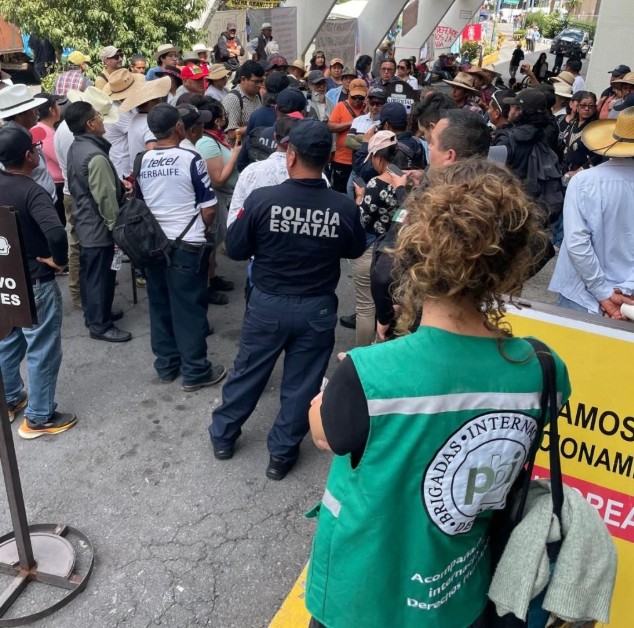
The call for British Columbia premier David Eby to defund the C-IRG in March 4 provincial budget

Stand.earth says:

This March, B.C. Premier David Eby will be presenting the budget, giving him the perfect opportunity to defund and disband the Critical Response Unit (CRU-BC), formerly known as the Community-Industry Response Group.

The C-IRG became very well known for their violent policing of land defenders opposing the Coastal Gaslink Pipeline, the Trans Mountain Pipeline, and clearcut logging in Fairy Creek.

Sign this petition from our allies to add your voice so our Premier and his cabinet know we are demanding they defund and disband the CRU/C-IRG.

And changecourse_ca has a “Call to action: Defund the CIRG!” — with the same petition link as noted above — that further notes:

Use the link in our bio to send an email demanding the BC government defund the critical industry response group (CIRG.) CIRG is a racist policing body created specifically to protect resource extraction projects and industry, and criminalize Indigenous resistance. The BC budget is set to be released on March 4, take action today to tell @davidebybc to defund CIRG. Follow @abolishcirg to stay tuned!

Click the link in our bio to take action

PBI-Guatemala accompanies the Indigenous Community of San Francisco Quezaltepeque as they call for Ancestral Law 6086 and resist mining

On February 12, PBI-Guatemala posted

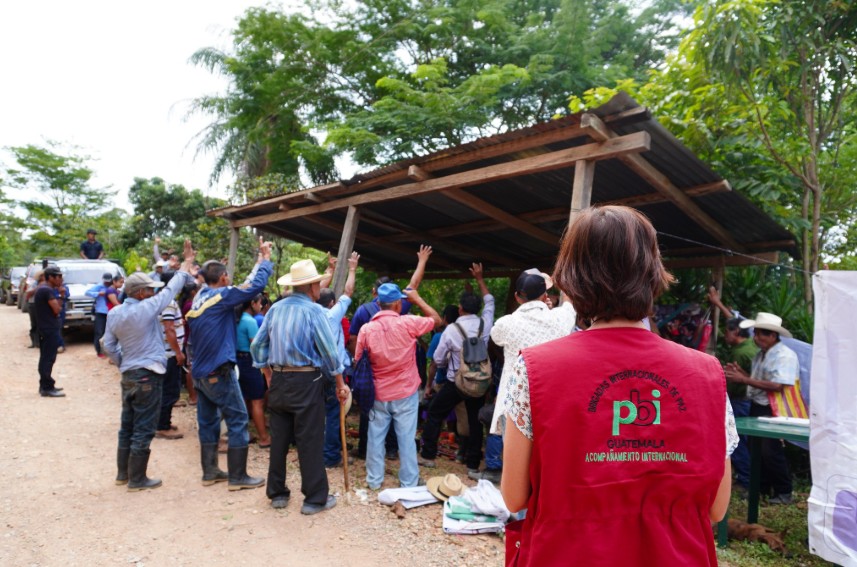
Today #PBIaccompanies the San Francisco Quezaltepeque Indigenous Community in the ceremony of handing over of rods to the 23 new Indigenous Authorities of the recently created Council of Ancestral Maya Ch’orti’ San Juan Ermita Indigenous Communities and to 5 new Indigenous Authorities of the Maya Ch’orti’ Indigenous Council of Olopa Chiquimula.

More than 12 communities of this municipality are organized to publicly express the legitimacy of their leaders and to defend their community autonomy.

The Facebook post by the Indigenous Community of San Francisco Quezaltepeque included that the ceremony was: Accompanied by international peace brigades PBI.

The Maya Ch’orti’ Indigenous Council of Olopa further explain: Today indigenous authorities of the Comunidad Indígena San Francisco Quezaltepeque and the Consejo Indígena Maya Ch’orti’ de Olopa Chiquimula and Camotan in assembly delivered sticks of authority to representatives of communities of San Juan Ermita and Olopa, in this way strengthens the organization of the Maya Ch’orti’ people for the defense of the territory of projects that violate their rights.

They add: Today indigenous authorities of the Maya Ch’orti’ Indigenous Council of Olopa Chiquimula and the Indigenous Community San Francisco Quezaltepeque and Camotan in assembly delivered rods of authority to representatives of communities of San Juan Ermita and Olopa, also ask to approve law 6086 biodiversity law and ancestral knowledge.

The Biodiversity and Ancestral Knowledge Law Initiative (6086)

Earlier this year, Prensa Libre explained:

Deforestation, climate change, the introduction of genetically modified organisms (GMOs), and extractive activities threaten both the ecosystems and the cultural traditions that have sustained these lands for centuries. Faced with this reality, the Biodiversity and Ancestral Knowledge Law Initiative (6086) emerged, a legislative proposal aimed at safeguarding these fundamental pillars for the country’s sustainability.

In 2017, a diverse group of actors, including ancestral authorities, indigenous and peasant organizations, academics, lawyers, and deputies, came together to discuss the negative effects of the imposed development model and seek viable solutions. After years of consensus and collaboration, Bill 6086 was introduced, a legal framework that represents collective aspirations to protect biodiversity and ancestral knowledge.

Initiative 6086 includes:

Community management of natural resources: The law proposes that indigenous communities have greater control over their territories and resources. This approach not only recognizes their role as guardians of the environment, but also promotes sustainable development models that respect cultural and environmental principles.

Regulation of extractive activities: Legal mechanisms are proposed to limit the environmental impact of extractive projects, ensuring a balance between economic development and environmental conservation.

The Indigenous Community of San Francisco Quezaltepeque

The Indigenous Community of San Francisco Quezaltepeque belongs to the Maya Ch’orti’ people. They are resisting Minerales Sierra Pacifico S.A. This company has five exploration licenses for gold, silver, copper, lead and zinc. The Ch’orti’ people are concerned about the negative impacts of these mining activities.

Minerales Sierra Pacifico S.A. is a subsidiary of Vancouver, Canada-based Gold Group Management Inc.

Gold Group in Canada

The Gold Group Management website has noted that one of its member groups, Rackla Metals, has gold exploration projects located in the eastern Yukon and western Northwest Territories, Canada.

In May 2018, the Whitehorse Daily Star reported: The [Yukon] territory’s assessment board has recommended approval of a 65-kilometre, all-season road through virgin wilderness to the Rackla Gold Property. Serious concerns have been raised [about the proposed road] by the First Nation of Nacho Nyak Dun.

The Maya Ch’orti’ Indigenous Council of Olopa

The Maya Ch’orti’ Indigenous Council of Olopa is working in the municipality of the same name, in the department of Chiquimula and formed by 14 communities.

The communities of Olopa are confronting the company American Minerals S.A., which was granted a 25-year antimony extraction license in 2012, without prior consultation with the communities. In 2016, when mining activities began, the communities became aware of the negative impacts of these activities on water and the environment, and demanded the closure of the project.

We continue to follow this.