Home Blog Page 5

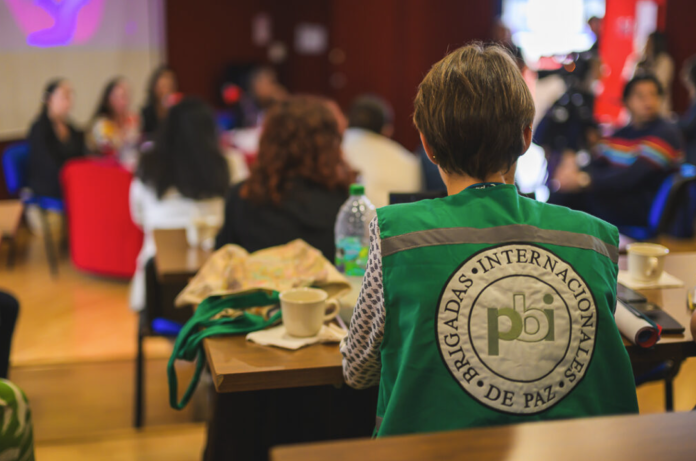
PBI-Colombia accompanies Nomadesc at popular hearing in Siloé, Cali that denounces State violence against the National Strike

The Peace Brigades International-Colombia Project has posted on social media:

“Today, 05/22/2026, we accompany @Nomadesc [the Association for Research and Social Action] at the Public Popular Hearing in Siloé, Cali, five years of impunity that families and organizations continue to denounce in the face of the violent persecution suffered by young people during the Social Outbreak of 2021.

Social organizations report 64 people killed, in addition to multiple persecutions and aggressions aimed at punishing the exercise of social protest and the work of relatives in the search of memory, truth and justice; facts that continue to this day.”

Nomadesc is continuing to mark the 5th anniversary of the national strike and social uprising that began on April 28, 2021, as well as the preceding protests that began on November 21, 2019.

Amnesty International has summarized: “Throughout the 2021 National Strike, Colombia witnessed mass demonstrations across the country. The protests made visible the historical claims of marginalized populations in the country.  Inequality, racism, violence and the consequences of the internal armed conflict were key structural causes of the social explosion. …Instead of listening to the demands of the thousands of people who demonstrated, the government of Iván Duque responded with repression and violence to discourage the peaceful protests and ultimately to punish those who were demanding change in the country.”

We highlight again the solidarity expressed by the labour movement in Canada with the national strike in Colombia:

Click on the hyperlinks to see statements from the Canadian Labour Congress (CLC), Unifor, the Canadian Union of Public Employees (CUPE), the United Steelworkers (USW), the Public Service Alliance of Canada (PSAC), the National Union of Public and General Employees (NUPGE), the Canadian Union of Postal Workers (CUPW), the Union of Food and Commercial Workers (UFCW), the British Colombia General Employees Union (BCGEU) and the Service Employees International Union (SEIU).

Peace Brigades International has accompanied Nomadesc since 2011, and its president Berenice Celeita since 1999.

We continue to follow this.
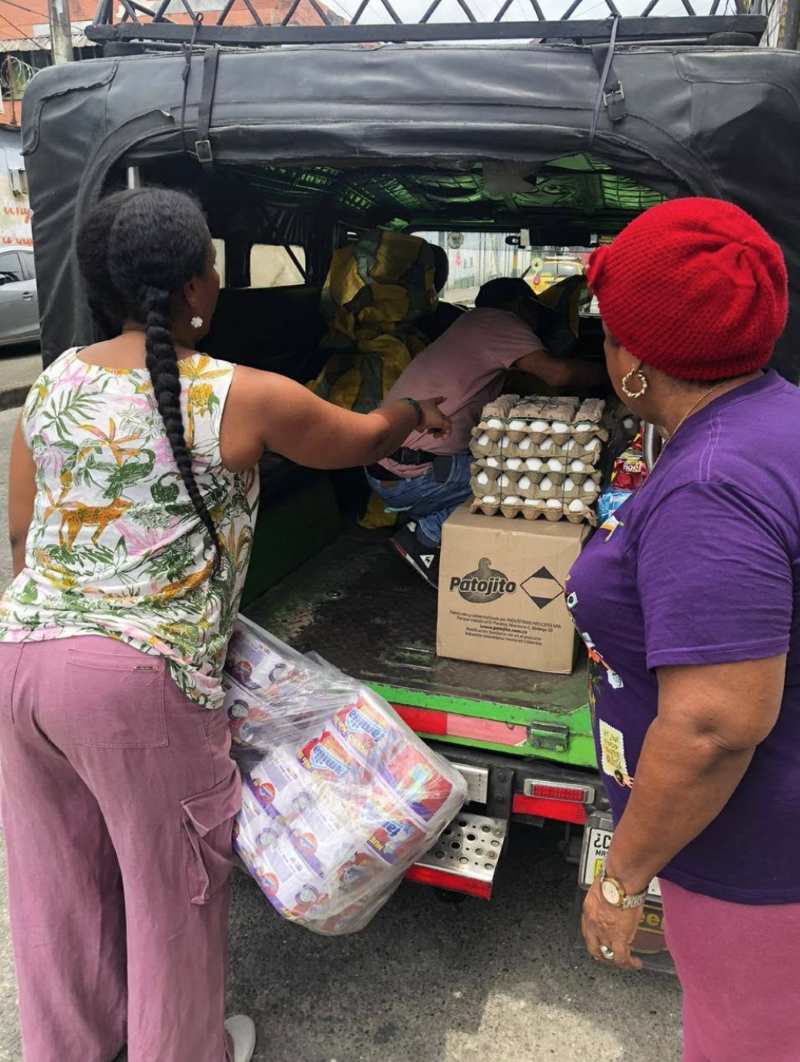
PBI-Honduras accompanies tour of UN agencies in Bajo Aguán where 19 workers killed in armed attack

On May 22, the Peace Brigades International-Honduras Project posted own social media:

“The Agrarian Platform rejects the characterization of the massacre that took place in the community of Rigores, Finca Paso Aguán, as a conflict between farmers; it reaffirms that the farmers’ struggle is nonviolent and can achieve success through legal channels, unity, and a popular movement, and calls for an independent investigation into the events that occurred.

This situation of extreme violence in Bajo Aguán has occurred during a tour by UN agencies in Honduras of peasant communities in the department of Colón, which aimed to highlight the needs and dangerous situation facing peasant communities in the area.

During the tour, accompanied by PBI, attention was drawn to the lack of school resources and electrical infrastructure, as well as the presence of armed groups in the area that threaten the safety of the peasant population.”

Additional context

Deutsche Welle reports: “Two separate armed attacks in Honduras killed at least 24 people on Thursday [May 21], according to police. The first incident took place at a ranch [the Paso Aguán farm] in the municipality of Trujillo, leaving at least 19 workers dead.”

Infobae provides this additional context: “The community of Rigores, in the municipality of Trujillo, department of Colón, became this morning of Friday, May 22, the epicenter of an indescribable and collective pain. In a suffocating atmosphere of mourning, terror and generalized impotence, the inhabitants and relatives gave a Christian burial to 11 of the victims identified in the bloody massacre perpetrated yesterday in an African palm plantation on the Paso Aguán farm.”

That Infobae news article adds: “Among the most devastating scenes of the funeral day was the burial of the sisters María Linda, Mirza and Rosa Rodríguez, three young workers whose lives were brutally cut short while they were looking for daily sustenance for their homes.”

We continue to follow this.
Surveillance by RCMP CRU-BC of “anticipated protest activity” against megaprojects raised in the Legislative Assembly of British Columbia

Video stills: MLA Jeremy Valeriote, Solicitor General Nina Krieger.

On April 28, The Tyee reported: “A B.C. [British Columbia] government group that works with police to monitor protests against the natural resource industry has also been keeping tabs on First Nations treaty negotiations and climate action initiatives, according to an internal document.”

That article further reports: “In a Jan. 12 meeting report obtained by The Tyee through a freedom of information request, the RCMP reported that ‘CRU-BC Intel’ is actively monitoring opposition to two liquefied natural gas projects — the Eagle Mountain-Woodfibre Gas Pipeline and the Prince Rupert Gas Transmission line — as well as protests against old-growth logging on Vancouver Island.”

On May 21, Member of the Legislative Assembly (MLA) Jeremy Valeriote questioned Solicitor General Nina Krieger about surveillance by the RCMP CRU-BC of Treaty negotiations and anticipated protest activity.

Treaty negotiations

Valeriote: The B.C. Greens have long called to disband the RCMP’s critical response unit, or CRU… CRU has faced hundreds of complaints and multiple court cases for systemic charter violations, but these government enforcers seem to be getting more powerful. A B.C. RCMP media relations officer said that CRU ‘does not monitor treaty negotiations but that it is briefed during secretariat meetings by other ministries that are directly involved in those discussions.’ To the Minister of Public Safety: what information about treaty negotiations are government ministries providing to the critical response unit and for what purpose?

Krieger: The critical response unit supports situational awareness and cross-government coordination on public safety, employee safety and the protection of critical infrastructure. This work is coordinated through the critical incident secretariat of government. This group does not monitor lawful advocacy or political activity, does not monitor specific groups, climate initiatives or treaty negotiations. The province fully respects the right to peaceful, lawful protest and the constitutional independence of First Nations in their negotiations with government.

“Anticipated protest activity”

Valeriote: According to the same media relations officer: ‘CRU provides updates to the secretariat regarding current enforcement actions in any anticipated protest activity.’ I fail to see how that’s not monitoring some of these protests. This is an exchange for the information the ministry provides about treaty negotiations. The secretariat maintains, as the minister said, situational awareness of treaty negotiations and climate action. So to restate, CRU is a paramilitary group that polices protests. Why is CRU collecting surveillance information about treaty negotiations? What use is that information to the Ministry of Public Safety and Solicitor General?

Krieger: I will reiterate that the secretariat really advances situational awareness and cross-ministry coordination around public safety. There is no monitoring of specific groups or treaty negotiations or specific initiatives. This is really sharing of information in this cross-ministry coordination group. Information might be shared that may or may not have an impact on public safety, but it is shared to monitor events, to monitor situational awareness and to really support any work to advance public safety that sometimes does occur. I will also say that there are proper channels and independent civilian oversight of the critical response unit and a complaint process for anybody that should wish to make any complaints or ask questions or concerns.

Systemic investigation of the CRU-BC

PBI-Canada is currently awaiting the release of the Civilian Review and Complaints Commission (CRCC) report on the systemic investigation of the RCMP Community-Industry Response Group (C-IRG), the previous name of the CRU-BC.

That investigation was launched on March 9, 2023, after the Ottawa-based CRCC received nearly 500 formal complaints about the RCMP C-IRG. As CBC journalist Brett Forester has previously reported: “More than 100 grievances accepted for investigation contain allegations of excessive force, illegal tactics, unprofessional behaviour, racism, discrimination and charter violations by the force’s Community-Industry Response Group (C-IRG).”

We anticipate the report will be released within the broad timeframe of early-July (at the very earliest) to mid-October 2026 (at the very latest).

The video of the debate in the British Columbia Legislative Assembly starts at 10:42:07. The text of the exchange can be found here.

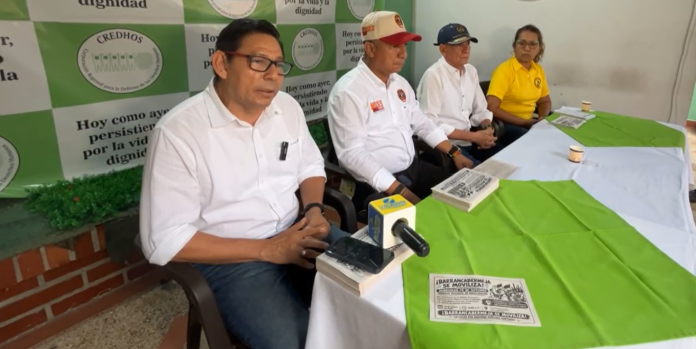
PBI-Colombia accompanies Nomadesc processes as they remember state violence against the National Strike

The Association for Social Research and Action (Nomadesc) has posted a video with text that says: “A space of listening, memory and dignity together with victims, families and organizations affected by human rights violations during the 2019 and 2021 protests in Colombia.”

Nomadesc is continuing to mark the 5th anniversary of the national strike and social uprising that began on April 28, 2021, as well as the preceding protests that began on November 21, 2019.

Amnesty International has summarized: “Throughout the 2021 National Strike, Colombia witnessed mass demonstrations across the country. The protests made visible the historical claims of marginalized populations in the country.  Inequality, racism, violence and the consequences of the internal armed conflict were key structural causes of the social explosion. …Instead of listening to the demands of the thousands of people who demonstrated, the government of Iván Duque responded with repression and violence to discourage the peaceful protests and ultimately to punish those who were demanding change in the country.”

We highlight again the solidarity expressed by the labour movement in Canada with the national strike in Colombia:

Click on the hyperlinks to see statements from the Canadian Labour Congress (CLC), Unifor, the Canadian Union of Public Employees (CUPE), the United Steelworkers (USW), the Public Service Alliance of Canada (PSAC), the National Union of Public and General Employees (NUPGE), the Canadian Union of Postal Workers (CUPW), the Union of Food and Commercial Workers (UFCW), the British Colombia General Employees Union (BCGEU) and the Service Employees International Union (SEIU).

We continue to follow this from Canada, including this activity today.


Further reading

-Nomadesc organizes 5 actions to end impunity on the 5th anniversary of the Social Uprising in Colombia (PBI-Canada, April 25, 2026)

-Questions remain about the use of Canadian armoured vehicles and helicopters during the national strike in Colombia (PBI-Canada, May 5, 2022).

Human rights groups call for Elbit and IAI to be denied entry for CANSEC arms show due to complicity in war crimes

This press release states: “The International Centre of Justice for Palestinians (ICJP) Canada, in collaboration with Just Peace Advocates, has formally requested that the Canada Border Services Agency deny entry to representatives of Israeli arms manufacturers Elbit Systems and Israel Aerospace Industries seeking to attend CANSEC 2026 in Ottawa.”

The ICJP “is an independent organization of lawyers, politicians and academics who support the rights of Palestinians and aim to protect their rights through the law.” Just Peace Advocates is “a Canadian based independent human rights organization promoting Just Peace/Paix Juste through the rule of law and respect for human rights in Canada and around the world for the Palestinian people and those that stand in solidarity for the human rights of the Palestinian people.”

Their release adds: “In a legal submission to Canadian authorities, ICJP Canada argues that representatives of the two companies may be inadmissible under Section 35(1) of the Immigration and Refugee Protection Act (IRPA), based on complicity in war crimes, crimes against humanity, and genocide against Palestinians in Gaza since October 2023.”

It further highlights: “Elbit Systems and Israel Aerospace Industries are among the principal defence contractors supplying military technologies, drones, weapons systems, and surveillance equipment used by Israeli forces during attacks in Gaza. ICJP Canada argues that permitting representatives of these companies to attend Canada’s largest arms and defence exhibition risks undermining Canada’s obligations under domestic and international law.”

The full press release can be read at: ICJP Canada calls for Canada to deny genocide-complicit companies from attending Canadian Arms Fair (May 21, 2026).

Complicity in war crimes

The American Friends Service Committee (AFSC) has noted: “On [October 13, 2023] the Israeli military fired 120mm tank rounds at journalists in south Lebanon, killing Reuters journalist Issam Abdallah and injuring six others in what could amount to a war crime. The munitions used were most likely M339 rounds made by Elbit Systems, according to Amnesty International.

The AFSC also notes: “A large Israeli state-owned weapons manufacturer, Israel Aerospace Industries makes multiple weapons systems specifically for the Israeli military, including the Heron TP killer drone.”

Attacks on human rights defenders and journalists

Front Line Defenders has documented the killing of at least 31 Palestinian human rights defenders in 2023 and 2024. They state “those defending the right to health and the right to life as doctors, nurses, or ambulance workers, those exposing and documenting war crimes as journalists, and those providing humanitarian support as volunteers or employees of aid agencies were all specifically targeted by Israeli bombs or guns.”

The Committee to Protect Journalists has further documented: “Drone killings of press members are on the rise: surging from two in 2023 — the first year CPJ documented such killings — to 39 in 2025. …Of the 39 deaths involving drones that CPJ documented in 2025, 28 were by Israel’s military in Gaza.”

BHRC report

Last week, the Business and Human Rights Centre stated there were “forty-six attacks against defenders raising concerns about arms and weapons companies and their complicity in conflict and genocide – a significant increase from only two attacks recorded per year in 2023 and in 2024.”

Their report references an incident in Ottawa: “Protesters at arms fairs targeting companies selling weapons to Israel [have been detained in several countries and] a journalist in Canada was forcefully restrained and arrested by police for covering protests against the CANSEC arms show, targeting companies linked to weapons sales to Israel and the war in Gaza.”

Shut Down CANSEC

The Ottawa-based Shut Down CANSEC campaign has highlighted in its demands: “End the criminalization of peaceful protests against genocide and occupation.” More than 50 organizations have endorsed this call.

We continue to follow this.
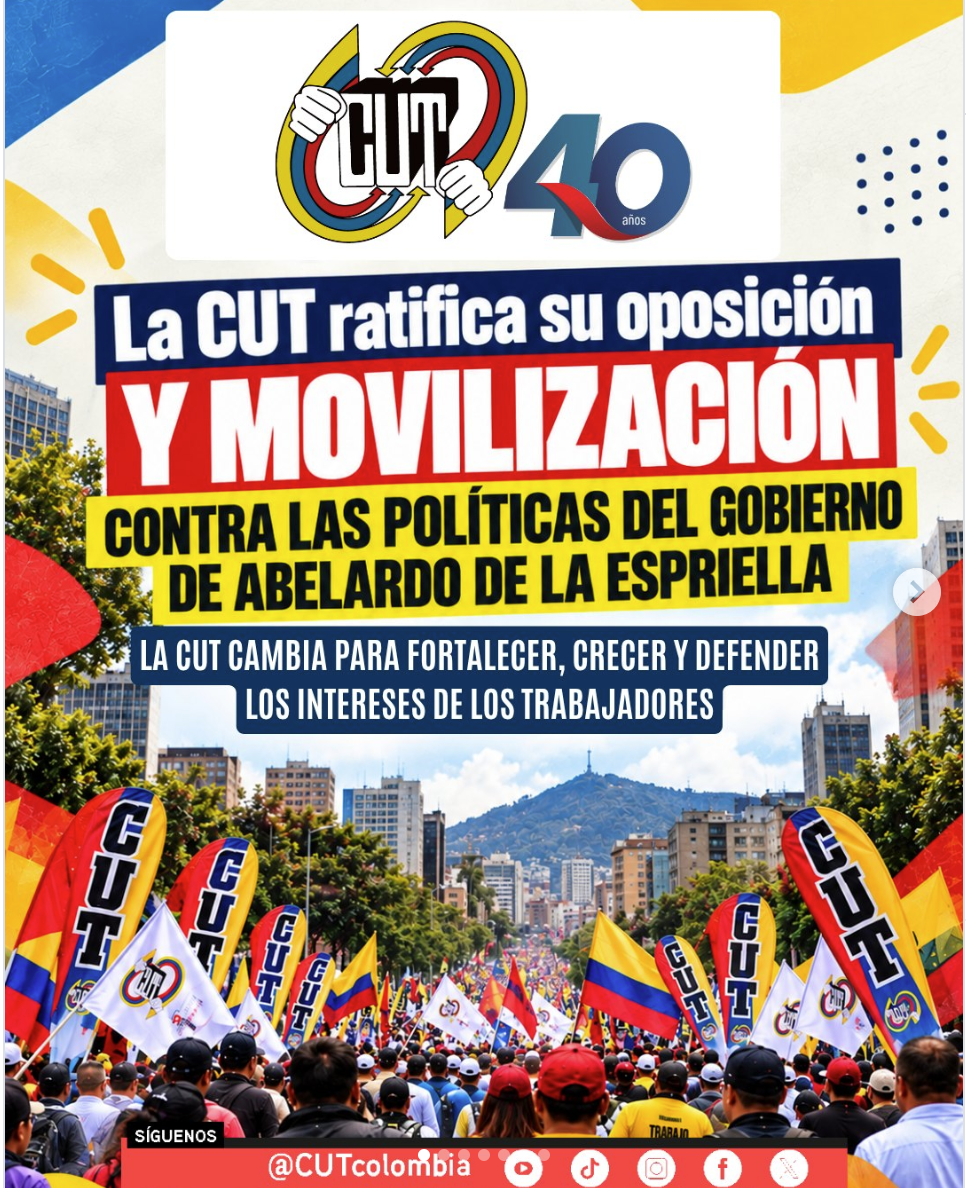
Instagram image by Shut Down CANSEC.

Asuncat members, National Protection Unit guards killed in attack in Catatumbo region of Colombia

Photo: Asuncat member Freiman David Velásquez.

Infobae reports: “On May 19, there was a massacre in a rural area of the municipality of Tibú, Norte de Santander, in which union leader Freiman Velásquez, his sister [Yidy Smith Velásquez Benítez] and two of his bodyguards (Sebastian Murillo and Robinson Carvajalino) were killed.”

El Pais and other news sources identify Freiman David Velásquez as a member of the Association for Peasant Unity of Catatumbo (Asuncat).

RCN Noticias adds: “According to the UN Human Rights Colombia report, social leader Iván Stiven Camacho Castillo of the Association for Peasant Unity of Catatumbo, and Mayerlis Yoselín Hernández Ramírez and Yidy Smith Velásquez Benítez [Freiman’s sister], members of the same association, were also killed in the massacre.”

The Infobae article adds: “The murdered leader [who was inside a National Protection Unit vehicle] was a beneficiary of the state protection program due to previous threats against him, related to his community work and defense of human rights. The authorities reported that the attack took place while the social leader was carrying out activities in the sector, and although the bodyguards tried to repel the aggression, they were overtaken by the attackers, who fled the scene after committing the crime.”

Asuncat

The organization describes itself as being “founded as yet another expression of the Catatumbo people’s struggle and resistance.”

It was founded in 2019.

Peace Brigades International-Colombia has accompanied humanitarian missions in Catatumbo and further amplified the concerns of the Campesina Association of Catatumbo (Ascamcat).

Unionized protection workers killed

Infobae highlights that Giovanni Galló from the National Association of Security Workers (Analtraseg), a union representing National Protection Unit members, commented: “It is known that armed groups use high-caliber rifles to carry out these attacks, but these vehicles that are sent … only support pistols or submachine guns, those vehicles do not support those higher calibers of arms. …It has been insisted that for these areas of the country superior armour must be used, which resist and that exist for this type of area. Glass has been found to hold up more than even minimal armor material. Obviously, it is expensive, but they are going to protect people’s lives.”

The perpetrators

El Espectador reports: “Although the authorities have not yet confirmed who would be behind the events, the Police said that members of the Camilo Torres Restrepo Front of the National Liberation Army (ELN) commit crimes in the Catatumbo sector.”

And Semana also notes: “According to Indepaz, members of the Camilo Torres Restrepo Front of the GAO [the Gulf Clan organized armed group] ELN and members of the EM BMM [Magdalena Medio block] Gentil Duarte commit crimes in that area.”

Presidential candidate comments

In response to the killings, Iván Cepeda Castro posted: “My solidarity with ASUNCAT and with the peasantry of Catatumbo. I have said it and I reiterate it: there cannot be peace dialogues if social leaders are assassinated.”

The first round of the presidential election in Colombia will be held on May 31 with a possible second round on June 21.

We continue to follow this.
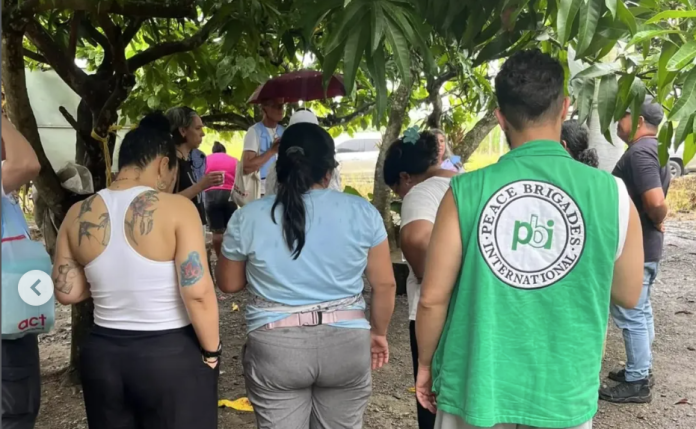
PBI-Guatemala accompanies Marta and Mirtala Hernández Agustín at court hearings on the forcible disappearance of Luz Leticia

The Peace Brigades International-Guatemala Project has posted on social media:

“This week, #PBI is accompanying Marta and Mirtala Hernández Agustín to the hearings regarding the investigation into the forced disappearance of their sister #LuzLeticia on November 22, 1982. Among other evidence, an expert report was presented on documents found in the National Police Historical Archive that revealed police actions linked to the events.

To learn more about the case and the sisters’ struggle, we invite you to read: https://shorturl.at/pP93Y.”

That link leads to this PBI-Guatemala article (reposted below in full).

But first we highlight this one excerpt: “Doña Valentina participated in the formation of the Mutual Support Group (GAM), joining her efforts with those of other families in the same situation. It was at that time that the Hernández Agustín family came into contact with Peace Brigades International (PBI), which at that time accompanied the GAM, and which, already in 1984/85, accompanied one of the Hernández Agustín sisters who finally had to go into exile in Canada. Currently, PBI continues to accompany Valentina, Marta and Mirtala, Luz Leticia’s mother and sisters.”

40 years searching for Luz Leticia

“The truth must come to light so that history does not repeat itself”1

Luz Leticia Hernández Agustín was captured and disappeared by state security forces on November 22, 1982, at the age of 25. It is feared that she was a victim of torture and extrajudicial execution for collaborating in the kidnapping of Jorge Mario Ríos Muñoz, nephew of the de facto Head of State at the time, Efraín Ríos Montt. The objective was to exchange Ríos Muñoz for a colleague who had been disappeared the previous month.

Luz Leticia’s family has not stopped looking for her since then, traveling a long and arduous road in favor of justice. In January 2023, after more than 40 years of tireless struggle, a judicial process was opened on this case. One of the main perpetrators, the former commander of the Special Operations and Reactions Battalion (BROE), Juan Francisco Cifuentes Cano, who was arrested on May 21, 2021 for the Diario Militar case, has been linked to proceedings for forced disappearance and crimes against humanity.

Background

The events occurred during the bloodiest years of the Internal Armed Conflict (CAI) that devastated Guatemala between 1960 and 1996. The CAI began to take shape as a result of the coup d’état perpetrated against the democratic government of Jacobo Arbenz, which ended the decade known as the Democratic Spring (1944-1954), returning to dictatorial regimes. Faced with this closure of spaces, numerous popular and insurgent movements began to develop throughout the country that sought to reverse the political and social conditions of oppression and poverty in which the country was immersed.

The bloodiest stage of the CAI was marked by numerous crimes against humanity committed by several military governments. As pointed out by the Historical Clarification Commission (CEH), the government of Efraín Ríos Montt (1982-1983), which is part of this stage, “gave continuity and expanded the scorched earth policy designed and implemented by his predecessor Romeo Lucas García (1978-1982).

Ostensibly established to destroy insurgent movements, such repressive policies were nevertheless systematically used to destroy social movements that advocated for change and challenged military dictatorships (…). The scant 17 months in which Ríos Montt presided over Guatemala were the most brutal of the conflict. Human rights organizations estimate that 10,000 people were killed in the first three months of his government. During the first eight months of his term, 10 massacres were recorded every month. More than 400 indigenous communities were destroyed. Survivors and relatives of these crimes, as well as human rights organizations, have been fighting tirelessly for decades for justice to be done, the only way to reparation and not repetition of such atrocities.

Luz Leticia’s childhood and youth

Luz Leticia was born on November 22, 1957 into a humble family. She was the eldest of six brothers and sisters who, along with her mother, Valentina Agustín, and her father, Jorge Hernández, grew up in a house near the train tracks, between zones 12 and 13 of Guatemala City, in the La Reformita neighborhood.

Doña Valentina and Don Jorge, both of peasant origin, worked very hard to be able to get their family ahead. He died in 2021 at the age of 88. Since he was a child he worked as a young settler on a farm in Colomba Costa Cuca. According to his daughters Marta and Mirtala, he never forgot his origins and instilled in them values based on humility and mutual respect. He also transmitted to them a way of seeing the world in connection with nature. Doña Valentina was born in Huehuetenango, in the bosom of a Mam family with strong Catholic convictions. She instilled in her daughters a firm belief in peace, love, the need to share and not to do to others what you do not want for yourself. All this marked the path for them to follow.

Despite the extreme poverty in which the family lived, Luz Leticia’s sisters say that, during those years, they were never aware of it, because they grew up surrounded by fruit trees, vegetables, flowers and some domestic animals that formed, together with Don Jorge’s radiotechnics work, the basis of subsistence for the family and a source of joy for the little ones. In addition, they emphasize that the affection and care with which their parents always treated them, made their childhood always full of love. In the words of Mirtala, the youngest of the sisters, “materially we did not have, but the love of home was everything”.

Luz Leticia was the oldest and had an important role in the care of her sisters and brothers. Mirtala remembers her as a very loving and hardworking person, who was always there to accompany and support her. In the same way, she treasured deep values of justice that always accompanied her. For Mirtala, Luz Leticia was and is a source of inspiration, a heroine.

Luz Leticia began her secondary studies at the Belén Institute in 1971. Later, in 1974, she entered the National Central School of Commercial Sciences, where he studied Expert Accounting. When she finished, in 1976, she entered the Faculty of Economics of the University of San Carlos (USAC). During those years, she also worked at the “El Mar” Warehouse, located on Sixth Avenue in Zone 1, to be able to pay for her studies. Her sisters remember that Luz Leticia dreamed of being an economist to contribute to the family economy and the progress of the Guatemalan people.

As Mirtala recalls, her sister Luz Leticia was full of strength and desire to live. She dreamed and believed in a different Guatemala, in democracy and freedom.

Luz Leticia joins “Our Movement”

In 1980, Luz Leticia told her family that she was going to leave her job to set up an accounting firm with other people. Among them was her friend Ileana del Rosario Solares Castillo, who sometimes visited the family home. However, that new project in which Luz Leticia embarked was actually “Our Movement”, an urban insurgency group detached from the Organization of the People in Arms (ORPA). During those years, the student movement was strong and organized. Many young people joined him.

From then on, Luz Leticia remained more distant from family life. Mirtala remembers that her sister suffered a noticeable physical deterioration, she was extremely thin and seemed very tired. Even so, she continued to visit his family sporadically. One of the last times Mirtala remembers seeing her sister was an occasion when she invited her to eat cake at a bakery in the center. Mirtala was 16 years old. They never saw her again.

Arrest and disappearance

On September 25, 1982, state actors kidnapped the militant Ileana del Rosario Solares Castillo. According to the documents of the Historical Archive of the National Police (AHPN), from “Our Movement”, the decision was made to carry out the kidnapping of Mario Ríos, to exchange his freedom for that of Ileana. This kidnapping took place on October 13, 1982 and lasted until November 21 of the same year. The house that was used to hide him was located in the Monterreal neighborhood, in Guatemala City, and Luz Leticia collaborated by pretending to live there with her partner. Between November 21 and 22, a police rescue operation was carried out that culminated in the discovery of the dictator’s nephew and the disappearance of Luz Leticia and her partner Ana Maria López Rodríguez. At first, the operation went to the Melgar Díaz neighborhood, where they arrested 14 people, 9 of them minors. Subsequently, the agents under the orders of Cifuentes Cano, went to the Monterreal neighborhood where Luz Leticia, Ana María, María Cruz López Rodríguez and Leandro Gabriel Calate Temu were arrested.

As it was a case related to the family of the Head of State, it became public and quite mediatic. In December of the same year, María Cruz López Rodríguez and Leandro Gabriel Calate Temu were consigned to the Special Jurisdiction Courts. Leandro was killed during a transfer and, although the autopsy showed signs of torture, the official version maintained that he died of a gunshot during an escape attempt. María Cruz was sentenced to 30 years in prison. Later, during the government of Oscar Humberto Mejía Víctores (1983-1986), she was amnestied. He died in 2002. During those years she wrote a manuscript in which she acknowledged that on the day of her arrest, in addition to Leandro, two more women were arrested, her own sister, Ana María, and Luz Leticia. They were incorporated into the clandestine detention system, thus violating their right to a fair trial, dignified treatment and life, as Luz Leticia’s mother and sisters point out. There is numerous testimonial and documentary evidence that points to the fact that they were retained in the tunnels that are under the old polytechnic school. Nothing was ever heard from his whereabouts again.

During those days, the country’s press reported the finding and rescue of Río Montt’s nephew, however, the Hernández Agustín family did not know that this event affected them directly until approximately November 26, 1982. That day a man visited Don Jorge. He was a tall individual, very well dressed and armed. He told her that his daughter had been captured and insisted that they should demonstrate in front of the presidential house to demand her release. This terrible news marked a before and after in the family’s life. A week later, Gustavo Morataya Hernández, Luz Leticia’s partner, confirmed her arrest and disappearance.

From that moment on, the Hernández Agustín family began a search that has never ceased. For years they filed writs of habeas corpus before the Supreme Court of Justice (CSJ), visited prisons and hospitals, demanded before different competent state bodies that investigations be initiated to clarify the facts, and even went to the Inter-American Commission on Human Rights (IACHR). In 2001, the Court concluded that the State of Guatemala had violated the right to life, humane treatment, personal liberty, a fair trial, and judicial protection of Luz Leticia, Ana María, and Ileana.

Doña Valentina participated in the formation of the Mutual Support Group (GAM), joining her efforts with those of other families in the same situation. It was at that time that the Hernández Agustín family came into contact with Peace Brigades International (PBI), which at that time accompanied the GAM, and which, already in 1984/85, accompanied one of the Hernández Agustín sisters who finally had to go into exile in Canada. Currently, PBI continues to accompany Valentina, Marta and Mirtala, Luz Leticia’s mother and sisters.

One more step towards the truth

On January 20, 2023, more than 40 years after the disappearance of Luz Leticia, the hearing of Juan Francisco Cifuentes Cano’s first statement took place in the 5th Criminal Court of First Instance of Guatemala City. Doña Valentina was especially excited “to see a light in the search for justice for her first daughter.”

Undue delays in the process have occurred over the years, violating the rights of the family. In fact, the hearing cited above was rescheduled up to eight times for various reasons that according to the family seem to act as an excuse and strategy of attrition. In the last hearing of the first statement, Cifuentes Cano was linked to the process for the crimes of forced disappearance of Ana María and Luz Leticia and for crimes of duties against humanity. The intervention of the legal representation of the Hernández Agustín family gave the case a special gender focus, highlighting the use of gender and sexual violence as tools of torture2.

The case was opened thanks to the family’s enormous efforts to find justice and bring to light the truth about what happened. “The disappearance of our sister deeply hurt the family and in order to heal we need to recover the remains of Luz Leticia and that her murderers face justice once and for all,” says Marta.

In 2006, the State of Guatemala offered them a friendly settlement agreement that they rejected because, as they say, “we do all this to bring to light the truth that our sister lived. But not only for that, for us it is an act of justice that should flood with hope the hearts of the families, who, like us, have lost loved ones unjustly, inside and outside Guatemala. Because silence is one of the greatest accomplices of murderers. Because the truth must come to light so that history does not repeat itself. For them, here and there. For justice.”

1All the information contained in this article and which has no other source, was extracted from an interview conducted by PBI with the sisters (Marta and Mirtala) and the mother (Valentina) of Luz Leticia.

2In its report Guatemala, Memory of Silence, the Commission for Historical Clarification (CEH) points out that “the rape of women, during their torture or before they were murdered, was a common practice aimed at destroying the dignity of the person in one of its most intimate and vulnerable aspects.”

PBI-Mexico accompanies rally at 25th meeting of Special Search Commission for Gabriel Alberto Cruz Sánchez and Edmundo Reyes Amaya

On May 19, the Cerezo Committee posted on social media: “Rally at #SEGOB [Ministry of the Interior] to mark the 25th meeting of the Special Commission on Searches #ForcedDisappearance #GabrielandEdmundo”

Later that day, they also posted: “Remarks by Nadi Reyes Maldonado, daughter of Edmundo Reyes Amaya, upon leaving the Special Search Commission #ForcedDisappearance #GabrielandEdmundo”

Edmundo Reyes Amaya and Gabriel Alberto Cruz Sánchez

The Cerezo Committee has previously explained: “On May 25, 2007, in the city of Oaxaca, Edmundo Reyes Amaya and Gabriel Alberto Cruz Sánchez, members of the Popular Democratic Revolutionary Party-Popular Revolutionary Army (PDR) were arrested and disappeared by various police and military groups.”

Supreme Court decision and formation of Special Search Commission

Proceso has reported: “On May 6, 2019, the Fourth District Court of Amparo in Criminal Matters in Mexico City issued a sentence that recognized ‘the serious violation of human rights’ against Popular Revolutionary Army members ‘by agents of the Mexican State’.” That decision was appealed by the Attorney General’s Office (FGR) and the Secretariat of National Defence (Sedena).

The Committee of Relatives of the Detained and Disappeared notes: “On August 10, 2022, the First Chamber of the Supreme Court of Justice of the Nation issued the ruling in favor of the victims, Gabriel Alberto Cruz Sánchez and Edmundo Reyes Amaya, detained and disappeared on May 25, 2007.”

A Special Search Commission was established on November 3, 2022. A first objective was to develop a comprehensive search plan.

Accompaniment

Peace Brigades International began to accompany the Cerezo Committee in 2002.

We have followed this case of the forcible disappearance of Edmundo Reyes Amaya and Gabriel Alberto Cruz Sánchez for almost four years beginning with this article: PBI-Mexico accompanies Cerezo Committee at sit-in protest at Supreme Court (August 11, 2022).

PBI-Canada met with Francisco Cerezo Contreras of the Cerezo Committee in Mexico City in February 2026.

PBI-Honduras accompanies march for International Day Against Homophobia, Transphobia, and Biphobia

The Peace Brigades International-Honduras Project has posted on social media:

“’Commemorating the International Day Against #LGBTIphobia [on May 17] means remembering that challenges still exist, but also that together—women, men, and everyone in between—we continue to build a more inclusive, humane, and loving world,’ says the @arcoirishn [Rainbow] association.

Various diversity groups marched from Central Park to Congress to demand compliance with the Inter-American Court of Human Rights rulings regarding Vicky Hernandez [who was killed most likely by security forces on the night of the coup in Honduras in June 2009] and Leonela Zelaya [who was killed most likely by the police in September 2004] and to raise awareness of the violence faced by the community.

According to various statistics, there have been nearly twenty violent deaths [in Honduras] so far in 2026 alone, nine of them of trans women.

The march, accompanied by PBI, included the Center for Development and Cooperation LGBTI (Somos CDC), Muñecas de Arcoíris [Rainbow Dolls], the Association of Lesbian and Bisexual Women (LITOS), and, and the Honduran Committee on Sexual Diversity, among others.

#lgbtq+rights #transrights”

We continue to follow this.
PBI-Honduras attends judicial hearing as international observer as three indicted in the murder of Juan López

The Peace Brigades International-Honduras Project has posted on social media:

“’These are historic moments in the fight against impunity and require the ongoing support and vigilance of national and international society,’ the CMDBCPT [Municipal Committee for the Defense of Common and Public Goods of Tocoa] states.

The National Territorial Court of San Pedro Sula issued an indictment against [the former mayor of Tocoa] Adán Fúnez, [along with] Héctor Méndez, and Juan Ángel Ramos, who are accused of the murder of human rights defender Juan López and of the crime of criminal conspiracy.

The CMDBCPT, represented by Justice for the People Law Firm, recognizes the importance of this ruling, which is based on technical, documentary, and testimonial evidence presented during a hearing lasting more than 17 hours [on May 15-16], which PBI attended as an international observer.

-The preliminary hearing [for the three alleged intellectual authors of the murder] will be held on August 12, although it cannot be ruled out that the defense will file appeals, which would delay the judicial process.

-Meanwhile, on May 25, Lenir Pérez [one of the most powerful businessmen in Honduras and the co-owner of Inversiones Los Pinares, a controversial iron mining project in Tocoa] will face an initial hearing for the illegal extraction of natural resources and aggravated damage to Carlos Escaleras National Park.

-The trial against the perpetrators [the alleged material authors Oscar Alexis Guardado Alvarenga, Daniel Antonio Juárez Torres and Lenin Adonis Cruz Munguía] of Juan López’s murder will take place in mid-June.”

Tu Nota has further explained:

“A judge issued a formal indictment early Saturday [May 16] morning with the measure of preventive detention against the former mayor of Tocoa, Colón, Adán Fúnez, as well as against Juan Ángel Ramos Gallegos and Héctor Eduardo Méndez, accused of the murder of environmentalist and former municipal councilor Juan Antonio López.

The Public Prosecutor’s Office (MP) believes that the three defendants are responsible, as intellectual authors, for the crime of murder to the detriment of López, a renowned environmental defender of Bajo Aguán and critic of mining projects in the northern part of Honduras.

Fúnez, Méndez and Ramos Gallegos were captured on May 12 during a series of raids carried out in the municipality of Tocoa, as part of the investigations related to the crime of Juan López that occurred on September 14, 2024.

The case has gained national relevance because the Prosecutor’s Office supports the hypothesis of the existence of an organized structure aimed at silencing one of the main environmental defenders of the Bajo Aguán region.”

Accompaniment

With PBI-Honduras, PBI-Canada coordinator Brent Patterson visited Tocoa and Guapinol on October 29-30, 2024, about six weeks after Juan Lopez was killed.

Peace Brigades International has accompanied Municipal Committee for the Defence of Common and Public Goods of Tocoa (CMDBCPT) processes and the defenders of the Guapinol River since January 2019.

As PBI-Honduras physically accompanies this process, PBI-Canada continues to follow this from Canada.

Additional reading: Wiretaps and protected witnesses would implicate Adán Fúnez in the murder of Juan López (Marcia Perdomo, Criterio.hn, May 16, 2026).