

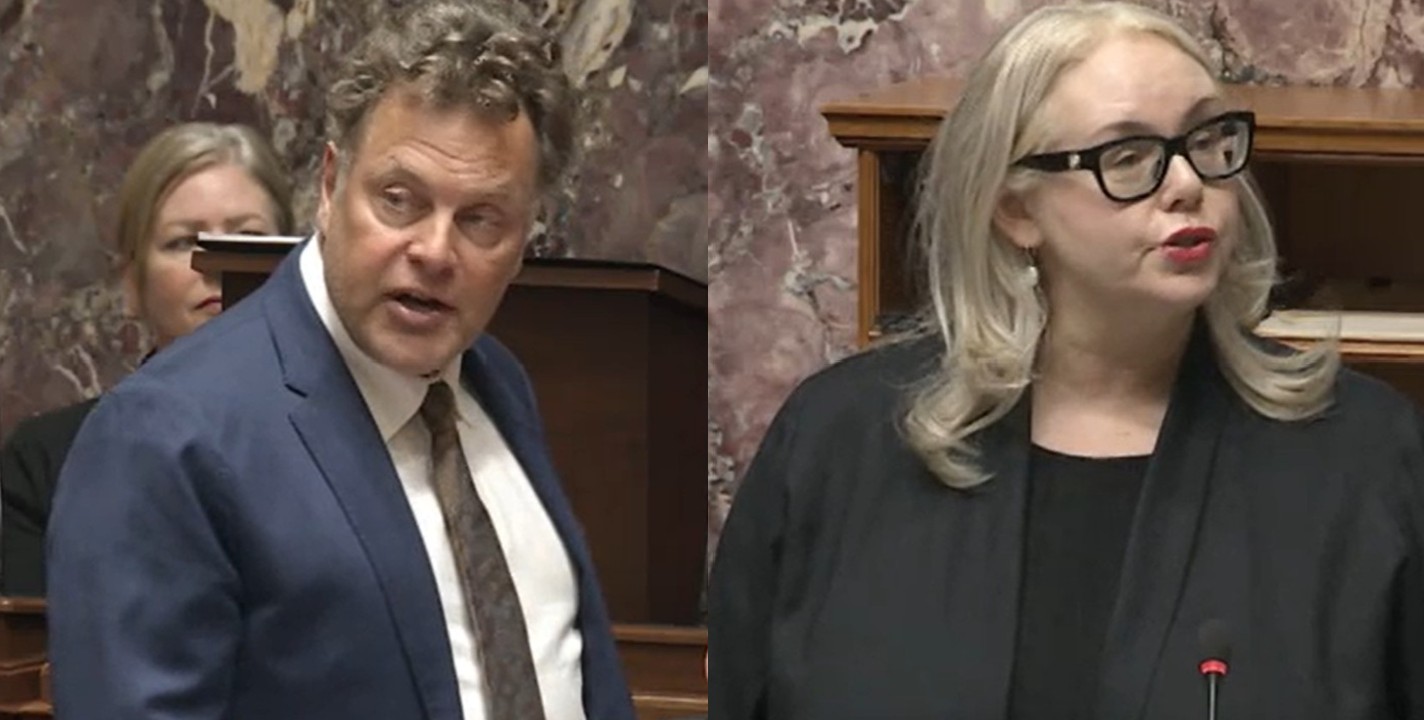
Video stills: MLA Jeremy Valeriote, Solicitor General Nina Krieger.
On April 28, The Tyee reported: “A B.C. [British Columbia] government group that works with police to monitor protests against the natural resource industry has also been keeping tabs on First Nations treaty negotiations and climate action initiatives, according to an internal document.”
That article further reports: “In a Jan. 12 meeting report obtained by The Tyee through a freedom of information request, the RCMP reported that ‘CRU-BC Intel’ is actively monitoring opposition to two liquefied natural gas projects — the Eagle Mountain-Woodfibre Gas Pipeline and the Prince Rupert Gas Transmission line — as well as protests against old-growth logging on Vancouver Island.”
On May 21, Member of the Legislative Assembly (MLA) Jeremy Valeriote questioned Solicitor General Nina Krieger about surveillance by the RCMP CRU-BC of Treaty negotiations and anticipated protest activity.
Treaty negotiations
Valeriote: The B.C. Greens have long called to disband the RCMP’s critical response unit, or CRU… CRU has faced hundreds of complaints and multiple court cases for systemic charter violations, but these government enforcers seem to be getting more powerful. A B.C. RCMP media relations officer said that CRU ‘does not monitor treaty negotiations but that it is briefed during secretariat meetings by other ministries that are directly involved in those discussions.’ To the Minister of Public Safety: what information about treaty negotiations are government ministries providing to the critical response unit and for what purpose?
Krieger: The critical response unit supports situational awareness and cross-government coordination on public safety, employee safety and the protection of critical infrastructure. This work is coordinated through the critical incident secretariat of government. This group does not monitor lawful advocacy or political activity, does not monitor specific groups, climate initiatives or treaty negotiations. The province fully respects the right to peaceful, lawful protest and the constitutional independence of First Nations in their negotiations with government.
“Anticipated protest activity”
Valeriote: According to the same media relations officer: ‘CRU provides updates to the secretariat regarding current enforcement actions in any anticipated protest activity.’ I fail to see how that’s not monitoring some of these protests. This is an exchange for the information the ministry provides about treaty negotiations. The secretariat maintains, as the minister said, situational awareness of treaty negotiations and climate action. So to restate, CRU is a paramilitary group that polices protests. Why is CRU collecting surveillance information about treaty negotiations? What use is that information to the Ministry of Public Safety and Solicitor General?
Krieger: I will reiterate that the secretariat really advances situational awareness and cross-ministry coordination around public safety. There is no monitoring of specific groups or treaty negotiations or specific initiatives. This is really sharing of information in this cross-ministry coordination group. Information might be shared that may or may not have an impact on public safety, but it is shared to monitor events, to monitor situational awareness and to really support any work to advance public safety that sometimes does occur. I will also say that there are proper channels and independent civilian oversight of the critical response unit and a complaint process for anybody that should wish to make any complaints or ask questions or concerns.
Systemic investigation of the CRU-BC
PBI-Canada is currently awaiting the release of the Civilian Review and Complaints Commission (CRCC) report on the systemic investigation of the RCMP Community-Industry Response Group (C-IRG), the previous name of the CRU-BC.
That investigation was launched on March 9, 2023, after the Ottawa-based CRCC received nearly 500 formal complaints about the RCMP C-IRG. As CBC journalist Brett Forester has previously reported: “More than 100 grievances accepted for investigation contain allegations of excessive force, illegal tactics, unprofessional behaviour, racism, discrimination and charter violations by the force’s Community-Industry Response Group (C-IRG).”
We anticipate the report will be released within the broad timeframe of early-July (at the very earliest) to mid-October 2026 (at the very latest).
The video of the debate in the British Columbia Legislative Assembly starts at 10:42:07. The text of the exchange can be found here.

