Home Blog Page 394

On Indigenous Peoples Day, Indigenous rights defenders remain the target of criminalization and fatal attacks

Photo by Skyler Williams.

Today is the International Day of the World’s Indigenous Peoples. The United Nations says: “On this day, people from around the world are encouraged to spread the UN’s message on the protection and promotion of the rights of indigenous peoples.”

Just ten days ago, the Global Witness Defending Tomorrow report on the killings of land and environmental defenders around the world highlighted that:

“Indigenous peoples are at a disproportionate risk of reprisals. Last year, 40% of murdered defenders belonged to indigenous communities. Between 2015 and 2019 over a third of all fatal attacks have targeted indigenous people – even though indigenous communities make up only 5% of the world’s population.”

This year’s Global Witness report also notably drew attention to the criminalization of the Wet’suwet’en people in Canada in 2019.

The global human rights organization IWGIA (International Work Group for Indigenous Affairs) has further highlighted that:

“According to the United Nations (UN), indigenous rights defenders are facing greater violations of their rights today than they were just a decade ago. Every year, thousands of indigenous peoples are criminalised and discriminated against – increasingly, this trend takes the highest toll of all: the life of indigenous rights defenders.”

In September 2019, Victoria Tauli-Corpuz, the United Nations Special Rapporteur on the rights of Indigenous peoples at that time, noted: “Extractive activities within indigenous peoples’ lands and territories undertaken without adequate consultation or consent are the main source of serious violations of their human rights, including violence, criminalisation and forced displacement.”

Peace Brigades International accompanies numerous defenders of land rights, culture and natural resources in Colombia, Guatemala, Honduras and Mexico.

We have noted: “International declarations and mechanisms on indigenous rights enshrine the right to self-determination for indigenous peoples and recognise the importance of land rights for the original inhabitants of many countries now governed by the descendants of colonizers. These rights are often the focus of conflict as powerful interests wish to exploit the natural resources found within and beneath traditional territories.”

This year, PBI-Canada draws attention to the struggles of Secwepemc land defenders opposed to the Trans Mountain tar sands pipeline, Wet’suwet’en land defenders working to stop the Coastal GasLink fracked gas pipeline, Six Nations land defenders protecting Haudenosaunee territory from a 1,000 unit housing development, and Haida land defenders protecting Haida Gwaii from a luxury fishing resort during the COVID-19 pandemic.

We also note the similarities in the criminalization of Indigenous peoples for defending land rights in Saskatchewan and Guatemala.

We remain concerned about the unresolved arson attack against the Spirit of the Buffalo Camp on Treaty 1 territory this past April.

And we further draw attention to the Mohawk land defenders who face a court hearing in Napanee, Ontario this coming Tuesday August 11 for their peaceful blockade on Tyendinaga territory in solidarity with the Wet’suwet’en peoples.

#IndigenousDay #IndigenousPeoplesDay 

Second draft of UN Binding Treaty on transnational corporations released prior to October negotiations

On August 6, the second revised draft of the Binding Treaty on transnational corporations and human rights was released.

The preamble to it includes the text: “Emphasizing that civil society actors and human rights defenders have an important and legitimate role in promoting the respect of human rights by business enterprises, and in preventing, mitigating and seeking effective remedy for business-related human rights abuses.”

This follows the release of the Front Line Defenders report in January of this year that told us that 304 human rights defenders had been killed last year, as well as the release of the Global Witness report in July that documented that 212 land and environmental defenders were killed in 2019 (up from 164 in 2018).

This second revised draft will be discussed at the 6th session of intergovernmental negotiations that will be held in October 26-30 in Geneva.

This past February, Equal Times reported: “Discussions are taking place within the United Nations on introducing a legally-binding instrument to regulate the activities of multinationals. Progress is, however, very slow, with countries such as the United States, Russia, China and Brazil doing everything they can to block the process.”

PBI-Colombia accompanied Yessika Hoyos from the Jose Alvear Restrepo Lawyers Collective (CCAJAR) has also commented: “Many companies together with the states have been blocking this issue. They haven’t allowed for a Treaty to be created.”

And given/despite the number of Canadian corporations implicated in human rights violations related to mining and oil and gas operations, Oxfam Canada has noted: “Canadian government officials have been largely absent from the process so far.”

Peace Brigades International supports the call for a binding global United Nations Treaty on business and human rights.

The full text of the second revised draft can be read here.

British Columbia grants permission for pipeline construction near Unist’ot’en Healing Centre

Photo: Karla Tait, Unist’ot’en healing centre clinical services director, arrested by the RCMP on February 10. Photo by Amber Bracken/The Narwhal.

The Tyee reports: “The province’s Environmental Assessment Office has granted [TC Energy-owned] Coastal GasLink permission to begin pipeline construction near the Unist’ot’en Healing Centre [which is] located a kilometre from the pipeline route.”

The article adds: “The healing centre is also located on the road leading to Coastal GasLink’s 9A Lodge work camp, and an influx of workers has raised concerns about the connection between work camps and missing and murdered Indigenous women.”

The Tyee further reports that clearing and grading of the pipeline route is expected to begin through the area in September.

Earlier this summer, the Unist’ot’en Camp posted that they will be “holding a summer work camp to repair and build urgently needed infrastructure around the Healing Centre” from August 25 to September 7 “to ensure the Unist’ot’en can continue their crucial healing work.”

Karla Tait, the director clinical programs at the Unist’ot’en Healing Centre, and Anne Spice, an Indigenous feminist and anti-colonial organizer, have written: “Indigenous peoples carry the pain of genocide, of intergenerational and current traumatic experiences, coupled with inequities in the social determinants of health.”

Tait and Space add: “The over-representation of Indigenous people with mental health conditions, addictions, incarceration and suicidality indicate that many cannot cope with the heavy burdens of colonization.”

The Unist’ot’en have affirmed: “The healing programming depends on connection to, and traditional use of, the land itself. All of Talbits Kwah territory is required for hunting, trapping, gathering medicines, berry picking, and visiting cultural ceremonial sites.”

And yet this healing centre now risks being within a kilometre of a fracked gas pipeline that lacks the consent of the Wet’suwet’en and within 13 kilometres of a man camp that would house hundreds of workers for the pipeline.

The final report by National Inquiry on Missing and Murdered Indigenous Women and Girls (June 2019) quoted James Anaya, the former United Nations Special Rapporteur on the Rights of Indigenous Peoples, on the issue of these work camps.

Anaya said: “Indigenous women have reported that the influx of workers into indigenous communities as a result of extractive projects [have] led to increased incidents of sexual harassment and violence, including rape and assault.”

The Inquiry found that “work camps, or man camps, associated with the resource extraction industry are implicated in higher rates of violence against Indigenous women at the camps and in the neighbouring communities.”

Wet’suwet’en territories have now been subjected to two militarized RCMP (federal police) raids and an ongoing occupation enforcing problematic and skewed court injunctions allowing construction of the pipeline.

On January 8, 2019, fourteen land defenders were arrested for blocking the access of Coastal GasLink pipeline workers to Wet’suwet’en territory. RCMP commanders instructed officers to “use as much violence toward the gate as you want”.

And on February 6, 2020, a second RCMP raid resulted in the arrest of six land defenders, followed by eleven more arrests on February 9. Then on February 10, seven women, including Karla Tait from the healing centre, were arrested by the RCMP while holding a ceremony to honour missing and murdered Indigenous women and girls.

For updates on this present situation, please see the Unist’ot’en Camp Facebook page. For the application form for the August 25 to September 7 work camp in support of the healing centre, please see Unist’ot’en 2020 Summer Work Camp.

PBI-Guatemala accompanied UVOC draws attention to climate change and dam on the Polochic River

The Verapaz Union of Campesino Organizations (UVOC) is an Indigenous and peasant organization dedicated to the defence and promotion of access to land for the peasant population in the departments of Alta and Baja Verapaz.

UVOC has 367 affiliated communities (about 50,000 families), 98 percent of which are Indigenous Maya Q’eqchi’, Poqomchi’ and Achi.

On August 7, UVOC tweeted: Climate Change affects the Q’eqchi’s and Poqomchi’s communities. Their link leads to this statement that notes:

“Climate change [puts] the lives of ecosystems, communities and q’eqchi’s and poqomchi’ peoples in Alta Verapaz at risk. The main causes of this are megaprojects including hydroelectric, mining and monocultures. That is why the peasants and indigenous peoples of the Verapaces must unite as movements to definitively curb the death projects that are generating global warming.”

UVOC also posted this 1:42 minute video on Facebook along with the text:

“50 Mayan families q’eqchi’ of the Chitun community in San Miguel Tucuru, demand that Mr. Juan Luis Bosch president of the Santa Teresa Hydroelectric Plant return the land where they lived, since they were taken from them since they were imposed on them the project that works with a capacity of 24 megawatts with which they divert the Polochic River.”

On its webpage about the Santa Teresa Hydroelectric Plant, CMI Energia notes: “Located in the municipality of San Miguel Tucurú, Alta Verapaz. This central uses the strength of the Polochic river, has the capacity to generate 16 MW.”

It also notes that the plant began operating in 2011.

PBI-Guatemala has been accompanying UVOC since 2005, following threats and serious intimidation against some of its members. In the few last years the accompaniment of UVOC has been extended to some of the communities that the UVOC advises, with PBI carrying out regular visits with them.

Lockheed Martin and Boeing spin jobs argument in bid to win $19 billion in public funds for new warplanes

This past April, Guardian columnist George Monbiot critiqued the British government’s intention to buy a fleet of 138 F-35s and the prioritization of “imaginary threats, while neglecting real ones” with these words: “Can it bomb the coronavirus?”

While the coronavirus obviously can’t be bombed by warplanes, the arms companies that want to manufacture them for Canada, aware of the public’s nascent concern about this country’s pandemic swollen federal debt of $1.2 trillion, will need to counter the argument that spending $19 billion on warplanes is a poor allocation of public funds.

More than four months ago, Elliot Hughes, a senior advisor at the Ottawa-based Summa Strategies, observed: “The soaring deficits [associated with COVID-19 spending] will place tremendous pressure on government to reduce its spending in non-COVID-19 areas in favour of healthcare and related priorities.”

Now, the CBC’s Murray Brewster reports: “Lorraine Ben, the chief executive officer of Lockheed Martin Canada, said the fighter jet program is important to the country’s economic recovery from the pandemic because it delivers high-skilled, high-paying jobs.”

On June 25, Brewster had also reported that a “presentation by Boeing executives [that emphasized its history of delivering high-paying aerospace jobs] arrives against a background of a pandemic-ravaged economy…”

Lockheed Martin has already highlighted that Canadian companies have been awarded contracts as part of the F-35 global supply chain amounting to “$2 billion USD and approximately $120 million in capital investment for facility upgrades.” It omits though that this has come at the cost of US$541.3 million in taxpayer dollars since 1997.

Now, Lockheed Martin is arguing that it could add $16.9 billion to the gross domestic product of this country over the lifetime of the F-35.

Brewster also notes the implied threat from Lockheed Martin that should the Canadian government not choose the F-35, the existing contracts, worth $2 billion, would be honoured for the duration of their term but might go elsewhere afterwards.

While transnational corporations that profit from war are going to make their best pitch to win $19 billion in public funding – especially when the speculation is that Canada may reduce its order from 88 to 65 warplanes – the Canadian government should also be challenged on the logic of this planned purchase.

A former Deputy Minister of National Defence has written that “new Canadian fighters are not required to protect Canada’s populace or sovereignty” and a quick review of the 1,598 bombing missions that Canada’s current fleet of CF-18s have conducted does not suggest they helped to bring peace or stability to Iraq, Libya, Syria and Yugoslavia.

As for the economic argument, research has found that $1 million spent on “defence” creates 6.9 direct and indirect jobs, while the same amount invested in solar power creates 9.5 jobs, in health care 14.3 jobs, and in education 19.2 jobs.

This suggests that $19 billion spent on a green new deal, our public health care system and public education would do far more for the economy than buying the sales pitch for warplanes from the two largest arms manufacturers in the world.

Six Nations land defenders arrested by heavily armed police at 1492 Land Back Lane protest against housing development

Photo by Real Peoples Media.

On July 19, Six Nations land defenders began occupying the site of a planned housing development site near Caledonia, Ontario. The 218-unit development is reportedly the first phase of a 1,000-unit development.

Land defender Skyler Williams says: “This is Six Nations territory and it’s going to remain Six Nations territory.”

By July 31, the Ontario Provincial Police (OPP) escorted a court sheriff who read and delivered an injunction against the occupation.

And on August 5, dozens of OPP officers raided the site and arrested 9 land defenders for not complying with the court injunction.

Williams has posted: “Several rubber bullet shots fired at land defenders.” Yotakahron Jonathan further confirmed on Twitter: “Rubber bullets fired by OPP at onkwehonwe (Original Peoples).” An unidentified woman in a video also commented: “Three paddy wagons of land defenders were taken from their traditional territory by force.”

The Chatham Daily News reports: “In retaliation, other members of the Six Nations of the Grand River shut down a nearby Highway 6 bypass, part of one street and another road, burning tires and barricading the roads. They also blocked a rail line running through Caledonia and turned back one train.”

A police helicopter was deployed as the protest expanded.

While the elected council of the Six Nations of the Grand River says it has “accommodated” the housing development (through the transfer of 42.3 acres of land and a $325,000 cash payment from the builders), many members of the community have not consented to this. The land defenders maintain that the housing development violates Haudenosaunee sovereignty and have named the site 1492 Land Back Lane.

Russ Diabo has explained some of the historical context: “[The Grand River tract] runs about a mile each side of the Grand River right down to Lake Erie. And they’ve lost over 90 per cent of it through improper, illegal sales to where they just have the existing Six Nations reserve today. …It’s the broader issue about the Grand River tract which is outstanding.”

The Hamilton Spectator further notes: “Williams said the Canadian government and band council alike need to consult more widely before further development can happen on disputed territory.”

Williams says: “If you’re not going to come to the table for meaningful discussion, to make it a real process where everybody in our community feels heard and accommodated and consulted with, then you’re going to continue to have these flashpoints in time where you’re met with resistance.”

A spokesperson for Losani Homes, one of the companies involved in the housing development, says this protest came as “a complete surprise”.

And yet one can look to the protests in Caledonia in 2006 against the Douglas Creek Estate development or this Toronto Star article from August 2017 that highlights the “disagreement between the elected band council and the Haudenosaunee Confederacy, a traditional government system comprised of five First Nations. The latter says it has been responsible for the lands for over 10 years.”

One can also look to the recent resistance to a 400-unit residential development on Kanehsatà:ke territory near Oka, Quebec.

The deeper complexities of the dispossession of Indigenous peoples from their lands, along with the repeated concerns articulated about the imposition of federal government sanctioned band councils versus traditional forms of Indigenous governance, speak to the need for a different approach rather than the familiar path of court injunctions, heavily-armed police enforcement and the arrest of land defenders.

For additional updates on the situation, you can visit the Facebook pages of 1492 Land Back Lane and Real Peoples Media.

To make a donation to 1492 Land Back Lane, you can e-transfer your contribution to landback6nations@gmail.com or click here for their GoFundMe page.

Nuclear disarmament remains an imperative 75 years after Hiroshima and Nagasaki

Image by Thoughtco.

On the 75th anniversary of the bombing of Hiroshima and Nagasaki, it is imperative not to historicize the suffering of those who died, but to situate the memory of them in the present struggle against the threat of nuclear militarism.

More than 210,000 people killed in Hiroshima and Nagasaki

75 years ago, two atomic bombs were dropped on the cities of Hiroshima and Nagasaki. By the end of 1945, the bombing had killed more than 210,000 people.

It is believed that about 120,000 people died instantly and that tens of thousands more died in the days, weeks and months that followed that year. In the years that followed, many more people faced leukemia and cancer due to the radiation.

Setsuko Thurlow, who survived the bombing of Hiroshima when she was 13-years-old, reminded us just a few years ago: “Each person had a name. Each person was loved by someone. Let us ensure that their deaths were not in vain.”

Let us also remember that the uranium used in the bomb dropped on Hiroshima was refined in Ontario and that research in Ontario and Quebec also played a role in the production of the plutonium used in the bomb dropped on Nagasaki.

There were alternatives then and now

This week, Professor Benoît Pelopidas wrote: “According to the US Air Force’s own review, finalized not long after the end of the war, Japan would likely have surrendered that same autumn even in the absence of atomic bombings or an invasion.”

“Similarly, the Joint Chiefs of Staff expressed skepticism about the use of atomic bombs both before and after the fact.”

Pelopidas thus challenges the long-standing notion that while many were killed in Hiroshima and Nagasaki, it saved the lives of many American soldiers.

He argues that the alternatives to dropping the atomic bombs included: “negotiations, a demonstration of the atomic bomb in an uninhabited area, continued strategic bombing short of the use of atomic weapons, continued economic blockade, and waiting for the Soviets to declare war against the Japanese empire.”

A massive diversion into nuclear militarism

It has also been estimated that the United States, between 1940 and 2005, spent more than $7.5 trillion on nuclear weapons.

The most recent figure is that the nine nuclear weapon states spent $72.9 billion in 2019 on nuclear weapons, a 10% increase over 2018.

And a Congressional Budget Office report last year estimated that the United States will spend $494 billion on nuclear weapons from 2019 through 2028.

This represents a massive diversion of spending away from the public good and speaks to the need to defund nuclear war and divert that spending to alternatives.

PBI founders acted against nuclear weapons

At least three of the founders of Peace Brigades International took extraordinary steps to end the scourge of nuclear weapons.

Murray Thomson was 23 years old when Hiroshima and Nagasaki were bombed. He said that experience made him a pacifist and he spent the next 73 years of his life forming organizations, giving speeches, writing, and initiating campaigns against nuclear weapons.

In 1958, 43-year-old George Willoughby and three others sailed 6,400 kilometres on the South Pacific Ocean to put themselves in between the US Navy and its testing of an atomic weapon. They were arrested near Honolulu and sentenced to 60 days in jail.

And in 1962, 33-year-old Hans Sinn undertook an 8,000 kilometre Vancouver to Berlin peace walk to publicize the need for nuclear disarmament.

Canada’s role today

Significantly, Canada has not signed the United Nations Treaty on the Prohibition of Nuclear Weapons, the first legally binding international agreement to comprehensively prohibit nuclear weapons with the goal of leading towards their total elimination.

Professor Jim Harding has also argued that Canada has long violated the Nuclear Non-Proliferation Treaty of 1970 through uranium mined in Saskatchewan and refined in Ontario fuelling the US nuclear weapons stream.

And Matt Korda, a research associate for the Nuclear Information Project, has commented Canada “actively participates in NATO’s Nuclear Planning Group” and allows “American and British nuclear-capable vessels to visit our ports.”

As we commemorate the 75th anniversary of the death of more than 210,000 people in Hiroshima and Nagasaki, let us recommit ourselves to stopping this country’s role in supplying, facilitating, participating in and providing cover for nuclear militarism.

In the words of Setsuko’s recent letter to Prime Minister Justin Trudeau:

“The approaching 75th anniversary of the atomic bombings of Hiroshima and Nagasaki on August 6th and 9th would be the appropriate moment to acknowledge Canada’s critical role in the creation of nuclear weapons, express a statement of regret for the deaths and suffering they caused in Hiroshima and Nagasaki, as well as announce that Canada will ratify the UN Treaty on the Prohibition of Nuclear Weapons.”

On August 6, PBI-Canada will participate in the Quaker Peace and Social Concerns Ottawa-organized 75th Anniversary Memorial and Lantern Ceremony.

Canadian fighter jets, militarism and the human rights to water and sanitation in Iraq and Libya

Photo: 2,000-pound GBU-10 bombs are mounted on a CF-18 fighter jet at a base in Italy before deployment to Libya in 2011.

The Canadian government is planning to spend $19 billion on new fighter jets. That contract could be awarded within the next 18 months.

One way to understand what they might be used for is to look at how Canada’s existing fleet of CF-18 fighter jets have been used in the recent past.

Iraq

The CBC has reported: “In 1991, the Canadian Forces deployed 24 CF-18s to aid the U.S. during the first Gulf War. These aircraft were based out of Qatar and flew over 5,700 hours, participating in 56 bombing missions.”

In an article published earlier this year, The Hill reported on the present challenge of Iraq in meeting its demand for electricity.

The Hill explains: “Iraq’s electricity woes can be traced to 1991, when the U.S.-led bombing campaign nearly destroyed Saddam Hussein’s electricity infrastructure. The campaign included 215 sorties aimed at Iraq’s grid.”

That article adds: “Human Rights Watch condemned the bombing, saying that the destruction of Iraq’s grid ‘resulted in severe deprivation of clean water and sewage removal for the civilian population and paralyzed the country’s entire health care system’.”

And it noted: “The lack of clean water led to a cholera outbreak. Water contamination and other health-related problems resulted in a surge in civilian deaths with credible estimates putting the number of Iraqis killed by disease at 70,000.”

Almost 30 years later, the problem persists.

Earlier this year, Chatham House highlighted: “Baghdad has a sewage treatment plant that originally ran on its own electricity source, but this capacity was destroyed in 1991 and was never replaced. The city continues to suffer from dangerous levels of water pollution because the electricity supply from the grid is insufficient to power the plant.”

Libya

In August 2011, the National Post reported: “Six CF-18s — backed up by one spare — have logged 733 bombing sorties above the North African nation, while the Canadian refuelling and reconnaissance aircraft have added hundreds more flights.”

The Canadian Press adds: “They eventually flew 10 per cent of all NATO strike missions.”

Investigative journalist Nafeez Ahmed has written NATO “debilitated Libya’s water supply by targeting critical state-owned water installations.” That included bombing a state water utility in Sirte in April 2011 and the water-pipe factory in Brega in July 2011.

The water-pipe factories in Sirte and Brega were essential to the Great Man-Made River (GMR), a pipeline system that supplies water from the Nubian Sandstone Aquifer System in the southern part of the country to northern cities including Tripoli and Benghazi.

Ahmed adds: “By September 2011, UNICEF reported that the disruption to the GMR had left 4 million Libyans without potable water.”

And in his May 2015 article he highlighted: “The GMR remains disrupted to this day, and Libya’s national water crisis continues to escalate.”

Again, the problem persists.

Earlier this year, Reuters reported that Libya continues to be ravaged by conflict and limited access to water is of additional concern given the COVID-19 pandemic.

Targeting water a breach of human rights

Following an attack on the water system in Aleppo, Syria in 2014, the United Nations issued this statement that highlighted: “The Secretary-General notes that preventing people’s access to safe water is a denial of a fundamental human right.”

More recently, UN Special Rapporteur Léo Heller noted: “Ten years ago, on 28 July 2010, the United Nations General Assembly passed Resolution 64/292, which explicitly recognized water and sanitation as a human right and acknowledged that water and sanitation are essential to the realization of all human rights.”

Despite these acknowledgements, it does not appear that Canada or NATO have an explicit, publicly stated position that prohibits the bombing of the infrastructure essential to the human rights to water and sanitation.

Militarism did not bring peace to Iraq and Libya but rather fuelled a continuing crisis. Meanwhile, the world spends nearly $3 trillion a year on military expenditures, while $150 billion a year would deliver universal safe water and sanitation.

Ontario Teachers’ Pension Plan shares in Lockheed Martin valued at USD $2.13 million

As of May 21, 2020, the Ontario Teachers’ Pension Plan owned 6,283 shares in Lockheed Martin valued at USD $2.13 million.

This is not new.

According to Security and Exchange Commission information, the OTPP has owned shares in Lockheed Martin dating back to at least September 30, 2011.

Lockheed Martin is the world’s biggest arms manufacturer. In 2017, the company’s arms sales totalled USD $44.9 billion and it recorded a profit of USD $2.0 billion.

Its operations are not without controversy.

On August 9, 2018, a laser-guided bomb manufactured by Lockheed Martin was dropped on a school bus in Yemen by a Saudi-led coalition warplane that killed 40 school children ages 6 to 11. Another 56 children were wounded in that attack.

Corporate Knights has commented: “Some of the world’s largest investors who do invest in other major weapons companies—such as the US$1 trillion Norwegian Sovereign Fund and US$564 billion Dutch pension APG—will not touch Lockheed Martin with a ten-foot pole, because of its one-third interest in the company that runs the U.K. Government’s nuclear weapons program.”

Lockheed Martin forms part of the Atomic Weapons Establishment (AWE) consortium that is responsible for the design, manufacture and support of warheads for the United Kingdom’s nuclear weapons.

It is also notable that as of July 2019, Vestcor Investment Management Corporation, jointly owned by the New Brunswick Teachers’ Pension Plan and the New Brunswick Public Service Pension Plan, held USD $1.87 million in shares in Lockheed Martin.

On July 31 of this year, Lockheed Martin submitted its bid for a $19 billion contract to the Canadian government to manufacture 88 warplanes for the Royal Canadian Air Force. It is believed that its F-35 is favoured to win this competition.

In its public pitch for this contract, Lockheed Martin noted: “The F-35 has an operational mission radius greater than 700 nautical miles in low observable configurations and internal fuel capacity of nearly 19,000 pounds. When the mission doesn’t require low observability, the F-35 can carry more than 18,000 pounds of ordnance.”

Lockheed Martin has also highlighted: “Approximately 50,000 jobs will be created in Canada through the selection of the F-35.” Notably though, research by the Costs of War Project found that while $1 million spent on “defence” creates 6.9 direct and indirect jobs, the same amount invested in elementary and secondary education 19.2 jobs.

The Ontario Teachers’ Pension Plan pays pensions and invests plan assets on behalf of 329,000 working and retired teachers.

Canadian pension funds invested in Lockheed Martin:

Chart: Corporate Knights

As of March 2020, the Royal Bank of Canada also owned 2.39 million shares in Lockheed Martin valued at USD $810.52 million, as did the Bank of Montreal (USD $181.02 million), TD Asset Management (USD $158.25 million) and the Toronto-Dominion Bank (USD $68.27 million).

Photo of F-35 fighter jet.

PBI-Guatemala provides accompaniment in the 4th most dangerous country per capita for land and environmental defenders

On August 1, the Peace Brigades International-Guatemala Project posted an article from Nomada, an independent platform for investigative journalism, titled: Guatemala: the sixth most dangerous country in the world to defend land and environment.

That article notes: “According to [the human rights organization] Udefegua [Unit for the Protection of Human Rights Defenders in Guatemala], in 2019 494 assaults were reported against human rights defenders, including 15 murders.”

It adds: “These figures include 157 attacks on people defending the territory and indigenous peoples, the environment and the right to land.”

The Global Witness Defending Tomorrow report documents that 12 land and environmental rights defenders were killed in Guatemala last year.

As noted in the Nomada headline, that’s the 6th highest number in the world but also the 4th highest per capita in the world.

PBI first operated a project in Guatemala from 1983-1999, which closed following the Peace Accords. Unfortunately, the human rights situation soon began again to deteriorate, and local organizations asked PBI to return.

The current project opened in 2003.

As noted in PBI’s 2019 Annual Review, “In Guatemala, 22 volunteers stood beside those defending their territories against the imposition of large-scale economic projects. They have witnessed the criminalization of these brave people and raised the issue with the Guatemalan government and diplomatic corps. Despite challenges, PBI continues to support movements of resistance against injustice.”

PBI-Guatemala accompanies 10 organizations, including the Cunén Communities’ Council, the ‘New Day’ Ch’orti’ Campesino Central Coordinator, the Peaceful Resistance Cahabón, and the Union of Campesino Organisations for the Verapaces.

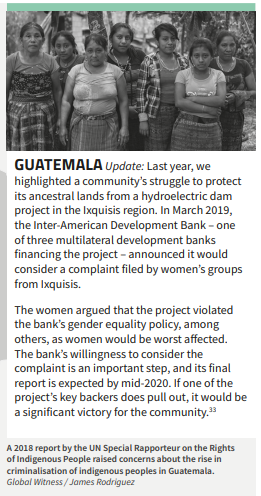
Excerpt from Global Witness report: