Home Blog Page 337

Canadian banks have provided $59.572 billion to fracking companies since the Paris agreement

@QuitRbc projected this image on RBC’s central branch in Montreal on the morning of April 8, the date of the bank’s annual shareholders meeting.

Canadian banks are among the top financiers of fracking.

According to the Banking on Climate Chaos Report 2021 (page 74), Canadian banks have provided $59.572 billion to fracking companies between 2016 and 2020:

Scotiabank ($18.261 billion), RBC ($16.009 billion), TD ($13.827 billion), Bank of Montreal ($8.560 billion) and CIBC (2.915 billion).

That same report highlights (on page 136) that ExxonMobil ranks as the largest current and future producer of fracked oil and gas company in the world:

ExxonMobil has 3,529.97 million (3.5 billion) barrels of oil equivalent in shale reserves currently under production and 18,148.77 million (18.1 billion) barrels of projected shale expansion (projected production to 2050 from wells not yet drilled).

This past week, the Colombian National Hydrocarbons Agency (ANH) confirmed that ExxonMobil had been awarded a contract to frack near the community of Puerto Wilches in the department of Santander.

The company will put $53 million towards their Platero fracking pilot project in this ecologically sensitive Magdalena Medio region of Colombia.

Naomi Klein signed this letter to UN Secretary-General Antonio Guterres calling for a global ban on fracking highlighting that fracking for fossil fuels “torpedoes our global efforts to tackle climate change and violates basic human rights.”

And David Boyd, the UN Special Rapporteur on human rights and he environment, specifically has called on Colombia to prohibit fracking “in light of its obligations under constitutional, international, human rights and environmental law.”

Six members of the Alliance for a Colombia Free of Fracking (Alianza Colombia Libre de Fracking) have death threats against them.

Webinar on April 29

To hear directly from these Colombian environmental defenders (who have all recently received death threats) speak about their opposition to ExxonMobil and fracking, please join us on Thursday April 29 by registering here.

Ivan Madero, Yuli Velasquez, Oscar Sampayo, Yuvelis Natalia Morales

Webinar will provide update on proposed law to ban fracking in Colombia in accordance with the Paris agreement

To hear the latest on the proposed law to ban fracking in Colombia, join this webinar on April 29. Photo by Wesley Tomaselli.

On August 10, 2020, Semana Sostenible reported: “Environmentalists and congressmen came together today to present a bill banning the exploration and exploitation of non-conventional deposits of hydrocarbons in the Colombian territory with fracking, a technique that the national government has been insisting on.”

At the time, the Alliance for a Colombia Free of Fracking said one of the main reasons behind the bill was to fulfill the goals of the Paris Agreement. They referred to Law 1844 that the Congress approved on July 14, 2017 that ratified Colombia’s accession to the Paris Agreement that seeks to limit global warming to 1.5 degrees Celsius.

The proposed bill has the support of 41 members of Congress from eight political parties and several organizations including the Alliance and CRY-GEAM.

This past January, David Boyd, the UN Special Rapporteur on human rights and the environment, expressed his support for the bill at a Congressional public hearing.

Boyd stated: “In light of its obligations under constitutional, international, human rights and environmental law, fossil fuels must be replaced by renewable energies. I respectfully maintain that the government of Colombia must pass a law to prohibit fracking.”

Boyd also reminded Congress that Colombia is party to the Paris Agreement.

Despite this, the National Hydrocarbons Agency (ANH) has awarded two contracts for fracking pilot projects near Puerto Wilches, Santander.

One of those contracts went to ExxonMobil.

Today, The Guardian reported on a new study that suggests that the “lucrative pay and share options have created an incentive for oil company executives to resist climate action.” That article reports that the salary of the CEO of ExxonMobil in 2018 was $18.8 million.

The Guardian has also reported: “The largest five stock market listed oil and gas companies spend nearly $200m (£153m) a year lobbying to delay, control or block policies to tackle climate change, according to a new report.” That article includes a chart showing ExxonMobil spending more than $40 million on this.

It’s not clear what role, if any, ExxonMobil has taken with respect to the law to ban fracking in Colombia. It’s fair to assume though that it does not support the legislation given its $53 million investment in its Platero fracking pilot project.

For an update from Colombian environmental defenders on the bill that would ban fracking, the ExxonMobil fracking pilot project and more, please join our bilingual (in English and Spanish) webinar on Thursday April 29. To register for that, click here.

Webinar panel: Colombian environmental defenders Ivan Madero, Yuli Velasquez, Oscar Sampayo, Yuvelis Natalia Morales, plus Karen Hamilton (Above Ground), Luis van Isschot (Peace Brigades International-Canada).

Land and environmental rights defenders remain in danger as COP26 set to meet virtually from May 31 to June 17

Four environmental human rights defenders have been killed every week since the COP21 summit in December 2015.

The Guardian reports: “On Thursday night, the decision-making body of Cop26 – made up of the UN, the UK and representatives of developing and developed countries – ruled that governments should hold a three-week long virtual meeting from 31 May to 17 June, to begin negotiations and hammer out agreements on key aspects of the talks.”

That article adds: “But countries will still have to wait until they meet in person to rubber stamp any decisions.” That in person meeting of COP26 remains scheduled for November 1-12 in Glasgow, Scotland.

The climate crisis and human rights

Michelle Bachelet, the United Nations High Commissioner for Human Rights, has warned that the climate crisis is greatest ever threat to human rights.

The UN Human Rights Council has further stated: “Environmental human rights defenders must be ensured a safe and enabling environment to undertake their work free from hindrance and insecurity in recognition of their important role in supporting States to fulfil their obligations under the Paris Agreement.”

PBI-Canada in collaboration with other PBI entities continues to follow the situation for human rights defenders in the lead-up to COP26.

We believe that guarantees and protection mechanisms for threatened land and environmental human rights defenders should be incorporated in the text of any climate agreement.

Webinar

To join a webinar on Thursday April 29 at 3:30 pm EDT that will discuss Canada’s involvement in fracking in Colombia, the death threats faced by opponents of fracking in Colombia, and a proposed law to ban fracking in Colombia consistent with its obligations as a signatory of the Paris agreement, please click here.

The webinar features these four Colombian social leaders opposed to fracking. All of them have received death threats for their activism.

Colombian land and environmental rights defenders Ivan Madero, Yuli Velasquez, Oscar Sampayo andYuvelis Natalia Morales.

PBI-Colombia accompanied CSPP and COSPACC launch reports, books and texts in defence of human rights

The Committee in Solidarity with Political Prisoners (CSPP) and the Social Corporation for Community Advice and Training (COSPACC) held a GRAN LANZAMIENTO (big launch) on April 14.

The poster above says: “Do not miss the day of launching reports, books and texts in favor of the defence of human rights in Colombia.”

Among the four points noted on the poster is: “Proposal of policy guidelines for human rights defenders in Casanare.”

The CSPP and COSPACC have produced the report Criminalization of the defence of human rights in Colombia: The judicialization of defenders of land, territory, environment and peace. It documents that 74 per cent of the human rights defenders prosecuted between January 2012 and July 2019 were environmental defenders.

That report highlights the case of the eight social leaders in San Luis de Palenque, Casanare criminalized by Toronto-based Frontera Energy.

Michel Forst explains: “Social protests [took place] between 2016 and 2018 in response to the failure of Canadian public company Frontera Energy to fulfil its obligation to compensate communities affected by environmental damage and to repair damaged roads.”

Frontera then signed two protection agreements on November 16 and 19, 2018 with the Colombian Ministry of Defence totalling US$1.3 million.

Days later, on November 27, 2018, the army and police launched a massive operation and arrested eight social leaders.

It wasn’t until August 10, 2020, that a court revoked the custodial measures imposed on two of these social leaders. Then on September 16, 2020, after more than 500 days having elapsed without a trial, a judge ordered the release of the other leaders.

We continue to closely follow this case.

We were also honoured to have COSPACC lawyer Tatiana Triana speak on our webinar on International Women Human Rights Defenders Day on November 29 last year.

PBI-Colombia has accompanied COSPACC since 2009 and the CSPP since 1998.

Social leaders in Casanare were criminalized for opposing Toronto-based Frontera Energy.

PBI-Colombia accompanied dhColombia welcomes news that “9S” deaths will be investigated by human rights prosecutors

On April 10, El Espectador reported: “Last Friday, April 9, in the midst of the victims’ national day, lawyers representing the fatal and injured victims of the chaos that broke out in Bogota on September 9, 2020, received news that they were waiting for months ago.”

At least thirteen people died and hundreds wounded while protesting in Bogotá and the satellite city of Soacha following the police killing of Javier Ordonez on September 7.

The death of Ordonez evoked memories of the police killing of George Floyd in Minnesota given police pinned him to the ground with their knees as he cried “please, no more” and “I’m choking” in a video widely circulated on social media.

The article continues: “The investigating firm notified the lawyers that the processes were reassigned to prosecutors of the Directorate against Human Rights Violations.”

“In the words of lawyer Germán Romero of dhColombia, one of the organizations representing the victims of that night, ‘the request that a single specialized prosecutor, and hopefully of the human rights directorate, be aware of all investigations into arbitrary executions and attempted murders that occurred on September 9 last year has been made since December.’”

“While it took four months for the answer to arrive, Romero said, ‘we see it important, relevant, because a single prosecutor who has experience in crimes committed by Public Force agents can know in depth the evidentiary details.’”

“Specifically, lawyer Romero added, a human rights prosecutor can ‘do a cross-cutting analysis of what happened that day, in context, and not isolated investigations of prosecutors who did not have the possibility of confluenceing on their peer analyses.’”

The full article in El Espectador can be read here.

On April 9, dhColombia tweeted: “Never forget, the Massacre of September 9, 2020 was a massacre committed by the State at the hands of the Colombian Police.” PBI-Colombia accompanied dhColombia that day (April 9) at a protest in front of the Consulate of the European Union in Bogota that called on the international community to speak out against police violence in Colombia.

PBI-Colombia has been accompanying the Associated Network of Human Rights Defenders (dhColombia) since its founding in 2016.

PBI-Guatemala posts article about court challenge on redacted Canadian documents on the Goldcorp Marlin mine

Communities affected by the Marlin mine demonstrate at the Canadian embassy in Guatemala City. Photo by PAQG.

On April 8, PBI-Guatemala posted on their Facebook page an article about a court challenge in Canada over redacted government documents relating to a Canadian owned mine in Guatemala.

Red Eco reports: “On March 2, the Federal Court heard the case brought by Shin Imai, professor emeritus at Osgoode Hall Law School at York University, v. Canada. Shin Imai contends in his lawsuit that Canadian officials intervened on behalf of Goldcorp by pressuring decision-makers in Guatemala and the Inter-American Commission [IACHR].”

“The IACHR requested in May 2010 the precautionary suspension of the operation of Goldcorp’s Marlín mine, located in Guatemala’s San Marcos department.”

“The IACHR made the decision at the request of 18 local communities and after verifying that the Marlín mine caused damage to the health of the inhabitants, as well as their water sources and the environment.”

“Imai demands that documents be revealed showing that Peter Kent, then Canadian foreign minister, called to speak directly with Guatemala’s president [Álvaro Colom].”

‘In his not being able to do so, he spoke to the vice-president [Rafael Espada] a few hours before Guatemala made the final decision not to take the precautionary suspension measure of the mining project issued by the IACHR.”

“Emails from Canada’s then-ambassador to the OAS [Organization of American States], Allan Culham, addressed to senior Canadian officials at the Ministry of Foreign Affairs, indicate that the representative of Ottawa met with Santiago Canton, then executive secretary of the IACHR, to discuss the Goldcorp case.”

“The documents explaining the content of that meeting between Culham [from Canada] and Canton [from the IACHR] are completely censored.”

“To get out of doubt, Shin Imai and Charis Kamphuis, a professor of law at Thompson Rivers University in Canada, demand that [Global Affairs Canada] disclose the full content of the hidden documents.”

The article concludes: “While the case may take months to resolve, it is ‘of great importance to Latin America’, Imai said because it affects fundamental institutions of the OAS, such as the IACHR.”

To read the full Red Eco article in Spanish, click on: Hasta la CIDH fue presionada por Canadá a favor de proyecto minero.

PBI-Mexico accompanies the Peoples’ Front on a march on the 102nd anniversary of the murder of Emiliano Zapata

On April 10, PBI-Mexico posted: “Today we accompanied the Peoples’ Front in Defence of Land and Water ((FDPTA) watching a mobilization and cultural minutes in memory of Zapata against the megaprojects and in defence of the land and water.”

April 10th was the 102nd anniversary of the assassination of Mexican revolutionary Emiliano Zapata, who was 39 years old when he was killed by soldiers in Ayala, Morelos in 1919.

Zapata’s grandson, Jorge Zapata González, has been an outspoken opponent of the PIM megaproject that the Peoples’ Front opposes.

PBI-Mexico adds: “Protesters demanded Justice for Samir Flores, an indigenous defender and member of the FPDTA killed in 2019 in the context of their fight against the installation and operation of the Morelos Integral Project (PIM) megaproject.”

On February 20, 2019, Flores was shot in his home in Amilcingo, Morelos and died later that day in the hospital. He was 30 years old.

The perpetrator of that crime has not been brought to justice.

PBI-Mexico highlights: “From PBI we call on the Mexican and international authorities to avoid impunity for the murder of Samir, and to ensure the safety of FPDTA and all the people defending land and water.”

Three of the key components of the PIM megaproject are completed: the aqueduct that would take 50 million litres of water a day from the Cuautla River, a 171-kilometre gas pipeline that crosses three states, and the thermoelectric plant in Huexca, Morelos.

PBI-Mexico has accompanied the Peoples’ Front in Defence of Land and Water since 2020.

PBI-Mexico celebrates the continuing strong relationship with ASMAC and the communities they accompany

On April 8, PBI-Mexico posted: “Despite the contingency, at PBI we celebrate the continuation of a strong relationship with the organization Alianza Sierra Madre A.C. (ASMAC) and the defenders and communities that they accompany.”

They add: “PBI has accompanied ASMAC since 2018 due to the risks they face in their legitimate and recognized work in defense of human rights.”

In a feature article about ASMAC director Isela Gonzalez, The Guardian has reported: “A nurse by training, she later switched to anthropology. Some 22 years ago, her research took her for the first time to isolated villages among the pine-oak forests of the Sierra Madre, where she spent time with three tribes – the Rarámuri, Ódami and Tepehuán (who are together jointly named the Tarahumara by outsiders). She was awestruck by their social structure, use of forest medicines and relationship with the land.”

That article also notes: “Gonzalez’s group – Alianza Sierra Madre – initially started out as a biodiversity NGO. But they changed strategy when they realised the frontline of environmental protection was indigenous land.”

And it highlights: “To defend the Tarahumara’s rights, Gonzalez has organised protests, led occupations of government offices, filed lawsuits and compiled dossiers for the national government, the Inter-American Court for Human Rights and the United Nations.”

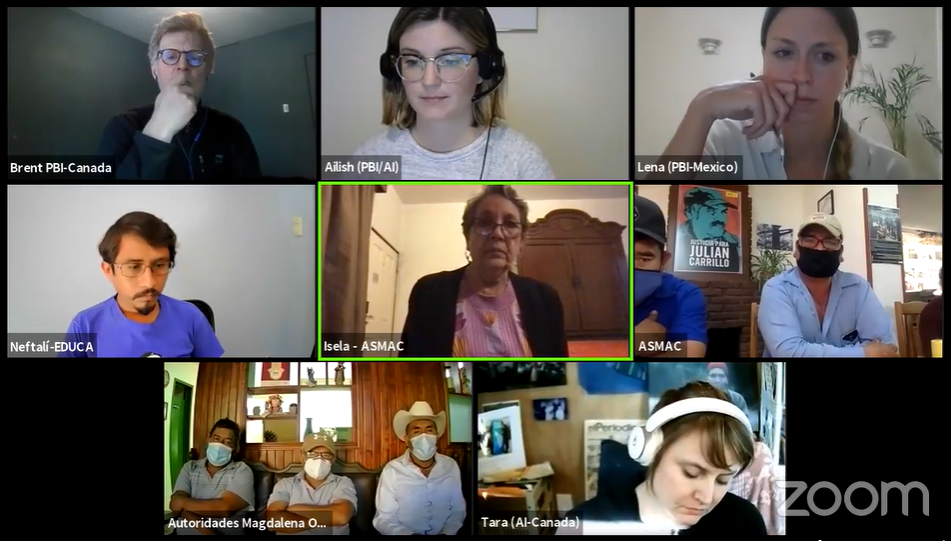
Gonzalez also participates in webinars, including the one on March 11 organized by PBI and Amnesty International Canada.

There she spoke about the assassination of Rarámuri land and territory defender Julian Carrillo, a protector of the community of Coloradas de la Virgen in the Sierra Tarahumara region in the northwestern state of Chihuahua.

The following day, on March 12, a court sentenced one of the two people who killed Julian Carrillo in October 2018 to 48 years in prison.

Gonzalez has commented: “It is a trial that sets a very important precedent, a message of no impunity for the killing of environmental defenders of land and territory, because public prosecutors were sensitive and included the cultural perspective.”

Both ASMAC and the Centre for Women’s Human Rights (CEDEHM) also commented that they hope the judgment will serve as a benchmark for other Indigenous communities facing the same obstacles in their struggle for respect for their ancestral territory.

Their full statement of the “historic ruling” can be read here.

To watch the PBI/AI webinar, click here.

PBI-Honduras observes court hearing for ARCAH environmentalists defending the Choluteca River

On April 14, PBI-Honduras posted: “Yesterday we observed the audience of seven defenders of the Choluteca River belonging to the organization Alternative for Community and Environmental Reclamation of Honduras (ARCAH). The judge issued a formal prosecution order and the oral and public trial will be held at the end of April.”

PBI-Honduras adds: “These seven people were arrested when they were exercising their right to peaceful demonstration. They are accused of forced displacement, a crime included in the New Penal Code. The Human Rights Table demands the Public Ministry and the Judiciary put an end to the misuse of criminal law against human rights defenders.”

ARCAH has explained in this Facebook post: “On March 29, 7 advocates and environmentalist advocates from organized communities in ARCAH were arrested and detained arbitrarily by more than 100 members of the State of Honduras security forces.”

ARCAH adds: “This is for the fight in defense of the Choluteca River against all the pollution caused by the ENTREPRISE AVICOLA EL CORTIJO. From ARCAH we stand before this condemnable act while demanding justice and freedom.”

Defensores en Linea has also reported that ARCAH was “demonstrating against water and air pollution caused by a poultry farm in the southern capital area.”

Their article further notes: “Villagers and advocates consent that the right to health, which is an inalienable right, have denounced for four years the pollution caused by the poultry company ‘El Cortijo’, its waste is seriously damaging at least four surrounding communities and the Choluteca River, where much of the company’s toxic waste falls.”

Last month, Criterion also reported: “The Alternative Community and Environmental Reclamation of Honduras (ARCAH) demanded in a statement that decree PCM-138-2020 that approves a millionaire trust for power generation with the construction of 14 dams, through the establishment of public-private partnerships, does not take effect.”

PBI-Honduras accompanies ASODEBICOQ at organizing meeting with communities in defence of common goods

On April 13, PBI-Honduras posted: “PBI accompanied ASODEBICOQ in its meeting with the communities of the El Listón sector, in the department of Santa Bárbara.”

“People from various communities in the sector met to continue strengthening these common spaces and organizing the communities in their leadership for the defense of the common goods of the region.”

PBI-Honduras adds: “Kevin, president of the Board, highlights the capacity of the communities to organize: ‘There is a light on the road, but it will depend on us. The magic wand is the struggle of the communities, which PBI accompanies.’”

ASODEBICOQ refers to the Association for the Defense of Common Goods of Quimistán (which is a municipality in the department of Santa Bárbara).

Radio Progreso reported that the department of Santa Bárbara is “threatened by more than 15 hydroelectric projects and 23 concessions for mining.”

That same article notes: “In the municipality of Quimistán, there is an imminent danger from the installation of the Santa Lucia hydroelectric dam, which is advanced by 90%. And, despite the fact that there is a strong rejection by the population, they currently intend to build a second hydroelectric dam also on the Cuyagual River.”

ASODEBICOQ is opposed to the construction of the Santa Lucia I and Santa Lucia II dams. It has called on the Government of Honduras to stop construction of the dams because the project violates the Indigenous and Tribal Peoples Convention, 1989, an International Labour Organization Convention, also known as ILO-convention 169.

Kevin from ASODEBICOQ has also commented: “We couldn’t organise demonstrations and occupations before, but since PBI has been supporting us, we have been able to do this. There have been threats but they are less now because they know that foreigners are watching what is happening in the municipality. So, we are safer. PBI is also part of Quimistan. We are like sisters and brothers.”

PBI-Honduras has accompanied ASODEBICOQ since May 2018.