Home Blog Page 294

Secwepemc land defender Kanahus Manuel highlights the need for security for land defenders

In this recent interview, Secwepemc land defender Kanahus Manuel shared with Ojibway artist Isaac Murdoch the need for security for land defenders:

“I really like what Amnesty International and some of those international organizations do by providing security for Native land defenders in South America. They don’t have that here, but we need to be able to provide it for our own land defenders to be able to have security for women and people, Elders who do want to go out and defend land, but they don’t have the security needed to do it because violence comes to us. We’re not asking for it, but it’s coming from the police, it’s coming from the Crown, it’s coming from the corporation, their workers, it’s also coming from just regular civilians that are just white supremacists who want to come with their hate.”

Manuel is a land defender who has mobilized to have Tiny Houses situated on unceded Secwepemc territory in British Columbia to block the construction of the 890,000 barrel per day Trans Mountain tar sands pipeline that would cross 518 kilometres of that territory without free, prior and informed consent.

By asserting Secwepemc territory, Manuel and other land defenders have experienced criminalization, judicialization, threats and harassment.

Most recently, a large swath of forest and blueberry fields was clearcut directly across from the Tiny House Warriors village at Blue River for the construction of the Blue River Camp Community, a man camp for up to 550 men working on the pipeline.

Manuel has tweeted about harassment and intimidation by those involved in the pre-construction phase of the Blue River camp. She has also drawn attention to the fact that one of the company security officers at the Blue River site is a former RCMP police officer.

Accompaniment in Canada

Last year, Peace Brigades International was able to carry out 505 physical accompaniments of defenders in Colombia, Honduras, Guatemala and Mexico, but does not yet have the capacity to provide physical accompaniments for defenders of territories in Canada.

We received inquiries in January 2020 about a possible presence on Wet’suwet’en territories in British Columbia prior to the RCMP raid against land defenders opposed to the TC Energy Coastal GasLink fracked gas pipeline, as well as in May 2020 at the time of settler mob violence against Mi’kmaq lobster fishers who were asserting their Treaty and inherent rights in New Brunswick.

Over the past two years, PBI-Canada has been exploring ways to expand our capacity to do more in Canada, as well as highlighting the similarities faced by land defenders in Latin America and Turtle Island, amplifying Indigenous land defence struggles in this country, and seeing if it might be possible to have people with experience in Latin America provide security trainings for land defenders here.

We will continue to work on this.

To watch the 1-hour conversation between Manuel and Murdoch on the Secwepemc land defence struggle, please click here.

Please note this upcoming event. It is also possible, as mentioned in the conversation linked above, that some of these sessions could be available online.

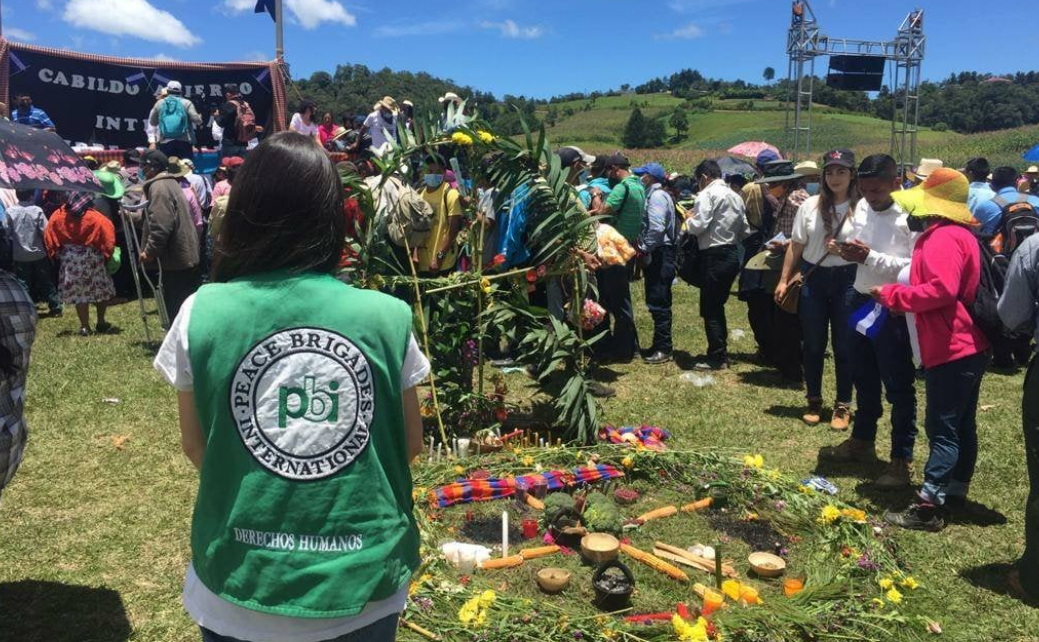
An example of PBI’s physical accompaniment of Indigenous water protectors in Honduras.

Remembering Indigenous land defender Dudley George killed by Ontario police

Indigenous land defender Dudley George was killed on this day in 1995.

George’s family was one of 18 families displaced from the Stony Point First Nation (about 75 kilometres north-west of London, Ontario) in 1942 when the federal government expropriated the land to build a military base. The government had promised to return the land after World War II, but at the time of George’s death, 53 years after that dispossession, the land was still occupied by the military.

George’s family moved back to Stony Point, then known as Camp Ipperwash, in 1993. After decades of writing letters, meetings and signing petitions, 35 land defenders began a reoccupation of Ipperwash Provincial Park on September 4, 1995.

Notably, the park contained burial grounds that the land defenders said were not being respected or protected.

On September 5, Ontario Premier Mike Harris met with several government officials. The provincial Attorney General later testified that Harris shouted: “I want the fucking Indians out of the park.” A recording also emerged of police officers discussing the premier’s view that the government had “tried to pacify and pander to these people far too long.”

The following day George was killed by an Ontario Provincial Police sniper.

The reoccupation of the park continued and by September 9 the provincial police, further escalating the situation, requested assistance from the Canadian Forces, including two Huey helicopters to be placed on standby.

On September 10, the Peace Brigades International-North America Project (PBI-NAP) was invited to “be observers for First Nations people if needed [and] do accompaniment for anyone fearing further violence on the part of the police.”

By the following year, PBI-NAP had made at least four visits to the area.

Camp Ipperwash is now closed, but the federal government still “owns” the land. The Department of National Defence says it will take 25 years to clear the unexploded grenades and artillery shells and to decontaminate the land.

An Ontario Provincial Police officer bearing a weapon rushes toward Tina George, who was carrying one of her daughters, at Ipperwash Provincial Park a day after her cousin, Dudley George, was shot to death by an OPP officer on September 6, 1995. Photo from Toronto Star/Ipperwash Inquiry.

Grand Council Chief Reg Niganobe’s statement on the 26th anniversary of the shooting death of unarmed land defender Dudley George.

PBI-Honduras accompanies meetings that reject ZEDEs, while Canadian investor pursues the Mariposa ZEDE

The Peace Brigades International-Honduras Project has been accompanying mobilizations and town hall meetings since this past June that are rejecting Economic Development and Employment Zones (ZEDEs).

La Tribuna notes that Article 2 of the ZEDE Law establishes different types of modalities including special agro-industrial zones, autonomous cities, renewable energy districts (for wind or solar parks), and special mining zones (such as Guapinol).

The Orquidea ZEDE, a special agro-industrial zone, is currently being built by the Agro Alpha company to grow chili peppers and tomatoes for export to the United States. It started with 34 hectares of land and will increase to 158 hectares in the next four years. It is expected to begin exports to the U.S. in October.

The Ciudad Morazán ZEDE in Choloma and the Próspera ZEDE off the northern Caribbean coast of Honduras would be considered autonomous cities.

The Associated Press reports: “Promotions for Próspera [on the island of Roatan] depict futuristic apartments overlooking the sea and promise a place with ‘key checks on governmental power, a bill of rights protecting people of all income levels and a straightforward structure for doing business.’”

AP explains: “The zones are exempt from import and export taxes and can set up their own internal forms of government, as well as courts, security forces, schools and even social security systems. They administer their own sea and airports, if any, as well.”

The Canadian ZEDE

PBI-Honduras has noted that beyond Ciudad Morazán, Orquídea and Próspera: “There are further ZEDEs for which, as Honduran civil society has noted, ‘there is no information whatsoever’, such as the Mariposa ZEDE.”

That ZEDE is being led by Canadian Daniel Morin and his wife Katerina.

Katerina has written: “In 2012 we learned that Honduras passed new legislation enabling their Special Economic Zone (SEZ) program that later became known as Economic Zones of Employment and Development or ZEDEs.”

She adds: “We sold everything we had in Canada, bought a truck and a trailer, and drove all the way from Montreal to Guatemala to be closer to the action.”

Now, the website for Mariposa says: “We believe this project is possible to realize in Honduras as part of the Honduran ZEDE Program. This page has been created to attract future residents, investors, and team members while we are still working on our master plan to be presented to the Honduran Government in the near future.”

Their vision is “to create a startup city” that would “become a Health Sanctuary with clinics that use a combination of Holistic, Naturopathic, Functional, and Integrative Medical approaches” and that would “create an Ecstatic Birth culture by providing educational opportunities for future parents and birth practitioners.”

A “Little Canada” ZEDE in Trujillo?

In October 2015, Canadian activist Karen Spring wrote: “In the Trujillo region, Garifuna communities are being evicted from their ancestral lands amid the possible construction of an Economic Development and Employment Zone (ZEDE) or Model City.”

In that article, she highlighted that: “[Canadian investor Randy] Jorgensen’s investments are seen as the seed of a future ZEDE or parts of what could grow into a free trade, special development zone in the region.”

Canadian journalist Sandra Cuffe also reported in December 2014 on this development and her article quotes Jorgensen who says: “We sold 500 properties to Canadians. They’re starting to call it Little Canada.”

On July 3, PBI-Honduras observed the open town hall in the central square of the city of Trujillo where the municipality was declared free of ZEDEs.

PBI accompaniment

As PBI-Honduras continues to accompany the town hall meetings that are rejecting ZEDEs, PBI-Canada will also continue to research what we can find out about Canadian investments and interests in these ZEDEs.

The FPDTA-MPT to take part in the Zapatista ‘Journey for Life’ advocacy tour in Europe

Liliana Velázquez and Samantha Cesar.

Liliana Velázquez and Samantha César of the Peoples Front in Defence of Land and Water from Morelos, Puebla and Tlaxcala (FPDTA-MPT) are taking part in the “Journey for Life” tour of the Zapatista Liberation Army (EZLN) through Europe.

Rosa Luxemburg Stiftung’s regional office in Mexico City recently spoke with them.

While their full conversation can be read here in German, below are a few key excerpts in English from that interview.

Velázquez and César noted:

“This trip through Europe will strengthen the FPDTA-MPT and the EZLN as well as all those who want to defend the life damaged by extractivist policies. It is a policy of death aimed at destroying the lungs of the world. As we know, the most important forests are located on indigenous territories. Hence the offensive against indigenous people.”

“The AMLO government has not brought any changes to our struggle. It presents itself as left-wing but acts like a centre-right government: the neoliberal and extractivist economic model remains, the free trade agreements confirm this. The government has entered into agreements with companies – especially from Canada, China and Spain – that are literally devastating our country with government permission.”

“Women have a distinct, leading role in the defense of the territory. We are the ones who protect life on many levels. We are determined to defend life. Nature, indigenous communities and women have experienced much violence in the capitalist model. That is why both the indigenous movement and the women’s movement have developed such a force.”

“Among the demands that are unfulfilled and that we want to make visible are justice in the case of the murder of Samir Flores. This includes the investigation of the murder and the arrest of the perpetrators who were involved as backers or performers. Likewise, the criminalization of activists who oppose the megaproject must stop.”

“We also demand the complete stop of the Integral Project Morelos [PIM]. This megaproject is directly harming 60 communities. The project disregarded the normative systems of Indigenous communities. The damage caused by the construction progress of the PIM must be repaired.”

The full article can be read in German at «Von verschiedenen Territorien aus erheben die Frauen ihre Fäuste».

The Peace Brigades International-Mexico Project has accompanied the Peoples Front in Defence of Land and Water (FPDTA-MPT) since 2020.

PBI-Colombia accompanies Justice and Peace Commission observation mission in San Juan, Chocó

On September 3, PBI-Colombia posted: “Today we accompany the Justice and Peace Commission on the coast of San Juan, Chocó, in a mission to observe and verify the conditions of Indigenous and Afro-descendant communities in a situation of displacement due to territorial disputes between armed actors in the zone.”

Colombia Informa has explained: “Since 2018, the collective territory of Afro communities and indigenous reservations in the middle of San Juan has been illegally militarized. This is a serious violation of human rights and of Law 70 of 1993, which recognizes the collective ownership of the land of Afro-Colombian communities.”

Most recently, the Colombian Pacific Human Rights Network (REDDHHPAC) has complained that the Gaitanista Self-Defense Forces of Colombia (AGC) arrived in the area on August 13-15 and that there has been fighting with the National Liberation Army (ELN).

Telesur also reports that REDDHHPAC have stated that National Army troops have also entered the area and falsely identified themselves as either dissidents of the Revolutionary Armed Forces of Colombia-People’s Army (FARC-EP), the AGC or the ELN.

The communities of the San Juan River have made a public appeal to the international community to contribute to the verification and protection of the civilian population.

On August 26, Contagio Radio reported that the Justice and Peace Commission has denounced that since the arrival of the AGC there have been massive displacements of Indigenous Wounaan communities.

That article adds: “Despite the strong humanitarian crisis and the various appeals to the State, no emergency humanitarian assistance has been provided, even with the visit of the Ombudsman’s Office. On the other hand, the military response has consisted of warning Indigenous communities to refrain from transiting by land or water due to the threat of the AGC without there being evidence of actions by the Public Force to combat this paramilitary structure.”

And it notes concerns about complicity between the National Army and the AGC under the pretext of confronting the ELN guerillas.

Furthermore: “[The Justice and Peace Commission] emphasizes that in the region there is also a permanent presence of the National Navy without so far developing actions to protect the lives of Indigenous and Black communities and without there being actions to combat the paramilitary structures that control the territory in full view of all.”

The Justice and Peace Commission has tweeted: “Murder, threats and displacement without a response from the State” as well as highlighting in this recent statement : “The human rights crisis and humanitarian crisis continue without a state response to the Black and Indigenous communities of this region.”

PBI founder Daniel N. Clark: “We are like the street arm of Amnesty International”

The founding statement of Peace Brigades International was released on September 4, 1981. Eleven people wrote that statement, including Daniel N. Clark. He was at the first meeting that began on August 31 that year on Grindstone Island, Ontario that discussed our purpose, structure, key principles, and name.

PBI-Canada executive director Brent Patterson recently met with Daniel, and we share excerpts from their talk as part of the recognition of PBI’s 40th anniversary.

The discussion began with a reflection on our founding statement that highlights: “We are forming an organization with the capability to mobilize and provide trained units of volunteers. If hostile clashes occur, a brigade may establish and monitor a cease-fire, offer mediatory services, or carry on works of reconstruction and reconciliation.”

Daniel notes this original vision soon evolved into protective accompaniment: “It was out of our work in Central America where we were interposing our bodies between potential assassins and kidnappers and government forces and people without guns in their hands just trying to speak their mind and make their request about information about disappeared family members and economic justice. It became very clear we could provide a service by interposing ourselves as internationals who had some spotlights and credibility between these out-of-control armies to protect people.”

In terms of PBI’s continuing core principles of non-hierarchical, consensus-based decision-making, Daniel recalls: “That definitely has its roots in Quakerism that had also made its way into the general peace movement in the 1960s and 1970s.”

On PBI’s principle of non-partisanship, Daniel says: “If it’s only about who has the most guns, or the most people to bear them, none of us are safe, but if we can stand up for truth and justice, while not cutting the humanity of the opponent, we could be of greater use as the world tries to resolve its conflicts.”

He also highlights: “At the same time, we are agents for justice. We place our folks in situations where we are animating and strengthening popular movements. PBI does work to balance power and to animate popular movements because that’s where the need is and that’s where we put our volunteers.”

Daniel further comments: “We are partisans for justice. In a way we are like the street arm of Amnesty International. They don’t do onsite actions; they investigate and publicize. We are trying to make a system that is just.”

Daniel also spoke about PBI’s early decision not to criticize armed resistance movements.

He says: “There are many ways up the mountain. Even Gandhi said to the consternation of many that if the only way to achieve liberty and justice were armed, he would use violence. But he said that isn’t the only way. We weren’t going to go in and tell people suffering under oppressive situations that they were wrong, rather we wanted to animate and enable people who didn’t want to use violence or couldn’t use violence. The different approaches of violence and non-violence don’t mix well, but it was a reality.”

Forty years after the founding meeting, Daniel says: “I’m very impressed where PBI has gone over the years. PBI is quite amazing to me thinking about our original time when $5,000 was a lot and back when we didn’t even have internet or email. I’m very pleased and a little bit proud where this has all gone.”

And looking ahead to the coming years, he notes: “I would like us to see us move from adopting treaties on human rights and the environment to enforcing them. The US has clearly violated the Nuremberg principles when it dropped nuclear bombs on non-combatants. I would like to see if there is capacity for PBI to have a presence when there are governmental leaders violating international law. That is a potential broadening area.”

For more on 40 years of PBI solidarity, please see our Anniversary Timeline.

And to watch a 55-minute video of Daniel speaking in 2001 about the founding of Peace Brigades International and our core principles, please click here.

PBI-Colombia welcomes IACHR decision on precautionary measures for journalists Alberto Tejada and Jhonatan Buitrago

On June 16, José Alberto Tejada (first on the left), Danilo Rueda from the Justice and Peace Commission (third from the left) and Javier Garate (in the middle with the green PBI vest) met with Embassy officials from several countries to discuss attacks on press freedom in Cali during the national strike.

On August 31, Contagio Radio reported: “The Inter-American Commission on Human Rights [IACHR] has responded to the request of the N21 Legal Team and the Justice and Peace Commission, to protect the lives of Alberto Tejada and Jhonatan Buitrago of Channel 2 of Cali, given the seriousness of the threats and harassment against them for the journalistic work they carry out and have fulfilled in the framework of the National Strike.”

That article adds: “In the IACHR communication, they resolve that the Colombian State must guarantee the protection of the lives of Channel 2 journalists, in addition to taking the necessary measures so that they can continue to develop their journalistic work without being subjected to threats and harassment by agents of the State or third parties, in addition to the protection measures must be agreed with the victims to ensure that they are suitable and correspond to the needs of Tejada and Buitrago.”

The media statement from the IACHR and Resolution 69/2021 can be read in full here.

Context from Amnesty International

In this report issued on August 26, Amnesty International highlighted: “Since the beginning of the national strike, Tejada has denounced the irregular and improper actions committed by the public forces against those who demonstrate peacefully in the city of Cali, epicentre of the national strike.”

It further notes: “On 9 July, Tejada requested precautionary measures to the Inter-American Commission on Human Rights (IACHR) and protection measures from the National Protection Unit (UNP) for him, his team, and the premises Channel 2. On 23 August, the UNP partially responded to the request. Nevertheless, the scheme proposed does not meet the security needs of Jose Alberto, his family, and his team.”

The IACHR decision announced on August 31 requests that the Government of Colombia inform the IACHR within 15 days of this decision of the adoption of the precautionary measures agreed upon and to update this information periodically.

PBI accompaniment

On August 23, PBI-Colombia accompanied a meeting between Tejada and the IACHR Special Rapporteur for Freedom of Expression. And on June 16, PBI-Colombia accompanied meetings Tejada had with the Canadian, European Union, Norwegian and UK embassies.

PBI-Colombia has accompanied the Justice and Peace Commission, one of the two organizations that brought the request to the IACHR for precautionary measures for Tejada and Buitrago, since 1994.

PBI-Canada welcomes the IACHR decision and looks forward to the full implementation of the precautionary measures requested.

Tsleil-Waututh water protector Kayah George says TMX a “genocide against my people”

Photo: Kayah George speaks with APTN News on August 30 about the Trans Mountain tar sands pipeline and insurance companies.

Tulalip and Tsleil-Waututh water protector Kayah George ‘Halth-Leah’ writes:

“My people are descended from the sea. That is the meaning of our name: Tsleil-Waututh, “people of the inlet.”

Our creation story tells us that we were created from the sediment in the Burrard Inlet in Vancouver, Canada. The inlet is our grandmother, our oldest relative. The lands along this inlet have been my peoples’ home since time immemorial.

At 22 years old, I have spent over half my life fighting alongside my family, for our home and for all of your homes and this land that is slowly eroding along with the climate. The Trans Mountain pipeline has threatened our land and our livelihoods since it was built in 1953, with 84 reported oil spills to date.

Instead of listening to our cries on this stolen land, the federal government has used public dollars to buy the project and approved an expansion pipeline (TMX) which would triple the flow of oil.

Those who back the pipeline do not see the sea as a living being. But we do, and we fear for the endangered orcas, the fish, the sea itself.

This pipeline is nothing short of genocide against my people. That is why every single member of the nation has opposed Trans Mountain since the beginning. We stand in solidarity on both sides of the border: my mother’s tribe, Tulalip, in the United States, and my father’s, the Tsleil-Waututh, in Canada.”

Her full commentary in the Toronto Star, significantly her call to insurance companies not to provide insurance for the pipeline, can be read at Canada’s Trans Mountain Pipeline is ‘genocide against my people.’ Why it’s ‘climate suicide’ for insurance companies (August 27).

On September 2, Indigenous Climate Action highlighted: “Indigenous, environmental, and climate groups sent an open letter to twenty insurance companies that have failed to rule out insuring the Trans Mountain pipeline network, following the August 31 expiration date of one of Trans Mountain’s key insurance policies.”

They add: “The letter is being sent to insurance companies that have previously been linked to the pipeline project and have not yet ruled out involvement: AIG, Chubb, Energy Insurance Limited, Liberty Mutual, Lloyd’s of London, Markel, Starr, Stewart Specialty Risk Underwriting, and W.R. Berkley. It is also being sent to Lloyd’s syndicates that are likely involved in the project through the Lloyd’s marketplace: Apollo, Arch, Ark, Beazley, Brit, Canopius, CNA Hardy, Hiscox, Inigo, MS Amlin, and Navigators.”

To read their Open Letter, please click here.

PBI-Honduras accompanies town hall meeting in Intibucá that rejects ZEDEs

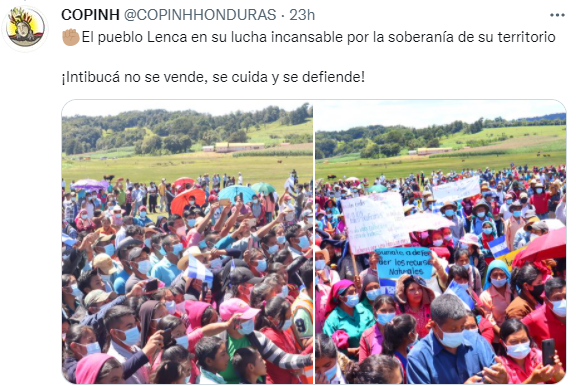
On September 2, the Peace Brigades International-Honduras Project posted: “PBI accompanies town hall meeting where the municipality of Intibucá said no to ZEDEs. In this way, it becomes the first municipality in the department to declare its territory free from the Special Development and Employment Zones.”

COPINH on ZEDEs

Criterio.hn also reports: “The Civic Council of Popular and Indigenous Organizations in Honduras (COPINH) celebrated the citizen action that involved the struggle of the Lenca people in Azacualpa, Intibucá, and through which it became the first municipality in the department to declare its territory free of ZEDE.”

That article adds: “The coordinator of COPINH, Bertha Zúniga Cáceres expressed through this social network that ‘Today we won dignity and sovereignty!’ by giving a ‘resounding no to the PROJECT of the ZEDE’.”

The PBI-Honduras post also quotes COPINH saying: “We believe in our land, we believe in our cultivation, we believe in our indigenous people! Always up in the fight in search of the liberation of the ancestral territories as our companera Berta Cáceres taught us.”

More about ZEDEs

In their September newsletter, PBI-Honduras explains:

“The implementation of Zones of Employment and Economic Development (Zonas de Empleo y Desarrollo Económico – ZEDEs), an idea that emerged in force in the context of the 2009 Coup d’État, is currently being defended by the Honduran Government as a form of economic development and a centre for the creation of numerous jobs. Civil society organisations warn, however, that the establishment of ZEDEs could lead to serious human rights impacts.

The main impact these groups fear is the cession of national sovereignty, creating a favourable environment for corruption. The National Centre of Field Workers (Central Nacional de Trabajadores del Campo – CNTC) warns that the ZEDEs plan entails the privatisation and sale of national territory and common and natural goods to foreign capital, which will hold complete autonomy in the administration of public services and the criminal justice system. They also refer to their social impacts (such as forced displacement and increased conflict), environmental impacts (such as deforestation and pollution), and economic impacts (such as increased poverty and the loss of livelihoods).

‘Honduras will not be Zede-d’ has been the main response of Honduran society in the face of the implementation of ZEDEs in different areas throughout the country. Civil society describes the initiative as part of a continuum of extractivist policies that have led to the plunder of the country in past decades, including mining and banana enclaves.

PBI has been observing and accompanying actions in opposition to this initiative, which have been led by the National Movement Against ZEDEs and for Sovereignty, including protests, marches, consultations and town hall meetings. By 6 June, over 180 municipalities declared themselves free of ZEDEs. This number has continued to grow. Although these actions have been held throughout the country, the majority of such declarations were made in the north of the country, in the Atlantic coast corridor.

The banding together of civil society organisations and their discontent in the face of the ZEDEs could become a mobilising element in the November elections.”

For more from PBI-Honduras on this, please see “Honduras will not be Zede-d”.

France 24 also reports on this in their article Hondureños protestan contra “ciudades soberanas”, zonas extraterritoriales de inversion.

#HondurasNoSeZEDE

PBI in Jalapa, Nicaragua in 1983 as “tracer bullets lit up the sky”

Peace Brigades International (PBI) was formed 40 years ago this week (August 31-September 4, 1981) on Grindstone Island just south of Ottawa.

PBI’s first on-the-ground work was in September 1983 in Jalapa, Nicaragua close to the Honduran border where US-backed Contra forces were launching attacks.

JoLeigh Commandant, who became the first director of PBI’s Toronto-based Central America Project around November 1982, was part of our presence there.

A November 1983 Santa Cruz Friends Bulletin includes a story told by Mary Duffield of PBI’s presence in Nicaragua.

Mary wrote:

“As one of four Friends involved in a two-week nonviolent vigil for peace along the Nicaraguan-Honduran border, I truly believe we are nourishing a seed of enormous potential in this Peace Brigades International idea.

The vigils culminated usually in celebrations of song and laughter, the youngsters especially delighting in the Spanish version of ‘Old MacDonald had a Farm’, (as tracer bullets lit up the sky and automatic rifles sounded off in the distance).

The day before we left Jalapa, we attended the funeral of one of the young men killed by mercenaries blowing up a customs station. After the church ceremony (the revolution has not opposed the churches, and many religious officials are in total support of the Sandinistas), Antonio’s army companeros bore the coffin along.

The company commander also was the dead boy’s grandfather. He had lost his son only a little while before. The grandfather ordered the man’s youngsters and related children to scrape the first dirt down over the coffin. The sobbing little ones could not do this.

So, the old man entreated them tearfully: ‘You must … we’re doing this for you, we’re doing this for the children…’

The villagers began to sing their hymns, and we joined in. Then JoLeigh Commandant, impulsively, moved to the woman calling to Antonio to stay, put her arms around her, saying: ‘Yes, we are all doing this for the children. That is why we must have peace, for all the world’s children.’

The old man and the woman turned toward JoLeigh and nodded, with a new awareness in their eyes, and somehow we were all uplifted for a moment of shared hope. We all clasped hands in that sacred awareness.

The morning we left Managua for home we heard the radio broadcasters: ‘This is the morning the Peace Brigadiers are leaving. These are the people who came all the way here to show us that many North Americans care about the people of Central America.’“

For more on our history, please see this Anniversary Timeline.

Photos: JoLeigh at a United Nations Conference on Discrimination Against Indigenous Populations in the Americas in Geneva in September 1977. And JoLeigh in a photo posted on Facebook at the time of her passing in 2013 at 90 years of age.