Home Blog Page 290

COP26 must address gender-based violence against Indigenous women land defenders

Photo: Secwepemc land defender Mayuk Manuel assaulted by Trans Mountain pipeline worker, September 15, 2021. The Canadian government-owned pipeline is being built on Secwepemc territory without their free, prior and informed consent.

On September 25, The Guardian reported: “Women must be enabled to play a greater role at the Cop26 summit, as the needs of women and girls are being overlooked amid the global climate crisis, a coalition of feminist groups has said.”

That article adds: “More than 120 groups have signed the call, to be presented at a six-day online forum starting on Saturday, which includes demands to promote women’s leadership and equity, protect the rights of indigenous peoples, improve food security, recognise a human right to water, and to protect forests, oceans and other ecosystems.”

The Call to Action for the Global Women’s Assembly for Climate Justice (September 25-30) highlights: “We must transition from an extractivist, colonial paradigm of exploit, extract and decimate to a sustainable, globally-conscious one of respect, restore and replenish.”

The Guardian article on this Assembly further notes: “Studies have also found the climate crisis exacerbates gender-based violence against women.”

Last year, this study by International Union for the Conservation of Nature (IUCN) devoted a chapter (pages 162-180) to the issue of gender-based violence against women environmental human rights defenders (WEHRDs).

The study notes: “Indigenous communities are often on the frontlines of defending their territories, resources and rights from extractive projects and corporate interests. Across the globe, many indigenous women join this fight, facing intersecting and reinforcing forms of gender-based and other violence, due to a long history of discrimination associated with racism, socio-economic and political marginalisation.”

It then cautions: “When women and other EHRDs remain silenced, transnational corporations’ control over resources and governments’ backing of their interests permeates society and reinforces impunity.”

The study concludes: “Eliminating GBV and discrimination against WEHRDs and strengthening their voice in defence of the environmental is critical for achieving an equitable society that allows for resources and benefits to be shared and sustained among all.”

During the United Nations COP26 summit, that takes place from October 31 to November 12 in Glasgow, Scotland, there will reportedly be a day focused on gender issues, including a discussion of a gender action plan.

Peace Brigades International-Canada affirms that discussion should include strategies to end violence against women environmental human rights defenders, notably Indigenous women land and environmental rights defenders.

Tweet by Secwepemc land defender Mayuk Manuel:

Tweet by Secwepemc land defender Kanahus Manuel:

A Call to Action from the Global Women’s Assembly for Climate Justice.

COP26 should recognize that environmental defenders are crucial to solving the climate crisis

Photo: Peace Brigades International accompanied environmental defenders Sandra Calel (Guatemala), Juan Carlos Flores Solis (Mexico), Andrea Regina Pineda (Honduras) and Ivan Madero Vergel (Colombia).

At the United Nations COP21 climate summit in Paris in December 2015, the world committed to pursuing ways to limit the global temperature increase to 1.5 degrees Celsius above pre-industrial revolution levels.

That year, the global increase had reached 1°C for the first time.

Significantly, the Nationally Determined Contributions (NDCs), the term for carbon emission reductions promised by countries, made at COP21 would likely result in a 3.2°C temperature increase over pre-industrial levels by 2100.

As of this September, following the latest round of NDC submissions, the UN says the world is on the pathway to a 2.7°C increase by the end of the century.

A key objective of the upcoming COP26 summit starting on October 31 is to ramp up ambition on those NDCs to limit the temperature increase to 1.5°C.

In terms of narrowing this ambition gap, Climate Action Tracker noted this month that the NDCs submitted by Canada, Colombia, Mexico and Indonesia are “highly insufficient” and that those submitted by the European Union, Germany, Switzerland and the United States are slightly better but still “insufficient”.

Global Witness has noted: “Land and environmental defenders play a vital role in protecting climate-critical forests and ecosystems. When they take a stand against the theft of their land, or the destruction of forests, they are increasingly being killed.”

It has also highlighted that on average four land and environmental defenders have been killed every week since the Paris Climate agreement in December 2015.

Earlier this month, its ‘Last Line of Defence’ report found that 227 land and environmental defenders had been killed in 2020 for peacefully standing against the destruction of nature. 125 of them, slightly more than half the global total, were killed in Colombia (65), Mexico (30), Honduras (17) and Guatemala (13).

That report warns: “The violence against land and environmental defenders and the climate crisis are intimately connected, and we will not solve one without the other.”

Cognizant of this longstanding issue, the UN Human Rights Council passed this resolution in 2019 that says defenders “must be ensured a safe and enabling environment to undertake their work free from hindrance and insecurity, in recognition of their important role in supporting States to fulfil their obligations under the Paris Agreement.”

Most recently, at the opening of the 48th session of the Human Rights Council on September 13, the UN High Commissioner for Human Rights Michele Bachelet said that in many regions environmental human rights defenders were threatened, harassed and killed often with complete impunity and that her office would push for more ambitious, rights-based commitments at the COP26 summit.

Peace Brigades International-Canada is calling on Prime Minister Justin Trudeau to acknowledge the dangers faced by land and environmental defenders, both around the world and on Indigenous territories in Canada, and to advocate that their critical role be reflected in the statements and commitments made at the COP26 summit.

PBI-Colombia shares article on the Nydia Érika Bautista Foundation for Human Rights

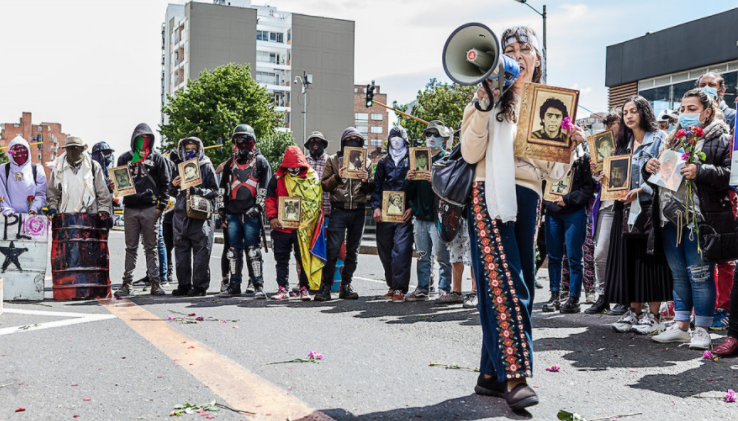
Photo: “Yanette Bautista cries out for justice in front of the JEP accompanied by frontline members.” Source: J. Marcos / Mª Ángeles Fernández.

On September 22, CTXT published this feature length article in Spanish: Las víctimas que Colombia no quiere.

Key excepts from the article include:

In Colombia, the number of missing persons has numbered in the thousands since the late 70s.

The National Center for Historical Memory speaks of 80,472 victims, of which almost 59,000 are still missing, 8,100 have been found dead and more than 11,000 the whereabouts are not known but there is information.

The Nydia Érika Bautista Foundation for Human Rights counts more than 120,000 people.

Nydia Érika Bautista disappeared on August 29, 34 years ago.

The morning [of August 29, 2021] is cold in Bogotá, even the rain appears momentarily in the symbolic act of planting plants. The new flowery corner is called ‘Garden of Memory’ and is located on the Park Way.

“Let’s take the opportunity to think about them and them. Let’s remember, let’s honor them,” asks one of the members of the Nydia Érika Bautista Foundation, the collective that convenes the day.

Nydia’s sister, Yanette Bautista, and her niece Andrea Torres, who saw their aunt being taken away, run an organization that was born in exile.

The family had to leave in the face of threats and today, again in Colombia, they fight for the search for people, for truth, for reparation, for non-repetition, for justice and peace.

“We have walked these 34 years demanding justice and we have not achieved it, but we are moving forward. Colombia has not yet reached the truth of what happened during the armed conflict, nor justice or non-repetition.”

Micro in hand, Yanette Bautista, a wiry, serious woman, with a beautiful and long brunette braid half discarded, speaks with a strength that her body disguises.

“Let them be returned to us alive!” she cries; “Because they took them alive!” reply the forty people participating in the symbolic act of sowing. “Missing!” she continues. “Present, present, present!” they follow. “Until when?” she insists. “See you always!” they close.

Yanette Bautista was also there because the foundation she presides over was one of the conveners.

Although her body was lost among those who protested, when she picked up a loudspeaker, she stood as a true leader: “We demand that the JEP [Special Jurisdiction for Peace] open a macro-case of forced disappearance. We don’t want to be discriminated against anymore, we don’t want justice to be inequitable. We are here to demand that the JEP listen to us. Enforced disappearances are crimes against humanity and we claim our right to know the truth and to full reparation.”

“We are here with the young people of the front line of the Resistance Portal who are accompanying us in our demands. And we are with them because they are leaders of social protest, they are leaders of the popular movement and they have the right to a good name and to have their demands heard,” Yanette Bautista shouted again with force, surrounded by a score of young people locked in front of number 63-44 of Carrera 7 in Bogotá.

Dressed entirely in black, barely a millimeter of skin in the air, a member of the front lines read a poem dedicated to Nydia Érika Bautista.

“They plucked you from the earth mercilessly, under the complicit shadow (…) leaving in the mud a future snatched (…) The hatred continued in the dispossession of a generation of dreamers. In you, Nydia, the memory of building a new world is reborn.”

We encourage you to read the full article at Las víctimas que Colombia no quiere.

The Peace Brigades International-Colombia Project has accompanied the “Nydia Erika Bautista” Foundation occasionally since 2007 and fully since 2016.

PBI supports recommendation of moratorium on extractive projects that affect territories of Indigenous peoples

On September 22, Peace Brigades International presented at the 48th session of the United Nations Human Rights Council in Geneva.

PBI’s Kim-Mai Stéphanie Vu stated:

“We welcome the reports of the Special Rapporteur on Indigenous Peoples and the Working Group on Arbitrary Detention. We support the recommendations aimed at the approval of moratoriums on extractive projects that affect the territories of indigenous peoples during the recovery phase of COVID-19.

Coinciding with what is reported in its reports, PBI has observed a growing increase in the use of criminalization and preventive detention to hinder and discourage the defense of human rights, particularly affecting indigenous defenders.

It is the case of Víctor Vásquez Lenca indigenous defender of MILPAH, Honduras in preventive prison accused of crime of “forced displacement”, and of the Choreachi community, Mexico, which demands the ownership of their lands of 32,500 hectares before the Superior Agrarian Court since 1994 and that was stigmatized, criminalized and forcibly displaced in this process. In addition, we regret the murder of at least 9 indigenous people from the North Caribbean Coast, Nicaragua in August 2021.

Likewise, the 1614 cases of arrests of defenders, students, journalists and political opponents in Nicaragua between April 2018 and December 2020 according to IACHR report, and 37 from May 2021 to date, in the context of the human rights crisis.

In the same way, we regret the 2,854 arbitrary detentions registered in Colombia between August 2018 and September 2021 in the framework of social protests. They are also concerned about multiple complaints of runaway detentions in alleged forced disappearances that occurred in the last months during the “national strike”.

Likewise, the silence is worrisome as the response of some governments such as that of Honduras to the Opinions of the UN Working Group on Arbitrary Detention. Given the recent extension of the preventive detention of the defenders of the Guapinol River, it is urgent that the government of Honduras adopt the measures recommended by the Working Group on Arbitrary Detention in its Opinion about the case.”

For a video of this presentation (in Spanish), please click here. To watch the presentation (with English translation), go to the 30:40 mark of the video here.

PBI-Honduras accompanies Arcoiris at LGBTQI+ rights march in San Pedro Sula

On September 22, PBI-Honduras posted: “This past weekend we were in San Pedro Sula [the country’s second largest city after Tegucigalpa] accompanying Arcoíris, the LGTB Association of Honduras and other LGTBI groups in the country in demanding recognition of the Gender Identity Act and the Equality and Equity Act.”

Equality and Equity

The Honduran Constitution expressly bans same-sex marriage and refuses to recognize them even if they have been legally sanctioned in other countries, including in Canada where it has been legal since July 2005. Honduras also bans adoption by same-sex couples.

Gender Identity Act

In Honduras it is not possible to change your name and it’s “forbidden by law to make any modification of the sex assigned in the original birth certificate.” This past July, the Inter-American Court on Human Rights (IACHR) ruled that the Honduran State must allow people to alter their gender identity on identification documents and public records.

The Peace Brigades International-Honduras Project has accompanied Arcoíris, the LGTB Association of Honduras since July 2015.

This week a new Parliament is elected

This week, the federal election concluded in Canada. Next up, the House of Commons is scheduled to resume sitting on October 18.

We will be working to identify the new and returning Members of Parliament we can work with to advance protection strategies for the human rights defenders who Peace Brigades International accompanies in Latin America.

We will be sharing with them the recommendations from the recent International Observation Mission to Colombia, as well these measures recently proposed by U.S. Representative Alexandria Ocasio-Cortez relating to Colombia.

You can help amplify the call for this progressive human rights-focused agenda by retweeting our post on AOC’s proposals.

Top posts this week:

In Canada:

Upcoming:

  • We are planning a webinar for October 30 with PBI field volunteers who will share what it’s like to be a brigadista. Stay tuned for the confirmation of the date and the information on how to register for this Zoom webinar.
  • We are also planning a webinar for November 6 with environmental defenders we accompany speaking about the United Nations COP26 climate summit that will be happening at that time in Glasgow, Scotland.

You can also find daily social media updates about PBI accompaniments on Twitter and Facebook. Be sure to follow and like us.

To support our work, please consider making an online donation here.

In solidarity, Brent at PBI-Canada

PBI-Mexico supports joint statement opposing the harassment of journalists and migrant rights defenders in Chiapas

Photo: Migrants march in Tapachula, Chiapas. Photo by Claudio Cruz/ AFP.

There are presently thousands of migrants that have been stopped in Tapachula, Chiapas near the Mexican border with Guatemala.

Reuters reports: “Many of the Central and Latin American migrants, including a large Haitian contingent, have been stuck for months in the city of Tapachula, complaining that authorities have stopped them from transiting through Mexico.”

“Mexican migration officials and military personnel have been criticized by rights groups for using violence to stem the flows of U.S.-bound migrants in the south of the country.”

Reuters also notes: “Mexican security officials were caught on video this month beating migrants trying to move out of Tapachula, sparking criticism from the United Nations human rights and refugee offices…”

This statement signed by Front Line Defenders, IM-Defensoras, the Center for Justice and International Law and others with the international observation of SweFOR Mexico and Peace Brigades International-Mexico expresses concern about this situation in Tapachula and incidents in nearby Mapastepec and Huixtla.

That statement says:

“The signatory organisations express their deep concern over and the persistent climate of hostility and the recent increase in violence against migrants, journalists, and migrant rights defenders in the south-east of Mexico.

Since 28 August 2021, the National Guard and the INM [National Institute of Migration] have carried out regular joint operations to stop the transit of migrants attempting to leave Chiapas due to delays in the resolution of their migration regularisation or refugee procedures.

According to reports from organisations such as the Collective for Observation and Monitoring of Human Rights in the Mexican Southeast (COMDHSE), the operations have been carried out violently and without adequate protocols that respect the rights and dignity of migrants. Human rights defenders who accompany migrants in their demands for their rights have experienced new waves of harassment by Mexican authorities.

These organisations [signing this statement] condemn the harassment of migrant rights defenders in this area by elements of the national authorities, and believe they are being targeted solely as a result of their legitimate and peaceful human rights work.

They also call for the respect for the human rights of all persons transiting Mexican territory, recalling that migrating and requesting refuge is a right guaranteed in the Mexican Constitution and in the international instruments to which Mexico is a party.”

The full statement can be read at Harassment of journalists and migrant rights defenders in Chiapas.

PBI presents at Interactive Dialogue with the Working Group on Enforced Disappearances

On September 21, Peace Brigades International made an intervention at the Interactive Dialogue with the Working Group on Enforced or Involuntary Disappearances.

Mexican human rights defender Maricela Vazquez Sanchez of the Paso del Norte Human Rights Centre stated:

“We welcome the report of the Working Group and join its concern about reprisals against families of victims of disappearance and human rights defenders and organizations that support them.

Mexico has 357 cases pending clarification before this Working Group, although officially 92,060 people are still missing, including Daniel Armando Guzmán Ramos. In addition, the seekers face multiple attacks, including murder, so it is urgent to guarantee their protection, especially during search activities.

In Honduras, Sneider Centeno, President of the Community Board and member of OFRANEH and three other people from the community detained by armed persons identified with vests of the Investigation Police Directorate on July 17, 2020.

His disappearance is linked to actions of land recovery pursuant to a resolution of the Inter-American Court of Human Rights. Since that day his whereabouts are unknown and there have been no relevant advances in the investigations.

Colombia has not ratified Articles 30 and 31 of the International Convention, despite 100,000 enforced disappearances with extremely high rates of impunity.

Alarming have been the recent disappearances during the nationwide protests in 2021, and in the port of Buenaventura. Expansion works port in Buenaventura would irreversibly affect the location of the remains of people disappeared, as in the case of Estero San Antonio, on which the Special Jurisdiction for Peace is studying the approval of precautionary measures.

In Guatemala, the so-called “Diario Militar” trial is currently being carried out, a case that seeks clarify responsibilities in the forced disappearance of 183 people between 1983-86. 12 are accused ex-military and police officers, 9 of whom are already involved in the process.

The relatives of victims, organizations, lawyers, prosecutors and other justice operators linked to this trial face continuous and strong acts of intimidation and threats, particularly worrying in the context of the near destruction of the State of Law in Guatemala and legislative initiatives for amnesty even for forced disappearances.

We support recommendation 108 of the report that asks States to adopt specific measures to prevent acts of intimidation and retaliation, protect those who work in cases of enforced disappearance and punish the perpetrators of such attacks. Similarly, it is urgent that the States of Colombia and Guatemala accept the request for an official visit from the Working Group.”

You can watch the video of this intervention with English interpretation here (starting at 01:43:27) and in Spanish simply by clicking here.

PBI-Mexico has accompanied the Paso del Norte Human Rights Centre since 2013.

Police violence intensifies against land defenders at Fairy Creek blockades in Canada

Photo by The Globe and Mail.

As of September 17, the Royal Canadian Mounted Police (RCMP) have arrested 1,043 individuals since May at the Fairy Creek blockades on Pacheedaht and Dididaht territories on Vancouver Island in British Columbia, Canada.

Now, CANADALAND reports: “One video taken on August 21 showed an RCMP officer ripping the Covid face masks off of two women, seconds before police unleashed pepper spray onto a crowd at close range.”

That article also quotes Kristy Grear, a producer and videographer with an independent film studio, who says: “I watched [the RCMP] pick up a girl by her hair and make her open her mouth and deploy the pepper spray into her mouth.”

She also says: “I saw one officer spread the legs of a young woman and spray the pepper spray up her pants and into her genital area. I watched people be [dragged] out and choked and beaten and stepped on and kicked and punched.”

The article also notes: “There have been allegations that Indigenous people and people of colour appear to have been specifically targeted for harassment and arrest.”

Furthermore, on August 21, Stó:lō and Nuučaan̓uuɫɁatḥ land defender Sii-am Hamilton posted: “The RCMP ripped hair out of [T’Sou-ke land defender Kati George-Jim] head when they dragged her body across the pavement.”

She adds: “This police officer proceeded to climb on top of her body and bang her head against the pavement. Without question the most brutal arrest I’ve witnessed to date at the blockade. Her hair was literally on the road after her body was dragged away.”

An anonymous email to Victoria Buzz also states: “There have been reports of sexual assaults by RCMP, continued media suppression and repeated targeting and mistreatment of Indigenous women, BIPOC and LGBTQ+ and 2 spirit land defenders.”

The CANADALAND article reports: “The RCMP recommends that anyone with issues about their behaviour submit a complaint. And demonstrators at Fairy Creek have been doing just that, with at least 91 having been filed to the RCMP’s watchdog body, the Civilian Review and Complaints Commission (CRCC).”

But suggesting police impunity for these actions “lawyer Paul Champ says that the CRCC is quite limited in its ability to actually hold the force to account.”

The full CANADALAND article and podcast by Cherise Seucharan can be found at “Essentially you have a police state”.

A Defence of Indigenous Land BIPOC fund -Fairy Creek has been established “to support Indigenous land defenders in whatever ways are needed to support their frontline work.” To date, it has raised more than $150,000.

For our previous update on this, please see RCMP violence against Indigenous land defenders and settler allies at Fairy Creek old-growth forest blockades (August 22, 2021).

Gidimt’en land defenders mobilize to protect archeological site from Coastal GasLink fracked gas pipeline

Gidimt’en land defenders are presently mobilizing on their unceded territory within the province of British Columbia in Canada to protect an archaeological site from the Coastal GasLink fracked gas pipeline.

Earlier this month, The Tyee reported that the area at risk is a ridge near Lamprey Creek.

Downstream the creek flows into the Morice River (Wedzin Kwa to the Wet’suwet’en) at a traditional village site called Ts’elkay Kwe Ceek. And upstream are sites at McBride and Collins lakes that contain house pits, also evidence of past occupation.

The article highlights: “To the Wet’suwet’en, this site holds clues, pieces of their history on the landscape that dates back millennia. To the B.C. government’s archaeology branch, it is known simply as GbSs-8.”

Past excavations by archaeologists have revealed evidence of use that pre-dates the arrival of Europeans, including lithics, materials related to stone tools.

Some of those artefacts could be 5,000 years old.

Molly Wickham, a member of the Gidimt’en Clan of the Wet’suwet’en Nation who carries the hereditary name Sleydo’, says: “This is legal evidence of our title. If they come and destroy this, they’re wiping us off this territory. They’re erasing the evidence of us being here. So, it’s really important that it’s protected.”

In early August, Wickham learned the site is slated for destruction under the authority of a permit issued by the BC Oil and Gas Commission to Coastal GasLink.

In 2015 and 2019, provincial government archaeologists recommended that if the pipeline could not avoid the site, then “mitigation options will be determined in consultation with the client, Archaeology Branch and relevant First Nations.”

That would involve Coastal GasLink applying for a site alteration permit and potentially hiring archaeologists to recover any remaining artifacts before the site is destroyed.

The Tyee adds that when Wickham and other land defenders were at the site in early September, “her voice [was] drowned out by a helicopter flying low, circling once over the group she leads before moving on.”

It also notes the threat of criminalization faced by the land defenders: “Two pickup trucks with Coastal GasLink’s private security have staked out the spot where the youth and Elders in Wickham’s group have parked their vehicles about 100 metres away. The security guards video the procession of vehicles as it leaves the site.”

Now, in this 4-minute video posted on September 20, Wickham provides the most recent update on the situation.

Wickham notes: “Coastal GasLink came in with about 15 trucks and security with workers to destroy one of our cultural sites. We went out to the territory and confronted them about it. …All of the workers there didn’t seem to know anything about any permits, didn’t seem to know anything about consultation, there was no archaeologist to be found.”

“After several hours of discussing this back and forth, they called the RCMP instead of an archaeologist. One RCMP officer showed up. …We described to him that CGL was trying to do this work unlawfully even according to their own law. …About an hour later another RCMP officer came to talk about what was going to happen. During that time all the CGL workers packed up their things and left the territory.”

Wickham adds: “They don’t have any lawful site alteration permits. …There’s no real enforcement that happens. There’s no consequences for them coming in and destroying our cultural sites.”

The threat to this archaeological site continues.

For updates, please see the Gidimt’en Yintah Access website, the Gidimt’en Checkpoint Twitter feed  and the Yintah Access Instagram page.

An earlier post on this situation can be read on the PBI-Canada website at: Gidimt’en land defenders seek to stop destruction of heritage site from construction of Coastal GasLink fracked gas pipeline (August 16, 2021).