
Home Blog Page 288

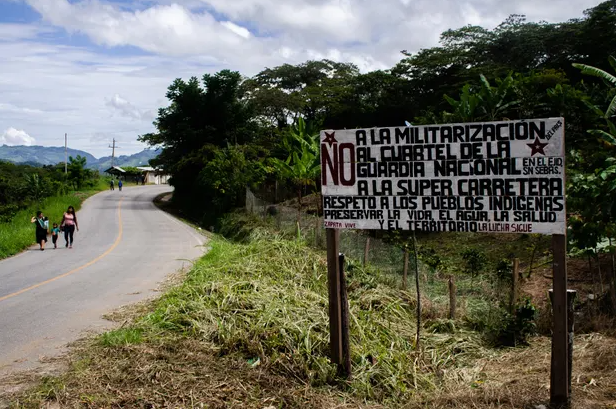
National Guard barracks, militarization of territory a concern for Indigenous peoples, environmental defenders in Mexico

Photo: “No to militarization to the national guard barracks [and] to the super-highway. Respect for indigenous peoples. Preserve life, water, health and land. Zapata lives. The struggle continues.” Photo by Caitlin Cooper.

On October 4, The Guardian reported: “The national guard has built 165 barracks in Mexico since it was created only two years ago by President Andrés Manuel López Obrador… [The Indigenous Tzeltal ejido of San Sebastián Bachajón, Chiapas] is leading the first lawsuit against one of 500 or so barracks planned across the country.”

The article highlights that the community was not consulted about the base, nor did it give its free, prior and informed consent to it.

Ivette Galván, a lawyer with the Miguel Agustín Pro Juárez Human Rights Center (Centro Prodh), says: “This is the first [injunction] presented by an indigenous community against these barracks on the infringement of their collective rights.”

The Guardian article adds: “For the Tzeltal inhabitants of Chiapas, the barracks also raise concerns about their sovereignty in the face of development.”

“At stake in the region are at least 40 infrastructure projects, including the Mayan Train, a controversial plan for a 1,000-mile (1,600km) railway connecting Palenque in Chiapas with other tourist sites in the Yucatán peninsula, and a 400-mile highway connecting Pijijiapan with Palenque. The community in San Sebastián Bachajón [that launched the lawsuit against the barracks] is opposed to the highway project.”

Gustavo Castro, founder of the local organisation Otros Mundos Chiapas, says: “One of the greatest threats of militarization is the repression of social movements and protest, especially for a region with a long history of organisation.”

Castro, who was with Indigenous Lenca defender Berta Cáceres when she was killed in March 2016, further notes that security forces have been also used to silence environmentalists to protect foreign investment in Nicaragua and Honduras.

The article also quotes Cata Hernández of the National Coordinating Committee of Indigenous Women (Conami) who says: “What we know is that in the past, the deployment of the military has had a negative impact, particularly for women and girls.”

The article continues: “The rape of three Tzeltal women at a military checkpoint in 1994 has gone unpunished.”

There are numerous other examples of sexual violence committed by the military against Indigenous women.

That includes Valentina Rosendo Cantú, an Indigenous Me’phaa woman who was sexually assaulted by soldiers on February 16, 2002. Her struggle has been accompanied by Sandra Alarcon and the Human Rights Centre of Montaña de Tlachinollan.

The Peace Brigades International-Mexico Project has relationships with Centro ProDH, Tlachinollan and at least seven organizations that oppose the Mayan Train megaproject including the Peoples’ Front in Defence of Land and Water.

PBI-Mexico has also linked the militarization of territory with the forced disappearance of three members of the Alvarado family in December 2009 after they were arbitrarily detained by the Mexican army in the state of Chihuahua. The case has been represented by several groups including the Paso del Norte Human Rights Centre.

Canadian military bases

In Canada, the Dene Su’lene’ were displaced from their lands in Alberta when the Cold Lake air force base and weapons range was built in 1952. Briarpatch has reported: “The Cold Lake Air Weapons Range (CLAWR) is Canada’s only tactical bombing range and is now home to oil and gas extraction activities as well.”

The Ojibwa of Aazhoodena were displaced from their lands in Ontario when Camp Ipperwash was established in 1942. Land defender Dudley George was killed by Ontario police during a reoccupation of those lands in September 1995.

The Innu ancestral homeland of Nitassinan in Labrador has also been impacted by low-level flight testing by NATO fighter jets that didn’t end until 2005. They are now struggling against the Muskrat Falls hydroelectric dam flooding their lands.

Canada also continues to support the base in Ala Verapaz, Guatemala that displaced the Indigenous Q’eqchi’ community of Chicoyogüito from their ancestral lands in 1968.

And The Breach recently reported on the establishment of Canadian military bases in Germany in 2009, Kuwait in 2011, Jamaica in 2016, and Senegal in 2018. Senegal is in strategic proximity to Mali where a dozen Canadian mining companies have $1.8 billion invested in gold mines. The International Work Group for Indigenous Affairs (IWGIA) has noted: “Highly polluting extractive industries such as gold mining (Mali is the fourth largest producer in Africa) are in the hands of multinationals: their profits provide no benefit to the local population.”

Photo: A protest at the Goose Bay air force base in 1988 in opposition to NATO low level flight training over Nitassinan.

Fridays for Future calls on world leaders at COP26 to stop the violence against environmental and land defenders

Photo: School strike for the climate in Milan, Italy, October 1.

Fridays for Future is a youth-led and -organized global climate strike movement that started in August 2018 when Greta Thunberg began a school strike for climate.

They have made six demands of world leaders in the lead-up to the United Nations COP26 climate summit that starts on October 31.

One of those demands is: “Stop the violence and criminalization against indigenous peoples, small farmers, small fisherfolk, and other environmental and land defenders. Support the work they do.  Respect and listen to our defenders.”

This echoes the United Nations Human Rights Council resolution (adopted on March 21, 2019) that: “Stresses that human rights defenders, including environmental human rights defenders, must be ensured a safe and enabling environment to undertake their work free from hindrance and insecurity, in recognition of their important role in supporting States to fulfil their obligations under the Paris Agreement.”

The protection of defenders is urgently needed given Global Witness has documented: “On average, four Defenders have been killed every week since December 2015 – the month the Paris Climate Agreement was signed – with countless more targeted with non-lethal violence or criminalised as a result of their peaceful activities.”

On Friday October 1, Thunberg and Fridays for Future mobilized in Milan, Italy.

Canadian Environment and Climate Change Minister Jonathan Wilkinson was in Milan that day along with representatives from more than 40 other countries to set the final agenda for the COP26 summit in Glasgow, Scotland.

Aljazeera reported: “[The proposals from the youth] will be vetted by climate and energy ministers’ pre-COP26 gathering in the next few days before the Glasgow conference.”

There has been no clear statement of support yet from the ministers with respect to the urgent protection needs of land and environmental defenders.

Exclusion of defenders from COP26

Fridays for Future has also highlighted: “Now more than ever, we have to join the masses and follow the lead of environmental defenders, workers, and those most ignored.”

And yet Indian Country Today reports: “Limited access to COVID-19 vaccines in certain regions, travel restrictions and quarantine in the United Kingdom for people from ‘red list’ countries in Central and South America, Africa and Asia, and rising costs of travel and lodging are hindering Indigenous participation.”

Tom Goldtooth, executive director of the Indigenous Environmental Network, says: “I’m questioning the legitimacy of this conference, since the people who really need to be there might not be able to attend.”

Andrew Miller of Amazon Watch notes: “It will be interesting to see if there’s any concrete outcome from the COP26 beyond lip service to Indigenous peoples and rights.”

Miller, who is also active with Peace Brigades International-USA, adds: “We always debate whether or not to go to the annual COP meetings. From a cost-benefit perspective, it may not be worth it for Indigenous leaders to spend limited funds and to take two weeks away from essential community organizing against loggers, gold-miners, etc.“

PBI webinar, November 6

Fridays for Futures has also noted: “MAPA (Most Affected Peoples and Areas) are not just sad experiences, we must highlight their rich stories of resistance.”

Peace Brigades International will be amplifying the voices and demands of frontline climate defenders we accompany in Colombia, Guatemala, Honduras and Mexico on a webinar scheduled to take place on Saturday November 6.

Stay tuned for more details on this.

Fridays for Future has announced their next major mobilizations will be on October 22 and November 5.

Canadian Environment Minister Jonathan Wilkinson has yet to commit to the protection of land and environmental defenders, including Indigenous Secwepemc and Wet’suwet’en defenders now being criminalized for opposing megaprojects on their territories in Canada.

Water protectors remain undeterred as Canadian Line 3 tar sands export pipeline begins operation

Photo: On November 29, 2016, Prime Minister Trudeau announced his government’s approval of the Line 3 export pipeline.

On October 1, CTV reported: “Enbridge Inc.’s Line 3 pipeline is in service and is expected to transport 760,000 barrels per day at full capacity.”

The Associated Press adds: “Enbridge expects to start running the pipeline at its full capacity of 760,000 barrels per day in mid-October.”

Tara Houska of the Giniw Collective says: “We face years in prison for defending the drinking water of tens of millions downstream from Alberta tar sands oil set to flow through the Mississippi River headwaters, 22 rivers, 800 wetlands.”

Notably she adds: “We are not deterred.”

The Calgary-based Enbridge Inc. tar sands pipeline runs from Hardisty, Alberta to Superior, Wisconsin. It is 1,659 kilometres in length, the majority of which is in Canada with the remaining 585 kilometres in the United States.

Houska notes: “It was given a green light under President Trump and backed by President Biden.”

In Canada, Prime Minister Justin Trudeau approved the construction of the pipeline on November 29, 2016, the same day that he also approved the Trans Mountain pipeline now being constructed on Secwepemc territory without consent.

Enbridge has reported that the Canadian portion of the pipeline is complete and began commercial service in December 2019.

The Rainforest Action Network (RAN) has documented that the top five financiers of Enbridge are Canadian banks: TD Bank, Bank of Montreal, Scotiabank, RBC and CIBC. Collectively they have provided billions of dollars in financing to Enbridge.

Significantly, Houska has written: “Rubber-bullet welts spread purple down my arms and back, courtesy of Minnesota police, who have reportedly billed nearly $2 million in security-related costs to a fund set up by Canadian pipeline giant Enbridge.”

She has also previously highlighted: “Enbridge is dumping millions of dollars to incentivize and encourage police officers to repress, suppress and surveil, harass Indigenous people and our allies that are helping us try to stop this pipeline from happening in our treaty territory.”

More than 800 water protectors were arrested since construction of the pipeline began in Minnesota in December 2020.

People’s Front rejects “crumbs of justice” and the imposition of the thermoelectric plant

Video of media conference.

On October 1, El Pais reported that a suspect has been arrested in the murder of Huexca thermoelectric plant opponent Samir Flores Soberanes.

Flores was a member of the People’s Front in Defence of the Land and Water Morelos-Puebla-Tlaxcala. He was murdered on February 20, 2019.

The suspect has been identified only as Javier N.

He will have a hearing on October 6.

The article notes: “The Attorney General’s Office [FGE] has ruled out that the murder of the Nahuatl leader is linked to his campaign against the work.”

This is a claim rejected by Samir’s family and others.

The article adds: “There are two other alleged killers who have been ‘fully identified’ but are still at large, the prosecutor said.”

La Jornada further notes: “The FGE would have identified these three people since February or April 2019 but remained silent.”

“Activists said Samir’s family is not aware that [Javier N] was the one who called Samir, and if he did, they said he ‘would be the weakest link’ in the criminal organization.”

They want not just the material perpetrators of the assassination arrested, but also the intellectual authors, the ones who planned and ordered the killing.

“[The People’s Front] demanded that the case be investigated with seriousness and depth since for them the murder of their partner is for his activism against the PIM, and that if it had been that ‘simple’ [and not related to the megaproject, the authorities] would have clarified the homicide in a month or two.”

The El Pais article highlights: “After the arrest, the president, Andrés Manuel López Obrador, has informed this Friday that his Government will start the project again.”

Juan Carlos Flores Solís, a member of the People’s Front in Defense of Land and Water,  comments: “This was an announcement of political opportunism and a political management of this detention is taking place since it occurs in the context of López Obrador’s visit and in the middle of the tour of Europe.”

He further notes: “This is only a small part of all the justice that must be obtained in this case, it is just the small thread that has to be pulled to see who the real culprits of Samir’s murder are. We are not willing to receive crumbs of justice to receive more injustice such as the imposition of the thermoelectric plant.”

And he says: “The appearance of justice can lead us to more injustice.”

MSN reports: “In February of this year, opponents of the Morelos Integral Project (PIM) warned that the La Huexca plant could start operating at any time in the presence of the military. In November 2020, elements of the National Guard removed a sit-in that prevented the last stretch of works.”

Now the operation of the plant may be imminent.

The Peace Brigades International-Mexico Project has accompanied the People’s Front in Defence of Land and Water since early 2020.

Salvemos los cerros works to save hills to save water, mitigate climate change

The Facebook page for Salvemos los cerros de Chihuahua (Save the hills of Chihuahua) highlights: “The hills of Chihuahua are a source of life, knowledge, beauty, work and culture, and today they are at risk, join us to save them.”

It adds: “We are inhabitants of Chihuahua City, we want to save the hills that are the source of life, water, air, culture, identity, because we believe that if we do nothing, we and future generations will not be able to enjoy this enormous wealth and beauty. We want more people to join and share this information, and to raise awareness among their families and friends. We do not want more destruction of the environment or more pollution, we want people to develop to the fullest with values in balance with mother nature.”

And their website notes: “We all lose out with the terrible political and economic model that destroys the environment. A few make a lot of money, but money can’t be eaten, it can’t be taken, it can’t breathe, and it can’t heal. What do we prefer, to take care of Mother Earth, to respect the collective human rights of us and our children or that a few continue to earn a lot of money?”

Last month, El Heraldo de Chihuahua reported: “Activists of the ecological group Salvemos Los Cerros de Chihuahua, held a demonstration on the Periférico R. Almada with the aim of demanding that the large hill be recognized as a protected natural area in its modality of natural monument.”

That article adds: “Luis Rivera, spokesman for the movement and one of the activists, said that the destruction plans that affect this hill continue on the part of the authorities, so they seek to raise awareness among citizens, through these peaceful activities.”

This past July, they also tweeted: “The hills help capture water and mitigate climate change. As the destruction of natural areas advances, so will “natural” disasters.”

In July, Luis Rivera also spoke at this Facebook live event on the topic of Climate Crisis and Racism in the context of #500AñosdeResistencia (500 years of resistance).

Raichali has also reported: “Luis Andrés Rivera, “Lucho”, of Salvemos Los Cerros Chihuahua, demanded that the State Government accept the proposal for the ecological preservation of the 18 hills of Chihuahua, which have been intentionally burned on several occasions.”

That article adds: “Activists suspect that the intention behind these fires is to destroy the existing flora and fauna and thus, those who are interested in these spaces, can argue that an administrative change in land use is necessary, to promote other types of projects.”

It further notes that Salvemos Los Cerros Chihuahua works with Extinction Rebellion, Cooperación Ecológica A.C., and Fridays for Future among other groups on these issues, including the issue of water protection in the state of Chihuahua.

To learn more about Salvemos los cerros de Chihuahua you can find them on Twitter and Facebook.

Photo by Gerardo Aguirre/El Heraldo.

Calls grow for human rights to be on the agenda of the COP26 climate summit

The call for a UN Special Rapporteur

Numerous states and organizations are calling for the creation of a United Nations Special Rapporteur on climate change and human rights.

Among the many organizations who signed an open letter this summer calling for the creation of this position is the Colectivo de Abogados José Alvear Restrepo (CCAJAR), which is accompanied by the Peace Brigades International-Colombia Project.

The Climate Vulnerable Forum (CVF), which is comprised of 48 nations including Colombia, Guatemala and Honduras, is also backing this motion.

Supporters highlight: “The UN Human Rights Council, currently in session, could take this decision now. This is precisely what the CVF has called for in its manifesto for Cop26. By doing so, the Council would demonstrate that UN bodies can take decisive climate measures, a much-needed positive impulse for the Glasgow summit.”

Reuters reports: “The potential new post is expected to be deliberated at the ongoing Sept. 13-Oct. 8 session of the U.N. Human Rights Council, as one of two new resolutions related to the environment, according to diplomats.”

That article adds: “A UN official said the exact role would depend on the final text establishing the position – but noted climate change will threaten a broad range of human rights.”

Human rights defenders killed since COP21

On average, four land and environmental defenders have been killed every week since the COP21 summit in Paris in December 2015.

Global Witness has also documented that 212 people were killed in 2019 for peacefully standing against the destruction of nature. 108 of them, more than half the global total, were killed in Colombia (64), Mexico (18), Honduras (14) and Guatemala (12).

Cognizant of this longstanding issue, the UN Human Rights Council passed a resolution in 2019 that says defenders “must be ensured a safe and enabling environment to undertake their work free from hindrance and insecurity, in recognition of their important role in supporting States to fulfil their obligations under the Paris Agreement.”

The Paris Agreement reached at COP21 pledged to hold global warming well below 2 degrees Celsius, the scientifically-advised limit of safety, with an aspiration not to breach 1.5C above pre-industrial levels.

Forest defenders at risk

Earlier this week, The Guardian reported: “[The COP26 climate summit] will not produce the breakthrough needed to fulfil the aspiration of the Paris agreement, key players in the talks have conceded.”

But, according to the article, “The UK, charged as host with delivering a successful outcome, is hoping that progress will be made on other issues, including phasing out coal, providing climate finance to poor countries, and improving the protection of forests.”

Global Witness has highlighted: “In instances where defenders were attacked for protecting particular ecosystems, 70% were working to defend the world’s forests from deforestation and industrial development.”

They add: “Almost 30% of the attacks were reportedly linked to resource exploitation (logging, mining and large-scale agribusiness), and hydroelectric dams and other infrastructure. Of these, logging was the sector linked to the most murders, accounting for 23 cases. Mexico saw a large rise in logging- and deforestation-related killings, with 9 in 2020.”

This suggests the importance of including provisions reflecting the need to protect forest defenders in the Glasgow Agreement.

Access to COP26, PBI webinar

This week, the CBC also reported: “There are ongoing concerns that the persistence of COVID-19 and the U.K.’s strict border measures will limit the participation at COP26 of many advocacy groups who claim they are already shut out of the formal talks.”

Given this, Peace Brigades International is organizing a webinar on Saturday November 6 to help highlight the relationship between human rights and climate change. Meetings between foreign ministers and human rights defenders are also being organized.

The COP26 climate summit starts on October 31.

The climate crisis is a crisis of human rights.

PBI-Canada observes the first National Day for Truth and Reconciliation

The Scream by Kent Monkman depicting the RCMP forcibly removing Indigenous children from their families to be taken to residential schools.

Today marks the first National Day for Truth and Reconciliation in Canada.

The day honours the children who died at residential schools as well as the survivors, their families and communities.

More than 150,000 Indigenous children were taken from their parents and sent to at least 139 residential schools as part of a campaign of forced assimilation.

In 1883, Prime Minister Sir John A. Macdonald said in the House of Commons: “Indian children should be withdrawn as much as possible from the parental influence.” That same year Public Works Minister Hector-Louis Langevin allocated $43,000 for the federal government’s first three industrial schools for Indigenous boys.

The last residential school closed in 1996.

The Truth and Reconciliation Commission documented the deaths of 3,201 children at residential schools, its chair Justice Murray Sinclair has stated that 6,000 children may have died at these schools, but Cindy Blackstock and Pam Palmater have estimated that more than 12,000 children died.

There are also an estimated 80,000 Indigenous people alive today who carry the trauma of having experienced residential schools as children.

PBI-Canada recalls that the United Nations defines “forcibly transferring children of the group to another group” as genocide.

Today is also Orange Shirt Day. This is a day that honours the children who survived residential schools and remembers those who did not.

It remembers Phyllis Webstad of the Stswecem’c Xgat’tem nation who arrived on her first day of school in a new orange shirt only to have it taken from her.

Phyllis has shared:

“I went to the Mission for one school year in 1973/1974. I had just turned 6 years old. I lived with my grandmother on the Dog Creek reserve. We never had very much money, but somehow my granny managed to buy me a new outfit to go to the Mission school. I remember going to Robinson’s store and picking out a shiny orange shirt. It had string laced up in front and was so bright and exciting – just like I felt to be going to school! When I got to the Mission, they stripped me, and took away my clothes, including the orange shirt!”

PBI-Canada rejects the violence of colonization, displacement, forced assimilation and genocide.

On this day, we also recognize the ongoing Indigenous struggles for sovereignty and justice on their lands in opposition to megaprojects.

This includes the Secwepemc struggle against the Canadian government owned Trans Mountain pipeline, the Wet’suwet’en struggle against the repression of Canadian police and the Coastal GasLink pipeline, and the Canadian Department of Fisheries and Oceans (DFO) criminalizing the treaty rights of the Sipekne’katik nation to fish.

#NationalDayforTruthandReconciliation

#OrangeShirtDay

Photos: The RCMP raid on January 7, 2019 against Wet’suwet’en land defenders opposed to the construction of the Coastal GasLink fracked gas pipeline on their territories without free, prior and informed consent. Photos by Michael Toledano.

PBI-Colombia accompanies the Commission of Justice and Peace as delegations visit Alto Guayabal and Turbo

On September 29, PBI-Colombia tweeted: “National and international delegation with @IrelandColombia [the Embassy of Ireland in Colombia], @HelenaSweden [Helena Storm, the Swedish Ambassador to Colombia], @enoorman [Ernst Noorman, the Dutch Ambassador to Colombia], @MAPPOEA [the Mission to Support the Peace Process] visited with @Justiciaypazcol [Commission of Justice and Peace] to ethnic communities in Alto Guayabal and Turbo, supporting requests for #AcuerdoHumanitarioYa [Humanitarian Agreement Now], due to a serious security crisis in territories.”

Additionally, Irish Ambassador Alison Milton tweeted: “We visit the Alto Guayabal community, Jiguamiando. We are concerned about the situation and we sympathize with them for the murder of Dilio Bailarin. We call for a global humanitarian agreement now! To protect these communities. No more deaths!”

Dutch Ambassador Noorman also tweeted: “We visit the community of Alto Guayabal, Urabá. The situation is very worrying. We sympathize with the guard for the recent murder of #DilioBailarín and we call for a humanitarian agreement now! for the protection of indigenous peoples. No more deaths!”

Dilio Bailarín

On September 20, Contagio Radio reported:

“Dilio Bailarín, who at 5:45 in the afternoon about 20 minutes from the Alto Guayabal Reservation, was attacked with a firearm.

According to the information received, in 2020, Dilio and five other leaders were threatened and persecuted by members of the structures of the Autodenfensas Gaitanistas de Colombia, AGC, which operate in Bajo Atrato, Carmen del Darién.

In 2019, Dilio Bailarín was also a victim of the ELN, as the group tried to kidnap him along with another social leader, however, the community prevented the act.

At this time, human rights organizations, such as the Justice and Peace Commission and international humanitarian organizations are moving to the region to accompany the community that is in fear.

Dilio’s murder has shocked the Embera community and the international community that sponsors the peace-building process in the midst of the armed conflict in the region.

It should be remembered that the Alto Guayabal Biodiverse Humanitarian Reserve is a non-violent protection measure within the territories that are facing the extractive interests of multinationals that are unaware of the rights of the communities of the indigenous peoples.

The Justice and Peace Commission also denounced that despite the precautionary measures of the IACHR, the National Government did not adopt the necessary precautions to protect the life of the indigenous leader.”

The Peace Brigades International-Colombia Project has accompanied the Commission of Justice and Peace since 1994.

The Commission of Justice and Peace can be found on Twitter here.

PBI-Honduras accompanies CEHPRODEC at ZEDEs and Mining Law appeals at Supreme Court of Justice

On September 29, PBI-Honduras posted: “PBI accompanies CEHPRODEC in the presentation of unconstitutionality appeals against the ZEDES [Zones of Employment and Economic Development] and against the reform of the Mining Law.”

Their post quotes Donald Hernández of CEHPRODEC who says: “We know that there is no mine in the world that does not pollute. There is no green mining.”

EDN TV further explains: “Members of different environmental organizations have come to the CSJ [Supreme Court of Justice] facilities to present two appeals of unconstitutionality against the ZEDES project and several mining projects that threaten the environment.”

Proceso Digital has noted: “The ZEDEs are areas of the national territory subject to a ‘special regime’ in which investors would be in charge of fiscal, security and conflict resolution policy, among other competences.”

Avispa adds: “It should be noted that the regions where the ZEDE are projected have abundant natural assets, in addition to having the presence of indigenous population, whose context is affected by different territorial conflicts and the threat of other extractivist projects.”

MiningWatch Canada has stated: “The General Mining Law was developed with technical assistance paid for with Canadian overseas development aid. Its passage in 2013 lifted a seven-year moratorium on any new mining projects.”

It has also noted: “This law was developed and passed with strong diplomatic support from the Canadian embassy, and with contributions from the Department of Foreign Affairs and the former Canadian International Development Agency.”

Among the concerns expressed by Honduran groups including CEHPRODEC: “The law fails to ensure the protection of natural areas and water sources vital for human consumption and other uses health” and “imposes limits on citizen participation and contradicts provisions for environmental conservation by prohibiting areas free of mining from being created for any length of time.”

PBI-Honduras has accompanied the Honduran Centre for the Promotion of Community Development (CEHPRODEC) since May 2014.

Photo from video of the protest.

RCMP use pain compliance against land defender opposed to megaproject on Gidimt’en territory

On September 28, Gidimt’en land defender Sleydo’ provided this video update on the struggle to defend the sacred Wedzin Kwa headwaters from the Coastal GasLink pipeline being built on Wet’suwet’en lands without their free, prior and informed consent.

She notes: “The second day [Monday September 27] they [RCMP police] came in and tortured somebody for an hour and made another arrest.”

In the video you can hear that person, who is locked underneath a bus being used as a road barricade, screaming in pain. One RCMP officer says to the clearly distressed land defender: “You unhook, you can fix your pants.”

At that time, Gidimt’en Checkpoint tweeted: “[The RCMP] do not have proper tools, they are just pulling on the person and trying to use pain compliance to get them out.”

Unicorn Riot has commented: “Pain compliance is a matter of public controversy and is considered by many to be a form of torture as it deliberately causes intense, unbearable pain to a prone and generally helpless person.”

The use of pain compliance by the police is being used against peaceful land defenders including at the Fairy Creek blockades and in Minnesota.

Last month, Tara Houska of the Giniw Collective met with Mary Lawlor, the United Nations Special Rapporteur on human rights defenders, and told her that Minnesota police have used pain compliance against people standing up for water in opposition to the Line 3 pipeline.

And last week, More Perfect Union posted this 4-minute video with those water protectors noting: “The torture tactics have left some activists with partial facial paralysis.”

The World Organization Against Torture (OMCT) has stated: “Events in recent years have shown, more than ever, that torture is not just inflicted behind walls but in bright daylight. The world is witnessing, from Chile to Hongkong to Belarus, violent repression of protest movements by law enforcement officials in contravention of the absolute prohibition of torture and other ill-treatment.”

It further notes: “The right of peaceful assembly protects peaceful assemblies – not merely lawful assemblies. This means that the authorities cannot rely on the purported unlawfulness of a peaceful demonstration to sidestep or evade their obligations. Participants in a peaceful assembly shall be respected and protected, including be free from fear.”

We continue to follow this disturbing trend of the use of pain compliance by the police against land defenders.