Home Blog Page 271

Haudenosaunee land defenders violently arrested and shackled by the RCMP for supporting the Wet’suwet’en struggle

Photo: Logan Staats, Skyler Williams and Layla Staats.

Three Haudenosaunee land defenders from southern Ontario travelled to Wet’suwet’en territory in northern British Columbia to support their struggle against the Coastal GasLink fracked gas pipeline being built without consent on their lands.

Those land defenders are Skyler Williams, Layla Staats and Logan Staats.

They were arrested on Thursday November 18, the first day of a militarized, heavily armed RCMP raid on Wet’suwet’en territory.

Just hours before his arrest, Skyler tweeted: “Once again, our nations must prepare for another attack on our homelands from Canada and police to satisfy corporate greed. We will stand up now with the Wet’suwet’en to protect their territory, because we know an attack on one of us is an attack on all of us.”

After he was arrested, Skyler told CBC reporter Jorge Barrera that RCMP officers called him by name and targeted him for arrest first. He says: “When we hit the ground, our heads were pushed into the ice.”

Logan further notes: “The RCMP punched me in the ear, slammed my head into the frozen pavement by my braids, kneed me in the spine and held me down while I was handcuffed and bleeding. I was only peacefully singing our water song hugging/protecting a 70 year old Matriarch.”

And Layla says: “I saw [the RCMP] grab [my brother Logan] by the braids and slam his face into the concrete and ice.”

The CBC also notes that Skyler and Layla say their ankles and wrists were shackled and that they were put in separate, box-like compartments in the back of SUVs for transport to their court appearance in Smithers on Friday November 19.

Skyler notes: “We were put in dog crates in the backs of SUVs by the RCMP. We were paraded in open court in our underwear while in shackles. I asked repeatedly to have my pants.”

And Layla says: “We were paraded around courts in our underwear with our ankles and wrists cuffed like criminals.”

Another CBC article reports: “According to an affidavit filed by the RCMP with B.C. court … the RCMP ran Williams’ name through two national police databases — the Police Records Information Management Environment (PRIME) database and the Canadian Police Information Centre (CPIC) — and found he was flagged as ‘violent’ and an ‘escape risk’.”

It adds: “It is not clear which police force flagged him, when or why.”

These are questions that must be answered.

But it is clear that there has been a long-standing pattern of the police criminalizing Indigenous land defenders who uphold their territorial rights.

The 30 people arrested on November 18-19 are due back in court on February 14, 2022.

We continue to closely follow this situation and call for the dropping of all charges against Wet’suwet’en and Haudenosaunee land defenders and allies.

Gidimt’en Checkpoint video from November 18.

PBI-Mexico accompanies Justice for Our Daughters at event in Chihuahua demanding justice for the victims of femicide

On November 25, the Peace Brigades International-Mexico Project posted: “In #Chihuahua, from the Cruz de Clavos, symbol of femicides in the state, PBI accompanies the act organized by Justicia para Nuestras Hijas [Justice for our Daughters] to remember and demand justice for the victims of femicide.”

Yesterday, AFP reported: “Mexico registered 736 femicide cases between January and September [of this year], following 975 cases in the whole of last year, according to official figures.”

This past August, Mexico News Daily also reported: “A gender violence alert has been activated for the five Chihuahua municipalities of Ciudad Juárez, Parral, Chihuahua, Cuauhtémoc and Guadalupe y Calvo, which have been identified as areas with a high level of violence against women.”

That article adds: “In the past 10 years, the five municipalities have seen 2,400 murders of women. In the first six months of 2021, the state ranked third for homicides of women and had an elevated level of rape.”

And just yesterday, The Globe and Mail reported that the number of women in Canada who were victims of homicide has risen over the past two years.

That article notes: “The spike – with 92 women killed in the first six months of this year, an increase from 78 in the first half of 2020, and 60 in the first half of 2019.”

“As activists mark the International Day for the Elimination of Violence against Women on Thursday, the Canadian Femicide Observatory for Justice and Accountability warns the deadly trend could continue through 2022 – particularly as the fallout of the pandemic continues to affect women disproportionately.”

That article also quotes Professor Myrna Dawson, the executive director of the observatory, who says this is not just a Canadian problem, but a global one.

To follow the Canadian Femicide Observatory on Twitter, click on @CAN_Femicide.

“Today, #25N and day by day, we point out that any form of repression and violence against women who fight must end. #DayAgainstGenderViolence.”

Likelihood of F-35 purchase increases as Boeing reportedly dropped from Canada’s fighter jet procurement process

On November 23, Ottawa-area activists held the ‘Defund Warplanes’ banner as the Speech from the Throne was being read. Photo by Koozma J. Tarasoff.

On November 25, the Canadian Press reported: “The federal government has told Boeing that its bid to replace Canada’s aging CF-18s with a new fleet of the American company’s Super Hornet fighter jets did not meets its requirements.”

The article adds: “Three sources from industry and government say the message was delivered Wednesday [November 24] as the other two companies [Lockheed Martin and Saab] were being told they did meet the government’s requirements.”

Reuters further notes: “Defense analysts had been certain Ottawa would exclude Saab’s Gripen plane. Unlike Canada, Sweden is neither a member of NATO or NORAD, the North American defense organization. Canada belongs to the consortium that developed Lockheed Martin’s F-35 jet, which defense sources say is the preferred choice of the air force.”

Liberals had vowed not to buy the F-35

This news increases speculation that the F-35 will be the aircraft chosen as Canada’s next fighter jet, possibly in March/April 2022.

Notably, just prior to becoming Prime Minister, Justin Trudeau vowed that a Liberal government would scrap the Conservative plan to buy F-35s and launch an “open and transparent competition” to buy more affordable airplanes to replace the current fleet of fighter jets.

Trudeau even promised to exclude the F-35 from that new bidding process.

The election platform for the Liberals in 2015 even stated in bold: “We will not buy the F-35 stealth fighter-bomber.”

Their Real Change platform further noted: “We will reduce the procurement budget for replacing the CF-18s, and will instead purchase one of the many, lower-priced options that better match Canada’s defence needs.”

Questions about the procurement process

Beyond why the F-35 remains in the running despite these election pledges, here are five other questions we have:

1- When will the Parliamentary Budget Officer conduct a full-cost assessment of the lifespan costs of these fighter jets? While the purchase cost may be $19 billion, the full cost over 30-years has been estimated by community activists at $76.8 billion.

2- Will a calculation be made on the greenhouse gas emissions from this fleet of 88 fighter jets? A basic calculation would suggest the fleet could consume 3.94 billion litres of fuel. At COP26 this month there was a call for transparency in military emissions.

3- The current fleet of CF-18s has conducted an estimated 1,598 offensive bombing missions over the past 30 years. Murray Brewster of CBC News has reported on DND’s refusal to disclose the casualty figures from its bombing missions in Iraq and Syria. Will a comprehensive report on casualties be released before billions are spent on new warplanes?

4- At what point and how will the United States grant its “ultimate certification” of the Canadian government’s choice of a fighter jet? Lee Berthiaume of The Canadian Press has reported: “American officials will need to certify the fighter jet Canada buys at the end of a multibillion-dollar procurement [process].”

5- Will there be a parliamentary debate on the lifespan costs, carbon pollution, offensive uses and ultimate certification process prior to the contract with either Lockheed Martin or Saab being signed next year?

We continue to closely follow this situation.

Further reading: New warplanes signal the Canadian military’s continued occupation of Dene Su’lene’ lands in northern Alberta.

State violence against the Wet’suwet’en, non-compliance with UN convention mark Canada’s backing of megaproject

Video: An RCMP officer points his gun at Wet’suwet’en land defenders as the door to their cabin is broken down with an axe then a chainsaw, November 19, 2021.

The LNG Canada megaproject (including a liquefied natural gas export terminal supplied by a fracked gas pipeline) was conceived in 2011 with the formation of a joint venture between Shell, Mitsubishi, PetroChina and Korea Gas Corporation.

The Coastal GasLink project formally emerged in June 2012 when TransCanada (later rebranded as TC Energy) was selected by LNG Canada to design, build, own and operate the pipeline system that would feed the export terminal with fracked gas.

Wet’suwet’en opposition to any and all pipelines on their territory was evident from the early stages of this megaproject.

That opposition was quickly criminalized.

By January 24, 2014, the RCMP’s Critical Infrastructure Intelligence Team (CIIT) had produced an intelligence assessment on Criminal Threats to the Canadian Petroleum Industry that notes “violent aboriginal extremists” and includes in Appendix E an article from the Georgia Straight that briefly mentions the Unist’ot’en clan of the Wet’suwet’en nation.

A further document dated April 1, 2015, from the Government Operations Centre (GOC), that compiles information from the RCMP and other agencies, describes an unnamed Unist’ot’en leader as an “aboriginal extremist”.

Within five years of that second report, the RCMP had launched two militarized raids against the Wet’suwet’en.

The Guardian later reported that notes from a strategy session for the first heavily-armed raid showed that RCMP commanders argued that “lethal overwatch is req’d” – a term for deploying an officer who is prepared to use lethal force.

This despite RCMP documents indicating there was “no single threat indicating that [land defenders] will use firearms”.

Furthermore, The Guardian noted: “The documents also show close collaboration between the RCMP and TC Energy: police officers attended company planning sessions and daily ‘tailgate’ meetings, and were privy to CGL’s legal strategy.”

A third raid this past November 18-19 resulted in the arrests of about 30 people, including Gidimt’en land defenders.

There are first-hand accounts of the RCMP in CGL cars on the territory; white school buses of the same make used to transport RCMP officers from the Smithers airport to conduct the raids against land defenders later emerging from one of the CGL man camps on the territory; and RCMP officers arriving in CGL marked buses in the nearby town of New Hazelton to break-up a Gitxsan rail blockade in solidarity with the Wet’suwet’en.

Numerous concerns emerge from these reports.

These include the misrepresentation by the RCMP of Wet’suwet’en land defenders upholding their territorial rights as “extremist” and “violent”.

This concern is further compounded by the Canadian government’s financial involvement in this megaproject, notably its $275 million investment in June 2019 supporting the LNG Canada export terminal along with Export Development Canada’s $250 million to $500 million loan to Coastal GasLink in May 2020 for the construction of the pipeline.

The nexus of state investment (that could total $775 million) and state violence (backed by about $20 million in public funds) also leads to questions about the state’s commitment to adhere to the Supreme Court of Canada ruling (that recognized Wet’suwet’en title and rights to the land) and international human rights conventions, notably the International Convention on the Elimination of All Forms of Racial Discrimination.

The Committee on the Elimination of Racial Discrimination, the expert committee that monitors state compliance with the Convention, called on Canada in December 2019 (after the first RCMP raid and just weeks prior to the second raid) to stop construction on the Coastal GasLink pipeline and withdraw the RCMP from Wet’suwet’en territory.

The Committee then expressed disappointment with Canada’s inadequate response to their decision and just days before the third RCMP raid Canada missed the deadline to submit its periodic review on its compliance with the Convention it ratified in 1970.

The breaches of Wet’suwet’en and Canadian law, the criminalization of land defenders upholding their inherent and recognized rights, state violence and the appearance of collusion between the police and an energy company, along with the disregard of international human rights norms raise profound concerns that must be addressed.

Brent Patterson travelled to Wet’suwet’en territory on November 18 to observe, accompany and report on the Wet’suwet’en resistance to the Coastal GasLink pipeline.

Tweet from Leah Gazan, Member of Parliament.

New warplanes signal the Canadian military’s continued occupation of Dene Su’lene’ lands in northern Alberta

On November 23, Ottawa-area activists held the ‘Defund Warplanes’ banner as the Speech from the Throne was being read. Photo by Koozma J. Tarasoff.

The displacement of Indigenous peoples and the state’s militarization of their territories includes the stationing of warplanes on these lands.

This includes the current deployment of CF-18s on Dene Su’lene’ lands in northern Alberta, where Canada’s new warplanes would also be based.

In August 2020, the Canadian government awarded a $9.2 million contract for a new fighter jet facility at the base that would house the new warplanes, widely expected to be F-35s. That work is to start in the summer of 2022 while the jets are to arrive in 2025.

Dene Su’lene’ land defenders have stated: “In 1952, we were forcibly evicted from our homelands [so that the base could be constructed]. In Suckerville [on the shores of Primrose Lake], our people had a 7-day sit-in, refusing to leave. Reluctantly, after heavy coercion from the government, a deal was made.”

They add: “Our people left peacefully under the understanding that this was to be a short-term lease purely for military use, and that the 4,490 square miles of land was to be returned or re-negotiated after 20 years.”

On June 3, 2001, Dene Su’lene’ Warriors established a Peace Camp blockade 300 metres from the gate to the military base that also includes the Cold Lake Air Weapons Range (CLAWR) where live fire training exercises are conducted.

Also known as the Primrose Lake Air Weapons Range, it includes “an instrumented aerospace testing and evaluation range, a manned air-to-ground range (including a high explosive range), and an air-to-air gunnery range.”

Land defender Brian Grandbois was one of the opponents of the military base at that time. In an interview, he told The Dominion: “My great-great-great-grandfather is buried there on a point on that lake where they bomb.”

The Dene Warriors who set up the blockade stated: “They play with their air weapons and their fighter jets and all of their killing machines right on the homeland of the Dene who have confronted the giant military range by an unarmed peace camp.”

By October 2001, the Band Council of the Cold Lake First Nation signed a $25.5 million that would allow the military base and weapons range to continue. This amounted to $35 for each acre of the weapons range and $2,500 for each band member.

Even after a December 2001 referendum in which 625 band members voted in favour of the agreement, Warrior Publications noted: “Around 20 people are still at the camp regularly (despite bitter Winter cold), and they recently finished building their first permanent cabin and are in the process of building more.”

In November 2012, Sandra Cuffe wrote: “The construction of the Cold Lake air force base and the million-hectare Cold Lake Air Weapons Range … resulted in the displacement of many Indigenous people from their traditional territories. “

She highlighted: “Aside from a land claim settlement concerning the military base, the Cold Lake First Nation band council has also signed agreements with hydrocarbon corporations and owns a number of contracting companies serving the military and oil and gas industries.”

Cuffe quotes Grandbois who said: “They’re extracting huge amounts of resources, both in gas and oil. …If you look in the Air Weapons Range today in 2012, you’ll find the Denesuline are cleaning toilets for executives.”

And in another article Cuffe noted: “In April 2013, people got together to defy the military restrictions and began making trips into the northeastern part of the CLAWR. They began preparations to build cabins, openly engaging in traditional land use activities and actively asserting their rights to their territory.”

Grandbois passed on to the spirit world on February 14, 2019.

When we were on Wet’suwet’en territory this past week we met with Grandbois’ nephew who knows the stories of the land defence struggle against the Cold Lake air base. We look forward to connecting with him and amplifying those stories of resistance.

Further reading: Five questions for Ministers Filomena Tassi and Anita Anand on the purchase of Canada’s new fleet of fighter jets.

Dene Su’lene’ land defender Brian Grandbois.

Photo-journal of PBI-Canada’s 4-day visit to Wet’suwet’en and Gitxsan territories

Still from Gidimt’en Checkpoint video.

On November 19-22, I visited Wet’suwet’en and Gitxsan territories in northern British Columbia on behalf of PBI-Canada in response to this video appeal.

Sleydo’: “Whatever clan you are, whatever background you are, we need people to come and witness what’s happening on the yintah.”

Our plan was to tent on Wet’suwet’en territory near the site where Coastal GasLink intends to drill a fracked gas pipeline trench (888 metres in length) under the Wedzin Kwa river sacred to the Wet’suwet’en peoples.

On Sunday November 14, land defenders began enforcing a standing eviction against Coastal GasLink by closing the roads into the territory.

Still from Submedia video of Sleydo’ reading the eviction order.

Photo by Gidimt’en Checkpoint.

Thursday November 18

I flew from Ottawa to Vancouver then to Terrace on Thursday November 18 just as the news was breaking that the RCMP had begun a raid on Wet’suwet’en territory.

That day, the RCMP arrested about 17 people including legal observers, an accredited journalist, Haudenosaunee allies, and Wet’suwet’en elders at the 44-kilometre mark on the Morice River Service Road (a gravel road) that leads from the nearby town of Houston, through the territory to the drill pad site, and beyond.

Photo by Dan Loan.

Photo by Layla Staats, one of the three Haudenosaunee land defenders arrested on Wet’suwet’en territory on November 18.

Friday November 19

The morning after the arrests of these land defenders, I was present at the courthouse in Smithers as these land defenders had their first court appearance.

Photo: Land defender Skyler Williams has tweeted: “We were put in dog crates in the backs of SUVs by the RCMP. We were paraded in open court in our underwear while in shackles. I asked repeatedly to have my pants. We won’t stop. There’s nothing your goons can do to break our connection to our lands, our waters and to each other!”

Later that day I was also present at the RCMP detachment in Smithers as the land defenders were released.

That same day, the RCMP arrested another 11 people, including Sleydo’ Molly Wickham, Chief Woos’ daughter, and other Indigenous land defenders at Coyote Camp (at the 63-kilometre mark on the Morice River Service Road).

Stills from video by Michael Toledano.

Land defender Cody Merriman, Sleydo’s husband, was also arrested at the 44-kilometre mark that day.

Still from Gidimt’en Checkpoint video.

Photo by Gidimt’en Checkpoint.

Saturday November 20

On this day, we helped accompany four Dene youth wanting to travel the 66 kilometres on a remote logging road (that had been blockaded by the RCMP) so that they could reach the Unist’ot’en healing centre, a land-based wellness lodge for Indigenous peoples.

Photo by Unist’ot’en Healing Centre.

Leaving the healing centre after helping to accompany Dene youth there.

After the raid, the plan to tent on the territory was no longer possible, so after a night of improvising, I was able to stay at the Solidarity House.

As noted on their fundraising page: “The Supporter House opened its doors in August 2015. Since that time, it has welcomed many land defenders and supporters from all four directions under its roof. Whether travelling to and from the frontlines or dropping in for a well deserved break, the Supporter House has been there as a place to get a good night’s sleep, enjoy a hot meal, access the internet, and do laundry. A space that is autonomous and grassroots. We humbly operate on Wet’suwet’en territory in so-called Houston, BC.”

Sunday November 21

We drove to the Gidimt’en Checkpoint village at the 44-kilometre mark on the road to check on the status of the camp.

Photo by Amber Bracken.

Monday November 22

I drove from Houston to New Hazelton, where Gitxsan land defenders had blockaded the CN Rail railroad track in solidarity with the Wet’suwet’en. The day before, the RCMP entered the village, as Vuntut Gwitchin citizen Kris Statnyk has tweeted “to put down a peaceful protest led by Gitxsan families with a show of force, including tactical officers authorized for lethal oversight and traumatizing Gitxsan children.”

Video still: Denzel Sutherland-Wilson arrested in New Hazelton by the RCMP, November 21.

Photo by Kris Statnyk.

Still from APTN News video.

When I arrived in New Hazelton (67 kilometres north of Smithers), the roadside camp was still present though the railway blockade had ended.

There I met with land defender Kolin Sutherland-Wilson whose brother Denzel had been arrested the day before.

When I asked Kolin what he thought of the heavily armed RCMP Emergency Response Team in New Hazelton, he replied: “It’s terrorism. It’s meant to frighten us, but we are still here.”

PBI-Canada continues to follow this land defence struggle.

Updates

The Narwhal reports: “On July 7, 2022, the province’s legal team told B.C. Supreme Court Justice Marguerite Church it would prosecute Sleydo’ Molly Wickham, Shaylynn Sampson (Gitxsan Lax Gibuu Wilp Spookxw), Teka’tsihasere Corey ‘Jayohcee’ Jocko and Hannah Hall. The decision brings the total to 19 individuals arrested during the raid that B.C. Prosecution Service will pursue criminal charges against in the coming months.”

On August 8, Sleydo’ posted:

“I don’t know if people understand the severity of the time we are in right now. The Wedzin Kwa is about to be destroyed. Our sacred life giver where our salmon spawn, the cleanest drinking water in the whole yintah, the place out ancestors walked and drank from, where all the animals and beings drink and use to survive. It is about to be destroyed and we need you to come. Aug 20th for a week of Ceremony. Organize solidarity actions if you can’t make it. Nothing is more important than this, right now. This is our family, our future, our livelihood. It is life. Be as relentless as the systems in place meant to destroy us all.”

Photos by Gidimt’en Checkpoint of Coastal GasLink drill pad site by Wedzin Kwa (June 21, 2022).

Gidimt’en land defender Sleydo’: “C-IRG and the RCMP need to be abolished”

On Tuesday November 23, Gidimt’en Checkpoint posted this video of Gidimt’en land defender Sleydo’ speaking after four days in police custody.

In it Sleydo’ says: “C-IRG and the RCMP need to be abolished. Anybody who is not into prison abolition should be after this experience that we’ve had.”

For more on the so-called Community-Industry Response Group (C-IRG), please see What do we know about the RCMP’s resource extraction protection unit?

That article highlights Sleydo’s comment: “We want to live free on our lands, without the constant threat of violence by C-IRG, who are illegally occupying Gidimt’en territory.”

Sleydo’ was arrested on Friday November 19, the second day of militarized RCMP raids against the Wet’suwet’en to enable the Coastal GasLink pipeline that is being built on their territory without free, prior and informed consent.

The video of her arrest at gunpoint can be seen here.

More than 30 people were arrested by the RCMP over the two-day period of Thursday November 18 and Friday November 19.

All have now been released, but with conditions.

CBC reports: “Sleydo’, also known as Molly Wickham, is free to return to her home territory and engage in fishing, hunting, trapping and cultural practices, so long as she stays 75 meters away from Coastal GasLink worksites and equipment.”

“It is a stronger condition than that given to other Wet’suwet’en members who were released on the condition they stay at least 10 meters away from worksites and equipment. “

The article adds: “Everyone released is expected back in court the week of Feb. 14 for the next portion of their hearings.”

For updates, please see Gidimt’en Checkpoint on Twitter.

We also encourage you to read Canada should declassify, deconstruct and defund the RCMP by Mi’kmaq lawyer Pam Palmater. In that article, Palmater writes: “The only way we are ever going to stop RCMP racism and brutality against Indigenous peoples is to declassify, deconstruct and defund the institution itself.”

CBC photo of Sleydo’ embracing supporters after being released from Prince George Regional Correctional Centre on November 23.

PBI-Honduras accompanies COPINH in their offices as sentencing in the murder of Berta Cáceres still pending

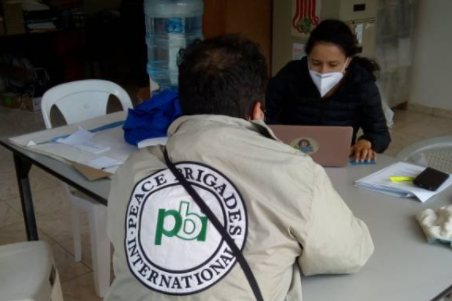
On November 23, the Peace Brigades International-Honduras Project tweeted: “PBI accompanies @COPINHHONDURAS in their offices to share about the risk situation and progress in the search for justice in the murder of #BertaCáceres.”

They add: “COPINH, family nucleus of #BertaCáceres and legal team will continue the precautionary measures in their favor according to the CIDH [Inter-American Commission on Human Rights].”

On July 5, The Guardian reported: “A US-trained former Honduran army intelligence officer who was the president of an internationally-financed hydroelectric company has been found guilty over the assassination of the indigenous environmentalist Berta Cáceres.”

That article adds: “Caceres, winner of the Goldman prize for environmental defenders, was shot dead two days before her 45th birthday by hired hitmen on 2 March 2016 after years of threats linked to her opposition of the $50m Agua Zarca dam.”

Now, more than four months later, David Castillo, the man found guilty in the murder, still has not been sentenced for this crime.

On November 19, Telesur also reported: “The family of Berta Cáceres and the members of COPINH will continue with the precautionary measures in her favor, as indicated by the Inter-American Commission on Human Rights (IACHR).”

Caceres family lawyer Víctor Fernández says Berta’s family faces “a power structure, the economic structure that murdered Berta Cáceres, who is not only David Castillo, but the company DESA, the national and international financial system that financed and even continues to benefit the entrepreneurs” who benefited from the concession of the hydroelectric dam” on the Gualcarque River sacred to the Lenca people.

Earlier this month, Open Democracy reported: “[COPINH continues to seek] the revocation of permission for the hydroelectric project. It wants the state to be held accountable for failing to protect Cáceres and to investigate the investment in initiatives premised on such massive human rights violations.”

PBI-Honduras has accompanied COPINH since May 2016.

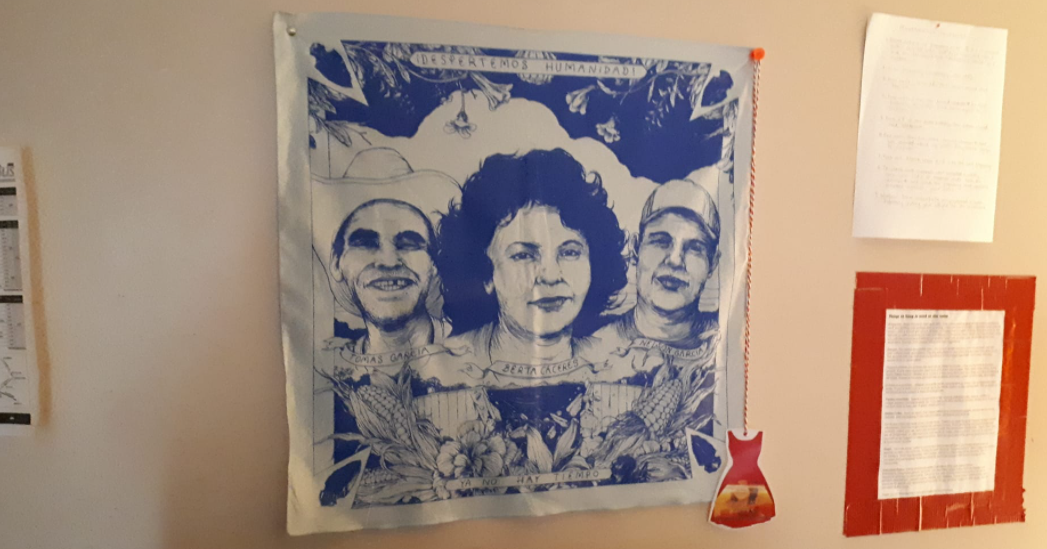
A wall-hanging in the Unist’ot’en Supporters House in the town of Houston, 7,200 kilometres north-west of Tegucigalpa. Wet’suwet’en land defenders and water protectors are being criminalized and are in jail for their struggle to protect their sacred Wedzin Kwa river from a fracked gas pipeline.

PBI-Colombia calls for urgent measures to guarantee life following the murder of social leader Hermer Antonio Monsalve

On November 20, Infobae reported: “The Humanitarian Action Corporation for Coexistence and Peace of Northeast Antioquia, Cahucopana Nordeste, denounced the murder of a social leader in Remedios, Antioquia. According to the corporation, the victim was identified as Hermer Antonio Monsalve.”

“According to the information provided by Cahucopana Nordeste, Monsalve was an inhabitant of the corregimiento of Carrizal and a candidate for the presidency of the Community Action Board (JAC).”

The news article also notes: “For its part, Peace Brigades International (PBI), described as worrying the wave of murders that Antioquia is experiencing.”

The PBI-Colombia tweet included above states: “The murder of another peasant in Carrizal is worrying. It is necessary to take urgent measures to guarantee the life of the communities in the Northeast Antioquia. PBI accompanies @CAHUCOPANA since 2013 in its promotion of human rights of campesinos.”

The PBI-Colombia tweet is also included in this Analisis Urbano article.

The Infobae article adds: “At least three people have been killed so far this week in the municipality of Remedios, located in the northeast of Antioquia.”

PBI-Colombia accompanies the Justice and Peace Commission as Jani Silva receives Amnesty International Write for Rights letters

On November 22, PBI-Colombia tweeted: “We thank the @SwedeninCOL embassy for the space shared with embassies to discuss the security situation of the leader Jani Silva, accompanied by @Justiciaypazcol. Today Jani received campaign letters #EscribeporlosDerechos [Write for Rights] from @amnesty in support of her defense of human rights.”

Representatives from the British, Norwegian, French and American embassies were present at the gathering at the Swedish Embassy.

Amnesty International has highlighted: “Jani Silva has dedicated her life to protecting the Amazon and the life that exists in it from efforts by armed groups and multinational companies to take control of her territory.”

This past April, they launched this video and a campaign to demand that Colombian authorities immediately take effective measures to guarantee the safety of Jani who has experienced multiple threats.

Yesterday, the New York Times published this guest essay in Spanish by Blanca Lucía Echeverry and Andrew Miller, the advocacy director for Amazon Watch and an active member of Peace Brigades International-USA.

They write:

“In the Putumayo region, members of the Border Command, an illicit armed group dedicated to controlling drug production on the border with Ecuador, told residents that they held negotiations with Nueva Amerisur, owned by the multinational oil company GeoPark, and agreed to ensure that nothing impedes the company’s work. so they warned residents not to interfere.

The criminal group declared environmental defender Jani Silva persona non grata, a priority case for Amnesty International. Since a threat of murder hangs over her because of her work to protect water resources and forest from oil exploration activities, she has been forced to move continuously to escape these killers.”

[Colombian president Ivan] Duque has done very little to protect [human rights] defenders or seek and bring their attackers to justice.

The National Protection Unit, created in 2011 to protect human rights defenders, in Silva’s case has provided transport support and, only under pressure, a certain police presence.

Although civilian and military authorities say they are investigating and taking steps to disarm illicit armed groups, in line with the commitment expressed in the 2016 peace agreement that ended a five-decade internal armed conflict with leftist guerrillas, organizations such as the Border Command continue to strengthen in the Amazon and other regions.

Most likely, Jani Silva’s situation will remain precarious.

But if Colombian and U.S. officials take concrete action, they could send a strong message that not only she, but the rest of the environmental defenders, have powerful allies who will leverage their influence to end the scourge of threats, attacks, and killings against those who protect the earth on behalf of all of us.”

Silva is accompanied by the Inter-Church Justice and Peace Commission, which has been accompanied by PBI-Colombia since 1994.