Home Blog Page 238

PBI-Guatemala accompanies family of Luz Leticia Hernández Agustín at remembrance ceremony

On April 19, the Peace Brigades International-Guatemala Project posted: “Today PBI accompanies the family of Luz Leticia Hernández Agustín in the ceremony of placing of the carnation of the university heroes and martyrs organized by the Center of Historical Memory of the USAC [University of San Carlos de Guatemala].”

Luz Leticia Hernández Agustín studied at the Belen Institute, School of Commerce and Faculty of Economics of the University of San Carlos. She was forcibly disappeared during the internal armed conflict.

The Inter-American Commission on Human Rights (IACHR) has noted Luz Leticia and Ana Maria López Rodríguez were “captured on November 21, 1982, by security forces made up of elements of the special operations reaction battalion (BROE) and the intelligence service. (SIM) while they were at the address located in block 4, block “E”, lot 13 of the Monte Real II neighborhood, zone 4 of Mixco.”

In 2014, the IACHR also reported on Case 9.111 that includes the disappearance of Luz Leticia, Ana Maria and Ileana del Rosario Solares Castillo.

The IACHR said:

“In Merits Report No. 60/01 dated April 4, 2001, the IACHR concluded that the State of Guatemala had violated the rights of Ileana del Rosario Solares Castillo, Ana María López Rodríguez and Luz Leticia Hernández to life (article 4), personal integrity (article 5), liberty personal (article 7), judicial guarantees (article 8) and judicial protection (article and 25) in conjunction with the obligation to guarantee the rights protected in the Convention [on human rights].”

“The Commission made the following recommendations to the State: carry out an impartial and effective investigation of the reported facts that determine the circumstances and [their] fate, … the identity of [those] responsible for their disappearance and punish them in accordance with the rules of legal due process…”

“Adopt full reparation measures for the violations verified, which include measures to locate [their] remains; the necessary arrangements to facilitate the wishes of his family regarding the final resting place of their remains; and an adequate and timely reparation for the next of kin of the victim.”

“The next of kin of the victim Luz Leticia Hernández Agustín have informed the State that prior to agreeing on an economic reparation or moral reparation measures, the State must deliver the remains of Luz Leticia.”

Impunity Watch has also noted that Luz Leticia’s disappearance is among the cases that have Historical Archive of the National Police (AHPN) documents.

On August 31, 2021, her mother Valentina Augustine stated: “After 39 years I’m still waiting, to start over, to heal the wound left 39 years ago by my daughter’s disappearance, only then will I be able to take the pause from my life. I demand the judiciary and public ministry where and why they took my daughter.”

Yesterday, USAC posted: “This act [the placement of a carnation] is considered by the relatives of the martyrs as a right to know and disseminate the truth.”

USAC tweet: “Today’s tribute remembers Luz Leticia Hernández Agustín.”

USAC tweet: “Leticia Hernández’s family remembers her as a woman committed to her family, small but with a big heart to help her neighbor, with a peasant and social conscience.”

Photo from Grupo De Apoyo Mutuo -GAM.

Photo by PBI-Guatemala.

PBI-Colombia seeks field volunteers, application deadline is May 2

The Peace Brigades International-Colombia Project is seeking field volunteers.

The deadline to apply is May 2.

The face-to-face training and final selection week will take place from August 28 to September 4 in Spain.

Those selected would begin to be placed in the field in late October and the following months.

Upon arrival in Colombia, new volunteers will receive a further two-week long Orientation/Initial Training in Bogotá.

From there, volunteers will be assigned to one of the field teams in Apartadó, Barrancabermeja or Bogotá.

It is crucial to know that applicants must be fluent in Spanish and be able to commit to 18 months of accompaniment work in Colombia.

While in Colombia, volunteers will receive a monthly stipend of 275 Euros and live in a PBI team house where their living expenses are covered.

The list of organizations that PBI-Colombia accompanies can be found here.

The application process and forms can be found here.

To watch the video of our  most recent webinar about being a PBI field volunteer, click here.

PBI-Canada webinar about fracking in Colombia, May 8

Carolina Agón, Yuvelis Morales and Bronwen Tucker. To register for our webinar to hear updates and analysis from them about fracking in Colombia, please click here.

The National Hydrocarbons Agency (ANH) has awarded contracts for two fracking pilot projects near Puerto Wilches in the Magdalena Medio region of Colombia.

The Kalé fracking project now has an environmental license from the National Environmental Licensing Authority (ANLA) to proceed. The licensing process for Platero is still underway.

Toronto-based Sintana Energy Inc. has highlighted that it “holds an undivided 30% non-operated participation interest in a Contract for Exploration and Production for Block VMM-37” where the Platero project would be conducted.

Calgary-based Canacol Energy Ltd., which holds two nearby “unconventional shale oil blocks”, has also commented that the Platero and Kalé projects are “positive steps towards realizing the commercial potential of the unconventional shale oil field in Colombia.”

The recent Banking on Climate Chaos report also notes that Toronto-based Scotiabank has provided millions of dollars in financing to Ecopetrol as well as Calgary-based Parex Resources, another company reportedly interested in fracking.

Webinar, May 8

Peace Brigades International-Canada is organizing a webinar on Sunday May 8 at 2:30 pm EDT to help build an understanding of what is happening in Puerto Wilches.

It will feature Carolina Agón (the vice president of the Federation of Fishermen of Puerto Wilches and a member of CREDHOS) and Yuvelis Morales (of Aguawil which is accompanied by CREDHOS). Both women have been threatened and displaced due to their activism against fracking in Puerto Wilches.

The webinar will also feature Bronwen Tucker (Edmonton-based Global Public Finance Campaign Co-Manager with Oil Change International). She will help us to understanding the Canadian corporate connections to fracking in Colombia.

To register for this webinar, please click here.

PBI-Canada webinar with PBI-Mexico accompanied defender Diana Villalobos Diaz, April 24

On April 24, join us to hear Diana Villalobos Diaz speak about the work of CONTEC in support of Indigenous communities in northwestern Mexico.

To register for this webinar, please click here.

Diana is a lawyer and the director of the PBI-Mexico accompanied Community Technical Consulting (CONTEC).

She will be talking about territorial struggles, self-determination for Indigenous peoples and the General Law on displacement.

Her work has also intersected with at least two Canadian companies.

Vancouver-based Pan American Goldfields

CONTEC spoke against the damage caused to the ecosystem in the town of Urique in Chihuahua after a dam at the Cieneguita gold-silver mine ruptured and the tailings waste travelled southward to the rivers and irrigation channels in the state of Sinaloa.

That mine is operated by the Vancouver-based mining company Pan American Goldfields Ltd. and the London, UK-based transnational Rio Tinto.

Calgary-based TC Energy

CONTEC also accompanied the struggle of the Indigenous Rarámuri forest community of San Elias Repechique against the TC Energy Encino-Topolobampo gas pipeline.

Diana co-authored this 43-page report on that struggle.

That struggle was not able to stop that pipeline, but it did result in the diversion of the pipeline away from the community of Repechique.

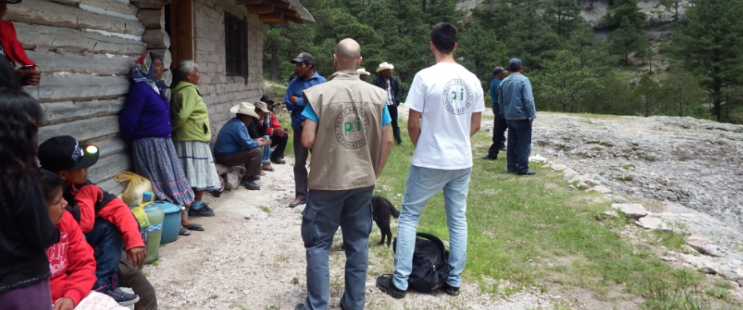
In August 2016, PBI-Mexico accompanied CONTEC on a visit to San Elías Repechique that struggled against the TC Energy pipeline.

Territorial struggles against mining, logging and tourism

Diana has highlighted: “There are three major economic projects in the mountains, these are mining, forestry and tourism. These concessions granted by the Mexican state to mining companies and those of forest exploitation, is without the consent of the indigenous population that are the most affected.”

Along with CONTEC drawing attention to the dam spill at the Cieneguita mine it is accompanying Repechique in their struggle to protect their forests from logging on Rarámuri land claimed by Fernando Cuesta as his Pino Gordo property.

CONTEC has also accompanied Repechique as they struggled against the Barrancas del Cobre-Creel Regional Airport being built in their ancestral forest.

There is also the continuing struggle against the dispossession of 154 hectares from the Rarámuri community of Mogótavo, located in the Copper Canyon, in the municipality of Urique, Chihuahua to develop a tourist complex.

On May 29, 2021, PBI-Mexico accompanied a mobilization against a tourist complex by the Indigenous communities of Mogotavo, Bacajípare and Huetosachi, of the Sierra Tarahumara for the defense of life and ancestral territory.

Self-determination

In August 2021, PBI-Mexico accompanied CONTEC at a blockade on the Creel-San Rafael highway conducted by the community of Repechique to further their demand for legal recognition of their ancestral territory.

On August 8, 2021, PBI-Mexico accompanied CONTEC at the mobilization convened by the Raramuri forest community of San Elias Repechique, to which members of the communities of Mogotavo, Cuiteco and Tewerichi also came.

General Law on displacement

As of December 2020, there were approximately 357,000 internally displaced persons in Mexico, up from 8,000 people in 2009.

While some have been displaced by climate change and natural disasters, the majority have been displaced by organized crime groups fighting for control of territory rich in natural resources, including timber.

Social movements have called on the López Obrador administration to implement the necessary protection frameworks in this regard.

PBI-Mexico reports that the Mexican Commission for the Defense and Promotion of Human Rights has highlighted that Chihuahua is one of the states with most episodes of internal forced displacement in the country.

Webinar, April 24

To learn more about CONTEC and these struggles, please join us at a webinar on Sunday April 24 at 2:30 pm EDT.

You can sign up for that webinar here.

PBI-Canada webinar with Chihuahua-based CONTEC director Diana Villalobos Diaz, April 24

On April 24, join us to hear Diana Villalobos Diaz speak about the work of CONTEC in support of Indigenous communities in northwestern Mexico.

To register for this webinar, please click here.

Diana is a lawyer and the director of the PBI-Mexico accompanied Community Technical Consulting (CONTEC).

She will be talking about territorial struggles, self-determination for Indigenous peoples and the General Law on displacement.

Her work has also intersected with at least two Canadian companies.

Vancouver-based Pan American Goldfields

CONTEC spoke against the damage caused to the ecosystem in the town of Urique in Chihuahua after a dam at the Cieneguita gold-silver mine ruptured and the tailings waste travelled southward to the rivers and irrigation channels in the state of Sinaloa.

That mine is operated by the Vancouver-based mining company Pan American Goldfields Ltd. and the London, UK-based transnational Rio Tinto.

Calgary-based TC Energy

CONTEC also accompanied the struggle of the Indigenous Rarámuri forest community of San Elias Repechique against the TC Energy Encino-Topolobampo gas pipeline.

Diana co-authored this 43-page report on that struggle.

That struggle was not able to stop that pipeline, but it did result in the diversion of the pipeline away from the community of Repechique.

In August 2016, PBI-Mexico accompanied CONTEC on a visit to San Elías Repechique that struggled against the TC Energy pipeline.

Territorial struggles against mining, logging and tourism

Diana has highlighted: “There are three major economic projects in the mountains, these are mining, forestry and tourism. These concessions granted by the Mexican state to mining companies and those of forest exploitation, is without the consent of the indigenous population that are the most affected.”

Along with CONTEC drawing attention to the dam spill at the Cieneguita mine it is accompanying Repechique in their struggle to protect their forests from logging on Rarámuri land claimed by Fernando Cuesta as his Pino Gordo property.

CONTEC has also accompanied Repechique as they struggled against the Barrancas del Cobre-Creel Regional Airport being built in their ancestral forest.

There is also the continuing struggle against the dispossession of 154 hectares from the Rarámuri community of Mogótavo, located in the Copper Canyon, in the municipality of Urique, Chihuahua to develop a tourist complex.

On May 29, 2021, PBI-Mexico accompanied a mobilization against a tourist complex by the Indigenous communities of Mogotavo, Bacajípare and Huetosachi, of the Sierra Tarahumara for the defense of life and ancestral territory.

Self-determination

In August 2021, PBI-Mexico accompanied CONTEC at a blockade on the Creel-San Rafael highway conducted by the community of Repechique to further their demand for legal recognition of their ancestral territory.

On August 8, 2021, PBI-Mexico accompanied CONTEC at the mobilization convened by the Raramuri forest community of San Elias Repechique, to which members of the communities of Mogotavo, Cuiteco and Tewerichi also came.

General Law on displacement

As of December 2020, there were approximately 357,000 internally displaced persons in Mexico, up from 8,000 people in 2009.

While some have been displaced by climate change and natural disasters, the majority have been displaced by organized crime groups fighting for control of territory rich in natural resources, including timber.

Social movements have called on the López Obrador administration to implement the necessary protection frameworks in this regard.

PBI-Mexico reports that the Mexican Commission for the Defense and Promotion of Human Rights has highlighted that Chihuahua is one of the states with most episodes of internal forced displacement in the country.

Webinar, April 24

To learn more about CONTEC and these struggles, please join us at a webinar on Sunday April 24 at 2:30 pm EDT.

You can sign up for that webinar here.

On March 24, 2022, PBI-Mexico signed an accompaniment agreement with CONTEC director Diana Villalobos Díaz in recognition of the danger her organization faces, notably for its work in defence of Indigenous rights.

PBI-Guatemala accompanies Mayan Poqomchi’ environmental defender David Alejandro Maxena Caal at court hearing

On April 18, PBI-Guatemala posted: “PBI accompanies David Alejandro Maxena member of UVOC at the hearing of coercion measures at the Cobán court.”

Earlier this month, UVOC posted: “Almost 2 months in prison without committing any crime. Since last February 14 this year, the Mayan Poqomchi’ community leader David Alejandro Maxena Caal, defender of human rights and mother land, was detained.”

UVOC adds: “The Santa Teresa Hydroelectric and the Shintun Agriculture S.A. municipality of San Miguel Tucuru, are the main plaintiffs against the communities that were stripped of their land that was an ancestral belonging to them.”

In January 2017, Avispa Midia explained: “In the case of the Santa Teresa hydroelectric plant, it belongs to the company Agro Comercializadora del Polochic, SA (AGROPOLOCHIC), a member of the CM [Corporacion Multi Inversiones] consortium.”

That article adds: “EGI Guatemala was involved in the construction of the Santa Teresa hydroelectric plant, located in the Polochic region, in the municipality of Tucurú, which is owned by the Agropolochic company, a member of the CM group.”

It further notes that EGI Guatemala is the main subsidiary of ENEL in Guatemala, which owns the El Canada hydroelectric dam. That dam has been described as a “controversial carbon finance project”.

The Santa Teresa dam is situated on the Polochic River, which discharges 70 per cent of the total freshwater input to Lake Izabal.

The Peace Brigades International-Guatemala Project has accompanied the Union of Verapaz Campesino Organizations (UVOC) since 2005.

On April 12, PBI-Guatemala also posted: “PBI accompanies David Alejandro Maxena, member of UVOC, Jorge Coc Coc and Marcelino Xol Cucul, members of the CCDA Verapaz The three defenders find themselves criminalized at Cobán prison.”

Three upcoming webinars!

We have three webinars in the coming weeks!

APRIL 24 – Accompanying the Rarámuri struggle for ancestral territory

Join us on Sunday April 24 to meet human rights defender Diana Villalobos Diaz who has challenged the Calgary-based TC Energy Encino-Topolobampo pipeline and the Vancouver-based Pan American Goldfields Cieneguita mine in Mexico.

Her Chihuahua-based organization CONTEC accompanies and supports Indigenous communities in their resistance struggles in the Sierra Tarahumara.

Register here.

MAY 8 – Accompanying water protectors in the fight against fracking

Join us on Sunday May 8 to hear Colombian environmental defenders Yuvelis Morales and Carolina Agón who have both received death threats due to their opposition to fracking in Puerto Wilches, Santander. They will be joined by Oil Change International researcher Bronwen Tucker who will speak about the role Canadian corporations have in fracking in Colombia.

Register here.

MAY 31 – Arms exports and militarization of territory

Join us on Tuesday May 31 to hear Mexican activist Quetzalli Villanueva, Dene land defender Little Wolf, and World Beyond War organizer Rachel Small speak about Canadian arms exports, militarization of territory, and peacebuilding.

This webinar will take place the day before the CANSEC weapons show in Ottawa.

Register here.

I hope you can join us!

Brent

Did the Colombian police use Canadian-made Bell 407 helicopters for surveillance of National Strike protests?

Photo: A Colombian national police Bell 407 helicopter.

The Ottawa-based Canadian Commercial Corporation (CCC) is a federal government agency that facilitates government-to-government contracts to sell Canadian goods and services to countries around the world.

Its 2013-14 annual report notes this “success story” in Colombia:

“As per the CCC contract with Ministry of Defense, four Bell 407 helicopters were delivered to the National Police; and two Bell 412 helicopters were delivered to the Naval Aviation Group [the Colombian navy]. The aircraft were manufactured by Bell Helicopter Textron Canada Ltd. of Mirabel, QC.”

Open-source research by Peace Brigades International-Canada reveals that Bell 407 helicopters were used for surveillance of the Colombian labour movement-organized National Strike mobilization on November 21, 2019.

On November 20, 2019, Semana reported that the Bell 407 Halcón (Falcon) helicopter would be used by the National Police to monitor National Strike protests in Bogotá with high resolution cameras with facial recognition technology.

At that time, Semana noted: “The aircraft, normally, carries four policemen (two pilots) and sends the images it takes to the police command, in real time, so that they are implemented in chases, padlock operations and all kinds of operations.”

Webinfomil.com further reported that the National Police would “deploy its entire fleet of Bell 407 Halcón surveillance helicopters … in the main cities of the country, where the most important concentrations are expected to occur.”

What was being surveilled?

The National Strike was convened by the Colombian labour movement, including the Unitary Central of Workers (CUT), the General Confederation of Labor (CGT) and the Confederation of Workers of Colombia (CTC).

Peace Brigades International-Colombia Project accompanied human rights defenders took part in the mobilizations that day.

The following day, Al Jazeera reported: “Hundreds of thousands of protesters marched through the dense city streets of Bogota and other cities across Colombia.” And AFP highlighted: “Spokesmen for several organizations backing the protests said more than one million people had marched nationwide.”

Why were so many people on the streets?

Semana Sostenible explains: “Stopping the killing of environmental and social leaders, stopping deforestation, prohibiting fracking and the use of glyphosate, protecting the moors and respecting popular consultations, are some of the reasons why environmentalists took to the streets to make themselves felt.”

How did the Colombian police respond?

By November 23, 2019, the PBI-Colombia accompanied José Alvear Restrepo Lawyers’ Collective (CCAJAR) tweeted: “The Colombian authorities must end the repression of social protests and the excessive use of force against those who demonstrate, guaranteeing the human rights of all people.”

PBI-Colombia echoed CCAJAR’s concerns by tweeting: “Social and peaceful protest is a human right above all else, disproportionate repressions cannot be justified against the civilian population, we request guarantees and respect for life.”

The National Strike protests continued into 2021, as have concerns about the actions and impunity of the Colombian national police.

In May 2021, the New York Times reported: “During Colombia ‘s decades-long conflict with violent rebel groups, the national police often fought on the front lines, using tanks and helicopters to combat guerrillas and destroy drug labs. It was a force made for war, one that has now found a new front, in the streets of Colombian cities , where police have been accused of treating civilian protesters as enemies on the battlefield.”

Were the Canadian-made Bell 407 helicopters sold to the Colombian National Police in 2013-14 used in the National Strike protests of 2021?

Ottawa Citizen reporter David Pugliese has previously noted: “The Ottawa-based CCC [Canadian Commercial Corporation] acknowledges  it conducts no follow-up to ensure exported Canadian-built equipment isn’t being used to abuse human rights.”

As such, the question remains unanswered.

We remain attentive to this situation and to the demands made by PBI-Colombia accompanied organizations NOMADESC and CREDHOS that Canada stop assisting the Colombian police with equipment as reported here and here.

PBI webinar, May 31

On May 29, 2014, the Canadian Commercial Corporation noted: “At CANSEC 2014, CCC led eight foreign delegations visiting from Argentina, Bahrain, Chile, Colombia, Kuwait, Mexico, Peru, and Saudi Arabia. CCC toured the exhibition floor with these delegations and introduced representatives to new Canadian technologies, facilitating meetings between foreign delegations and Canadian companies.”

The Bell 407 helicopters were sold to Colombia in 2013-14.

On this coming May 31, the day before CANSEC 2022, Peace Brigades International is organizing a webinar on arms exports and militarization of territory.

To register for that, please click here.

PBI-Colombia tweet: “The exercise of social protest is a basic right and legitimate political participation, #today we accompany the defender of #humanrights David Ravelo in #Barrancabermeja at the #NationalStirke.”

Thank you to CoDevelopment Canada for helping to amplify this story.

Coastal GasLink seeks criminal charges against Wet’suwet’en water protectors; next court appearance on June 1

Photo from Gidimt’en Checkpoint.

On April 17, Gidimt’en Checkpoint tweeted:

“On April 13, 2022 twenty seven land defenders arrested in the fall and into winter of 2021 on Wet’suwet’en territory appeared virtually before Justice Church.

Coastal Gaslink’s lawyer, Kevin O’Callaghan, recommended that the charges be criminal contempt, and not civil contempt.

…this would mean that the land defenders arrested during the Coyote Camp occupation at the drill pad site and the Likhts’amisyu Chief arrested on his own territory would face criminal charges.

We need to make [British Columbia’s Attorney General] David Eby aware that CGL [Coastal GasLink], the CIRG [the RCMP’s Community-Industry Response Group], and RCMP [Royal Canadian Mounted Police]…

…are abusing the intent of the court injunction to violently and illegally criminalize sovereign Wet’suwet’en people in an attempt to push through an industrial project that does not have the consent of the true title holders to the land.

The police have repeatedly used excessive force against unarmed Indigenous women and continuing to use an injunction to resolve Indigenous land issues will only result in further conflict and crisis.

The next court appearance for land defenders is scheduled for June 1st, 2022

At this appearance the crown prosecutor, Trevor Shaw will tell the court whether or not the BC Prosecution Service will intervene and take over the proceedings.

Visit http://yintahaccess.com and write to David Eby with your concerns.  AG.Minister@gov.bc.ca.”

The template letter to Eby is here.

Call-out for legal observers

Earlier in the week, Gidimt’en Checkpoint also tweeted: “Since March, RCMP have sent 6-8 officers into our village site, between 4-8 times each day, in order to harass & intimidate our elders, relatives & supporters.”

They then tweeted: “Come to the yintah and be a legal observer!”

They further explain: “We require a rotating team of upwards of a dozen legal observers. Your time and ethical commitment are the most useful assets; necessary supplies and training will be provided by experienced movement members & legal support organizers.”

The application form is here.

Drilling to start soon

This past February, a Coastal GasLink spokesperson stated: “We expect that the micro-drilling [under Wedzin Kwa] will take place starting this spring.”

The Terrace Standard adds: “[The] company is getting ready to install a starting shaft which is a deep circulation excavation acting as an entry point on the east side of the [river]. The active tunneling work is expected to take two and half to three months.”

Haudenosaunee land defenders Logan Staats, Skyler Williams and Layla Staats were arrested on November 18, 2021.

You can also help amplify this message with this tweet:

PBI-Honduras accompanies National Union of Rural Workers (CNTC) in the struggle for the right to land and food sovereignty

On April 17, PBI-Honduras tweeted:

“Despite their fundamental role in food production, 90% of rural women do not have land #DïaInternacionalDeLaLuchaCampesina [International Day of Peasant Struggles]. The #ONU [United Nations] invite #Honduras to review reforms of #CódigoPenal [Penal Code] that reduce civic space #criminalización [criminalization].”

The International Day of Peasant Struggles was established in 1996 by the international peasant movement La Via Campesina to commemorate the April 17th massacre of 19 landless Brazilian peasants.

At this time, we recall that Canada abstained in the vote on the United Nations Declaration on the Rights of Peasants and other people working in rural areas that was adopted by the UN General Assembly in December 2018.

PBI-Honduras has previously noted that this UN Declaration recognizes key elements such as “the right to land, to natural resources and to food sovereignty, based on the principle of equality between men and women.”

Image showing Canada’s vote on the UN Declaration shared by Andrea Nuila, gender and women’s rights coordinator at FIAN International, at a PBI co-organized webinar.

A 2-minute video produced PBI-Honduras, featuring two speakers from the National Union of Rural Workers (CNTC), can be seen here.

PBI Honduras has accompanied the CNTC since May 2018.

It is a small-scale farming and trade union organization that fights for a more just distribution of land in Honduras. Its aim is to support affiliated small-scale farming families so that they have access to land.

PBI-Honduras has noted: “Of the 404 communities that form the National Union of Rural Workers, just 20% have titles to their lands. Many others have worked and lived on their lands for three or four decades and have spent 15 years awaiting the official recognition of their rights that never seems to arrive.”

Overall, land distribution in Honduras is highly unequal.

Just 5% of large-scale farmers control almost two thirds of all cultivable land, while 71% of small-scale farmers have access to just 5% of it.

#DïaInternacionalDeLaLuchaCampesina