Home Blog Page 228

PBI-Mexico accompanies Justice for Our Daughters at remembrance for victims of disappearance, femicide and homicide in Chihuahua

On May 29, PBI-Mexico tweeted:

“Under the slogan ‘truth, justice and reparation’, relatives of victims of disappearance, femicide and homicide in the state of #Chihuahua, accompanied by @JusticiaPNH [Justicia Para Nuestras Hijas/Justice for Our Daughters], pay tribute and demand justice.”

On Facebook, they further note:

“PBI accompanies the acts organized by the relatives in the city of Chihuahua, who demand that the phenomenon of disappearances be visible, that searches continue and that full attention is given to the victims. They will do so on the 29th of each month.”

In March of this year, Martha Pskowski reported in the El Paso Times:

“Since the 1990s, murders of women in Juárez have drawn international attention. Chihuahua state now classifies femicide as the crime of killing a woman for reasons of gender. In 2022 so far, 26 women have been murdered in Juárez. According to the Executive Secretary of the National Public Security System (SNSP), on average 10 women were killed every day in Mexico during 2021.”

In November 2021, AFP also reported: “Mexico registered 736 femicide cases between January and September [of this year], following 975 cases in the whole of last year, according to official figures.”

That same month, The Globe and Mail reported that the number of women in Canada who were victims of homicide has risen over the past two years.

That article notes: “The spike – with 92 women killed in the first six months of 2021, an increase from 78 in the first half of 2020, and 60 in the first half of 2019.”

On March 7, Myrna Dawson wrote:

“The Canadian Femicide Observatory for Justice and Accountability (CFOJA) released 2021 numbers documenting the killings of 173 women and girls, primarily at the hands of men, on March 7. Since 2018, the CFOJA has documented the violent deaths of 700 women and girls, at least 90 per cent of which have been killed by men. This number includes 37 women and girls already killed in the first two months of 2022.”

Dawson adds: “For the prevention of femicide, this would also be a world free of misogyny.”

#CallItFemicide

Canadian company Terradyne sold armoured vehicles to the Saltillo police implicated in human rights violations

Still from Vanguardia video of Terradyne armoured vehicle used by the Saltillo Operational Reaction Group (GROMS).

The Newmarket, Ontario-based Terradyne Armored Vehicles Inc. has tweeted that it will be at the CANSEC arms show in Ottawa this coming June 1-2.

In May 2014, the Canadian company tweeted: “Mexico delegation stop by the Terradyne booth at @CANSECshow.” It has also tweeted that it was at EXPO Seguridad Mexico in April 2014. And in February 2014, it tweeted: “Take a look at this video of the GURKHA LAPV used by Saltillo Police Department – GROMS / SRT.”

These tweets were made amidst reports of human rights violations by the Operational Reaction Group (GROMS) in the city of Saltillo in the state of Coahuila.

In December 2012, MVS Noticias reported: “The Human Rights Commission of the State of Coahuila issued a recommendation against the municipal authorities of Saltillo for the arbitrary detention of a person by elements of the Operational Reaction Group, the GROMS, who caused injuries and kept the person incommunicado.”

Then in July 2013, the Migrant Human Rights Network (la Red DH Migrantes) expressed “its concern about the probable acts of torture, cruel, inhuman and degrading treatment, as well as violations of due process in the cases that occurred between March and June of this year [2013], documented and denounced by the Casa del Migrante de Saltillo ‘Frontera con Justicia’, AC, in the state of Coahuila.”

Their report compiled “the testimonies of at least 35 victims of alleged acts of threats, sexual assaults and torture by elements of the Municipal Preventive Police of Saltillo and agents of the Operational Response Group of the Municipality of Saltillo (GROMS).”

In August 2013, the World Organization Against Torture (OMCT) also stated: “The OMCT has learned that the first half of 2013 has been characterized by a disproportionate increase in violence against Central American migrants by the Municipal Preventive Police of Saltillo and the Operational Reaction Group of the Municipality of Saltillo (GROMS).”

Their article further noted: “The OMCT has been informed of cases of suffocation, electric shocks and rape among various torture techniques.”

In 2016, El Siglo Coahuila reported: “After it was found that elements of the Metropolitan Operational Reaction Group (GROM) assaulted four people in Saltillo [on October 10, 2013], the State Human Rights Commission ( la Comisión Estatal de Derechos Humanos/CDHEC) issued a recommendation to request that a procedure be initiated and that the elements that incurred in the violation of human rights be punished.”

In June 2018, this report co-authored by PBI-Mexico noted (on page 22): “In particular, [the Casa del Migrante de Saltillo/ House of the Migrant in Saltillo] cite the Reaction Group Metropolitan Operative (GROM), one of the most important police units in the past for his way of acting in abuse of authority, according to critics. According to the information received, said group would have found itself operational again in El Saltillo, integrated as a Group of Municipal reaction under a new scheme of security.”

And in June 2019, Vanguardia reported: “The Coahuila Human Rights Commission issued a recommendation against the Metropolitan Operational Reaction Group (GROM) for the murder of two countrymen who were executed on the Saltillo-Torreón highway.”

Last year, the Mexican Commission for the Defense and Promotion of Human Rights (Comisión Mexicana de Defensa y Promoción de los Derechos Humanos/CMDPDH) explained: “Although the special forces created in Coahuila between 2009 and 2012 were discontinued in 2016 after a series of scandals over cases of human rights violations, in reality they were only replaced by a new centralized organization called Fuerza Coahuila.”

Broader context

In 2016, the Amnesty International Surviving Death report demonstrated that “the Mexican police and armed forces routinely torture and ill-treat women, and that sexual violence is routine during arrest and interrogation.”

In 2019, Terradyne highlighted that it had sold its vehicles to the Nuevo Leon police in Mexico. It has also sold its Gurkha RPV vehicles to the Veracruz Fuerza Civil (civil force) and its MPV to the Ministry of Public Security in Ciudad Guadalupe, Nuevo.

CANSEC arms show, June 1-2

On Tuesday May 31, PBI-Canada will be hosting a webinar that discusses the issue of Canadian arms exports and militarization of territory in Mexico, Colombia and on Denesuline lands in northern Alberta. To register for that webinar, click here.

There will also be protests on June 1-2 against CANSEC. For more on that, click here.


Germany seeks to import more coal from Swiss-owned El Cerrejón mine that PBI-Colombia accompanied CCAJAR wants closed

Deutsche Welle reports: “El Cerrejon is the biggest open-cast coal mine in Latin America, and one of the biggest in the world. It sprawls across more than 69,000 hectares, an area the size of 100 soccer fields, and gulps down 30 million litres of water every day in the barren semi-desert of Colombia’s second-poorest department, La Guajira.”

“It is [now fully] owned by the Swiss company Glencore.”

The article highlights that German Chancellor Olaf Scholz spoke with Colombian President Ivan Duque about the mine in early-April. The Chancellor wans to import more coal from this mine to end its reliance on Russian coal.

Numerous groups in Canada including the Atlantic Regional Solidarity Network and MiningWatch Canada have also drawn attention to the fact that NB (New Brunswick) Power has been buying approximately 500,000 tonnes of coal from Cerrejón since the mid-1990s. Nova Scotia Power also imports coal from Cerrejón.

Impacts on the Indigenous Wayuu peoples

The Deutsche Welle article further notes: “Around 5,000 Wayuu children have died of starvation and thirst in the region around the mine.”

Rosa Maria Mateus Parra, a lawyer with the José Alvear Restrepo Lawyers’ Collective (CCAJAR), explains: “It’s caused by the shortage of water, because rivers and streams are contaminated, or have dried. And the lack of food because coal is now mined where indigenous communities grew their vegetables. Those children who survive have skin rashes and respiratory diseases because of the fine particle pollution.”

She adds: “We’ve proved all of this in court.”

Diversion of the Bruno stream

This situation could worsen.

The Unidas Por La Paz collective, formed in Berlin by Colombian immigrants, says that one day after the call between the German Chancellor and the Colombian President, El Cerrejón received permission from the Colombian government to divert the Bruno stream.

Infobae reports: “The permit for the exploitation of coal in Bruno stream was granted by the Ministry of Environment, without the consent of the Wayuu people, nor the experts who warned of the danger of drought.”

The article also explains: “The Bruno stream is the main tributary of the Ranchería River, the only river in the desert region of La Guajira, on which multiple indigenous, Afro-descendant and peasant communities depend for survival. According to experts, the diversion of the stream will cause it to dry out, preventing access to water for thousands of people.”

CCAJAR calls on UN Special Rapporteur

In 2020, CCAJAR asked Vancouver Island-based UN Special Rapporteur David R. Boyd to call for “an immediate suspension of the mining operations of Cerrejón” and “in accordance with its Paris Agreement obligations, relevant in order to guarantee the human rights of the Wayuu people, the Colombian State should gradually eradicate coal mining.”

CCAJAR further highlighted the impacts of the mine on the human right to water and noted: “The impact of the mining operation in the dramatic transformations of the water system of [Wayuu] territory in the last 30 years is undeniable.”

Boyd did speak against the mine.

Last year he commented: “I’m in hot water with the Government of Colombia right now because of a communication related to a massive open pit mine that has been damaging the human rights of the Wayuu indigenous people in Colombia for decades.”

“It absolutely boggles my mind that you can have a massive extractive operation that has produced billions of dollars in wealth for private investors and for the government of Colombia and right next door you have indigenous people who are living some of the most extreme poverty that I’ve witnessed in my life.”

He added: “That was a message not taken kindly by the companies or the government but those are situations that need to be highlighted and international attention will hopefully result in changes that advance the situation.”

CCAJAR launches constitutional action

Then in 2021, CCAJAR helped launch a constitutional action seeking the fulfilment of the right to participation for communities affected by the mine.

Their media statement explains: “The tutela action is a constitutional mechanism which allows any person to claim immediate judicial protection of their fundamental rights before a judge, at any time and in any place.”

It added: “These communities have suffered serious violations of human rights, affecting their right to a decent life, to water, to health, to food security and sovereignty, to information, to participation and to free prior and informed consent, among others.”

We continue to follow this situation.

PBI-Colombia has accompanied CCAJAR since 1995.

We are also deeply concerned that Canada may sell 50 light armoured vehicles (LAVs) to the Colombian army that could be stationed just 45 kilometres from the mine.

PBI-Colombia accompanies ACVC-RAN at workshop activities in Remedios, Antioquia

On May 27, PBI-Colombia tweeted:

“PBI accompanied @ACVCRAN [the Asociación Campesina del Valle del Río Cimitarra] in workshop activities of #human rights and #international humanitarian rights with the communities in the villages of Dos Quebradas and Campo Vijao, Remedios, Antioquia.”

PBI-Colombia has accompanied ACVC-RAN, a social organization operating in 120 villages in the Magdalena Medio region, since 2007.

It has previously explained: “For more than twenty years the ACVC has been striving for a dignified life for peasant families affected by Colombia’s internal conflict. It promotes the implementation of the Peace Agreement as a strategy to achieve structural changes in the Colombian countryside. One of its prime initiatives is helping small farmers substitute coca leaf plantations with environmentally sustainable agricultural projects.”

You can find ACVC-RAN on Facebook and Twitter.

PBI-Honduras accompanies CEHPRODEC as it works to defend the Talgua River and the Sierra de Agalta from logging

On May 27, PBI-Honduras tweeted:

“PBI accompanied @Cehprodechn [Honduran Centre for the Promotion of Community Development] during various activities in the Sierra de Agalta in the municipality of Catacamas, Olancho. We highlight the tremendous work that CEHPRODEC carries out in defense and protection of the environment in Honduras. #PBI has accompanied CEHPRODEC since 2014.”

On May 24, CEHPRODEC also posted on Facebook:

“Photographic summary of 5 days working hard accompanying the census survey in the Sierra de Agalta in the municipality of Catacamas. This activity was led by the Environmental Association Let’s Save the Talgua River and the Sierra de Agalta #AASARTSA, accompanied by the National University of Agriculture UNAG, the Rafael Madrid Institute, the Ecosystem and Environment Support Command #C9 and the Catacamas Municipal Mayor’s Office.”

Earlier this month, Tiempo reported:

“According to councilman Sergio Campos, there is currently concern in Catacamas, Olancho, due to the decay of the Talgua River.

Likewise, Campos reported that the Talgua River provides between “70% to 80% of the water we consume in Catacamas, and it is dying.”

Campos also mentioned the Sierra de Agalta, where 70% is in the territory of Catacamas, but we have turned our backs on it. The problem is the previous authorities and now we are practically doing the same.”

Campos also referred to the current situation of rivers in Honduras. “Despite the fact that President Xiomara Castro made a law, all that only remained on paper. What is happening is that we are fighting an organized group of criminals who are leaving us without natural resources,” Campos said.”

Last month, HCH also reported: “Environmental crime! Merciless logging slowly kills the Talgua River in Olancho.”

And last September, HCH reported: “The Talgua River is in danger if it exists, since the indiscriminate felling of trees is causing droughts. Surrounding residents accuse ranchers of carrying out the felling and ask the authorities to punish the forest murderers.”

We continue to follow this situation.

ALERT: Threats made against PBI-Colombia accompanied CCAJAR lawyer Yessika Hoyos Morales

On May 26, the José Alvear Restrepo Lawyers’ Collective (CCAJAR) tweeted:

“#Public Denunciation New threats against father of victim in Mondoñedo case and lawyer @YessikaHoyos member of @Ccajar.”

This statement from CCAJAR explains:

“On the morning of this Thursday, May 26, 2022, the human rights defender and member of the Cajar, Yessika Hoyos Morales, received on her cell phone a text message … which alludes to her work as a representative of Mr. Alfonso Mora León, father of Jenner Alfonso Mora, victim of the Mondoñedo massacre, committed by members of the National Police-Dijin on 6 and 7 September 1996.”

CCAJAR also notes:

“The day before, Wednesday, May 25, the defender also detected that in the afternoon there had been an illegal entry into her home. When a relative arrived at the home, she found the door wide open and some of the items in a different arrangement than usual.”

This is not the first threat in this case.

In June 2021, we reported on a previous threat in this article: PBI-Colombia accompanied CCAJAR lawyer receives threat during hearing into police killing of university students.

This past January, Hoyos spoke on a Day of the Endangered Lawyer webinar co-organized by the Law Society of Ontario’s Human Rights Committee.

In 2016, they issued this statement: The Law Society of Ontario expresses grave concerns over the harassment and intimidation of Yessika Hoyos and members of the José Alvear Restrepo Lawyers’ Collective (CAJAR).

The most recent threats come less than two weeks after the Inter-American Court of Human Rights (IACHR) held a public hearing on the persecution of CCAJAR, including illegal intelligence activities against them by different State agencies.

For more on this, please see our article: PBI-Colombia accompanies CCAJAR lawyers collective at Inter-American Court of Human Rights hearing.

PBI-Colombia has accompanied CCAJAR since 1995.

PBI-Colombia accompanies Nydia Erika Bautista Foundation at premiere screening of “Patidescalzas” in Bogota

On May 26, PBI-Colombia tweeted:

“Today in @centromemoria [the conference Centre for Memory, Peace and Reconciliation in Bogota] we accompany @nydia_erika [the Nydia Erika Bautista Foundation/FNEB] at the premiere of the documentary Patidescalzas on #Buenaventura, which pays tribute to black women seekers in their tireless search for truth, justice and reparation, in the midst of 120,000 disappeared people in #Colombia.”

Pikara magazine has previously explained that the women from Buenaventura seeking justice call themselves patidescalzas (or foot-footed or foot-shod), those who usually walk without shoes (and do and say what they think).

That article also notes:

“In the district of Buenaventura there are at least 1,200 missing persons, according to data collected by the Mothers for Life association [Madres por la vida] and the Nydia Érika Bautista Foundation (FNEB).

With the delivery of the report ‘Forced disappearance in Buenaventura. Dignify black lives and the struggle of women’, Mothers for Life and the FNEB demand that the Special Jurisdiction for Peace (JEP) investigate everything that happened in Buenaventura.

“The direct testimonies of the victims on which this report was based show an alarming impunity, racial discrimination and discrimination based on social origin, including in the administration of justice, and serious obstacles to accessing the rights to truth and justice that deepen the historical and structural discrimination of Afro-Colombian families and communities, and in their capacity as victims of the internal armed conflict, which continues to devastate the region.””

Truthout has also provided this additional context:

“The 2016 peace accord between the Colombian government and the Revolutionary Armed Forces of Colombia (FARC) was supposed to bring peace to regions like Buenaventura.

Under the accord’s “Ethnic Chapter,” the government would coordinate with Afro-descendant and Indigenous authorities to implement the accord’s provisions, including its security guarantees.

Five years after passage of the accord, its rural reform initiatives and security guarantees are among its least implemented provisions, as are those promoting Indigenous and Afro-descendant collective rights and gender justice.

This lack of implementation has had especially harmful implications for Buenaventura. The majority-Black region has long suffered state abandonment and soaring rates of poverty and unemployment. Residents overwhelmingly lack access to quality health care, education and constant running water.

Gender violence victims in Buenaventura have almost nowhere to turn for protection or justice. In the face of grinding poverty, youth are vulnerable to being pushed into armed groups that are battling to control narco-trafficking and illegal mining.

The Colombian government’s often hostile posture towards Afro-descendant and Indigenous collective territorial rights has not helped.

In 2009, Colombia’s Constitutional Court linked increased armed group violence in Afro-descendants’ communities to the state’s weak institutional backing for their rights.

It recognized three factors driving Afro-descendants’ disproportionately high rates of forced displacement: extreme poverty and exclusion, large-scale mining and agricultural interests, and deficient institutional and legal protection for their collective territorial rights.

The court found that these factors encouraged paramilitary and guerrilla groups to threaten Afro-descendant populations in a bid to get them to flee their territories.

By late 2017, a year after the peace accord was signed, the court found that these conditions had only worsened.”

We continue to follow this situation.

Global Affairs Canada responds to PBI-Canada on the human rights impacts of the Canada-Colombia Free Trade Agreement

Photo: The Canadian Embassy in Bogota.

In March of this year, Peace Brigades International-Canada responded to the public call from Global Affairs Canada for comments for the Annual Report on Human Rights related to the Canada-Colombia Free Trade Agreement.

We highlighted the “need to include Canadian investment in the fossil fuel industry in Colombia in this annual review, as well as to provide greater transparency on the trade in services and technology that supports this sector.”

We noted that Canadian oil and gas investments in Colombia totalled $8 billion in 2018 (the second largest location for Canadian energy assets abroad).

We also specified concerns about the Calgary-based companies Parex Resources in Santander and Gran Tierra in Putumayo.

We further noted community opposition to fracking and the risks being experienced by environmental defenders in Colombia. The Platero fracking pilot project is on an exploration block co-owned by Toronto-based Sintana Energy.

And we conveyed that we could not see how our input last year on the situation in Buenaventura was reflected in their previous report.

We had amplified the concerns of PBI accompanied organizations who have said that an increased trade in goods has human rights implications for this port city. We asked Global Affairs Canada to acknowledge the impacts of the port on the majority Afro-descendant/Black population of Buenaventura.

Response

Our submission stated: “We encourage you to reconsider the exclusion of investment provisions, especially with respect to fossil fuel and mining investment.”

On May 25, we received a one-page response that highlighted “the scope of this report does not include investments by private enterprises.”

Criticisms of the reports

In May 2014, then NDP trade critic Don Davies commented: “It’s a sham. Investment is a very big part of our trade with Colombia and to arbitrarily exclude that is another indicator that the government has no intention of producing a real report.”

By 2017, Amnesty International Canada withdrew from the annual process.

The 2021 report, when tabled in the House of Commons, will be posted here. We hold some hope that it will respond to our request for “details and analysis on the trade in products and services related the oil and gas industry in Colombia, including in mature fields and hydraulic fracturing (fracking).”

Our submission to Global Affairs Canada can be read in full here.

Letter from Global Affairs Canada.

Report on sexual misconduct in Canadian military to be released just prior to CANSEC arms show in Ottawa

Ottawa Citizen journalist David Pugliese reports: “Former Supreme Court Justice Louise Arbour has provided National Defence with a copy of her long-awaited review of sexual misconduct in the ranks.”

Pugliese adds: “The review, requested by the department, is expected to be released to the public by May 30.”

That’s just before hundreds of Department of National Defence personnel, as well as the Vice Chief of the Defence Staff and the Minister of National Defence, will be at the CANSEC arms show in Ottawa (June 1-2, EY Centre).

For more on a civil society protest against CANSEC, please click here.

Pugliese further notes: “One senior retired officer told Arbour’s team that National Defence and the Canadian Forces typically respond to sexual misconduct allegations by trying to undercut victims and protect the senior leadership. Sexual misconduct is seen as a public-relations problem, the officer added.”

This past October, CBC reported: “Since early February 2021, 13 senior Canadian military officers — current and former — have been sidelined, investigated or forced into retirement from some of the most powerful and prestigious posts in the defence establishment.”

That article adds: “Experts say they can’t think of another military anywhere else in the world that has seen so many senior leaders swept up in scandal at the same time.”

Colombia

In July 2020, The Guardian reported: “At least 118 members of the Colombian army have been investigated since 2016 for alleged involvement in sexual abuse against minors, the head of the army has said, amid accusations of sexual violence by soldiers against young girls.”

On June 23, 2021, the BBC also reported: “Temblores [says] it has received reports from 28 protesters who allege they were sexually abused by members of the security forces [since the National Strike began on April 28, 2021].”

In Colombia, the national police are part of the Ministry of National Defence.

WOLA has also noted that when the national strike began “human rights defender Berenice Celeita and her team at the Association for Research and Social Action (Nomadesc) were out in the streets of Cali monitoring and assisting the victims of police violence.”

That article adds: “Currently, Nomadesc represents over twenty cases of victims of this recent police violence. Among these cases are the parents of youth killed by the police, women subjected to sexual abuse, torture survivors, and individuals who have permanent ocular injuries due to the actions taken by security forces.”

Mexico

And in October 2020, WOLA reported: “The Tlachinollan Human Rights Center based in Guerrero, Mexico recently released a statement regarding the lack of progress in the cases of Inés Fernández Ortega y Valentina Rosendo Cantú, Indigenous women who were sexually tortured by members of the Mexican army in 2002.”

Their article adds: “The Interamerican Court of Human Rights ruled against Mexico in 2010, but the Mexican government has not fully fulfilled the obligations laid out by the court in its judgement.”

In 2016, the Amnesty International Surviving Death report demonstrated that “the Mexican police and armed forces routinely torture and ill-treat women, and that sexual violence is routine during arrest and interrogation.”

Among the recommendations in that report: “Order the prompt withdrawal of the armed forces from public security tasks, for which they are neither trained nor accountable.”

Canada

Following the release of the report The Toxic Culture of the RCMP, co-author Pam Palmater said: “If female RCMP officers are not safe from sexual assaults by male officers, it should be no surprise that marginalized Indigenous women and girls are not safe either.”

The concerns that have been raised about sexual violence in relation to the extractive industry and man camps could perhaps be extended to military bases.

WILPF has noted: “Since the first foreign military bases, activists and academics alike have highlighted and condemned the relationship between US military bases and forced prostitution, trafficking, and sexual exploitation of women and girls on or near the bases.”

Given the prevalence of violence against women within the military, violence against women by the Canadian military should also be documented.

There have been reports of Canadian (RCMP) peacekeepers involved in sexual misconduct in Haiti and of Canadian soldiers involved in misconduct Bosnia.

Webinar, May 31

On Tuesday May 31, please join Berenice Celeita from Nomadesc (Colombia) and Quetzalli Villanueva from Tlachinollan (Mexico) who will speak to this reality and the human rights implications of militarization. To register for that webinar, click here.

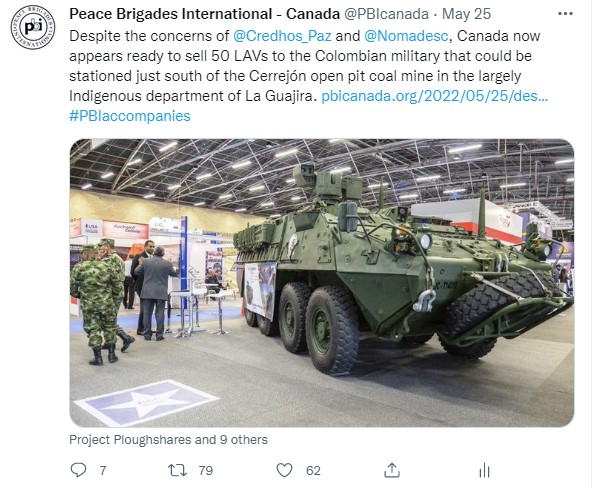
Despite calls from human rights defenders to freeze arms exports, Canada will sell 50 LAVs to the Colombian military

Photo: General Dynamics Land Systems exhibits its 8×8 LAV III at Expodefensa 2017 arms show in Bogota, Colombia.

On May 20, Infodefensa.com reported: “Yesterday, May 19, the Colombian Government, through the Ministry of Defense, approved the purchase of 50 General Dynamics Land Systems (GDLS) 8×8 LAV III DVH armored vehicles.”

The article adds: “The LAV III DVH is manufactured by the Canadian subsidiary of General Dynamics Land Systems.”

The deal appears to have been several years in the making.

In 2019, Infodefensa.com had also reported that the Colombian Army had shown interest in acquiring the LAV-III vehicles.

LAVs sold to Colombia in 2013-15

It’s not the first time Canada has sold light armoured vehicles (LAVs) to Colombia.

In January 2013, GDLS-Canada announced: “The Colombian Ministry of National Defence has awarded a USD $65.3 million contract to General Dynamics Land Systems-Canada for 24 Light Armoured Vehicles for the Colombian Army.”

Their media release adds: “The contract was signed through the Canadian Commercial Corporation, a Crown Agency of the Government of Canada.”

It was later reported that 32 LAVs were exported to Colombia.

La Guajira

In January 2015, ArmyRecognition.com noted: “The LAV III will go to the Colombian Army Combined Medium Arms Task Force, an army unit based in the town of Distracción, Guajira department, on the border with Venezuela.”

Distracción is located about 45 kilometres south of Cerrejon (where an open pit mine that exports coal to Canada is being challenged by the PBI-Colombia accompanied José Alvear Restrepo Lawyers’ Collective/CCAJAR).

The International Work Group for Indigenous Affairs (IWGIA) has also noted: “Most of the population of La Guajira department are Indigenous people who have survived for centuries in a hostile environment. …The Indigenous people blame more than 30 years of coal mining for contaminating their reservoirs. As if that were not enough, the mining companies have obtained licences to divert rivers and exploit the riverbeds.”

InfoDefensa.com now suggests the new LAVs that the Colombian Ministry of Defense wants to buy would also be stationed in La Guajira.

Canadian arms exports and the false positives scandal

This is also not the first time that human rights implications have been expressed about the sale of light armoured vehicles to the Colombian military.

In July 2015, Lee Berthiaume reported in the Ottawa Citizen: “Questions are being raised over the Conservative government’s push to sell arms to developing countries following explosive allegations linking Colombian military officers to the killing of hundreds of civilians during the country’s bloody civil war.”

This refers to false positives/falsos positivos.

“False positives” refers to innocent people extrajudicially killed by members of the Colombian army, and then falsely labelled as enemy combatants. It is now believed that 6,402 people were murdered by the army in this way between 2002 and 2008.

Colombian HRDs call on Canada to stop arms exports

This new sale comes after Colombian human rights defenders called on the Canadian government not to supply the Public Force/Fuerza Publica (the military and police) following the violence seen during the national strike/paro nacional in 2021.

Last year, the PBI-Colombia accompanied Regional Corporation for the Defence of Human Rights (CREDHOS) stated: “The military and the police are interfering with peaceful social protest. The army is patrolling different urban areas of the cities. We are calling on the international community to ensure that logistical or financial support to the police and national army is stopped because right now they are attacking the people and we don’t want that to continue.”

CREDHOS added: “If there is any sort of military support or technical assistance, please abstain from providing that military aid because they are attacking the civilian population.”

And on December 1, 2021, and May 16 of this year, just three days before the deal to sell the LAVs was announced, the PBI-Colombia accompanied Association for Research and Social Action (NOMADESC) met with Canadian Ambassador to Colombia Marianick Tremblay and called on her to ensure Canada did not support the Public Force.

Civil society, MPs and international community

Civil society, Members of Parliament in Canada and the international community have supported this demand.

In May 2021, the Americas Policy Group noted: “In 2014, Canadian-made light-armoured vehicles (LAVs) were sold by INKAS Armoured Vehicles Manufacturing to the Colombian government.” It then asked: “Could these same vehicles be the ones now being used to attack peaceful protests?”

That same month, the United Church of Canada stated: “Canada’s sale of light armoured vehicles and armoured personnel vehicles to Colombia regardless of their intended use is deeply concerning.”

And the New Democratic Party (NDP) highlighted with respect to Colombia: “The Liberal government needs to do a lot more to show that they are applying the arms export risk assessment criteria rigorously, to ensure that Canadian arms are not being sold to countries where there are concerns about human rights violations.”

NDP MP Heather McPherson further commented: “The violence and repressive tactics used by the Colombian police and military is shocking and unprecedented. The right to peaceful protest is important for any society.”

In June 2021, Bloc Québécois Member of Parliament Simon-Pierre Savard-Tremblay stated: “We want the Minister for Foreign Affairs to seriously reassess the export licences for military equipment to Colombia.”

Savard-Tremblay also noted: “As long as there is reasonable doubt that military equipment exported to Colombia is being used against the civilian population in human rights violations, licences should be suspended.”

Amnesty International Canada also stated: “Amidst profound concern about the deepening human rights crisis in Colombia and militarized repression of ongoing demonstrations across the country, Amnesty International Canada is calling on the Canadian government to suspend weapons exports to the South American country.”

That same month, more than 228 academics from across Canada wrote an open letter to Prime Minister Justin Trudeau that stated:

“Canada must also review any current or projected cooperation with the Colombian police or military and prohibit any future sale of weapons or light-armoured vehicles by Canadian companies until Colombia has reformed its National Police, among others to abolish the ESMAD and to foreclose the application of military justice to police officers.”

In October 2021, the International Observation Mission for the Guarantees of Social Protest and Against Impunity in Colombia included the recommendation:

“The European Union is required to suspend the sale of military weapons and riot control equipment under criterion 2 of the EU Code of Conduct on arms export. To the United States, and to any country that provides military weapons or riot gear, you are required to suspend sales commercial or donations of such weapons to ESMAD.”

Questions

At this point, it’s not clear if the sale has been finalized.

Nor is it clear if the Canadian Commercial Corporation has approved/signed the contract for the export of the vehicles to Colombia.

These are questions to be asked of Mary Ng, the Minister responsible for Canadian Commercial Corporation.

We will be trying to find out the answers to these questions.

Webinar, May 31

This issue will also be discussed on an upcoming PBI-Canada organized webinar on Canadian arms exports and militarization of territory that will include Berenice Celeita from NOMADESC and Rachel Small from World Beyond War.

To register for this webinar, click here.

So far, 115 people have registered for this webinar that will take place the afternoon before GDLS-Canada will be at the CANSEC arms show in Ottawa.

Image from CANSEC arms show in Ottawa, 2019.