Home Blog Page 224

PBI-Mexico accompanies ASMAC and CONTEC at Meeting of Indigenous Communities in Coloradas de la Virgen, Chihuahua

Photo by the Red en Defensa de Territorios Indígenas de la Sierra Tarahumara.

El Heraldo de Chihuahua reports:

“Children, adolescents and adults attended the Meeting of Indigenous Communities in Coloradas de la Virgen, Guadalupe and Calvo, Chihuahua; with the objectives of exchanging experiences on the defense of territory and natural resources between the Purépecha community of Cherán and the indigenous communities that make up the Network in Defense of Indigenous Territories in the Sierra Tarahumara (REDETI); as well as strengthening ties between the participating communities and filing complaints, on the part of the indigenous communities, with the State Human Rights Commission.”

“The meeting was organized by REDETI, made up of four civil society organizations [including the PBI-Mexico accompanied] Alianza Sierra Madre A.C. (ASMAC) and the Community Technical Consulting A.C. (CONTEC); and the indigenous communities that accompany in the defense of their territory and natural resources.”

“It highlights the participation of people who have been victims of forced displacement due to violence, the dispossession of territories and natural resources, in Coloradas de la Virgen, who had the opportunity to visit their place of origin after years of longing to return.”

“There was the presence of Peace Brigades International (PBI), an organization that provides support, protection and recognition to organizations and human rights defenders through international accompaniment.”

The full article can be read at Celebran encuentro de Defensa de Territorios Ancestrales en Guadalupe y Calvo.

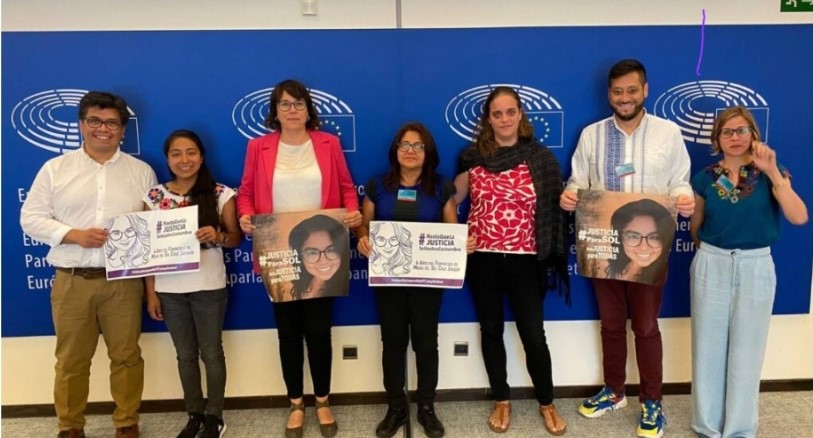
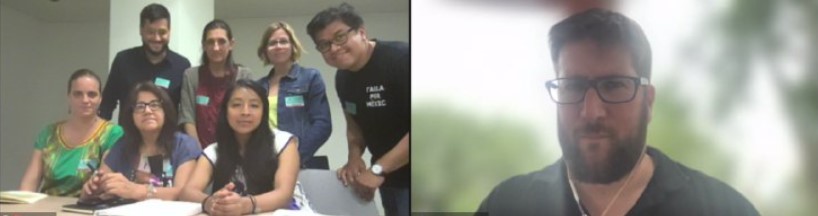
PBI-Mexico accompanies visit of Soledad Jarquín Edgar in Brussels as she seeks justice for the femicide of her daughter

Photo by SemMéxico.

SemMéxico reports: “During the last four days, Soledad Jarquín Edgar was in [Brussels], where accompanied by the organization Consorcio Oaxaca, she presented to different instances of the European Union the impunity and therefore the denial of justice in the femicide of her [27-year-old daughter María del Sol Cruz Jarquín on June 2, 2018].”

The article further notes that the visit to Brussels was also accompanied by the Peace Brigades International-Mexico Project, the World Organization Against Torture, Taula per México, and the EU-Lat Network.

And it explains: “Soledad Jarquín met with MEPs, as well as representatives of parliamentary groups, who expressed solidarity with the struggle of the defender and pledged to take all possible actions from her seat to achieve #JusticiaParaSol.”

Italian MEP Massimiliano Smeriglio (Group of the Progressive Alliance of Socialists and Democrats in the European Parliament), Catalan MEP Diana Riba i Giner (Group of the Greens/European Free Alliance) and Spanish MEP Miguel Urbán Crespo (The Left group in the European Parliament – GUE/NGL) all expressed their solidarity.

Smeriglio said: “I have met Soledad Jarquín Edgar, the mother of María del Sol, who was murdered 4 years ago in the state of Oaxaca. As co-chair of the EU-Mexico Commission, I pledged to follow the case and monitor the situation of femicide in the country.”

The article also notes: “Soledad Jarquín also met with representatives of the European Executive, responsible for the Human Rights and Mexico sections of the European External Action Service (EEAS), who showed strong concern when they were informed of the widespread impunity, the increase in femicides and the lack of due investigation that exists in the majority of violent deaths of women despite the existence of the criminal type of femicide.”

Soledad Jarquín will next travel to France, Switzerland, Germany and Spain.

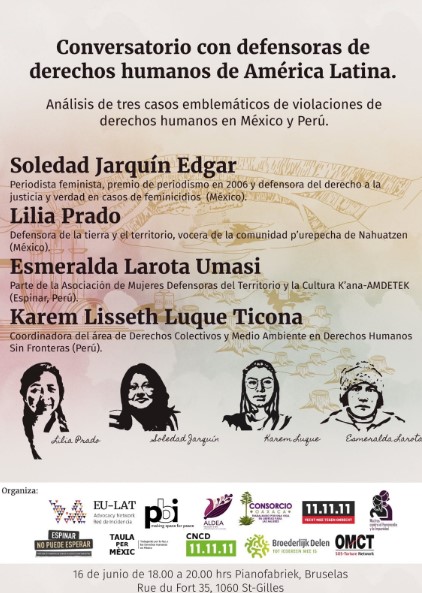
As noted on the poster below, Lilia Prado is also a featured speaker on this tour. She also met with MEPs including Miguel Urbán Crespo and Massimiliano Smeriglio.

Prado is a defender of the land and the rights of indigenous women. She comes from the Nahuatzen Community, in the Purépecha Plateau, in the State of Michoacán. She demands the recognition of Purépecha collective identity and the self-management of the territory under its uses and customs.

PBI-Colombia accompanies Nydia Erika Bautista Foundation at meeting with the German Embassy

On June 17, PBI-Colombia tweeted:

“Thank you @EmbAlemaniaCOL [German Embassy in Colombia] @caritas_ci [Caritas International] for meeting with @nydia_erika [Nydia Erika Bautista Foundation] after attacks and illegal intelligence against them, affecting +400 victims of #Forced Disappearance. International support is essential for #Women Searchers who demand Truth, Justice and Non-Repetition. @giz_gmbh [German Society for International Cooperation]”

This follows the German Embassy tweeting:

“Kidnapping, physical attacks, theft of sensitive information from victims. Very worrying what the Nydia Erika Bautista Foundation has told us and the pressure to which the social leaders of the country are subjected. It is essential to clarify the crimes and more security.”

PBI-Colombia also recently accompanied the Nydia Erika Bautista Foundation at meetings with representatives of the Embassies of France, Sweden, the European Union and Ireland.

This meeting follows a break-in at the office of the Foundation on June 5.

Infobae has reported: “[The Nydia Érika Bautista Foundation] denounced that in the early hours of last Sunday [June 5] a man entered the headquarters of the foundation in Bogotá where he stole information linked to a meeting [on June 1] with the president of the Truth Commission, the Jesuit priest Francisco de Roux, and photographs of the victims represented, members of the work team and the families that are accompanied by the foundation.”

Still from video of the break-in.

The Foundation has also stated: “These acts of intimidation of our defense of victims of forced disappearance, sexual violence and victims during the National Strike, now occur in the context of the recent delivery of Recommendations to the Truth Commission, legal actions and memory.”

It has also denounced: “The repeated theft of information and resources from the Nydia Erika Bautista Foundation and its directives in the last 9 months are not isolated events, they affect more than 400 victims in territories and could derive from intelligence and intimidation actions.”

In response, PBI-Colombia has tweeted: “Deep concern and solidarity with @nydia_erika for direct attack, theft of sensitive information and #illegal intelligence that exposes them to high risk as well as victims #Forced Disappearance to those who defend! Effective investigations are urgently needed to avoid #Impunity.”

PBI-Canada joins with the concern expressed by PBI-Colombia and other entities calling for an investigation and recovery of the stolen information.

PBI-Honduras highlights the Nueva Esperanza farmers as they may receive land titles after four generations of working the land

In this article, PBI-Honduras notes:

“The arrayán (Southern wax myrtle or bayberry) is a medicinal shrub that has curative properties, including the ability to cleanse the lungs.

It is also the name of the village where in 1983 seventeen women created the peasant farmers’ organization Nueva Esperanza (New Hope), in the municipality of Comayagua (Department of Comayagua).

The name, chosen for its powerful symbolic meaning, referred to the healing that they intended to bring to the “forgotten and mistreated” state-owned, untitled land* where they had lived for generations.

“The land was the dumping ground for Comayagua; our children lived surrounded by flies. You could find literally anything: hospital waste, human bones, glass, syringes… I remember that the roofs of our houses were made of discarded waste, people cut their feet whenever they walked anywhere and we had almost no water,” explains Isidra García Colato, president of the Nueva Esperanza peasant farmer organization.

The female founders of the group have worked hard for change despite the local context where women were considered to be “only good for cooking and giving birth to children”.

From the very beginning they were aware that they would need to collaborate with other groups.

“First we joined the Rural Workers’ Union (UTC) and then the National Rural Workers’ Central (CNTC).”

PBI-Honduras has been accompanying CNTC since May 2018.

In the last decade, Honduras’ National Agrarian Institute (INA) granted almost 79,000 land titles nationwide, of which only 37% correspond to women, and currently only 14% of all rural women have a land title.

If land access for rural women is difficult, access to financial resources remains virtually impossible. For precisely this reason, one of the biggest demands of rural women is the urgent implementation of the Solidarity Credit for Rural Women (CREDIMUJER) – a program approved by the National Congress over 7 years ago in 2015. However, the Honduran government has still not managed to implement the program.

As they waited for the land title or a loan that would give them to apply for the titles, the women of Nueva Esperanza, backed by the CNTC, continued training, increasing their knowledge of women’s rights and breathing life into a local literacy campaign.

Several years later, the land began to yield fruit: “we managed to dig our own well and the fields began to heal. We produced all sorts, we even had mangoes and plums,” recall the founders of this rural grassroots organization.

After forty years of struggle, bureaucratic procedures and a hard work, the women were recently issued the agrarian bonds in order to pay the supposed owners.

This has given rise to another “New Hope”: that the land titles might finally be registered in the name of those who have always cared for them and their descendants, since “we are already four generations who have lived and worked this land”.

To read the full article, click on Women, a ‘New Hope’ for the rural population.

FIDH comments on the European Commission’s proposed Directive on Due Diligence

On March 12, 2021, Euractiv reported: “[Members of the European Parliament] have urged the European Commission to table an ambitious due diligence law obliging [European Union] companies to address all aspects of their value chains that could affect human rights, the environment and good governance.”

On February 23, 2022, the European Commission released its proposal for a Directive on Corporate Sustainability Due Diligence.

In its commentary on that proposal, the International Federation for Human Rights (FIDH) says:

“Our organisations welcome publication of the proposal. Current voluntary instruments and business self-regulation have failed to stop corporate abuse. …However, while the proposal contains some very good elements, it still falls short on numerous fundamental points. …We regret that in drafting the proposal, the EU too often disregarded the existing globally agreed-upon set of best practice principles, which outline how corporations should ensure respect for human rights.”

Among its recommendations for improvements:

“Reinforce the role of civil society and the place of affected populations in the due diligence process. Provide for meaningful engagement of companies with the stakeholders; draw particular attention to indigenous people, human rights defenders, and vulnerable peoples or groups; and protect against reprisals.”

FIDH and its members recommend the inclusion of a specific article on consultation of stakeholders, including human rights defenders.

Their analysis says:

“[This article should note that] the involvement of stakeholders, including human rights defenders and trade unions, should happen at all stages of a project design, implementation, and monitoring, and at different levels of the value chain. It should also be warranted when designing and implementing remedial mechanisms.

The core provisions of the Directive should include an obligation to respect the free, prior, and informed consent of indigenous peoples.

The text needs to provide a specific provision on the protection of victims and the risk of reprisals faced by human rights defenders, trade union members, and local communities.”

In a presentation to the European Parliament’s Committee on Development (DEVE) last month, Peace Brigades International-Guatemala Project advocacy coordinator Kerstin Reemtsma highlighted:

“It is central that on one side the due diligence initiative and also the directive on the environment, includes strong provisions for the protection of human rights defenders, mainly environmental defenders, as well as very clear mechanisms for participation, meaningful participation prior to investment and environmental impact assessments of major development projects.”

In May 2021, the Canadian Network on Corporate Accountability launched model legislation for due diligence and corporate accountability in Canada. The Canadian model legislation can be read here.

Given the PBI’s accompaniment of human rights defenders in Colombia, Honduras, Guatemala and Mexico impacted by Canadian corporations, notably mining and oil and gas companies, we continue to follow developments on due diligence legislation in both Canada and the European Union with great interest.

For further commentary, please see:

PBI calls for due diligence legislation with four key provisions to protect human rights defenders (September 1, 2021)

PBI-Mexico accompanied lawyer calls for European due diligence legislation instruments for Indigenous rights (October 13, 2021)

PBI-Colombia notes due diligence is on the EU’s agenda in 2021; progress not yet seen in Canada (January 15, 2021)

Export Development Canada says it carried out ‘rigorous due diligence’ before loan for Coastal GasLink pipeline on Wet’suwet’en territory (May 11, 2020)

Canadian bank BMO supports human rights due diligence statement, but finances pipeline on Wet’suwet’en territory (May 7, 2020)

The Maple: Documents Raise More Concerns Than Answers About Armoured Vehicle Sales to Colombia

To subscribe to The Maple, click here.

The Maple reports:

A Canadian human rights organization says documents obtained from Global Affairs Canada (GAC) raise more concerns and questions than answers about whether or not the Colombian national police are using Canadian-made armoured vehicles to violate human rights.

Peace Brigades International – Canada (PBI) obtained GAC emails regarding the export of Canadian-built INKAS armoured vehicles to the Colombian national police through access to information (ATIP) legislation.

In an interview with The Maple, PBI executive director Brent Patterson said the emails confirm that in response to concerns from human rights groups like PBI about Canadian armoured vehicles being used by Colombia’s right-wing president Iván Duque to suppress a national strike in 2019, the Canadian embassy was spurred into action.

However, Patterson is concerned that the embassy simply took the police at their word that Canadian-made INKAS vehicles were not being used to suppress protests without any follow up investigation.

“From what we can ascertain in these emails, that’s kind of the end of the story,” said Patterson. “There’s no independent verification; there’s no other process underway.”

Patterson also expressed concern about the fact that the emails appear to show that GAC only bothered to contact the Colombian national police in response to pressure from civil society.

“Unless civil society was asking the government about this concern, it doesn’t seem that they, in and of themselves, would have looked into the matter,” he explained.

In all, said Patterson, the documents highlight “the lack of transparency, the lack of real rigour, the lack of independent investigation, the lack of any real seriousness about looking into the potential human rights implications of the sale of armoured vehicles to Colombia, when there are real reasons to be concerned about how they’re being used.”

Besides the brutal suppression of strikes and protests by police, he explained, Colombian activists have repeatedly warned that when mines and other extraction projects are set up, they are typically accompanied by an increased militarization of the affected areas.

“Given the level of Canadian investment in mining and oil and gas operations in Colombia, coupled with the sale of armoured vehicles and other military goods, I think it at least sets up an equation for concern,” said Patterson.

To read the full article in The Maple, click here.

The Maple on Twitter.

“Colombia Day” at the Prospectors and Developers Association of Canada (PDAC) mining conference in Toronto

Twitter photo: Juan Camilo Nariño, President of the Colombian Mining Association.

Wednesday June 15 was “Colombia Day” at the Prospectors and Developers Association of Canada (PDAC) mining conference in Toronto.

Colombia’s Minister of Mines and Energy Diego Mesa Puyo was at PDAC 2022, which ran from June 13-15 this year. The Northern Miner reports: “At PDAC, he announced the launch of the country’s first strategic mining areas for gold, opening up four blocks of claims in the department of Antioquia for bidding.”

Colombia’s national mining agency (Agencia Nacional de Minería/ANM) was also present at PDAC in Toronto this year. They stated: “With the aim of positioning Colombia as an investment destination and presenting the most representative advances and achievements of the mining sector, the ANM is preparing its participation in PDAC 2022, considered the most important mining fair in the world.”

The agenda for “Colombia Day” notes that its corporate speakers included representatives from the Vancouver-based companies Aris Gold Corp., B2 Gold Corp./Gramalote Colombia, Origen Artisanal Gold S.A.S, Minerales Cordoba SAS and the Toronto-based companies Collective Mining Ltd., Agnico Eagle Mines Ltd., Gran Colombia Gold.

In this report, the Working Group on Mining and Human Rights in Latin America (that includes the PBI-Colombia accompanied CCAJAR legal collective) noted: “José Reinel Restrepo, Parish priest of Marmato, Department of Caldas, Colombia, who led the resistance against the displacement of his community due to the activities of Gran Colombia Gold. His killing occurred on September 1, 2011, remains in impunity.”

Colombia Detail Zero also reports: “PDAC will be the stage to show that Colombia has geological potential to provide minerals for the energy transition such as copper, nickel, iron, manganese, among others.”

And Mesa says: “Without mining, the energy transition is not possible. The Government of President Iván Duque has committed to promoting the energy transition in the country and we have understood that the mining sector is a key ally in this objective.”

Concerns – “energy transition”

While Mesa framed mining as part of the energy transition, Kirsten Francescone of MiningWatch Canada commented: “The mining industry is profiting off the climate crisis as it tries to paint unprecedented mineral extraction as somehow good for the planet. But we need to call out PDAC for what it is: a space to greenwash an industry responsible for some of the worst environmental disasters in history.”

Francescone also stated: “What we see on the ground in Latin America, just like here in Canada, is the Canadian companies [are] committing environmental and human rights crimes.”

Purplewashing

Apart from greenwashing, the issue of purplewashing has been noted.

Friends of the Earth International has explained:

“Of special concern are initiatives tainted by greenwashing and purplewashing. These terms are used when states and corporations paint their actions as environmentalist and feminist, while continuing to place profits above the lives of the majority of the people, advancing environmental destruction and reinforcing patriarchy. Both greenwashing and purplewashing are already found in the field of the energy transition.”

Illegal armed groups

And commenting on the situation in Antioqua, the Peace Brigades International-Colombia Project has noted:

“The abundance of natural resources in these lands and the arrival of multinational companies, such as the Canadian Gran Colombia Gold, has provided the illegal armed groups who are present in the region with an extremely lucrative funding source in mining.

In the Nordeste Antioqueño, a highly militarized region, communities have resisted by activating their own protection protocols, in the face of a lack of state support to guarantee their safety.

Despite the enormous work carried out by human rights organizations such as the Peasant Association of the Cimitarra River Valley (ACVC) and the Humanitarian Action Corporation for Coexistence Peace in Northeast Antioquia (CAHUCOPANA), both accompanied by PBI, the violence seems to be endless.”

PBI accompaniment

We continue to monitor the intersection between Canadian mining interests in Colombia, related human rights violations, and the work of PBI accompanied organizations who support communities resisting environmental and social harms.

Elliot Lake Today: “For almost two hours, a large crowd of community leaders blocked Front Street in downtown Toronto to protest against the negative impact on workers and the environment from the operations of major mining companies around the world.”

Further reading: An overview of Canadian mining operations in Colombia (August 21, 2021)

PBI-Colombia accompanies Nydia Erika Bautista Foundation at meeting with Embassies in Bogota

Meeting with representatives of the Embassies of France, Sweden, the European Union and Ireland.

On June 14, PBI-Colombia tweeted:

“International support is key after repeated #intelligence attacks against the Nydia Erika Bautista Foundation, emblematic organization of #women, recognized for defense of #victims of forced disappearance. It is urgent to protect #women seekers. Without them there is no truth, justice and guarantees of non-repetition.”

The Embassy of France to Colombia also tweeted:

“After a valuable exchange with the director of the Foundation Nydia Erika Bautista, #Defenders of life leaders, we are concerned about the serious threats and attacks made against the members of the Foundation, who work with victims of enforced disappearance.”

The meeting at the Embassy of France included representatives from the Embassies of Sweden, the European Union and Ireland.

This meeting follows a break-in at the office of the Foundation on June 5.

Infobae has reported: “[The Nydia Érika Bautista Foundation] denounced that in the early hours of last Sunday [June 5] a man entered the headquarters of the foundation in Bogotá where he stole information linked to a meeting [on June 1] with the president of the Truth Commission, the Jesuit priest Francisco de Roux, and photographs of the victims represented, members of the work team and the families that are accompanied by the foundation.”

Still from video of the break-in.

The Foundation has also stated: “These acts of intimidation of our defense of victims of forced disappearance, sexual violence and victims during the National Strike, now occur in the context of the recent delivery of Recommendations to the Truth Commission, legal actions and memory.”

It has also denounced: “The repeated theft of information and resources from the Nydia Erika Bautista Foundation and its directives in the last 9 months are not isolated events, they affect more than 400 victims in territories and could derive from intelligence and intimidation actions.”

In response, PBI-Colombia has tweeted: “Deep concern and solidarity with @nydia_erika for direct attack, theft of sensitive information and #illegal intelligence that exposes them to high risk as well as victims #Forced Disappearance to those who defend! Effective investigations are urgently needed to avoid #Impunity.”

PBI-Canada joins with the concern expressed by PBI-Colombia and other entities calling for an investigation and recovery of the stolen information.

PBI-Honduras and Front Line Defenders issue statement on attacks against the LGBTI+ community as Pride Day approaches

Front Line Defenders and Peace Brigades International have issued this Joint Statement noting “the repeated lack of protection for defenders of the rights of the LGBTI+ community before a new increase in aggressions.”

Key excerpts from the Joint Statement include:

“The organizations Front Line Defenders and Peace Brigades International (PBI) are deeply concerned about the continued increase in violence in form of attacks, assassination attempts and acts of discrimination against persons women rights defenders of the LGBTI+ community in Honduras.

In a particular way, there is concern that the escalation of aggressions will intensify in the coming weeks, in the framework of the LGBTI+ Pride Day celebration on June 28, 2022.

During the first months of 2022, civil society organizations defending human rights have reported serious aggressions that denote a climate of strong tension and violence against those who defend the rights of the LGTBI+ community.

Between January and June, at least 19 violent deaths of people from the sexual diversity, according to data from the Office of the United Nations High Commissioner for Human Rights. It represents a considerable increase compared to the 28 registered by the Cattrachas organization throughout 2021.

Added to this are dozens of attacks, threats and discriminatory attitudes that make it difficult to exercise full rights to people of sexual diversity.”

The statement then notes the murder of Thalía Rodríguez of Red Lésbica Cattrachas (on January 10), the attack on Roger Silva of SOMOS CDC (on March 15), the attempted transfemicide against Rixy Garcia of the Collective of Trans Dolls Women (on May 14), threatening calls to Lucía Barrientos of the Committee for Sexual Diversity and Group of Lesbian Women, Bisexuals and Trans IXCHEL (on May 16), the murder of  Brayan Josué Lopez Guzmán of the Sampedrana Gay Community for Health organization and Colectivo Unidad Color Rosa (on June 5), and the assault against Ameliana Zerón of SOMOS CDC (on June 8).

The statement concludes: “Peace Brigades International and Front Line Defenders recommend to the international community to publicly show recognition of the work of the organizations of sexual diversity thus counteracting discriminatory narratives promoted by other actors [and] call on solidarity and national and international support for the protection of people defenders of the rights of the LGBTI+ community in the framework of Pride Day.”

The full statement can be read in Spanish here.

PBI-Honduras tweet: “#Alert @PBIHonduras and @FLDAmericas have identified repeated lack of protection for #LGTBI #humanrights community defenders. We are concerned that the increase in attacks will intensify in the coming weeks due to the commemoration of #PrideDay.”

Decolonial Solidarity supports calls for RBC defunding of Coastal GasLink pipeline

Video still: RCMP pull over Molly Wickham, Cody Merriman and their children on Wet’suwet’en territory, June 5, 2022.

Gidimt’en Checkpoint has noted the ongoing harassment by the RCMP of Wet’suwet’en land defenders opposed to the Coastal GasLink fracked gas pipeline being built on their territory without free, prior and informed consent.

They have tweeted: “Since March, RCMP have sent 6-8 officers into our village site, between 4-8 times each day, in order to harass & intimidate our elders, relatives & supporters.”

On May 26, they highlighted that the RCMP have trespassed on Wet’suwet’en territory more than 900 times since March.

Most recently, RCMP Off The Yintah tweeted the video above and noted: “June 5, 10:30am molly, cody and kids pulled over by CIRG [the RCMP’s community-industry response group] at 53 km on morice river road heading down.”

UN Resolution                      

In December 2019, the United Nations Committee on the Elimination of Racial Discrimination called on Canada to stop construction of the Coastal GasLink pipeline and to remove the RCMP from Wet’suwet’en territory.

Ignoring that resolution (prompted by the RCMP raid on Wet’suwet’en territory in January 2019 in which the police were prepared to shoot unarmed land defenders), the RCMP raided the territory again on February 6, 2020, and arrested 22 land defenders. Another raid happened on November 18-19, 2021, resulting in another 29 arrests.

Drilling imminent

This is also happening as drilling under the Wedzin Kwa appears imminent. This past February, a Coastal GasLink spokesperson stated: “We expect that the micro-drilling [under Wedzin Kwa] will take place starting this spring.”

The Terrace Standard adds: “The active tunneling work is expected to take two and half to three months.”

Calls for RBC to defund Coastal GasLink

On April 7, Wet’suwet’en Hereditary Chiefs travelled to Toronto to speak to the Royal Bank of Canada (RBC) annual shareholders meeting.

Stand.earth has noted: “RBC is among top commercial banks providing the CGL project with working capital, including CAD $275 million in project finance, a co-financed $6.5 billion loan, a $40 million corporate loan, and $200 million in co-financed working capital – while acting as financial advisor for the pipeline.”

While the Wet’suwet’en were refused the opportunity to meet with RBC, the calls continue for RBC to defund Coastal GasLink.

Upcoming dates

On July 7, we will learn if the BC Prosecution Service will seek criminal charges against Sleydo’ and nine other land defenders. Earlier this month, the BC Prosecution Service announced it plans to prosecute 15 other land defenders and supporters in this way.

On July 15, we may find out if Canada meets the deadline set by the UN Committee on the Elimination of Racial Discrimination to respond to its concerns.

For more on the ongoing mobilizing in solidarity with the Wet’suwet’en at RBC branches across the country, please see Decolonial Solidarity, including in Ottawa and Winnipeg.

Decolonial Solidarity-RBC Bank and First Sts, Ottawa: “If you’re in Ottawa, come join us.  We’re at  RBC – Bank St. and First  Ave. every Friday from 11am to 12 pm, We have a presence outside the bank while leafleting customers and passersby.  The leaflets provide information on RBC’s funding of the fracked gas pipeline Coastal Gaslink which is being pushed through Wet’suwet’en Territory without consent.  Land defenders have been violently arrested and criminalized.”