Home Blog Page 178

PBI-Guatemala visits with Maya Q’eqchi’ defenders Jorge Coc and Marcelino Xol in prison in Cobán, Alta Verapaz

On February 10, PBI-Guatemala posted:

“PBI accompanies and visit to the criminalized and imprisoned human rights defenders of the CCDA, Jorge Coc Coc and Marcelino Xol Cucul. They have been jailed since 2018.”

PBI-Guatemala has also previously explained: “Jorge Coc Coc and Marcelino Xol Cucul [are] human rights defenders and community leaders from Choctún Basilá, who have been criminalized and imprisoned since 2018.”

Both are Maya Q’eqchi’ defenders with the Campesino Committee of the Highlands (CCDA) in the Verapaz region that fights for access to land and against continued evictions and dispossession from ancestral lands.

In January 2022, the German newspaper Junge Welt also reported: “Jorge Coc Coc and Marcelino Xol Cucul, local indigenous authorities from the Choctun Basilá community in Cobán County and members of the CCDA, were sentenced to 35 years in prison in 2019 on fabricated charges of murder and attempted murder.”

PBI-Guatemala has accompanied the Campesino Committee of the Highlands (CCDA) Verapaz since July 2018.

PBI-Colombia accompanies the CSPP and CJL at ceremony where retired Colonel returns medal linked to extrajudicial killings

On February 9, PBI-Colombia tweeted:

“We accompany in Medellín the @CorpoJuridicaLi [Corporation for Judicial Liberty] and @CSPP_ [Committee of Solidarity with Political Prisoners] in a symbolic act and recognition of victims of #Extrajudicial Executions. Army Colonel (retired) Jaime Pinzón Amézquita returns “public order medal” merit received for carrying out #FalsePositives.

#WhoGaveTheOrder”

The Spanish news agency EFE reports: “Retired Army Colonel Jaime Humberto Pinzón Amézquita returned a decoration on Thursday [February 9] during a symbolic act held in Medellín to ‘dignify’ the victims of ‘false positives’ and apologize for these war crimes. Pinzón, who acknowledged before the Special Jurisdiction for Peace (JEP) his responsibility in at least 53 murders of civilians, left in the hands of groups of victims a medal awarded for his military actions 18 years ago.”

And the EFE article further notes: “JEP magistrate Nadiezhda Henríquez pointed out that this restoration exercise, which was accompanied by the Corporación Jurídica Libertad (CJL) and the Committee of Solidarity of Political Prisoners (CSPP), is ‘very important’ within a judicial process ‘so complex’.”

The false positives scandal

Last year, The Guardian reported: “A special peace tribunal [the JEP] in Colombia has found that at least 6,402 people were murdered by the country’s army and falsely declared combat kills in order to boost statistics in the civil war with leftist rebel groups. That number is nearly three times higher than the figure previously admitted by the attorney general’s office.”

That article adds “The killings, referred to in Colombia as the ‘false positives scandal’, took place between 2002 and 2008, when the government was waging war against the Revolutionary Armed Forces of Colombia (or Farc), a leftist guerrilla insurgency, which ultimately made peace with the government in 2016. Soldiers were rewarded for the manipulated kill statistics with perks, including time off and promotions.”

False positives and free trade with Canada

We recall that it was at the time of these extrajudicial killings that Canada began “free trade” talks with Colombia.

Canada announced in August 2002 that preliminary talks would begin with Andean countries (including Colombia). By June 2007, that was narrowed down to Colombia and Peru. On June 6, 2008, after five rounds of negotiations, Canada and Colombia concluded their negotiations on the agreement.

When Yessika Hoyos Morales with the José Alvear Restrepo Lawyers’ Collective (CCAJAR) visited Ottawa in May 2009 to speak against the agreement, she told Members of Parliament: “Extrajudicial executions by the national army have grown a lot, achieved through what is called ‘false positives’. The office of the public prosecutor reported that as of September 2009, they had been investigating 2,077 such executions. People were killed by the national army, by people who were supposed to protect them.”

At that time, she stated: “If Canada ratifies the free trade agreement it will give a message to Colombians and to the whole international community that Canada supports a government that violates human rights.”

Despite her pleas, Prime Minister Stephen Harper’s minority Conservative government passed the implementation act for the Canada-Colombia Free Trade Agreement with the support of the opposition Liberals on June 14, 2010.

We continue to follow this situation.

PBI-Guatemala accompanies water protectors, criminalized by sugar mill, to court hearing

On February 9, PBI-Guatemala posted:

“#PBI accompanies the 4 criminalized members of CCR, an organization that takes care of the defense and protection of natural resources on the South Coast of Guatemala, to the hearing of the presentation of evidence in the room of the Court of First Instance Criminal Narco activity and Crimes against the Environment from Retalhuleu.”

PBI-Guatemala has explained: “The Council of Communities of Retalhuleu (CCR) consists of more than 18 communities in the department of Retalhuleu (mainly in the municipality of Champerico). They began to organize in 2015 because of the adverse effects caused by the expansion of the monoculture of sugar and the use of large-scale agrochemicals and pesticides used by the mills in the region.”

In November 2019, Panorama Noticias reported: “Allegations of violations of the right to water, food and environmental pollution by the communities of the South Coast led to four defenders being criminalized by the mills of El Pilar and Magdalena. The Court of First Instance of Retalhuleu terminated a case in which they were accused, however, the case was appealed by sugar mills and the defenders were linked to the process.”

They are charged with illegal detention, coercion and threats. The accusations come from El Pilar and Magdalena, but Magdalena subsequently withdrew from the case.

Abelino Mejía Cancino, a member of the CCR’s Board of Directors and one of those criminalized, has commented that the purpose of this criminalization is to wear people down physically and psychologically, so that they abandon their demands.

Sugar exports to Canada

As seen in the chart below, Canada is one of the largest importers of sugar grown in Guatemala.

Chart by UN Comtrade Database.

In 2016, Simon Fraser University post-graduate student Reuben Jentink wrote: “The sugar is loaded onto ships at the Expogranel sugar loading terminal, responsible for the reception, storage, and loading of all sugar product exported from Guatemala’s Pacific coast at Puerto Quetzal. The sugar then travels 3662 nautical miles to the Rogers [Lantic] Refinery’s deep-sea wharf located at the Port of Metro Vancouver.”

And in 2019, PortsToronto reported that the MV Cape brought more than 18,920 metric tonnes of sugar from Guatemala to Redpath Sugar in Toronto.

CCR water defender Mejia Cancino has commented: “We need people to realize that when they consume sugar, it has an impact on the life of the communities and on the right to water for all. We call for the consumption of what is healthy and good produced by the campesinos and not products made by the big companies.”

PBI webinar with CCR water defender

On March 13, 2022, Mejia Cancino joined a PBI-Canada organized webinar on Defending the right to water from harm by the sugar industry in Guatemala.

The webinar was hosted by Toronto-based PBI-Canada Board member Marianna Tzabiras and also featured Brussels-based Kerstin Reemtsma from PBI-Guatemala.

You can watch the Facebook video of that webinar by clicking here.

Mejia Cancino spoke about the ways in which accompaniment and solidarity can help in the struggle to uphold the right to water:

– “We ask that the international community watch very closely what happens. You can send diplomatic support for the hearings so that they see we do have support.”

– “There is a year-by-year certification process for the sugar mills. They need to visit not just the sugar mills, but the communities, that they come to see the rivers, they need to see the reality of the poverty the sugar cane industry is leaving here in our country.”

– “An international commission needs to come to verify the damage that has taken place. And to say if you aren’t going to protect the environment, we can’t buy your sugar.”

Reemtsma added: “For people listening today, you can ask Canadian companies or the Ministry of Foreign Affairs how they guarantee in the supply chain respect for human rights because as I understand it this commitment does exist.”

The Peace Brigades International-Guatemala began accompanying the Council of Communities of Retalhuleu (CCR) in April 2020.

PBI-Nicaragua accompanies exiles in Costa Rica as they celebrate the release of 222 political prisoners

On January 10, Peace Brigades International posted:

“Yesterday, January 9, PBI accompanied the organizations of Nicaraguan human rights defenders exiled in Costa Rica, who celebrated the release in #Nicaragua of 222 political prisoners.

“We are flooded with a great feeling of struggle. You feel hope, joy and resilience,” the Red de Mujeres Pinoleras said on her website.

The Movimiento Campesino de Nicaragua , Colectivo de Derechos Humanos Nicaragua Nunca +, the Madres de Abril and other organizations have denounced the deportation and deprivation of nationality that makes these exiled people stateless. Likewise, they have raised concern for the more than 20 people who still remain in prison.

This day the Nicaraguan exile in #CostaRica reunited to embrace and be filled with forces and reaffirm the commitment to continue fighting against impunity, for truth, justice, repair and for the total restoration of human rights in Nicaragua.”

News and commentary

Photo: Former Sandinista revolutionary Dora Maria Tellez, who was sentenced in February 2022 to 8 years in prison, was released on February 9 and exiled to the U.S.

Agence France Presse reports: “Nicaragua’s government on Thursday [February 9] freed 222 people among hundreds of critics and opposition figures in jail for allegedly threatening the country’s sovereignty among other charges widely denounced as bogus.”

Among those released – former guerrilla Dora Maria Tellez.

AFP adds: “Tellez, 67, is a former comrade in arms of Ortega in the Sandinista National Liberation Front, now the ruling party. Having served as Ortega’s health minister in the 1980s, she left the party in 1995 to co-found the Sandinista Renovation Movement (MRS). Tellez became a vocal critic of Ortega, and denounced his government’s clampdown on 2018 demonstrations that rights groups say claimed 328 lives. She was among those rounded up in June 2021, and later sentenced to eight years in prison.”

Photo: Tellez in 1980.

El Pais further notes: “The regime of Daniel Ortega and Rosario Murillo, which exercises a policy of generalized repression in the Central American country, has released 222 of the 245 political prisoners that the country has without notifying the relatives. Immediately, he has banished them on a plane that has landed in Washington.”

That article adds: “The Mechanism of Political Prisoners Nicaragua, a civilian observatory, has assured however that, after comparing its list of people detained for political reasons in Nicaragua with that of people released today by the regime, they have identified ‘38 people who were not included.’” The observatory has stated: “We demand their release.”

And the BBC quotes a US State Department official who has commented: “The United States facilitated the transportation of these people once they are released in Nicaragua and they will receive a permit to remain in the country for two years for humanitarian reasons.”

Erika-Guevara Rosas with Amnesty International says: “While we share our excitement at the fact that those removed to the United States are no longer behind bars in Nicaragua, we are shocked and saddened that their detention has culminated in such a disturbing fashion. Those detained spent days, months and years in arbitrary detention, under extreme conditions, and have been forced into exile solely for demanding human rights.”

On September 21, 2022, Peace Brigades International presented to the 51st Session of the Human Rights Council at the United Nations in Geneva. Our statement began: “We welcome the High Commissioner’s report on the human rights situation in Nicaragua and echo his concerns about the deterioration of the situation. Coinciding with its report, PBI has verified that in the last year the reduction of civic and democratic space in Nicaragua has deepened.”

Our full statement can be read here.

Peace Brigades International launched its accompaniment project for Nicaraguans in exile in Costa Rica in January 2020.

The Inter-American Commission on Human Rights  has previously stated that 23% of the thousands of Nicaraguans in exile are human rights defenders, 20% are students who took part in protests, while others include former soldiers, police, journalists and doctors.

Photo by PBI-Nicaragua.

PBI-Colombia welcomes seven new field volunteers who will accompany organizations, defenders and communities

Photo: Nátaly (Mexico), Vieni (Mexico), Emily (Ireland), Jorge (Mexico), Mara (Spain), Marlinde (The Netherlands) and Arnaud (France).

On February 9, PBI-Colombia posted:

We warmly welcome seven new field brigade members who will accompany human rights defenders and organizations from the teams in Apartadó, Barrancabermeja and Bogotá.

“Two weeks ago we arrived in Bogotá. Seven people of different nationalities, with different backgrounds and perspectives, but with the same desire to continue building this project. It is fascinating to learn about PBI’s 30 years in Colombia and how its international character plays a role in defending human rights, being a bridge between organizational processes, defenders and the international community. After two intense weeks of training, we are very sorry to be separated, but we are full of enthusiasm to get to the field and get down to business.”

PBI-Canada joins in welcoming these new field volunteers.

Please also note that PBI-Guatemala is currently seeking field volunteers. More on this at: PBI-Guatemala seeks field volunteers, the deadline to apply is April 9.

PBI-Mexico has also just published this article by Sahara from the United States about what it’s like to be a field volunteer: Diary of a PBI Volunteer.

Stay tuned for details about our next field volunteer outreach webinar that will highlight the calls for new brigadistas from PBI-Guatemala and PBI-Honduras!

Export Development Canada provides financing to Isagen in Colombia

Photo: Sogamoso Dam.

According to the Export Development Canada (EDC) webpage for Individual Transaction Information, the Government of Canada’s export credit agency recently provided between $100 million and less than $200 million to Isagen SA.

In January 2016, Toronto-based Brookfield Asset Management bought a majority share (57.6 per cent) in the Colombian power generation and distribution company Isagen (and its Sogamoso hydroelectric dam). This despite, as Euractiv has reported: “The Sogamoso dam in northern Colombia, where, between 2009 and 2014, six activists have been killed and many more disappeared without a trace.”

The Globe and Mail has also reported that Brookfield was one of the largest recipients of EDC financing between 2001 and 2018.

Complaint from fishers in lower basin of Sogamoso River

Less than two weeks after the date of signing noted in the EDC chart above, El Espectador reported:

“After a complaint made by fishermen of the lower basin of the Sogamoso River, who assured that on December 25 and 26 [2022] there was a severe drought and fish mortality in some municipalities of Santander that are downstream of the Hidrosogamoso dam, the Minister of Environment and Sustainable Development, Susana Muhamad, called on hydroelectric plants not to make abrupt closures of gates.”

Muhamad said: “With respect to the situation that happened in Hidrosogamoso, the Sogamoso River and the downstream affectation, both to the ecosystem and to the communities, we must express an urgent and important call to the hydroelectric companies of Colombia not to close the gates without notifying the communities, without planning and without transitions so that the ecosystems adjust.”

She added: “It is very clear in the monitoring of the National Environmental Licensing Authority (ANLA) that from one day to the next the Sogamoso River went from 500 cubic meters per second to 80 cubic meters which, although it is the ecological flow, does not seem to be enough to guarantee the life of the River, the fish and also the sustainability of the fishermen and the inhabitants who depend on it.”

Tweet by Minister Susana Muhamad: “Regarding the situation of Hidrosogamoso, we will review the minimum ecological flows and the procedures for opening and closing floodgates, to guarantee the life of the Sogamoso river and the rights of the amphibian and peasant communities that depend on it.”

“El monstruo” and the fishing village of La Playa

In July 2022, Mongabay also reported:

“In La Playa, a fishing village of around 500 people in Santander, Colombia, well-kept houses and vibrant murals live in the shadow of el monstruo — the locals’ nickname for the Hidrosogamoso Dam, a mega project that has challenged local livelihoods and triggered a wave of activism.

Operating since 2014 on the Sogamoso River, Hidrosogamoso is Colombia’s fourth-largest hydroelectric dam. But ISAGEN, the company that built the dam more than a decade ago, now owned by multinational Brookfield Asset Management, failed to consult the community and address concerns about the project’s social and environmental costs, according to local sources.

Hidrosogamoso’s reservoir, Topocoro, replaced about 7,000 hectares (17,300 acres) of forest and cropland, causing deforestation and loss of habitat and aquatic species diversity. More than 1,000 people had to relocate, while the livelihoods of those relying on the river for fishing, small-scale mining, and subsistence agriculture suffered, according to Colombia’s Ombudsman’s Office and local NGOs.”

Fish and bird deaths in Barrancabermeja

And in March 2020, El Espectador reported:

“The fishermen of the San Silvestre spout, in Santander, denounce that since the middle of February there is a fish mortality in the place. According to them, this emergency is due to the fact that Isagen, a company in charge of the Sogamoso dam, opened the floodgates to feed the river that bears the same name.”

This past summer, PBI-Canada visited the San Silvestre wetlands along with FEDEPESAN, CREDHOS and PBI-Colombia.

We organized this webinar on December 7, 2022, as a follow-up to that visit.

Photo: On November 3, 2019, CREDHOS president Ivan Madero along with Andrea Nocove and Julia Figueroa from CCALCP also stopped outside the Brookfield office in Toronto.

Photo: On November 5, 2019, CREDHOS, CCALCP, Amnesty International, PBI-Colombia and PBI-Canada met with EDC in Ottawa.

PBI-Honduras accompanies Guapinol community resisting iron-oxide mine, seeking investigation into murder of two environmental defenders

On February 9, PBI-Honduras tweeted:

We recently visited the community of #Guapinol , in resistance against a mining project in the Montaña de Botaderos Carlos Escaleras NP [National Park], which according to the community has contaminated its river. We highlight the courageous work of community advocacy.”

They add:

“We remember the importance of protecting these defenders of the environment. Guapinol demands an impartial and rigorous investigation into the murders of Aly Domínguez and Jairo Bonilla, two defenders who were murdered more than a month ago, on January 7 of this year.”

Background

On January 10, PBI-Honduras had also tweeted:

“The Municipal Committee of #Guapinol demands from @MP_Honduras [Public Ministry] an independent investigation of the murder of #AlyDomínguez and #JairoBonilla. In addition, it warns about the risk that other defenders in the community run, pointing out the importance of effective protection.”

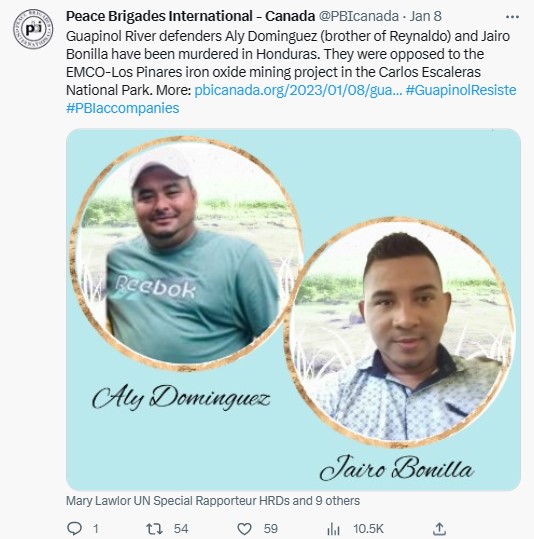
The following day, The Guardian reported: “Two environmental defenders have been shot dead in broad daylight in Honduras, triggering fresh calls for an independent investigation into the persecution and violence against a rural community battling to stop an illegally sanctioned mine.”

The article continues:

“Aly Domínguez, 38, and Jairo Bonilla, 28, from Guapinol in northern Honduras, were murdered on Saturday afternoon as they returned home on a moped after finishing work collecting payments for a cable company. They were intercepted by armed assailants and died at the scene, according to relatives.

Domínguez and Bonilla were co-founders of Guapinol’s grassroots resistance against an iron ore mine owned by one of the country’s most powerful couples. Domínguez was among 32 community leaders falsely accused of crimes by the mining company and local authorities.

Local police and prosecutors immediately ascribed the deaths to a botched mugging – even though the assailants fled without taking the victims’ moped, cellphones or money.”

Reynaldo Dominguez, Aly’s brother, says: “We reject the official hypothesis. These two young men were founders of the struggle to protect our natural resources from an illegal mine that is destroying rivers in the national park. For five years we’ve been threatened, criminalised and falsely imprisoned, the only thing left was murder.”

And Michael Phoenix, the head of research for Mary Lawlor, the UN Special Rapporteur for human rights defenders, says: “It’s vital that an independent impartial investigation is carried out which must take into account the possibility that Aly and Jairo have been retaliated against for their work defending human rights.”

Agnes Callamard, the Secretary General of Amnesty International, has also tweeted her support for an independent investigation.

The Washington, DC-based Institute for Policy Studies has also tweeted:

The Guardian adds: “The mine continues to operate, and the community have reported ongoing police harassment.” In February 2022, EFE also reported: “Los Pinares has installed a processing plant for iron oxide pellets in the municipality of Tocoa, department of Colón and has requested an ‘expansion of the area of the concession from 100 hectares to 1,000 hectares.”

We continue to follow this situation from Canada.

Earthworks analyst Patricia Rodríguez: “Social movements might soon win a huge legislative victory prohibiting fracking”

Photo: On June 28, 2022, the Regional Corporation for the Defence of Human Rights (CREDHOS), PBI-Colombia and PBI-Canada visited the community of Puerto Wilches and heard concerns about fracking and their determination to stop the pilot projects.

Earthworks analyst Patricia Rodríguez writes in NACLA:

“Progressive lawmakers, environmental groups, and social movements might soon win a huge legislative victory prohibiting fracking, one that could reverberate positively throughout the Global South.

In its current iteration, the proposed law, PL 114/2022, has 74 co-sponsors in a congress with greater representation by left and center-left parties, and strong backing from the Colombia Free of Fracking Alliance, a civil society movement of about 100 organizations from around the country.

In Colombia, the law would entail negotiating an end to already signed fracking contracts in order to avoid protracted disputes in international courts.

Note: One of the companies with a signed fracking contract is Calgary-based Parex Resources. Parex signed an exploration and production (E&P) contract with the National Hydrocarbons Agency (ANH) on September 18, 2014, for Block VMM-9 in the Magdalena Medio region. If a deal isn’t negotiated, Parex could theoretically file an investor-state dispute settlement (ISDS) challenge under the Canada-Colombia Free Trade Agreement for lost future profits should fracking be banned in Colombia.

Two pilot fracking projects, Kalé and Platero, started in 2019 in Puerto Wilches and were financed by the national oil company Ecopetrol and ExxonMobil. Local communities have risen up to oppose implementation of the projects.

[The pilot projects] are now on hiatus until the decision on fracking is made.

Note: While those pilot projects would both be operated by Ecopetrol, Patriot Energy, a wholly-owned subsidiary of Toronto-based Sintana Energy, owns a 30 per cent stake in the VMM37 block where the Platero fracking pilot project was to be conducted. ExxonMobil owns the remaining 70 per cent of VMM37.

By December 9, [Ecopetrol’s Vice President of Operations Alberto] Consuegra had shifted his narrative and announced that Ecopetrol was ready to invest more than $6 billion in conventional oil exploration and around 1,600 new drilling wells throughout Colombia.

[Ecopetrol]—and the Colombian government—are purportedly responding in part to pressure from the Biden government, which asked Colombian officials to increase oil production for import to the United States by 40,000 barrels per day, in response to dwindling supplies due to the war in Ukraine.

Note: Next month, PBI-Canada will be organizing a webinar with the PBI-Colombia accompanied José Alvear Restrepo Lawyers’ Collective (CCAJAR) highlighting that, despite human rights concerns, Colombian coal exports have also increased to Canada and Europe due to the war in Ukraine. Stay tuned for more on that.

Recent human rights reports cite connections between Ecopetrol, armed paramilitary groups, and violence against environmental leaders in Puerto Wilches, although Ecopetrol has denied the allegations.

Note: In a May 2022 webinar organized by PBI-Canada, Colombian environmental defenders highlighted their concerns about the links between Ecopetrol, paramilitary groups and the threats and attacks against environmental defenders.

Note: PBI-Canada has also helped to amplify Oil Change International’s research that Toronto-based Scotiabank has provided more than $3 billion in financing to Ecopetrol since 2018, while the Government of Canada-owned public bank Export Development Canada (EDC) has provided $300 million to Ecopetrol between 2012 and 2020.

Note: Colombian environmental defender Yuvelis Natalia Morales commented about Canada on a PBI-Canada organized webinar: “When your companies and banks are investing in mining and energy megaprojects in other countries where human rights are being violated every day, you are not an environmentalist country, you are not a green country. I’m sorry to be so blunt. This is a reality that people don’t often want to say because when you open your mouth that could mean you are shot in the forehead.”

Note: On July 5, 2022, PBI-Colombia and PBI-Canada raised concerns at a meeting at the Embassy of Canada in Bogota about the suspected links between Ecopetrol and paramilitaries, Canadian financing of Ecopetrol, and the threats experienced by environmental defenders. We continue to monitor and document concerns about these links.

During the contentious debates on the fracking ban, [Colombia’s Minister of Mines and Energy Irene] Vélez noted that the other 380 already signed oil contracts would not be prohibited (presumably these would go through extensive government scrutiny), and that any future contracts would only be eligible for approval between six to eight years from now.

Note: Before Gustavo Petro was sworn in as the president of Colombia on August 7, 2022, the previous president, Ivan Duque, oversaw the issuing of 69 new exploration blocks between 2019 and 2021. Portafolio has reported that with 26 blocks of those blocks going to Parex, 4 to Frontera Energy, 5 to Canacol Energy Ltd. (which operates as CNE Oil and Gas in Colombia) and 4 to Gran Tierra Energy (both Canacol and Gran Tierra are Calgary-based companies), 39 of the 69 new blocks went to four Canadian companies.

Note: We are monitoring public statements by these companies on Colombia’s energy transition plan. Gabriel de Alba, Chairman of the Frontera Energy Board of Directors (and co-chairman of the board of directors of the Montreal-based entertainment company Cirque du Soleil), has already told Semana: “I think the Duque Government’s approach with scientific [fracking] pilots to obtain supported information is the right one. I don’t think it’s convenient to deny us that opportunity.”

Throughout the debates, it has been evident that community-led opposition to fracking is key to pushing the ban forward.

The hearings will extend into early 2023.”

The full article Patricia Rodríguez can be read at Is Colombia One Step Away from a Fracking Ban? (NACLA, February 8, 2023).

PBI-Guatemala seeks field volunteers, the deadline to apply is April 9

The PBI-Guatemala Project is seeking field volunteers.

They have posted on Facebook:

Do you want to volunteer with human rights organizations in Guatemala?
📌We are open for call!
Find out more about the selection process: https://cutt.ly/ALS4pZ4 

That link leads to an article that notes:

Key dates

Opening of the selection process: February 7, 2023.

Deadline for applications: April 9, 2023.

The training and selection week will take place from 6 to 12 August 2023.

Requirements

Solid personal reflection on their motivations for working with PBI on the ground.

Good level of Spanish: spoken, written and reading.

Previous experience in grassroots, social, community, human rights or cooperation NGOs.

Availability to commit to 12 months of work in Guatemala.

Commitment to work following the principles of non-violence, non-partisanship and non-interference.

Willingness to work horizontally under a consensus decision-making structure.

Experience of work and coexistence in a team.

Possess basic knowledge of computers: word processors, e-mail or databases.

Be available to participate in the training and selection process. Participation in the week of training and face-to-face selection is essential.

Have two references that can account for your professional skills and personal qualities (it can be in the associative, solidarity, NGO or academic field).

Minimum age of 25 years.

PBI-Guatemala offers

Coverage of the following expenses: full round trip and return trip if one year of commitment is met, accommodation with rooms for two people, food and medical insurance. Monthly financial support of GTQ 1,609 for personal expenses and a repatriation of $ 100 once the stay is completed, as long as a minimum of 9 months has been met.

The full application process and package can be found here: Hacerse persona voluntaria sobre el terreno.

PBI-Guatemala accompanies Human Rights Law Firm at hearing on “safe home” fire that killed 41 and injured 15 girls and adolescents

On February 7, PBI-Guatemala posted:

“Today, #PBI accompanies the Human Rights Law Firm to the hearing of the #HogarSeguroCase. However, for the fourth time in 2023 and the eleventh time since 2019, the hearing has been suspended since the defense of one of the defendants rejected Judge Ingrid Cifuentes of the Seventh Court. In the previous hearing, the judge ruled that the lawyers of the defendant Luis Pérez Borja abandoned the defense for not showing up in court, which caused the suspension of the hearing. With this recusal, the trial cannot start until an appeals court decides, so the clarification of what happened during the state home fire continues to be delayed.”

The New York Times has previously reported:

“As fire swept through the classroom [on March 8, 2017, at the Virgen de la Asunción Hogar Seguro/safe home] the pleas from the 56 girls locked inside began to fade.

Most were unconscious or worse by then, as an eerie silence replaced their panic-stricken shouts.

The police officers guarding the door — who had refused to unlock it despite the screams — waited nine minutes before stepping inside. They got water to cool down the scorching knob.

Inside, dozens of girls placed in the care of the Guatemalan state lay sprawled on the blackened floor. Forty-one of them died.

A review of more than two dozen case files of victims and survivors — along with interviews of family members, group home employees and public officials — reveals a pattern of physical, psychological and sexual abuse allegations at the facility stretching back for years.

Six children had previously died in the government-run home from 2012 through 2015, mostly from preventable health-related complications, officials said. The authorities are also looking into 25 episodes of abuse reported in the year before the fire.

Beyond that, several girls had told their relatives well before the tragedy that they were forced to have sex with older strangers, according to interviews with members of three different families.

The disaster began with an escape attempt. Nearly 100 of the children in the state-run group home, known as Hogar Seguro Virgen de la Asunción, had decided to flee en masse.

But officials rounded them up and locked them inside the facility — the boys in an ample auditorium, the girls in a small classroom meant for only a few people.

After hours of incarceration — in which the girls were not allowed to use the bathroom — someone lit a match, thinking a fire might force the police to let them out.

Instead, most of the girls died as more than a dozen police officers argued over whether their supervisor, standing 10 feet away, should unlock the door with the keys hanging from her belt.

The girls, who had broken no laws and posed no threat to society, were victims even before the fire. As survivors of sexual abuse, violence or abandonment — often at the hands of their own families — the government had assigned them to the institution for their own safety. In theory, the world outside posed the greatest threat to them.

Between September and November of 2016 alone, more than 90 children ran away, according to prosecutors who have charged more than a dozen officials in connection with the fire.

Local journalists had recounted harrowing reports of abuse inside the home as far back as 2013 — rotten food, filthy bedsheets that caused skin diseases, violent orderlies.

Then, in February 2017, another batch of children began planning their own escape.

It began on Valentine’s Day, when the children were allowed to mingle. Scores of boys and girls agreed on a day to flee, but word of the plot began to leak. Around lunchtime on March 7, two girls faked a fight in the cafeteria, drawing the orderlies into the fracas.

The others ran.

Nearly 100 in all, they scaled the walls of the outer building and jumped into a ravine, a few injuring themselves in the fall. They scattered across a creek, taking off in different directions.

By 2:30 p.m., the authorities had caught them and brought them back to the home, where they were kept outside in the cold for hours as officials debated what to do.

Around midnight, the officials decided to lock up the children until the judge arrived. The girls, 56 of them, were crammed into a room of less than 500 square feet and given 23 polystyrene mattresses to share. One girl had fractured her pelvis in the escape attempt. Another was pregnant, though neither she nor the administrators knew it at the time.

Fifteen female police officers were put in charge, given the keys to the locked classroom and instructed to let no one out, officials said.

At 6 a.m., still cold and wet, the girls began to complain. They needed to use the bathroom. Without recourse, they stood up two mattresses to create a makeshift latrine.

Hours passed. Then one girl, fed up, lit a match, hoping to force the police into opening the door.

The officer-in-charge later told prosecutors that she risked her life to save the children. But phone records obtained by investigators show that she was busy dialing numbers from her phone, and witnesses say she dismissed the urgency to her subordinates.

Fifteen girls managed to survive the fire, but many now live with deep physical and emotional scars layered on top of the ones they already had.

One girl has burns over 95 percent of her body. The fire stripped her face of eyelids, lips and her nose. She hardly goes outside anymore to avoid the stares and teasing from other children.”

The full article can be read at A Locked Door, a Fire and 41 Girls Killed as Police Stood By (New York Times; February 14, 2019).

Further reading: The Story Behind the Fire That Killed Forty Teen-Age Girls in a Guatemalan Children’s Home (The New Yorker; March 19, 2017).

Photo: Some of the girls and adolescents who died either from smoke inhalation or later from the severity of their burns.

Those charged

In November 2017, The Guardian reported: “Initially, three people – the former minister of social welfare, his deputy and the director of the shelter – were charged with negligent homicide, abuse of power and mistreatment of minors. In June, three government officials and two police officers were also charged.”

In March 2021, EFE reported: “At least eight people including police officers and authorities have been charged with the deaths of minors.”

And CNN has reported that five are accused of breach of duties, wrongful death, mistreatment of minors and wrongful injuries. One of those is Lucinda Marroquín, the former deputy inspector of the National Civil Police, is accused of not opening the locked room for 9 minutes after the fire started. That CNN article adds that Santos Torres, the former director of Hogar Seguro, also faces five criminal charges, including abuse and homicide.
Photos (Getty Images/BBC): Among those who have been arrested: Anahy Keller, the former undersecretary of Protection and Fostering of Children and Adolescents; former Social Welfare Secretary Carlos Rodas; and the former director of the shelter, Santos Torres.