Home Blog Page 175

PBI-Honduras visits the campesina community El Arrayán, Nueva Esperanza with the National Union of Rural Workers

On February 27, PBI-Honduras tweeted:

“Last week we visited the campesina base “El Arrayán, Nueva Esperanza”, in Comayagua, together with the Dutch embassy and the @CntcTegucigalpa [the National Union of Rural Workers. The community is about to celebrate its 40th anniversary and is still waiting for a community title.”

Their Twitter thread adds:

“At the meeting they shared their story with us, as well as the difficulties they have faced due to the challenges and specific forms of violence with a strong gender content that they face as women defenders of land, territory and the environment.

PBI welcomes the existence of spaces in which human rights defenders can make their reality known in different places, such as embassies. We highlight the commendable work of the community in the defence of access to land, food sovereignty and rural women’s rights. If you want to know more about the base click here.”

PBI-Honduras has accompanied the National Union of Rural Workers (CNTC) since May 2018.

Peace Brigades International supports call for consensus renewal of the UN Special Rapporteur on Human Rights Defenders

Peace Brigades International has joined with 168 other organizations in signing this letter to all UN member states:

“Human rights defenders are people who act with humanity, serve humanity and who contribute to and bring out the best in humanity. They are key to our daily lives – they work so our governments are more transparent and accountable, our environment cleaner and safer, our schools and workplaces fairer, and our futures more sustainable. As human rights defenders confront power, privilege and prejudice, they frequently face a wide range of risks and threats, including against their organisations and their families, friends and loved ones. Despite their vital contribution, both some governments and non-State actors are still seeking to silence defenders as they expose injustices and demand accountability for all.

The mandate of the Special Rapporteur on the situation of human rights defenders is integral to their protection and recognition, globally. It gathers and responds to information on the situation of defenders around the world, engages constructively with governments and non-State actors and provides expert recommendations to promote the effective implementation of the ‘Declaration on the Right and Responsibility of Individuals, Groups and Organs of Society to Promote and Protect Universally Recognized Human Rights and Fundamental Freedoms’ (The Declaration on human rights defenders).

2023 marks 25 years since the UN General Assembly adopted the Declaration on human rights defenders. The adoption of the Declaration was a critical point in human rights history where it articulated how existing human rights law applies to the situation of human rights defenders, recognised the importance and legitimacy of human rights activity, and the need to protect it along with those who carry it out. It is apposite that this major anniversary coincides with the 75th anniversary of the Universal Declaration on Human Rights, reflecting the integral role that human rights defenders play in the realisation of universal human rights.

In 2022, the Human Rights Council reaffirmed the importance of the Declaration on Human Rights Defenders and its full and effective implementation, and that promoting respect, support and protection for the activities of human rights defenders, including women human rights defenders, is essential to the overall enjoyment of human rights, including in conflict and post-conflict situations. In 2021, the General Assembly passed by consensus with 85 State co-sponsors a resolution acknowledging the important and legitimate role that human rights defenders played in the COVID-19 response, as well as the challenges faced as a result.

At the 52nd session of the Council, States will consider a resolution extending the mandate of the Special Rapporteur for three years. This is a key opportunity for States and the Council to demonstrate their support and recognition for the indispensable role human rights defenders play to ensure that all people enjoy freedom, dignity, justice and equality.

Our organisations therefore urge all States to support the resolution renewing the mandate of the UN Special Rapporteur on Human Rights Defenders by: participating positively in the negotiations on the resolution; presenting early co-sponsorship of the text; resisting any attempts to dilute the mandate or State obligations; and supporting consensus renewal of the mandate.”

Other signatories to this letter include Amnesty International, Brot für die Welt, Center for International Environmental Law (CIEL), Center for Justice and International Law (CEJIL), CIVICUS, Committee for Free Expression (Comité por la Libre Expresión C-Libre), FIDH (International Federation for Human Rights), within the framework of the Observatory for the Protection of Human Rights Defenders, IFEX, Indigenous Peoples Rights International, International Service for Human Rights (ISHR), Lawyers without Borders Canada, Mesoamerican Initiative of Women Human Rights Defenders (IM-Defensoras), Project on Organizing, Development, Education, and Research (PODER), Protection International Mesoamérica, The Norwegian Human Rights Fund, Women’s International League for Peace and Freedom (WILPF), and World Organisation Against Torture (OMCT) within the framework of the Observatory for the Protection of Human Rights Defenders.

Minneapolis police arrest Nenoocaasi Camp defenders as efforts continue to convert former Roof Depot site into community hub

Photo: Plains Cree land defender Rachel Thunder stands outside Roof Depot, February 21, 2023. Photo by Jaida Grey Eagle/Sahan Journal.

On February 22, MPR News reported: “A day-long occupation of the Roof Depot site in the East Phillips neighborhood of Minneapolis ended when police swept the area and arrested eight people. Activists and neighbors had occupied the site for about twelve hours, camping out with tents, fires, and banners, to protest the planned demolition of the building.”

The article adds: “Rachel Thunder, an organizer with the American Indian Movement, was one of the people arrested. She and other occupiers stayed on-site when police gave them a ten-minute warning to leave. She said she was charged with misdemeanor trespassing.” 

Thunder says: “This show of force and violence from the Minneapolis Police Department under the city’s orders is a testament to their fear. Our occupation was nothing but prayerful, peaceful, sober, safe and unifying.”

Video: Thunder’s comments after her arrest.

MPR has also reported: “East Phillips neighborhood organizations and residents advocate for alternative uses of the area, including converting it to an urban farm, a community center and a site for tiny homes to shelter unhoused people.”

“Residents who oppose demolition say they believe it will release more pollution into the neighborhood. The lot next door to the Roof Depot was formerly designated as a Superfund site by the EPA — an area with significant arsenic contamination in the soil due to a pesticide plant that used to operate there.”

The Sahan Journal has further explained: “Members of the American Indian Movement and allies entered the gates outside of the warehouse Tuesday morning [February 21] at E. 28th Street and Longfellow Avenue, lit a sacred fire, conducted traditional sage and tobacco ceremonies, and began making camp, Thunder said.”

It adds: “The group, called Defend the Depot, is a coalition of people from the American Indian Movement, the East Phillips Neighborhood Institute, Little Earth Protectors, and other groups campaigning for environmental justice.”

That article adds: “The city of Minneapolis plans to demolish the building as early as Monday, February 27 so it can begin a public works facility expansion project.”

But by February 24, an injunction had been secured to delay that demolition for at least two weeks. The Sahan Journal reported: “The city of Minneapolis cannot proceed with plans to demolish the Roof Depot warehouse in the East Phillips neighborhood next week after a judge granted an injunction to a neighborhood group Friday [February 24] morning.” 

Mutual aid festival, February 26.

We continue to follow this.

For the latest updates, we are following on Twitter: Defend Nenoocaasi Camp, Rachel Thunder, East Phillips Urban Farm and Nick Estes. 

Twitter photo by Nick Estes.

PBI-Guatemala accompanies Maya Ch’orti’ Indigenous Council of Olopa at 7th anniversary of resistance to antimony mine

On February 26, PBI-Guatemala posted:

“Yesterday, #PBI accompanied the Maya Ch’orti’ Indigenous Council of Olopa Chiquimula and its communities in the commemoration of the Seventh Anniversary of Community Resistance against the operations of the mining company Cantera los Manantiales.

The resistance began on 25 February 2016, four years after the mining company obtained its mining licence to extract antimony for 25 years on 3 July 2012. In December 2019, the Supreme Court of Justice ordered the suspension of the mining company’s operations because it violated the right to free, prior and informed consultation with the Maya Ch’orti’ people.

During the commemoration, a reminder was made of the criminalization, in which ten people, seven men and three women, are being criminally prosecuted. Six have been sent to trial and the others are under investigation for the crime of illegal detentions.

Today the activity took place in the community of El Cerrón with the presence of the Indigenous Community of San Francisco Quezaltepeque, the Association of Mayan Lawyers – Nim Ajpu and social and artistic organizations.”

In 2019, Prensa Comunitaria reported:

“The company Cantera Los Manantiales, owned by Ovidio Guzmán, a well-known businessman in Esquipulas, has been operating for 7 years between the mountains of Olopa. Its activity has a direct impact on four communities: El Amatillo, Carrizal and La Prensa de Olopa and Carboneras de Chiquimula.”

And about this gathering, Prensa Comunitaria has also reported:

““As a Mayan people we are joining forces to be able to defend our territory against the threat of mining,” said Marvin Nájera, an indigenous authority from Quezaltepeque, hailing Olopa’s resistance. He reported that in his municipality there are requests for five mining projects.

The communities have denounced the impacts of mining projects, such as the cases of the Porvenir Quarry, in Camotán; El Manantial Quarry, in Olopa; El Pato mining project in Chiquimula, in the afforestation of hills and mountains such as the Merendón mountain.”

PBI-Guatemala has also previously explained: “The Maya Ch’orti’ Indigenous Authorities of Olopa and Quezaltepeque are fighting for recognition as indigenous communities, the recovery of their spirituality, the defense of their territory and the right to free, prior and informed consultation before the entry of mining projects into their territory. They also seek to minimize the negative impacts of mining activities on the health of the people in their communities, denounce illegal logging and fight against gender violence in their communities.”

PBI-Guatemala began accompanying the Maya Ch’orti’ Indigenous Authorities of Olopa and Quezaltepeque in June 2021.

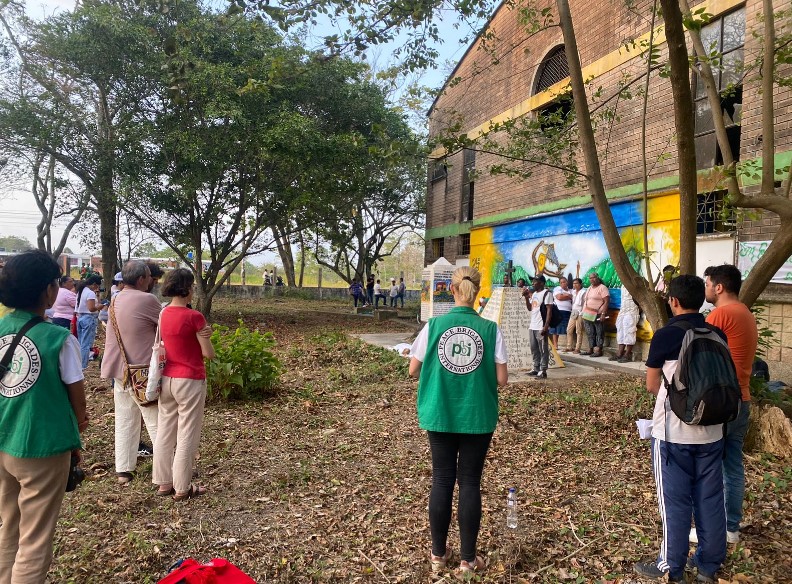
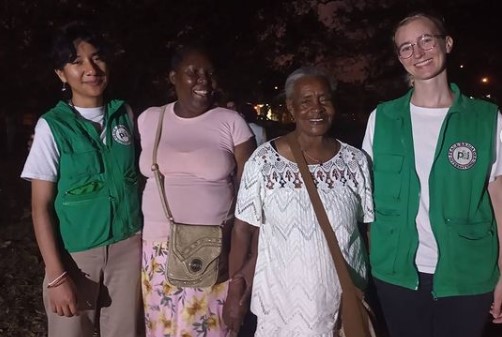
PBI-Colombia accompanies the 26th anniversary of Operation Genesis in Cacarica

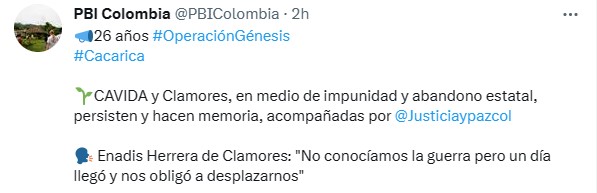
On February 24, PBI-Colombia tweeted:

“26 years #OperationGenesis #Cacarica. CAVIDA [the Communities of Self-determination, Life and Dignity from Cacarica] and [the community of] Clamores, in the midst of impunity and state neglect, persist and make memory, accompanied by @Justiciaypazcol. Enadis Herrera of Clamores: “We didn’t know about the war but one day it came and forced us to move”.

And Justice and Peace tweeted:

“#TheImageoftheDay #MeetingofMemories begins – 26th Anniversary We Are Genesis. We Are, We Are, We Persist in the Transforming Memory. @PeaceCommissioner @PBIColombia @petrogustavo @WOLA_org”

Operation Genesis began at 5:30 am on February 27, 1997.

PBI-Colombia has explained: “Operation Genesis included the participation of the Army, Navy, Airforce and National Police, in coordination with paramilitaries from the Cordoba and Uraba Self Defence Forces (AUC). The military and paramilitary operation resulted in over 70 crimes, including murders and enforced disappearances. As a result, around 3,500 people from the 23 communities of the Cacarica river basin were forcibly displaced.”

According to a 2003 ruling by the Inter-American Court of Human Rights (IACHR), the armed forces used bombs and machine guns against the inhabitants of the Cacarica river basin during a weeklong offensive.

That ruling found Colombia responsible for not preventing the 1997 displacement of thousands of Afro-Colombians and the brutal murder of Afro-Colombian campesino Marino Lopez Mena. During the incursion, paramilitaries killed Marino accusing him of being a guerrilla before capturing and beheading him.

WOLA has noted: “Operation Genesis formed part of a larger paramilitary political effort to displace Afro-Colombians from their territories to facilitate the entry and expansion of oil palm plantations throughout the department of Choco.”

Two years after their displacement, the communities of Cacarica obtained collective ownership of their lands, to which they returned in 2000. There, they established the Community of Self-Determination, Life, and Dignity of Cacarica (CAVIDA).

In August 2012, retired general Rito Alejo del Río, the 17th Brigade commander of the Operation,  was sentenced to 26 years in prison for the assassination of Marino. Rito Alejo del Río had also repeatedly accused the Justice and Peace Commission of being guerillas.

By September 2017, he was released from prison.

PBI has accompanied the Inter-Church Justice and Peace Commission since 1994.

PBI-Guatemala observes march on the National Day of Dignity for the Victims of the Armed Conflict

On February 24, PBI-Guatemala posted:

“#PBIaccompanies

Today we observe the March for Dignification of Victims of Armed Conflict.

This day is commemorated because on February 25, 1999, the Report of the Commission for Historical Clarification was presented. The Commission was established through one of the Peace Agreements, the Oslo Agreement of June 23, 1994, to clarify with all objectivity, equity and impartiality the violations of human rights and acts of violence that have caused suffering to the Guatemalan population.

#WeDon’tForget #GuatemalaNeverAgain”

Emisoras Unidas further reports:

“A march for the National Day of Dignity of the Victims of the Armed Conflict toured the Historic Center on Friday. The aforementioned commemoration is given on February 25 of each year in tribute to the survivors and to dignify the memory of those who lost their lives.

Various organizations, collectives and individuals gathered in front of the Palace of Justice of Guatemala, in zone 1 of the capital, where they carried out a Mayan ceremony, among other activities to honor the victims.

From that point, those present began a mobilization that passed in front of the headquarters of the Congress of the Republic and the Presidential House, until concluding in the Plaza de la Constitución.

They demand dignified reparation for the victims.

The Mutual Support Group (GAM) noted that, on the National Day of Dignity of Victims of Conflict, families seek to express their opposition to policies for oblivion and impunity.

“We will continue to demand memory, truth and justice for all,” the entity said.

Meanwhile, Miguel Itzep, of the Executive Committee of the National Platform of Victims’ Organizations, said that those who participated in the mobilization arrived in the capital from different points, including Alta Verapaz, Baja Verapaz, Quiché, Chimaltenango, Suchitepéquez and Escuintla.

He added that, in addition to this walk, from today different activities began in the interior of the country within the framework of this date.

“Our people, the victims of the conflict, are also there commemorating, but also denouncing the refusal of the State and its agencies not to meet the needs of the victims or fulfill the responsibility of reparation,” he said.

He mentioned that the current authorities abandoned the victims and, in turn, are compensating the ex-military who, in his words, are responsible for what happened in the internal war.”

And Prensa Comunitaria notes:

“The streets of the Historic Center were the scene of the march for the National Day for the Dignity of the Victims of the Armed Conflict that is commemorated every February 25, which was used by the survivors to send a message to the candidates of the 2023 electoral contest, with the filing of an amparo against Zury Ríos, daughter of the coup leader Efraín Ríos Montt.

Feliciana Macario, a member of the National Platform of the Victims of the Armed Conflict, told Prensa Comunitaria that Guatemala’s Political Constitution does not allow daughters and sons and relatives of coup plotters to be candidates for the presidency or be elected.

For us it is an action that goes against the dignity of the surviving families of the Internal Armed Conflict (CAI), said Macario.”

The internal armed conflict (that started in November 1960) killed an estimated 200,000 people and displaced more than one million people by the time of the Peace Accords of December 1996. 45,000 people are still unaccounted, including 5,000 children.

The conflict between state military forces and guerilla combatants was underpinned by the poverty, marginalization and racism against Indigenous peoples.

The United Nations-backed Commission for Historical Clarification determined that the Guatemalan military was responsible for 93 per cent of the atrocities – including forced disappearances, massacres and torture – and that 83 per cent of the victims were Indigenous Maya peoples.

The Commission concluded that acts of genocide occurred during the war.

Ojibwe water protector Tara Houska in court after being criminalized for opposing Line 3 pipeline by Enbridge-funded police

Tara Houska. Photo by MPR News.

On February 23, water protector Tara Zhaabowekwe Houska posted:

“Tomorrow at 1:30pm, I’ll appear at my first hearing on multiple criminal charges, including gross misdemeanor trespass on critical infrastructure, from a #StopLine3 demonstration on January 9, 2021.

Of over a dozen arrests, only a handful of us have outstanding charges from that date, mostly Ojibwe women who were charged after the fact & served by mail. 2 years later, the court is moving forward with criminalizing us for defending the drinking water of millions and giving voice to the earth.

Aitkin County law enforcement later engaged in use of pain compliance and physical force on human beings that shocks the conscience. Severe lacerations from dragging young people out of a piece of Line 3 pipeline with ropes, later charging those same land defenders with assisting attempted suicide. Twisting the limbs of climbers over 25 feet in the air, dangling their bodies as they screamed.

When this photo was taken, the Sheriff had used pain compliance on climbers as they were suspended and walked over, asking what I wanted. With the wetlands around us, I said “I got here and you were torturing people.” He answered “I’m sorry about that.”

Total disregard of human life and well-being, to defend a fossil fuel project that disregards human life and well-being. Violence begets violence.

Ours are acts of love, of empathy and community with all living beings. We stand.

Learn how to show up (in-person/virtually) & support Line 3 defendants here.

#LandDefenders #ProtectTheSacred #Truth #Love #Resistance.”

The link that Tara shares highlights:

“Water protectors are currently facing criminal charges in Minnesota for standing in defense of the water, the climate, and the treaty rights of the Anishinaabeg people.

These individuals put their bodies on the line to stop Enbridge’s Line 3 pipeline, a massive tar sands project that threatens the state’s lakes, rivers, aquifers and wild rice beds. Police forces – directly funded by Enbridge – have responded to this massive movement with surveillance, harassment, physical torture (“pain compliance”), and trumped-up charges, including felonies.

Signup to receive court information so that you can support Stop Line 3 defendants going through the court system, both in-person and virtually.”

Peace Brigades International-Canada has signed up to support Stop Line 3 defendants and you can too by clicking here.

For more, please see: Ojibwe water protector Tara Houska on police violence paid for by Canadian pipeline company (August 13, 2021)

PBI-Guatemala accompanies law firm at hearing on extrajudicial killing by police of Q’eqchi’ opposed to Santa Rita dam

On February 23, PBI-Guatemala posted:

“PBI accompanies the Human Rights Law Firm in the hearing on the #SamocochCase. 23 PNC [National Civil Police] agents are being processed accused of abuse of power and extrajudicial execution of three people from the Samococh community, Chisec, Alta Verapaz.

At today’s hearing, a Sociological and Gender Expertise presented with an intersectional approach by researcher Dr. Rachel Sieder on the individual and collective consequences of what happened on August 14 and 15, 2014 in the community. In addition, a witness from the community and an official from the PDH Human Rights Prosecutor’s Office declared.

Tomorrow, February 24th, at 8:30h will continue the hearing.”

PBI-Guatemala has previously explained: “More than 20 PNC officers are accused of extrajudicial execution, non-compliance with duties and abuse of authority for having caused the death of three Q’eqchi’ community members from Samococh village in Chisec, Alta Verapaz, during a demonstration [on August 15, 2014].”

The Santa Rita dam

The demonstration appears to have been against the Santa Rita hydroelectric dam on the Dolores River in Alta Verapaz.

Truthout explains: “In Monte Olivo, the state used its full force against the community. On August 14, 2014, 600 police units were deployed to evict a community of a few hundred families along the River Dolores. …In the following days, two other communities, 9 de Febrero and Samococh, both faced similar violent evictions to make way for the dam. These communities were driven out by 1,600 police units, and 22 community leaders were detained.”

That article also notes: “The Guatemalan-based company Hydro Electrical Santa Rita S.A., owned by the elite López-Roesch family, first proposed the Santa Rita hydro project in 2009. The powerful and influential cement company Cementos Progreso, owned by the Guatemalan Novella family, is reported to also have interests in the project.”

Prensa Libre further notes: “The confrontation occurred when dozens of police tried to evict peasants who had blocked the road from Chisec to Raxruhá, Alta Verapaz, to prevent the transfer of two leaders of the Peasant Development Committee [CODECA].”

“The PNC agents who arrived came from Cobán, where the Public Ministry successfully evicted some 160 families who were occupying the Santa Rita and Santa Rita Xalahá Canguini farms. In the first community [Santa Rita], families lived to avoid the construction of a hydroelectric plant [that lacked their free, prior and informed consent].”

That article adds: “The PNC tried to capture local leaders Rafael Chub and María del Carmen del Cid, which generated discontent among the residents and the confrontation.”

Financing of this dam

In 2017, Carbon Market Watch reported: “In October, the private sector lending arm of the World Bank Group (International Finance Corporation, IFC) confirmed the cancellation of a controversial Santa Rita hydroelectric project in Guatemala, approved under the UN’s carbon offsetting scheme Clean Development Mechanism (CDM).”

That article further highlights: “[The dam was going to be built with] financial support of a private equity fund backed by bilateral and multilateral institutions such as the German and Dutch development banks (DEG and FMO), the World Bank’s International Finance Corporation (IFC) and the Spanish Agency for International Cooperation (AECID).”

For more on the raid, please see the Witness Media Lab article/videos at: COMMUNITY REPORTERS DOCUMENT DEADLY RAID ON INDIGENOUS VILLAGES IN GUATEMALA.

We continue to follow this.

PBI-Honduras accompanies COPINH and CNTC in the Lenca community of Marcala as it faces eviction

On February 23, PBI-Honduras tweeted:

“We are accompanying @COPINHHONDURAS [the Civic Council of Grassroots and Indigenous Organizations in Honduras] and @CntcTegucigalpa [the National Union of Rural Workers] in the community of the Lenca Indigenous Council of Marcala, threatened to be evicted today. #DDHH #HumanRights.”

“We are concerned about the risk situation of the community and about the number of evictions that have been carried out in recent weeks. We recall the importance of peasant and indigenous communities for food security in #Honduras.”

And Contracorriente has tweeted:

“The Indigenous Lenca Council denounced that the National Police intends to evict 320 families in the area of the Santa Emilia de Marcala neighborhood, La Paz. The disputed land was taken on November 11, 2022. After a dialogue between a commission from the Lenca Indigenous Council and police officers, they withdrew from the area, but at the moment the families do not know if they will return to carry out the eviction, according to the Suyuguare community radio station.”

PBI-Honduras has accompanied COPINH since May 2016 and the CNTC since May 2018.

PBI-Colombia accompanies Cahucopana at meeting with Embassies on their report “Peace and dynamics of the armed conflict in Northeast Antioquia”

On February 22, PBI-Colombia tweeted:

“Now @CAHUCOPANA presents to the international community a report: ‘Peace and dynamics of the armed conflict in Northeast Antioquia’. In the midst of serious #HumanitarianCrisis in #NortheastAntioqua there are urgent guarantees of protection for human rights organizations such as @CAHUCOPANA.”

And Cahucopana tweeted:

“We especially thank the embassy of @CanadayColombia for making this type of scenario possible and @PBIColombia for their accompaniment. Making the human rights situation visible contributes to reducing the risk of leaders and the community in general. Financed by @Misereor.”

Among the Embassies that tweeted about the meeting were: Canada, Norway and Switzerland.

The Canadian Embassy tweeted:

Thanks to @CAHUCOPANA for presenting their troubling, but necessary annual report on Human Rights in #NortheastAntioquia to the international community. We salute your courage & essential work. Canada is proud to have provided the space.
@PBIColombia”

We continue to follow this.

PBI-Colombia has accompanied the Humanitarian Action Corporation for Coexistence and Peace in Northeast Antioquia (CAHUCOPANA) since 2013.