

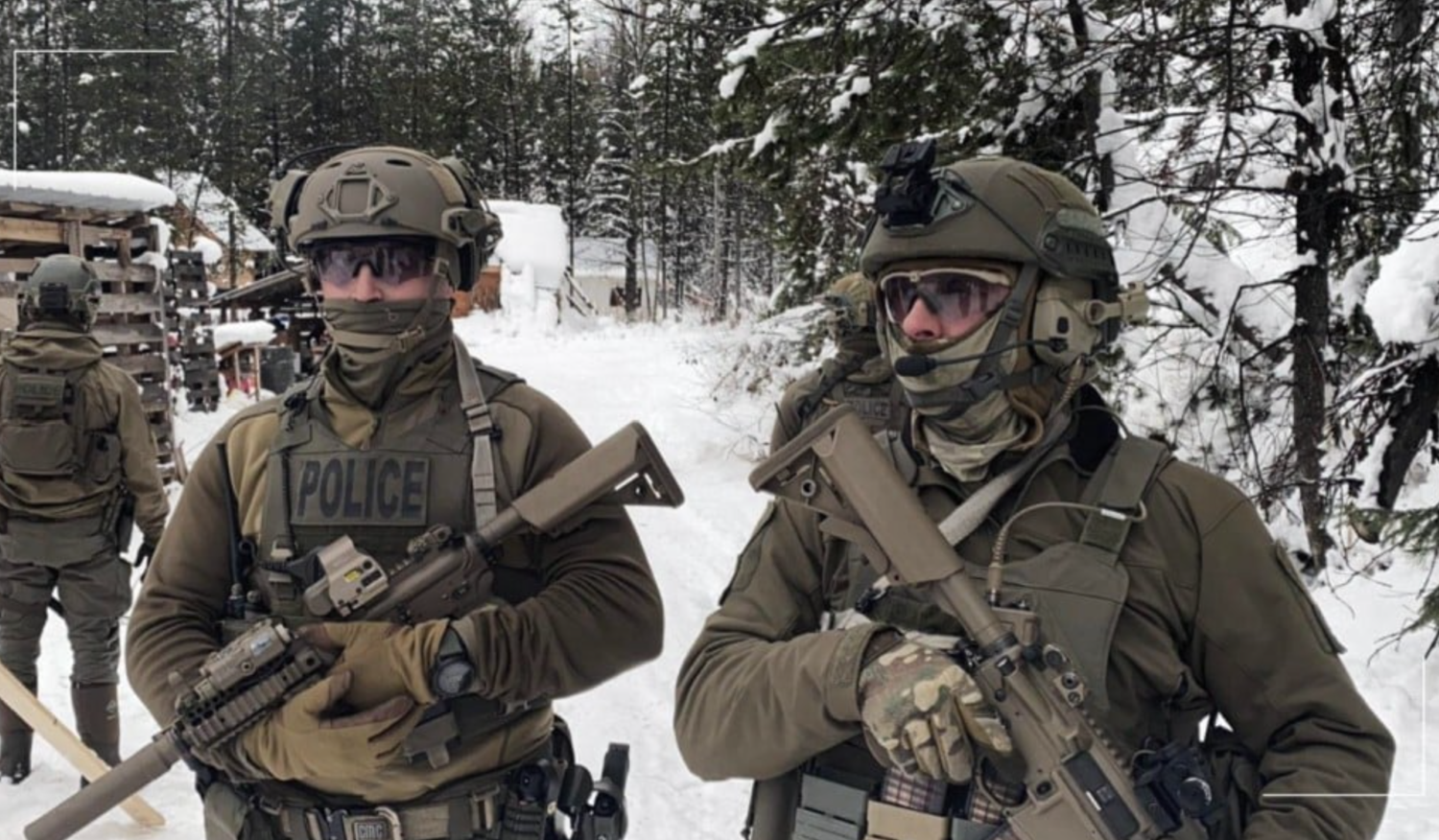
Photo: Royal Canadian Mounted Police (RCMP) C-IRG officers on Wet’suwet’en territory in November 2021. Photo by Michael Toledano.
The Government of Canada has introduced Bill C-39 to bring “speed, certainty, and predictability” to the building of major projects “so investors know that when Canada says it wants something built, Canadians will get it built.”
Previous reporting on Bills 14 and 15 in British Columbia reveals that the Royal Canadian Mounted Police (RCMP) Critical Response Unit-British Columbia (CRU-BC) participates in provincial government committees to respond to opposition of Indigenous land and environmental defenders to major projects.
The Canadian government has already recommended to the Major Projects Office the Prince Rupert Gas Transmission (PRGT) pipeline, that would cross approximately 50 kilometres of Gitanyow territory and 120 kilometres of Gitxsan territory; LNG Canada Phase 2, that would bring the construction of massive compressor stations on Wet’suwet’en territory; and the West Coast Oil Pipeline, that would cross 518 kilometres of Secwepemc territory, as major projects “of national interest by conditionally approving them to further streamline federal review and approval processes”.
While reported timelines are subject to change, the final investment decision (FID) on LNG Canada Phase 2 could be made as early as October 2026, the FID for the PRGT pipeline is targeted by the end of 2026, while construction on the West Coast Oil Pipeline could start as early as September 1, 2027.
The CRU-BC is already the subject of a “systemic investigation” by the Civilian Review and Complaints Commission related to its enforcement of “the Coastal GasLink Ltd injunction on Wet’suwet’en traditional territory”.
That long-delayed report could be released by mid-October 2026.
Bill C-39
On September 21, 2026, Prime Minister Mark Carney’s government tabled the 246-page Bill C-39, the Building Canada Strong Act, in the House of Commons.
The Toronto Star reports: “Government officials and cabinet ministers touted the legislation — which was applauded by at least one major business organization — as a way to create certainty for investments in development projects.”
That article adds that Bill C-39 includes “new rules to allow companies to pay offset fees if their projects harm fish habitats”, rules that would “allow construction to begin before a project is approved”, and the ability to “create special zones called ‘regions of national interest’ where approvals for projects can be ‘streamlined’.”
CBC News further reports: “Construction of projects with a national interest designation, or projects within the national interest zones, would be allowed to start before receiving all the necessary federal permits.”
Julia Levin of Environmental Defence says: “[Bill C-39] would make it practically impossible for the government to meaningfully consult Indigenous communities on major projects, which is constitutionally required.”
Bills 14 and 15 in British Columbia
In August 2025, Shiri Pasternak and Tia Dafnos wrote in The Breach about the relationship between CRU-BC and Bills 14 and 15, provincial legislation in British Columbia designed to fast-track major projects that are likely to be opposed by Indigenous land and environmental defenders.
Pasternak and Dafnos write: “An internal RCMP background document lays out how the rebranded unit is participating in two secretive provincial committees—the Critical Incident Secretariat and the Civil Disobedience/Public Order group—that coordinate intelligence between police, government, and industry and respond to opposition around major resource and infrastructure projects.”
They add: “One of the key roles of the unit on these two committees is intelligence coordination. The unit now has dedicated resources to monitor opposition to proposed and active infrastructure projects. Weekly reports from the RCMP to the BC government, obtained by The Breach, show that in 2024 CRU-BC was keeping tabs on opposition to the controversial LNG and gas projects across the province.”
Images of Critical Incident Secretariat (CIS) Situational Awareness Update (January 2026) from The Tyee.

While the Canadian government does not appear to have a Critical Incident Secretariat or Civil Disobedience/Public Order group as in British Columbia, it does have an Incident Response Group; a Government Operations Centre (GOC), that has previously labelled one of the Unist’ot’en land defenders as an “aboriginal extremist”; and a National Cross-Sector Forum (NCSF) consultation group.
Further research and analysis is required to discern the rights implications of Bill C-39 and RCMP CRU-BC surveillance and actions against Indigenous land and environmental defenders opposed to major projects deemed in the national interest.
We continue to follow this.

