

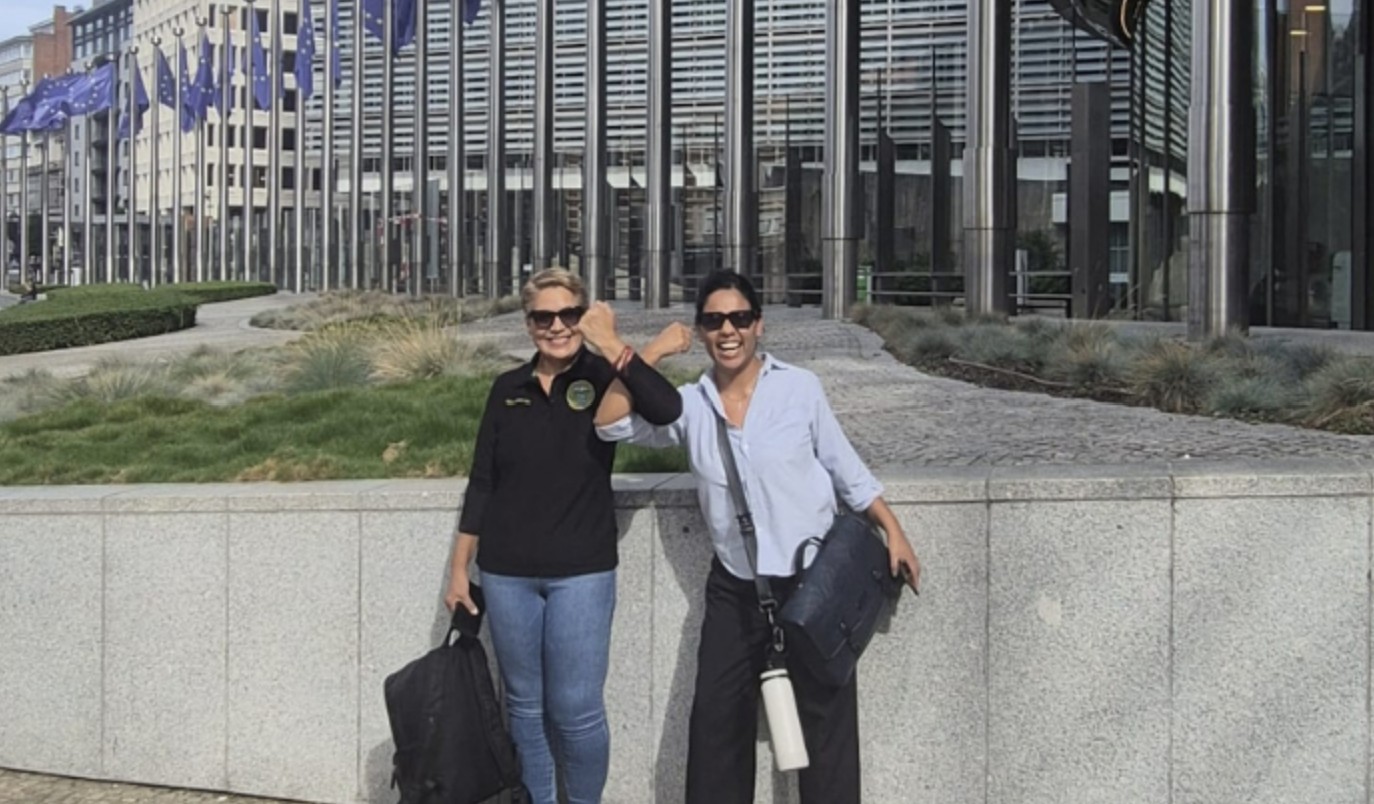
Photo: María Auxiliadora Haro and Nuria Yamada in Brussels.
The Peace Brigades International-Mexico Project is accompanying Nuria Yamada, a member of the Movement for the Defense of the Forest and Water Basins of Tancítaro (MODEBOCU), and María Auxiliadora Haro, a member of United People in Defense of the Sonora River Basin on an advocacy tour in Europe.
PBI-Mexico explains: “During the week of September 14, 2026, an advocacy, exchange and learning trip of Mexican women defenders was carried out in the city of Brussels that has been accompanied by PBI Mexico.”
They further explain that MODEBOCU is a community-based organization dedicated to socio-environmental monitoring, the accompaniment of citizen projects of public interest and mediation between the local population and agricultural producers.
PBI-Mexico also notes that United People emerged in defense of the Sonora River (which has been impacted by pollution originated since 2014 by toxic discharges related to mining activities – by the Grupo México Buenavista del Cobre mine) due to its opposition to the construction of water storage dams on the Sonora River itself.
In Brussels, the defenders met with the European External Action Service (EEAS) and the European Economic and Social Committee (EESC), as well as with civil society organizations and defenders from other territories.
European Union policies, such as the Global Gateway investment strategy and the implementation of the European Union’s Guidelines to Support Human Rights Defenders, were discussed. The Protect Their Voices Initiative was also discussed.
Global Gateway is a strategy to mobilize €400 billion in investments by 2027. Peace Brigades International recently signed a letter calling for Global Gateway to “create independent oversight, complaints, accountability and reparation mechanisms accessible to communities, organizations and human rights defenders affected by EU backed investments, and adopt specific measures to prevent, monitor and respond to the risks faced by defenders of land, environment and human rights in the context of development and infrastructure projects.”
The European Union Guidelines on Human Rights Defenders were established in 2008. In April 2026, the Human Rights and Democracy Network (HRDN) commented: “While the EU and its Member States have established valuable relocation and protection mechanisms, these remain fragmented, short-term, unavailable to those most at risk and inconsistent as reports and studies have shown.” An Amnesty International report in 2019 also found “an apparent lack of overall strategy and consistency in EU efforts to support HRDs, insufficient visibility of EU actions and channels of support and the absence of a targeted and impact oriented approach to public action.”
And Protejamos sus voces (Let’s protect their voices) began in 2021. A European Commission article notes: “Implemented in cooperation with 11 EU Member States, the initiative is held within the framework of the EU–Mexico High-Level Dialogue on Human Rights. …The initiative seeks to bring recognition and to increase engagement with human rights defenders and journalists, most of whom are women, who work in high-risk contexts to promote truth, justice and freedom of expression.”
The European Union and Canada
On September 16, 2026, European Commission President Ursula von der Leyen proposed in her 2026 State of the Union address that Canada should become an associate member of the European Union.
The next day, September 17, Canadian Prime Minister Mark Carney welcomed the proposal during his address to the European Parliament in Strasbourg.
It is not clear what associate membership would mean, but Politico has suggested it could be “something deeper than a free-trade agreement, less politically demanding than full EU membership, and potentially broad enough to cover trade, defence, energy, artificial intelligence, research and education.”
At PBI-Canada we are studying the implications of this for human rights defenders as well as the advocacy opportunities related to the plan for the European Parliament to open an antenna office in Ottawa to further strengthen parliamentary relations between the European Union and Canada.
To read the full PBI-Mexico article, go to: Newsletter #1: PBI Mexico accompanies Advocacy Tour of Europe (September 21, 2026).

Additional reading
–She leaves for Europe to spread the movement in defense of the Sonora River basin (article about María Auxiliadora Haro Romo, September 11, 2026)
–What the Earth Tells Us (a conversation with Nuria Yamada, April 2024).

