

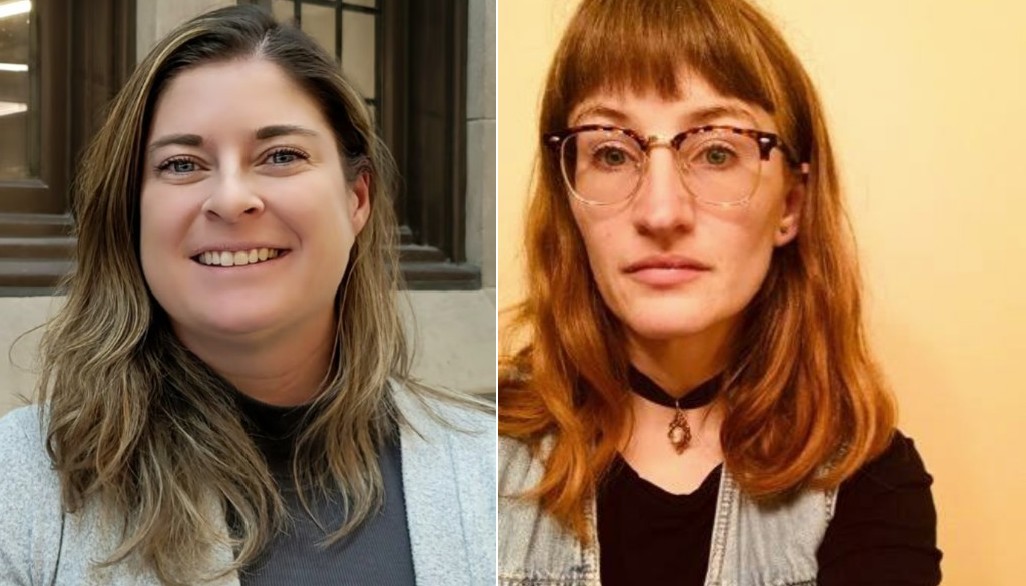
Photo: Lisa Rankin and Kirsten Francescone.
As Peace Brigades International-Canada works to strengthen its holistic protective accompaniment with credible and effective advocacy strategies, we are reviewing academic research on this subject.
In this article we look at Knocking on a Locked Door: Assessing Canada’s Response to Attacks Against Human Rights Defenders by Kirsten Francescone and Lisa Rankin published in the Journal of Human Rights Practice.
Francescone is an Assistant Professor in Human Rights and Global Development at Trent University in Peterborough, Ontario. Rankin recently completed her studies at Osgoode Hall Law School in Toronto and is currently a lawyer at Nova Scotia Legal Aid. Both have worked extensively in Latin America.
The abstract for their article highlights: “We assess the usefulness of advocacy at the level of embassies as a way of protecting defenders and demonstrate that, in our experience, calls for support to defenders were ignored.” Their “practioner points” further notes: “Human rights advocates and allies should reconsider embassies as useful spaces for engagement on behalf of defenders.”
Francescone and Rankin write in the body of the article: “Given the rampant abuses being committed by Canadian corporations abroad, several significant studies have mapped out the key ways in which the Canadian diplomatic service has acted at the behest of Canadian mining companies to promote their economic interests (for example Coumans 2019; MiningWatch Canada 2013). What has yet to be explored in the same kind of detail, however, is how that active ‘client engagement’ primarily through Global Affairs Canada’s Trade Commission Services (TCS) and embassy officials, simultaneously has meant repeated inaction or avoidance to fulfil their basic duties enshrined in international human rights law with respect to protecting Human Rights defenders.”
They further note: “As is common knowledge within the literature on Guatemala regarding the ongoing state of human rights in the country, Indigenous, human rights and land defenders are under a constant state of threat and face repeated violence (Amnesty International 2019; Cultural Survival 2022).”
“In our opinion, Canadian embassy officials in Guatemala are undeniably aware of the precarious situation within which Canadian companies are investing in the country, and were repeatedly reminded of the concrete and shocking events happening on the ground, often at the time they were unfolding.”
They then highlight: “In nearly 70 per cent of the cases that we were able to document regarding communications with the embassy, our communications were completely ignored by embassy officials. …When we did receive responses, they were vague, with the embassy citing its commitment to ensuring Canadian companies act according to the voluntary frameworks set up to prevent human rights violations. …In only another 15 per cent of the cases analysed did the embassy purport to do anything at all, which was to inform us of their intention to meet with a Guatemalan CSO [but] we were never provided any follow-up information which would corroborate this. Finally, in the most basic and yet most concrete demonstration of action, the embassy retweeted or sent out a Tweet on X7 (only 7 per cent of the instances).”
Francescone and Rankin conclude: “Our years of advocacy within the Canadian embassy in Guatemala did not appear to make any meaningful difference for human rights defenders facing direct threats from Canadian-headquartered companies operating abroad.”
The full article can be read at Knocking on a Locked Door: Assessing Canada’s Response to Attacks Against Human Rights Defenders (Kirsten Francescone, Lisa Rankin; Journal of Human Rights Practice; February 2025).
Additional reading
–We open a call for consultancy to investigate the current and future challenges of protection through international accompaniment (Peace Brigades International-Spanish State, September 21, 2026)
–Call for Consultancy – Building Protection through International Solidarity: Facilitating a participatory process of research, reflection, and collective construction aimed at designing a Strategic Roadmap to strengthen Decolonial International Protection (Peace Brigades International-Colombia, July 2026)
–Supporters of slain Mexican mining activist take case against Canada to the Inter-American Commission on Human Rights (CBC News, June 2023).

